What is a acting role letter?
When a manager goes on leave or leaves suddenly, someone often steps up to keep things running. Acting up is a great development opportunity, but without a letter it can end badly: no extra pay, no end date, and an assumption that the job is now theirs.
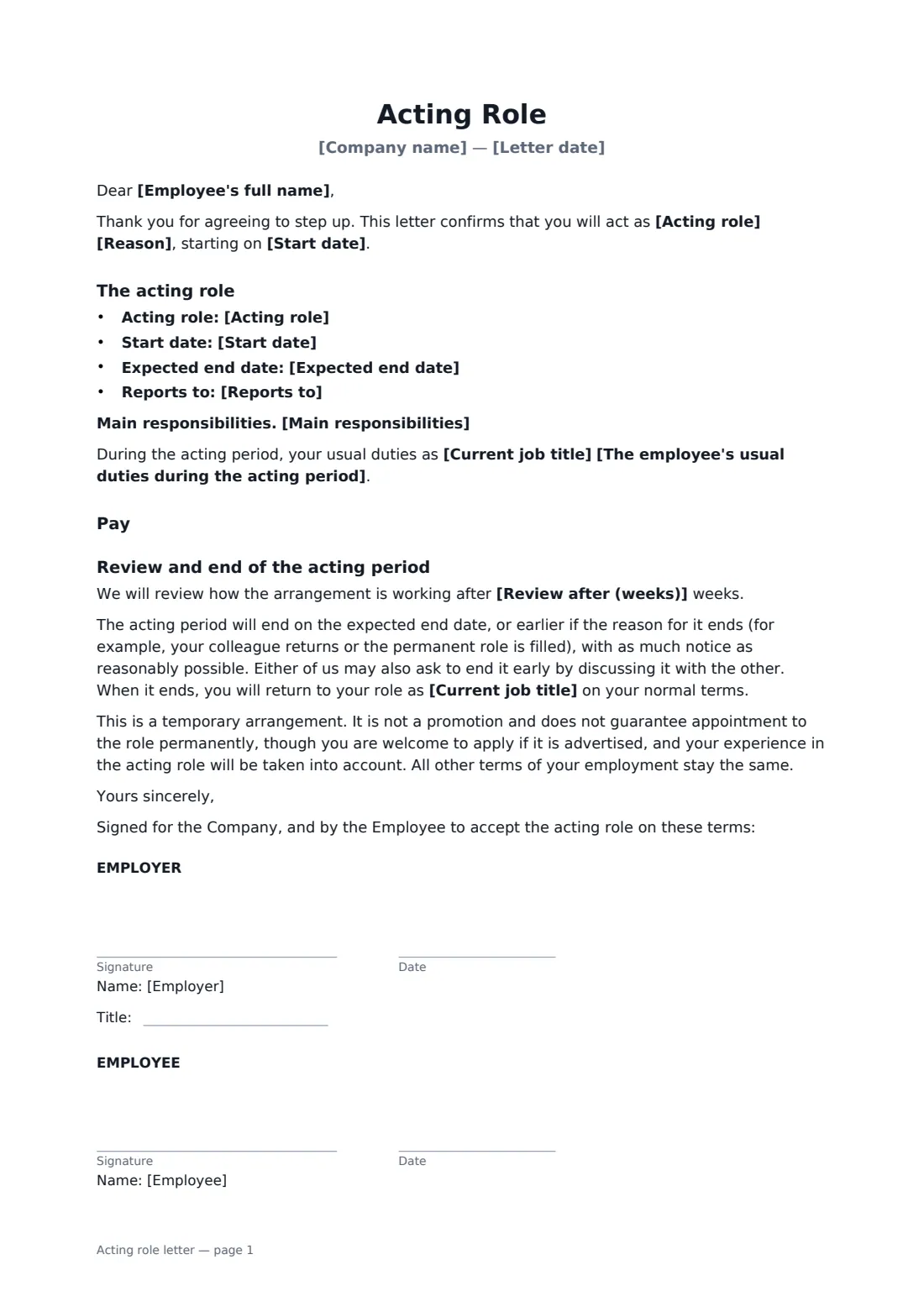
This letter confirms the acting role, the reason, the start and expected end dates, the reporting line and the main responsibilities, and what happens to the employee's usual duties. You choose an acting allowance on top of normal pay, the pay of the acting role, or no change. It sets an optional review point, explains how the acting period ends and that the employee returns to their usual role, and makes clear it isn't a permanent promotion — while inviting them to apply if the role is advertised.
- Best for
- Covering leave, vacancies, restructurings and projects
- Signed by
- The employer and the employee
- Pay
- Acting allowance, acting role pay, or no change
- Length
- 1 to 2 pages
When to use a acting role letter
- A team leader acting as department manager during parental leave
- Covering a director's role while it's being recruited
- An interim role during a restructuring
- Leading a specific project at a more senior level for a few months
- Recording an acting allowance clearly for payroll
What you fill in
16 blanks, then the name and email of each person who signs: employer, employee.
1 The letter
- Company name*
- Letter date*
- Employee's full name*
- Current job title*
2 The acting role
- Acting role*
- Reason* to cover a colleague's leave · while the permanent role is being recruited · during a restructuring · for a specific project
- Start date*
- Expected end date
- Reports to
- Main responsibilities*
- The employee's usual duties during the acting period* will be covered by others · will be reduced, as agreed with their manager · will continue alongside the acting role
3 Pay
- Pay during the acting period* An acting allowance · The pay of the acting role · No change to pay
- Currency*
- Allowance or new pay (gross)
- Per* year · month · week · hour
4 Review
- Review after (weeks)
5 Who signs
- Employer signature and date, job title
- Employee signature and date · Signs to accept the acting role.
What the acting role letter covers
- The acting role
- Pay
- Review and end of the acting period
Using the acting role letter, step by step
1 Describe the acting role
Enter the employee's current title, the acting title, the reason, start and expected end dates and who they report to.
2 List the responsibilities
Summarise the main responsibilities and choose what happens to the employee's usual duties.
3 Set the pay
Choose an acting allowance, the pay of the acting role, or no change, and enter the amount.
4 Send for signature
Add an optional review point, sign as the employer and send to the employee to accept.
Tips before you send it
- Don't let someone carry two full jobs. Decide what happens to their usual duties.
- If the acting period goes on much longer than planned, review the pay and the arrangement.
- Tell the team and other stakeholders who is acting, and from when.
- Use the promotion letter instead if the move is permanent.
Sign it online in minutes
- Fill in the blanks. Names, dates and amounts go straight into the agreement — the preview shows exactly where.
- Name who signs. Tick “This is me” for your own part. FileIt builds the PDF with every signature, date box on the right line, and you can check or move anything before sending.
- Send it. Each signer gets a secure link and signs from any device — no account needed. The signed PDF, with an audit trail and a Certificate of Completion, is filed in your vault and emailed to everyone.
Acting role letter: frequently asked questions
Is an acting role a promotion?
No. The letter says the arrangement is temporary and doesn't guarantee a permanent appointment, though the employee is welcome to apply if the role is advertised.
Should acting staff be paid more?
It's common to pay an allowance or the role's rate, especially for longer periods. Some collective agreements or policies require it. The letter lets you choose.
What happens when the acting period ends?
The employee returns to their usual role on their normal terms, and any allowance stops.
Is this the same as a secondment?
No. A secondment usually moves the employee to another organisation or department for a period. An acting role is a temporary step up within the same team or company.