What is Form TC-656?
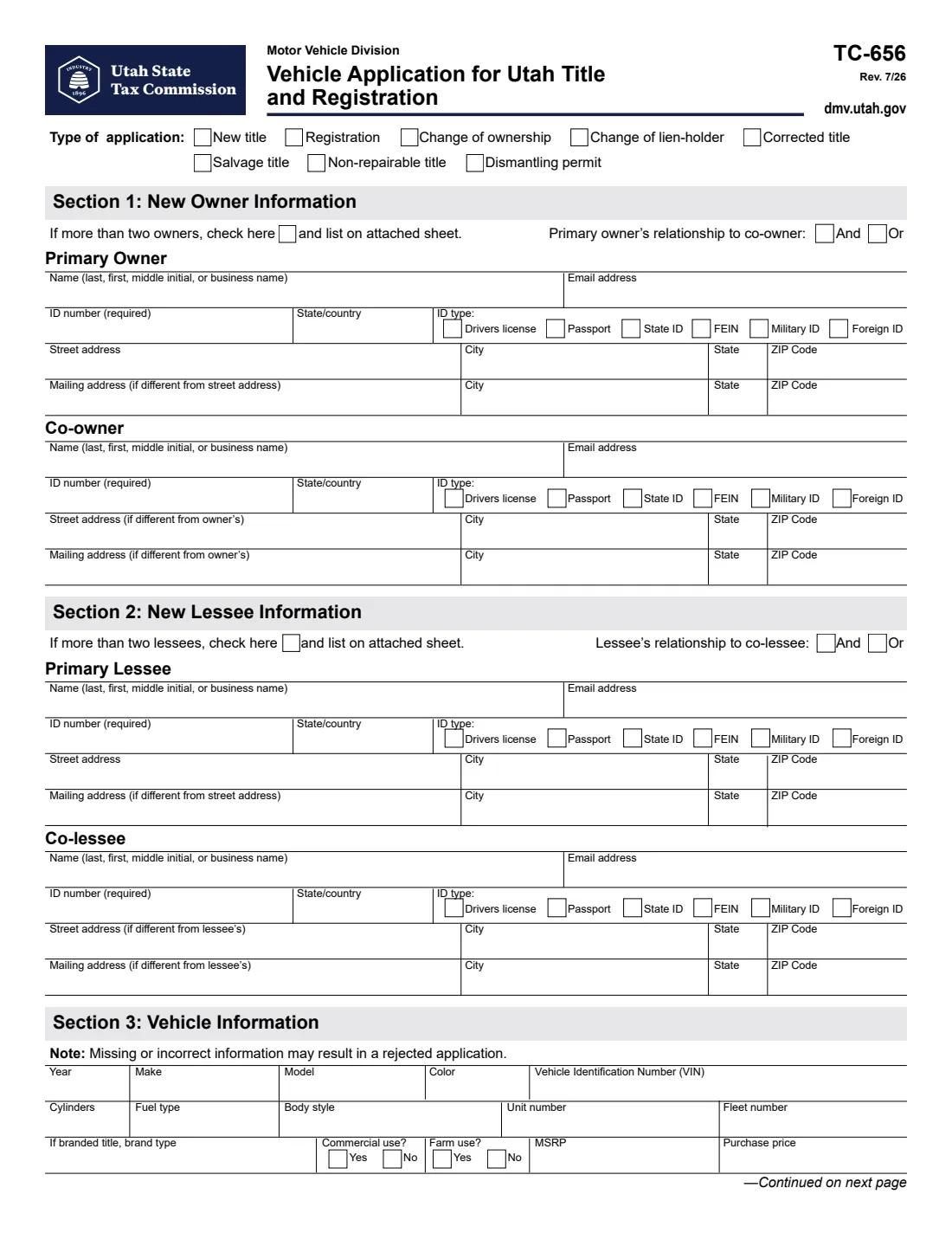
Form TC-656 is the Utah State Tax Commission's Motor Vehicle Division application for a vehicle's title and registration. One form covers a new title, registration, a change of ownership or of lien holder, a corrected title, a salvage or non-repairable title, and a dismantling permit: you tick what you're applying for.
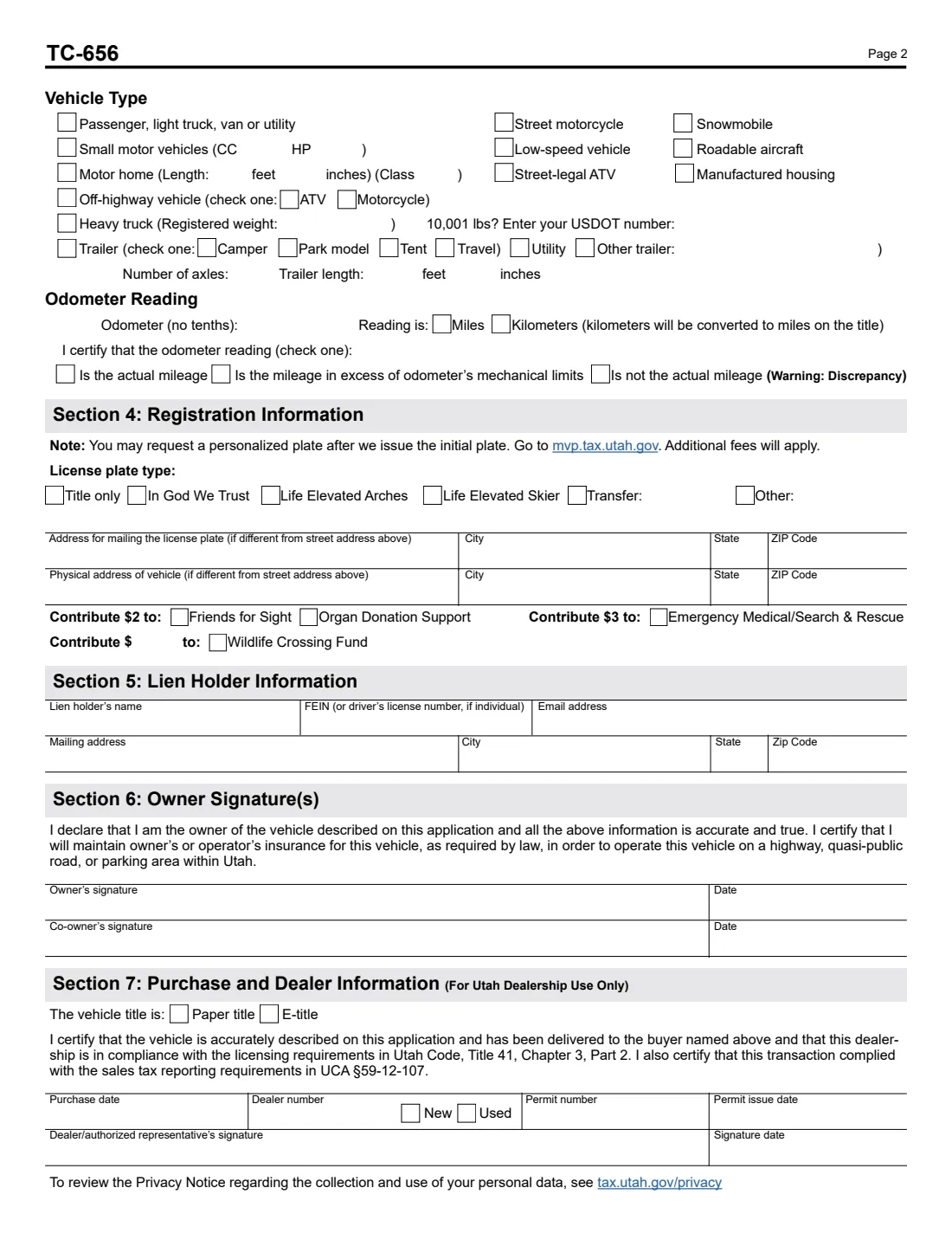
It records the new owner and any co-owner (and whether they hold the title with AND or OR), lessees for a leased vehicle, the vehicle itself (year, make, model, VIN, body style and more), the vehicle type and odometer reading, the license plate you want, optional contributions, and any lien holder.
FileIt pre-fills the owner's name and email from your vault, checks the VIN and the addresses, and prints your answers on the Tax Commission's own PDF (Rev. 7/26), accented names included. The owner and co-owner can sign by hand or through FileIt eSignature.
- Who files it
- The new owner (and co-owner) of a vehicle titled or registered in Utah.
- Pages
- 2: owners, lessees and the vehicle, then vehicle type, odometer, plates, lien holder and signatures.
- ID
- An ID number is required for each owner and lessee: driver license, passport, state ID, FEIN, military ID or foreign ID.
- Signature
- The owner, and the co-owner if any, in Section 6.
- Section 7
- Purchase and dealer information is for Utah dealerships only.
- Edition
- TC-656, Rev. 7/26
Who needs to fill out Form TC-656?
- Anyone who bought a vehicle and needs a Utah title and registration in their name.
- Owners adding or removing a lien holder, or correcting a title.
- Owners of salvage or non-repairable vehicles, or applying for a dismantling permit.
- Leasing companies and lessees registering a leased vehicle.
When to use Form TC-656
- After buying a vehicle, to transfer the title and register it in Utah.
- When you move to Utah and title and register a vehicle here.
- When a lien is paid off or a new loan puts a lien holder on the title.
What you need before you start
- Each owner's name, email, ID number, ID type and where it was issued, and address.
- The vehicle's year, make, model, color, VIN, body style, fuel type and cylinders, and the purchase price.
- The odometer reading (no tenths), and whether it's in miles or kilometers.
- The plate type you want, and the lien holder's name, ID and address if there's a loan.
What’s on Form TC-656
The 2026 edition has 2 pages. FileIt asks for it in 10 parts, and it is signed by Owner and Co-owner:
- Type of applicationOwner
- Section 1: Primary ownerOwner
- Section 1: Co-ownerCo-owner
- Section 2: New lesseeOwner
- Section 2: Co-lesseeOwner
- Section 3: Vehicle informationOwner
- Vehicle typeOwner
- Odometer readingOwner
- Section 4: Registration informationOwner
- Section 5: Lien holderOwner
How to fill out Form TC-656, step by step
1 Type of application
Tick everything that applies, for example new title, registration and change of ownership.
2 Sections 1 and 2: owners and lessees
The primary owner and any co-owner (AND or OR), and the lessee and co-lessee for a leased vehicle.
3 Section 3 and vehicle type
The vehicle's details, its type (with size, length or weight where asked) and the odometer reading and certification.
4 Sections 4 to 6
Plate type, where to mail the plate, optional contributions, the lien holder, then the owners' signatures.
Common mistakes to avoid
- Copying the VIN wrong: the form warns that missing or incorrect information may result in a rejected application.
- Leaving out an owner's ID number, which the form marks as required.
- Not choosing AND or OR between two owners.
- Filling in Section 7, which is for Utah dealerships only.
After you fill it out
Sign it: the owner, and the co-owner if there is one.
Submit it to the Utah Division of Motor Vehicles with the title and other documents your transaction needs (see dmv.utah.gov).
Keep a copy. FileIt files the PDF in the owner's vault folder.
Fill out Form TC-656 online with FileIt
- Pick the person. Choose someone from People and FileIt fills in their name, date of birth, address and other details it already knows.
- Answer plain-language questions. One part of the form at a time, with the official help text beside each question — 121 fields in all. Your answers save as you go.
- Check the live preview. Watch your answers land on the real Utah State Tax Commission, Motor Vehicle Division form, and let FileIt do any worksheet arithmetic.
- Generate the official PDF. FileIt prints your answers into the agency’s own PDF and files it in that person’s folder in your vault. Sign it, or send it for e-signature.
FileIt fills the form — it never files or submits anything for you. Deliver the finished form to whoever asked for it, the way the form’s instructions say.
Start Form TC-656 now — it’s freeForm TC-656: frequently asked questions
What is Utah Form TC-656 used for?
To apply for a Utah vehicle title and registration, and for changes such as a new owner, a new or released lien holder, a corrected title, a salvage or non-repairable title, or a dismantling permit.
What does AND or OR between owners mean?
It's how the owners are listed on the title: the form asks for the primary owner's relationship to the co-owner, And or Or.
Which ID can I use?
The form lists driver license, passport, state ID, FEIN, military ID and foreign ID, with the ID number and the state or country that issued it.
Can I get a personalized plate?
The form says you may request one after the initial plate is issued, at mvp.tax.utah.gov, and that additional fees apply.
What if there are more than two owners?
Tick the box in Section 1 and list the others on an attached sheet. The same goes for lessees in Section 2.
Official sources
- Blank form (PDF), published by Utah State Tax Commission, Motor Vehicle Division: https://tax.utah.gov/forms/current/tc-656.pdf
- Official instructions and guidance: https://tax.utah.gov/forms/current/tc-656.pdf
- Edition shown on this page: TC-656, Rev. 7/26 (checked 2026-10-25).
FileIt is not affiliated with or endorsed by Utah State Tax Commission, Motor Vehicle Division or any government. This page explains the form in general terms and is not legal, tax or immigration advice. Always read the official instructions, and check that you are using the edition the recipient accepts. Page last reviewed 2026-10-25.