What is Form N-400?
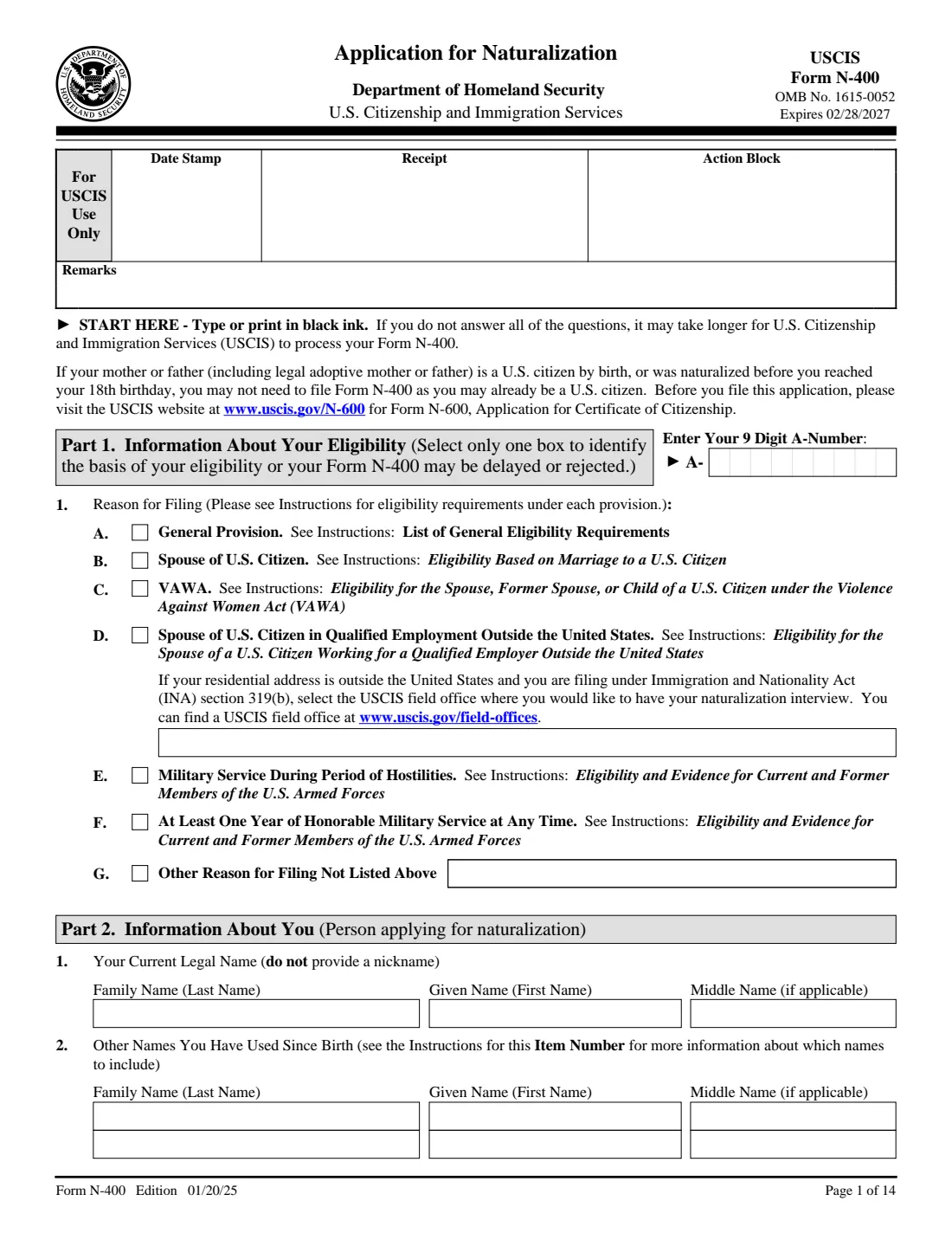
Form N-400 is the Application for Naturalization from U.S. Citizenship and Immigration Services. Most applicants are lawful permanent residents who qualify under the general provision, as the spouse of a U.S. citizen, or through military service. The current edition is Edition 01/20/25, 14 pages long.
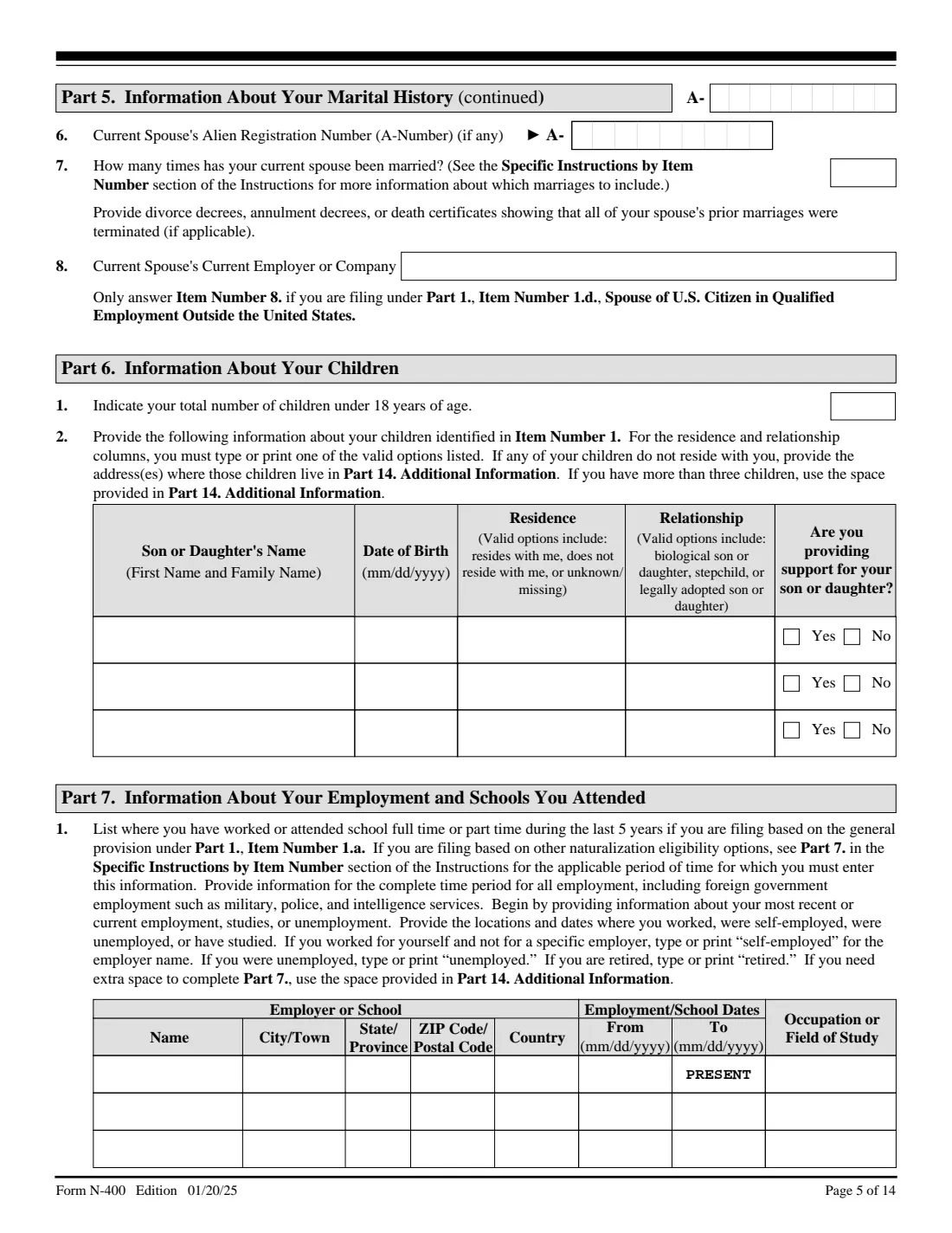
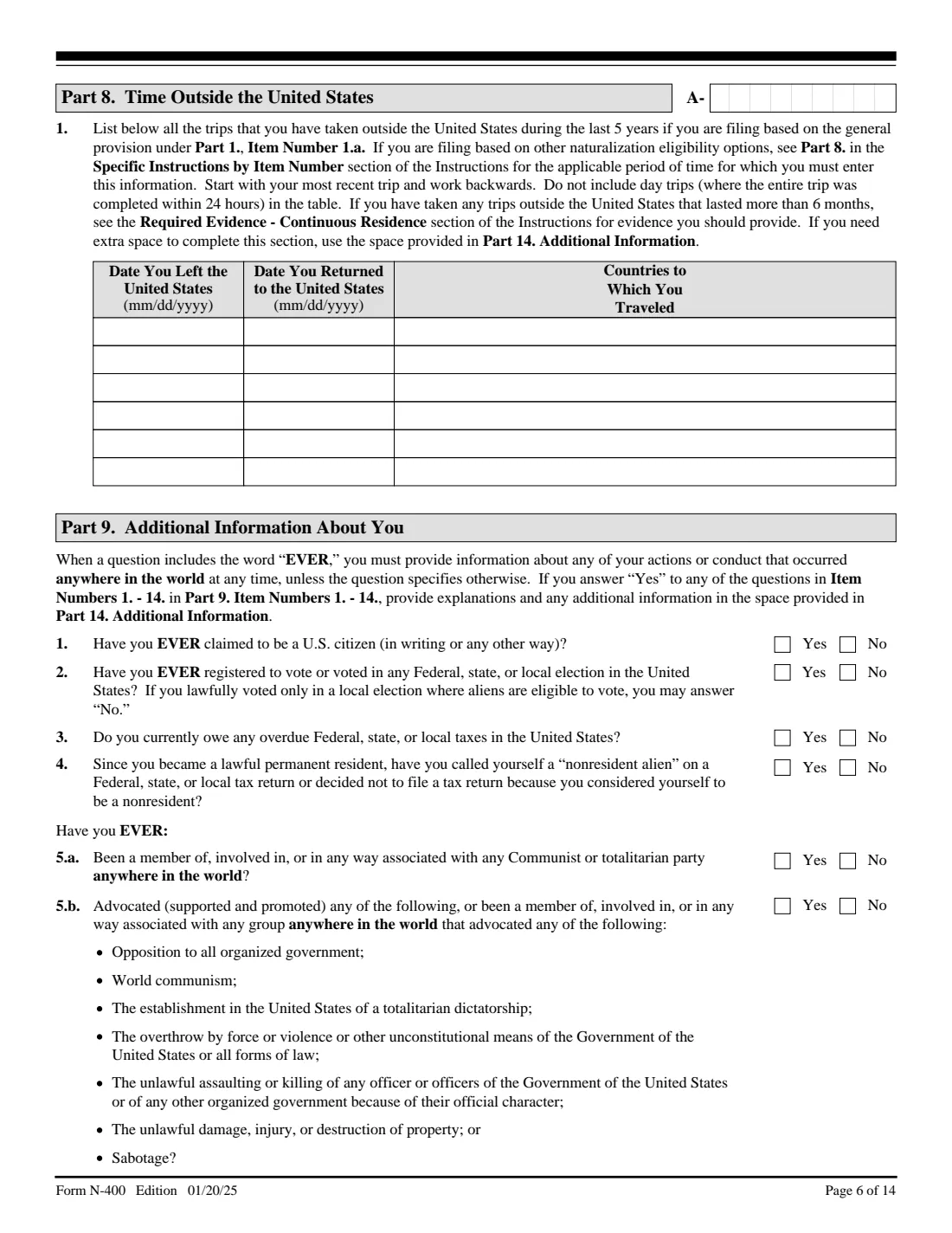
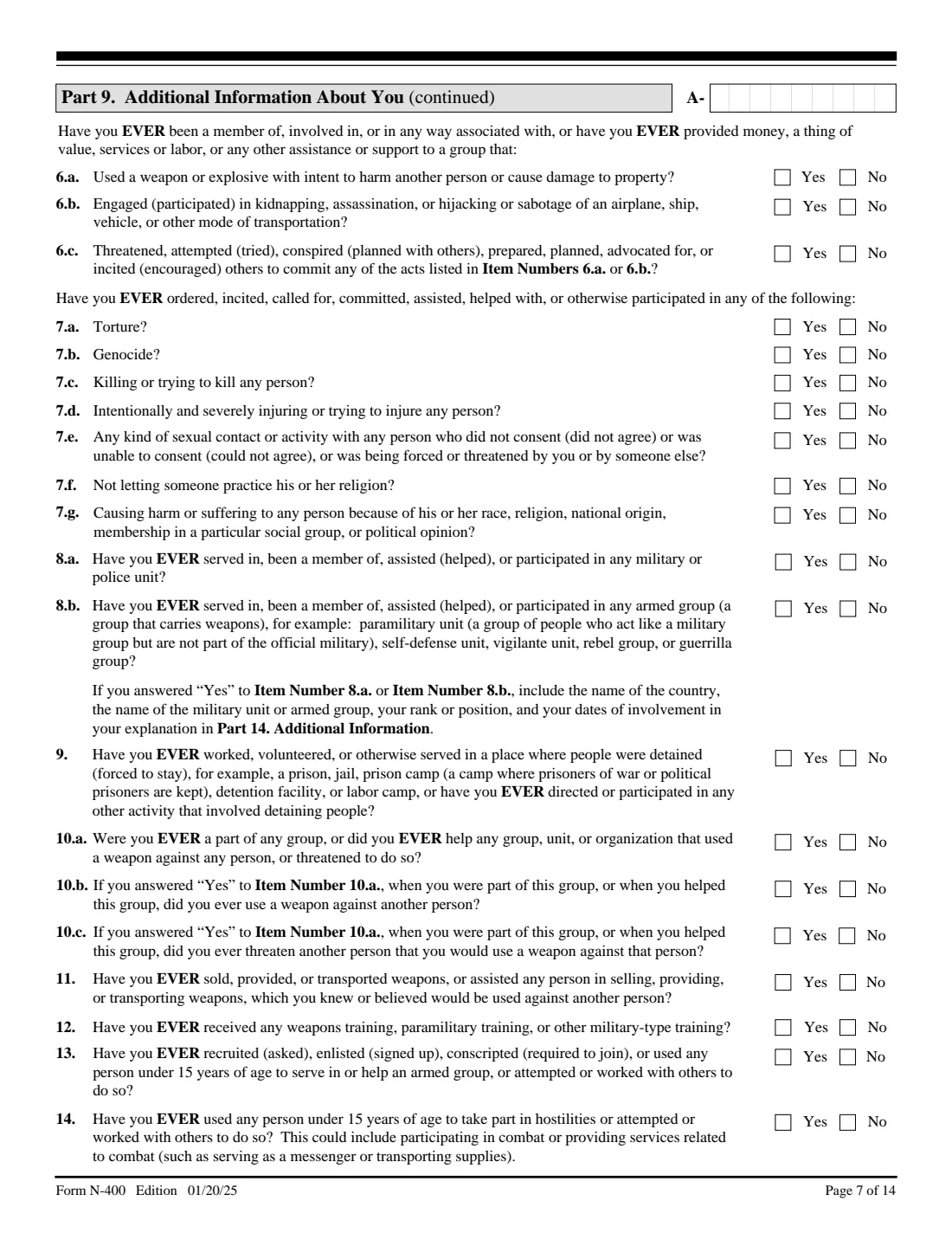
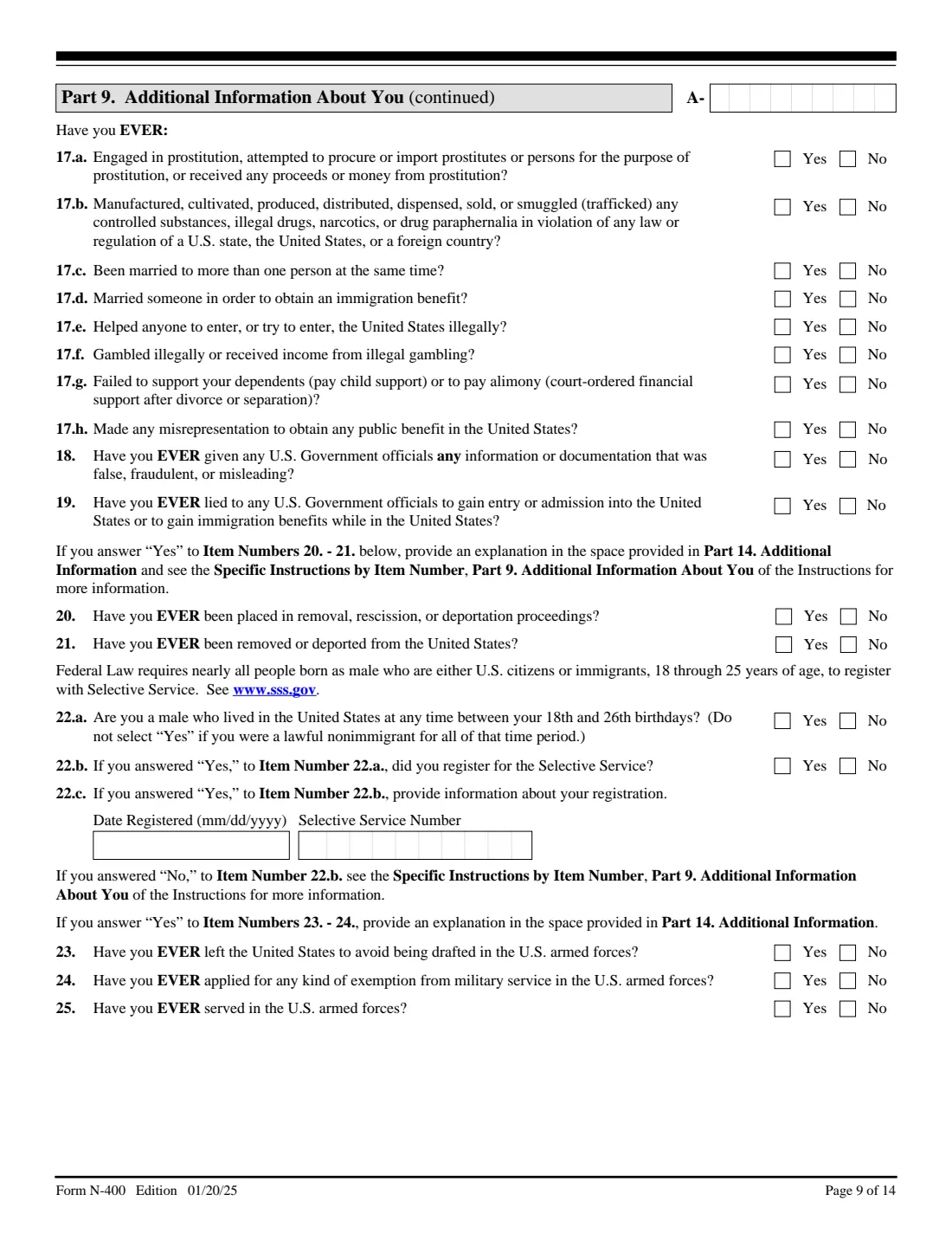
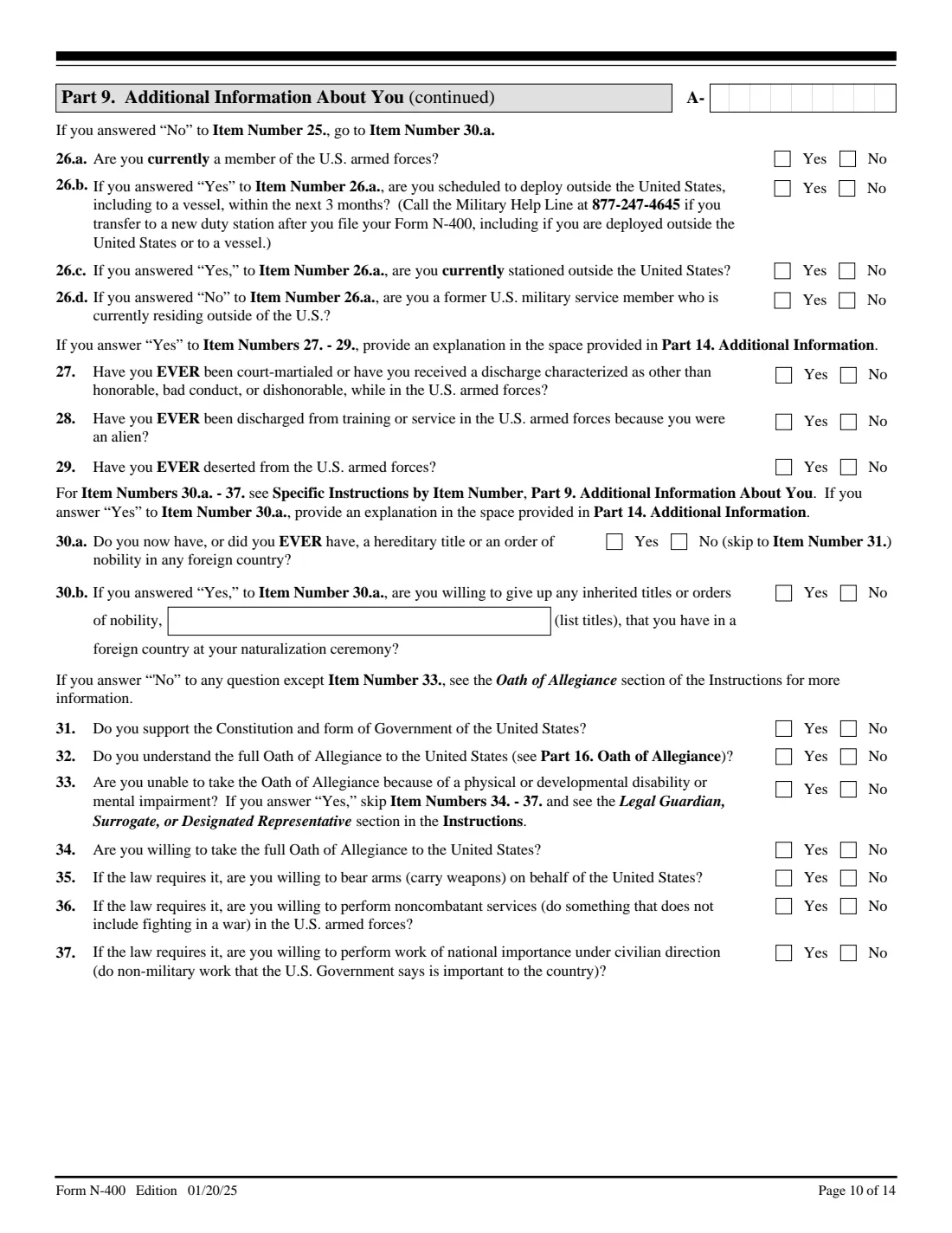
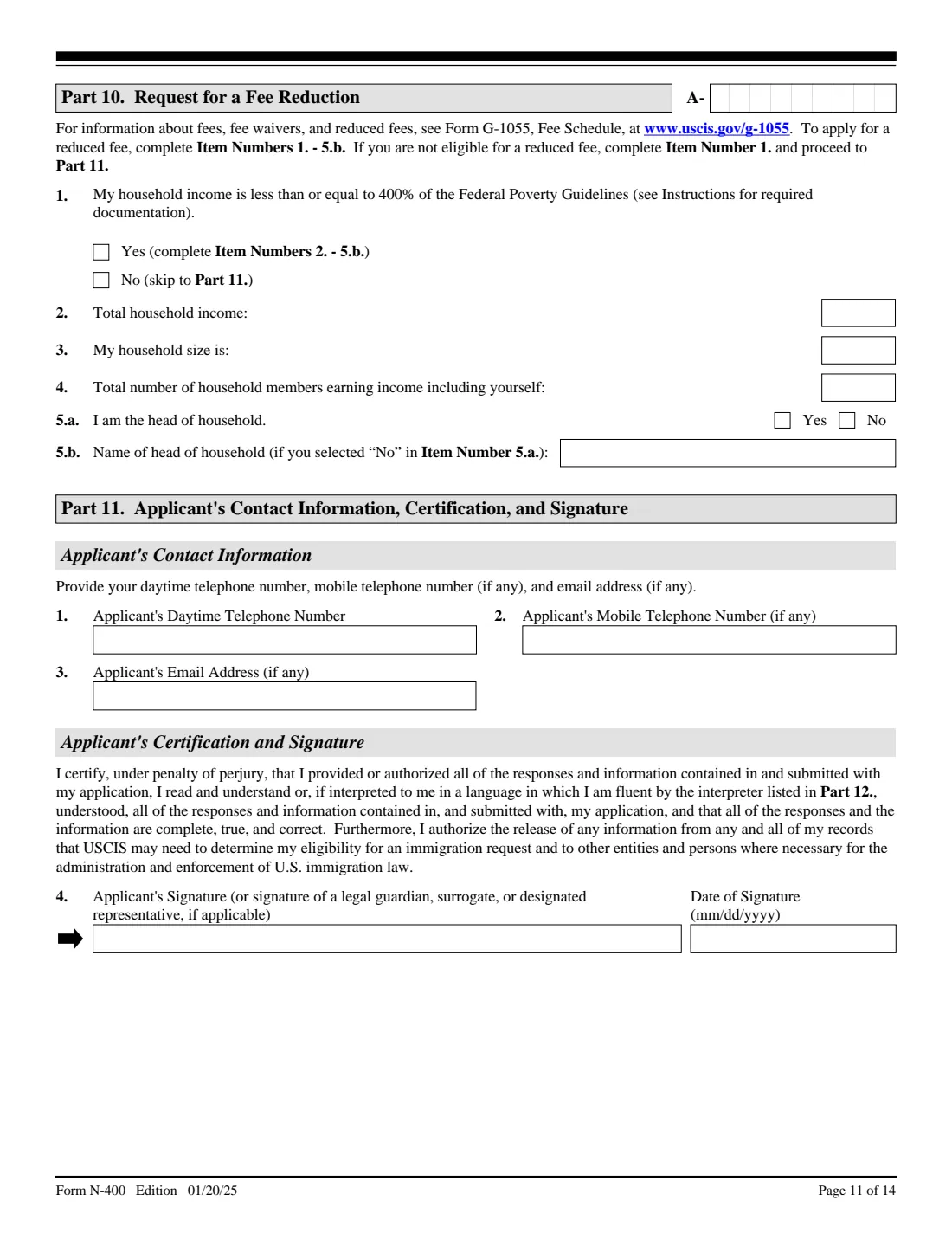
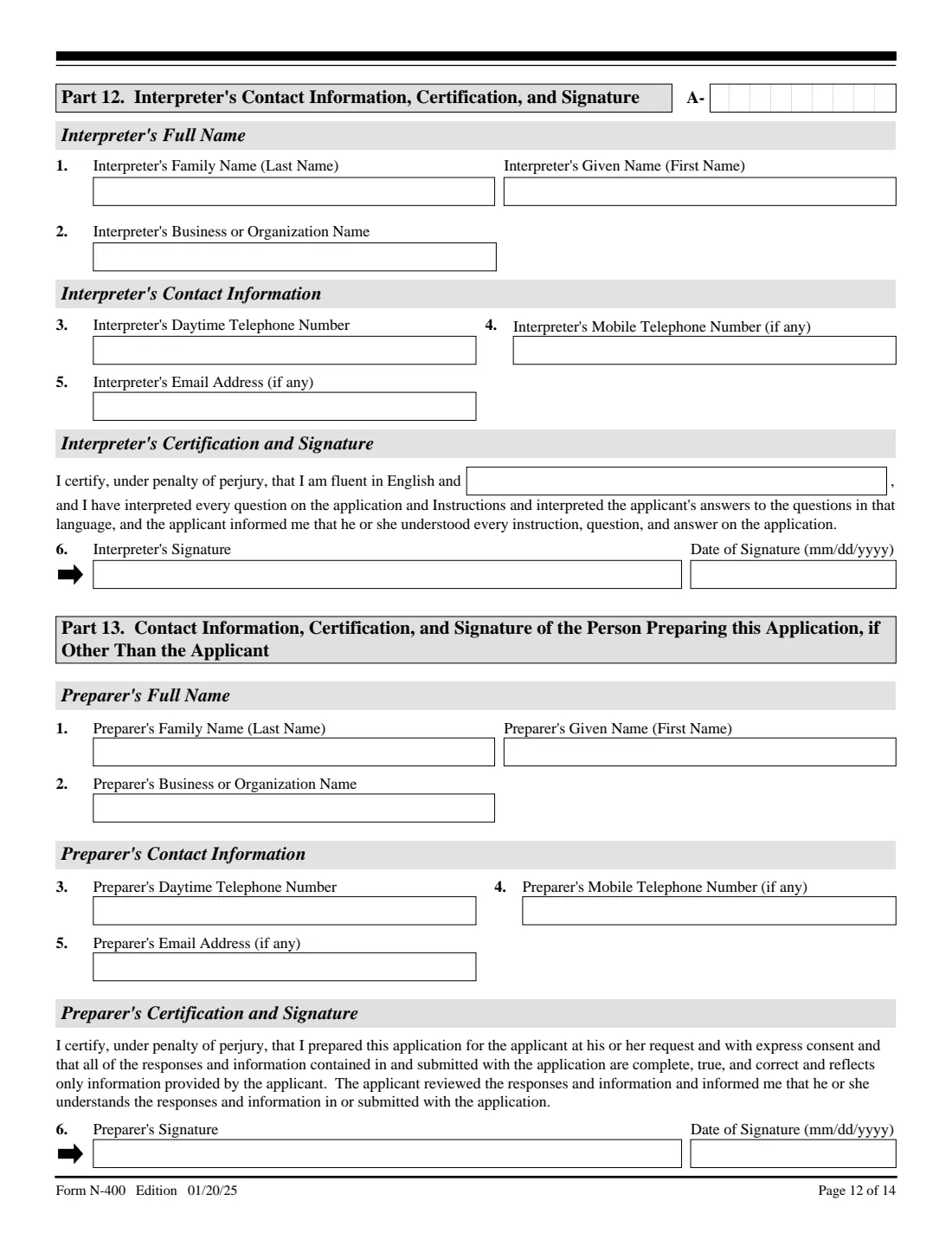
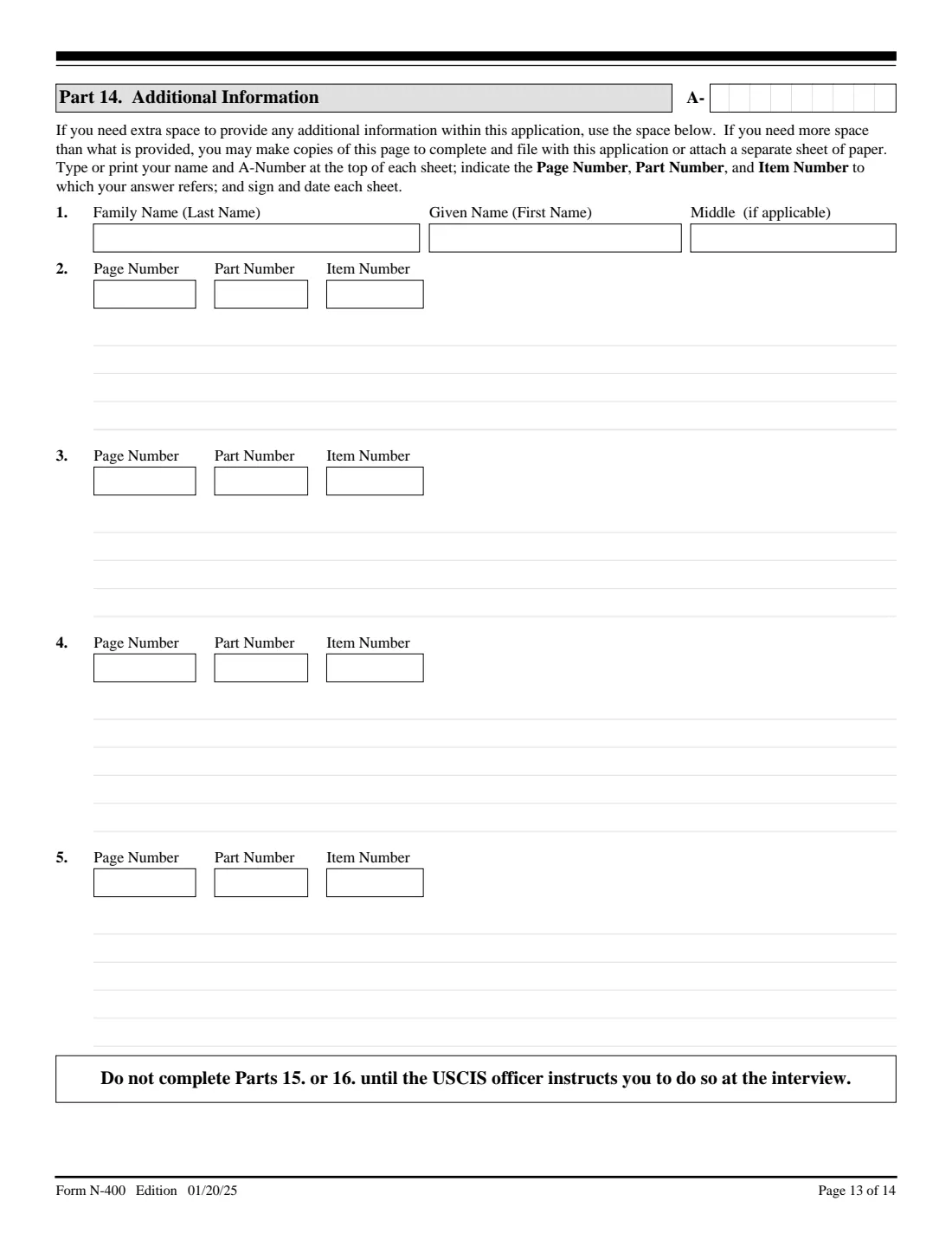
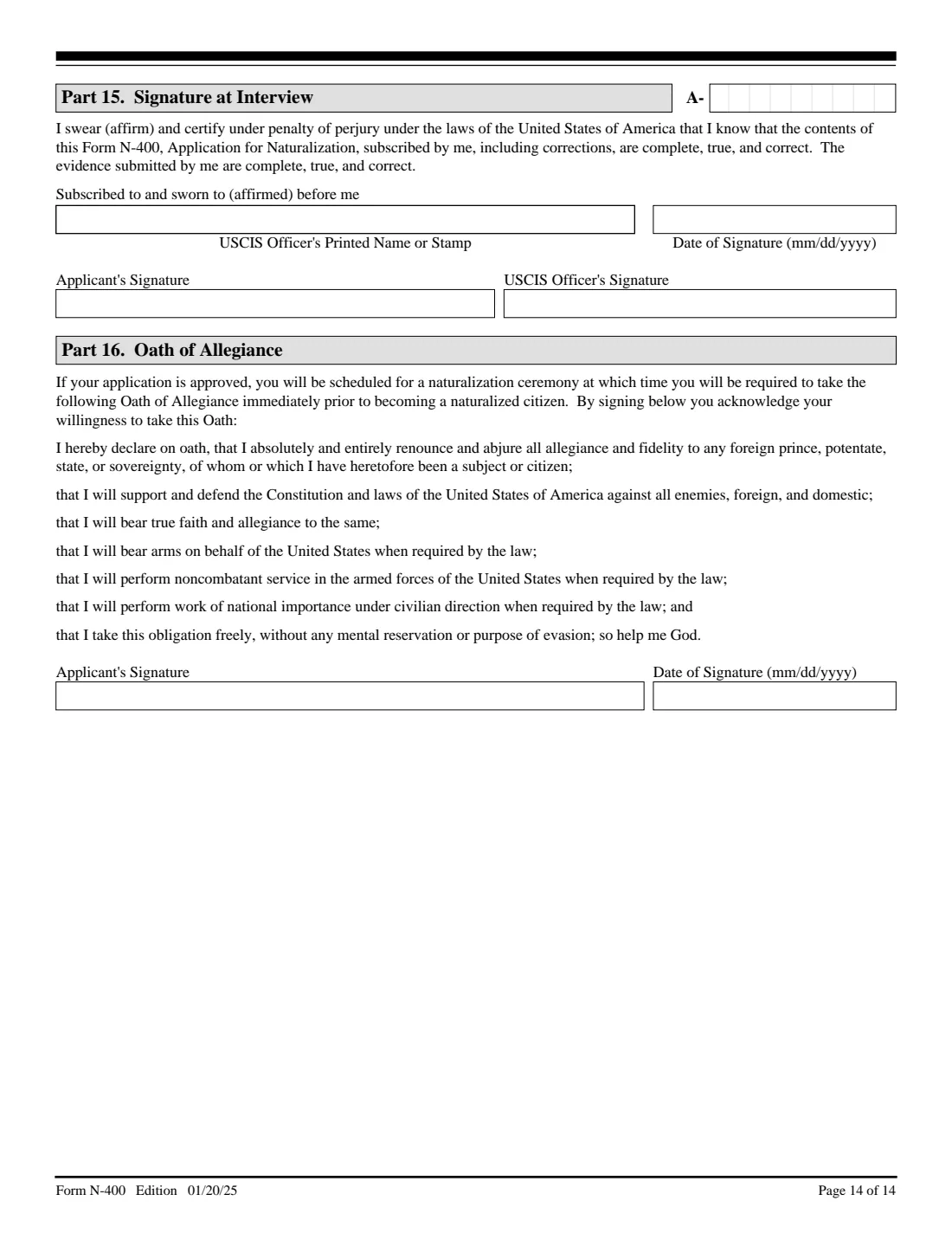
It starts with your eligibility basis and personal details, then biographic information, every address and job for the required period, your marital history and children, and your trips outside the United States. Part 9 asks the yes-or-no questions about your history and conduct, the Selective Service, military service and the Oath of Allegiance. Part 10 is an optional request for a reduced fee, Part 11 is your signature, Parts 12 and 13 are for an interpreter or preparer, and Part 14 is extra space. Parts 15 and 16 are signed at your interview.
FileIt lets you fill out the N-400 online. It pre-fills your name, date of birth and email from the People records in your vault, repeats your A-Number on every page, fills the weight one digit per box, wraps answers in the narrow table cells, and reminds you when a Yes answer needs an explanation in Part 14. USCIS requires a handwritten signature, so you print and sign it. FileIt keeps the filled form in your vault and never files anything with USCIS.
- Who fills it
- A lawful permanent resident (or a qualifying service member) applying to become a U.S. citizen.
- How to file
- Online with a USCIS account, or on paper by mail as uscis.gov/n-400 describes.
- Fee
- On Form G-1055, Fee Schedule (uscis.gov/g-1055). Part 10 requests a reduced fee if your household income qualifies.
- Signatures
- Signed by hand in ink. Parts 15 and 16 are signed in front of a USCIS officer at your interview.
- Edition
- Edition 01/20/25 (OMB 1615-0052, expires 02/28/2027), 14 pages.
- Agency
- U.S. Citizenship and Immigration Services (USCIS), Department of Homeland Security.
Who needs to fill out Form N-400?
- Green card holders who meet the residence and physical presence requirements of the general provision.
- Spouses of U.S. citizens applying on the basis of their marriage.
- Spouses of U.S. citizens working abroad for a qualifying employer.
- Current and former members of the U.S. armed forces.
- Applicants under the Violence Against Women Act provisions.
When to use Form N-400
- When you meet the residence period for your basis; the instructions explain the early filing window.
- After gathering your address, job and travel history for the required period.
- When you want your name legally changed as part of naturalization.
What you need before you start
- Your A-Number, Permanent Resident Card details and the date you became a permanent resident.
- Every address and employer or school for the required period, usually the last 5 years.
- Dates and countries of your trips outside the United States in that period.
- Marriage, divorce and children's details, and your spouse's citizenship information if you file as a spouse.
- Any arrest, citation or charge, with the dates, places and results, plus court records.
- Your Selective Service registration details, if it applies to you.
- Household income and size, if you ask for a reduced fee.
What’s on Form N-400
The 2025 edition has 14 pages. FileIt asks for it in 14 parts:
- Part 1. Information about your eligibilityApplicant
- Part 2. Information about youApplicant
- Part 3. Biographic informationApplicant
- Part 4. Information about your residenceApplicant
- Part 5. Information about your marital historyApplicant
- Part 6. Information about your childrenApplicant
- Part 7. Your employment and schools you attendedApplicant
- Part 8. Time outside the United StatesApplicant
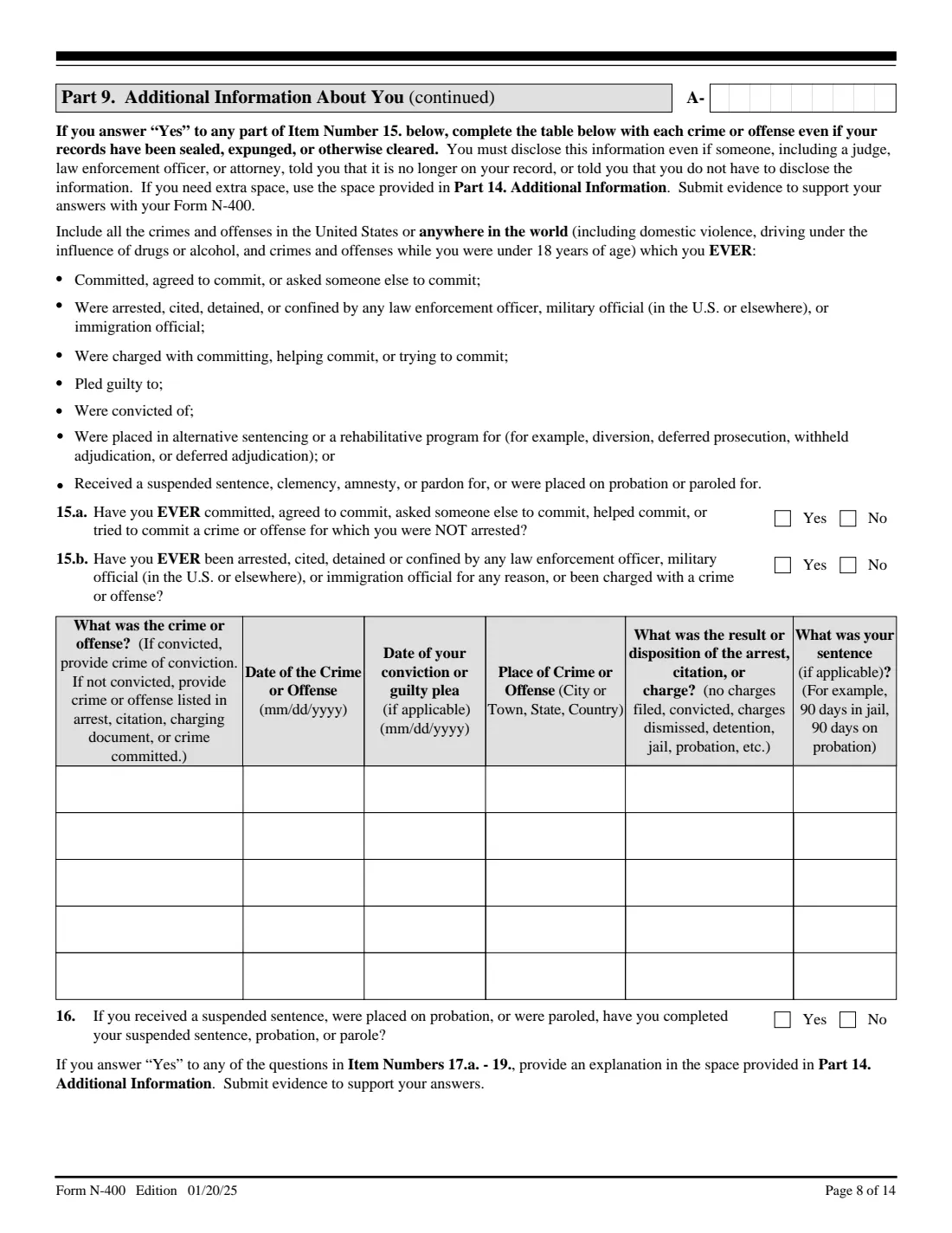
- Part 9. Additional information about youApplicant
- Part 10. Request for a fee reductionApplicant
- Part 11. Applicant's contact information, certification and signatureApplicant
- Part 12. InterpreterInterpreter
- Part 13. Person preparing this applicationPreparer
- Part 14. Additional informationApplicant
How to fill out Form N-400, step by step
1 Parts 1 and 2: Eligibility and you
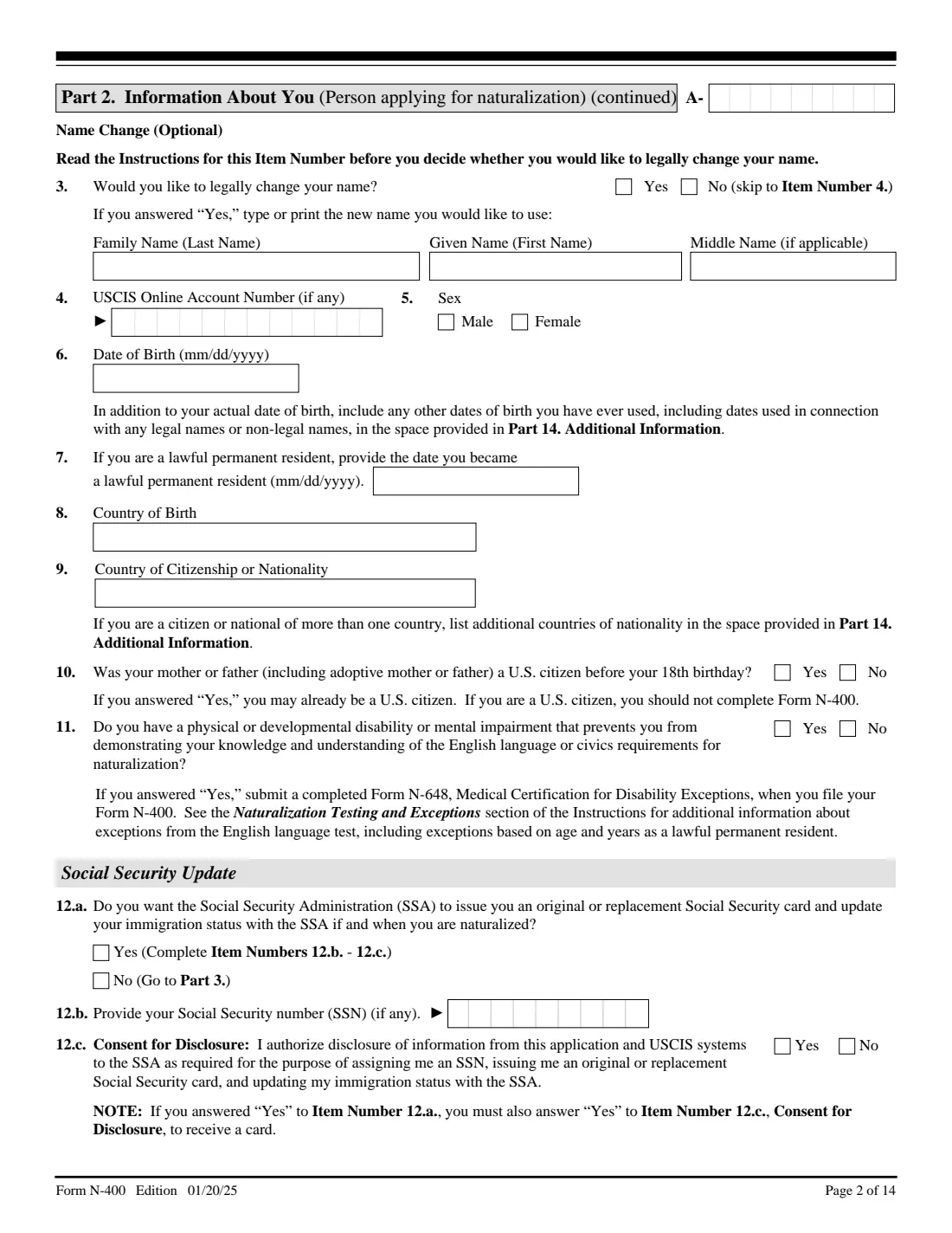
Choose one basis for filing and enter your A-Number, names, any name change you want, sex, dates of birth and permanent residence, countries of birth and nationality, and the Social Security update questions.
2 Parts 3 and 4: Biographics and residence
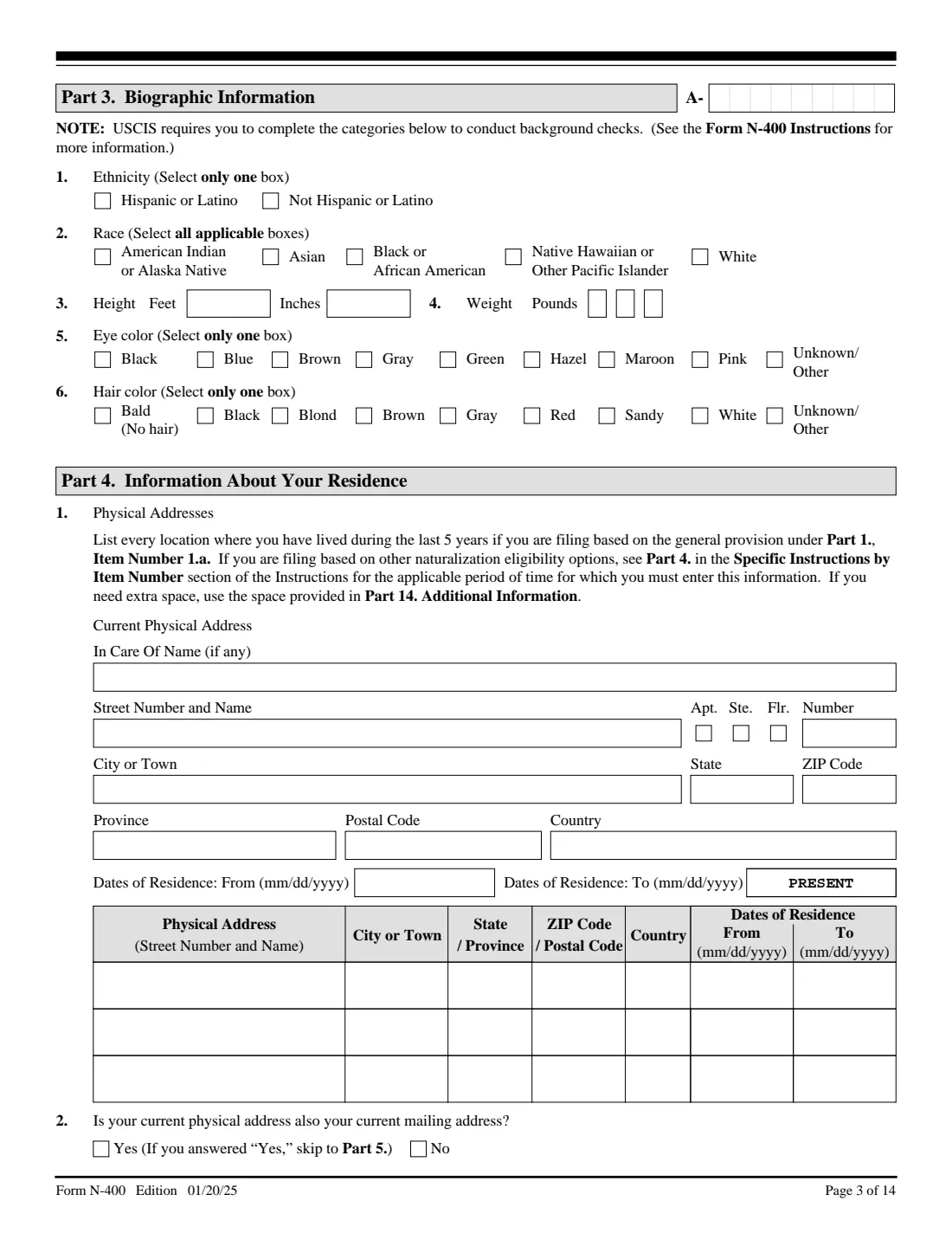
Give your ethnicity, race, height, weight, eye and hair color, then your current address and every earlier address in the required period, and a mailing address if it is different.
3 Parts 5 to 8: Family, work and travel
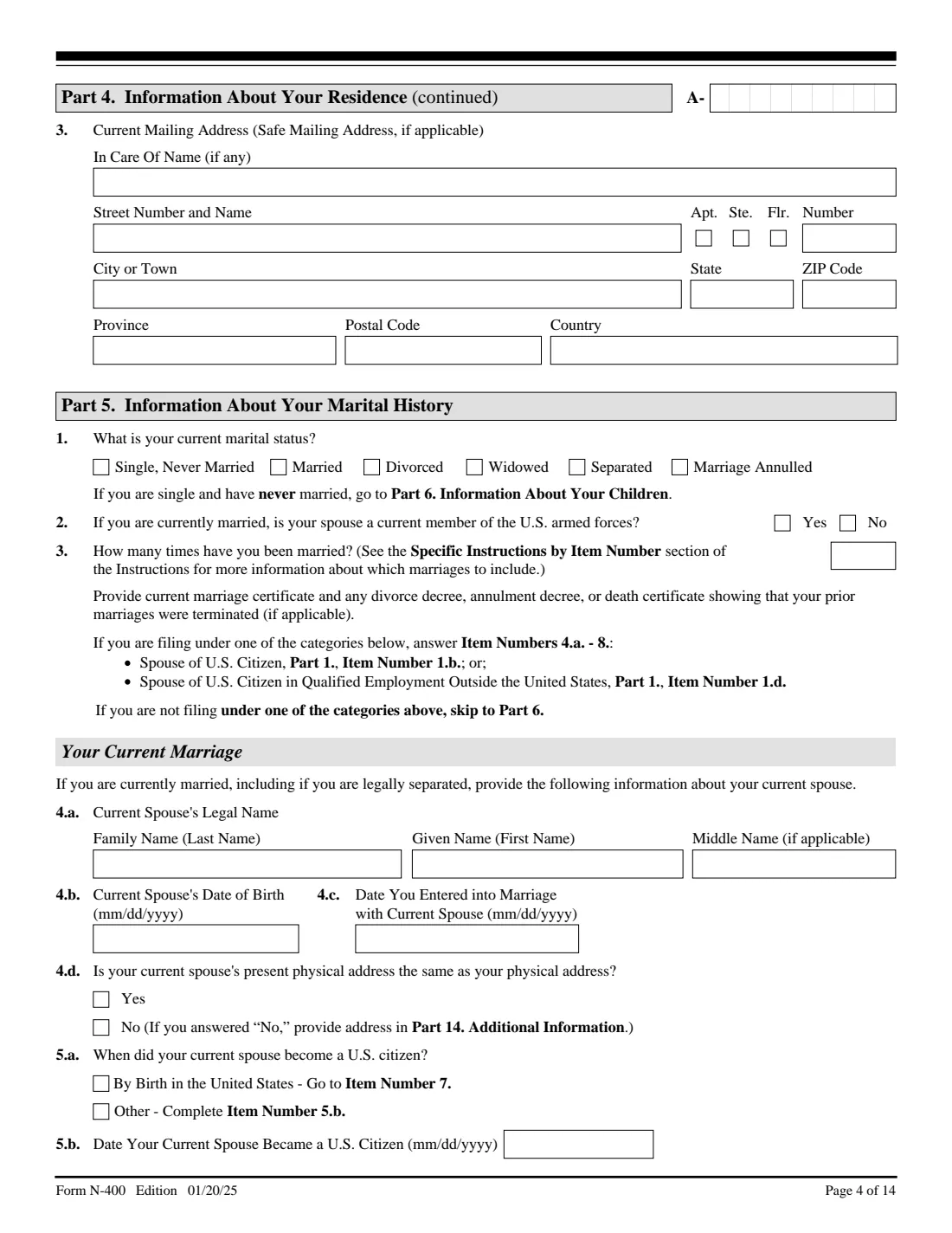
Describe your marital status and current spouse, your children under 18, where you worked or studied, and every trip abroad longer than 24 hours. More entries go in Part 14.
4 Part 9: Additional information
Answer every question. A Yes to most of them needs an explanation in Part 14, and crimes or offenses go in the table with the dates, places and outcomes, even if your records were sealed or expunged.
5 Parts 10 to 14: Fee, signature and extra space
Request a reduced fee if you qualify, add your phone and email and sign by hand. Interpreters and preparers fill their own parts, and Part 14 holds anything else, labeled with the page, part and item number.
Common mistakes to avoid
- Leaving Part 9 questions unanswered, which can delay your case.
- Answering Yes in Part 9 without an explanation in Part 14.
- Missing addresses, jobs or trips in the required period, or leaving gaps in the dates.
- Leaving out an arrest or citation because it was dismissed, sealed or expunged.
- Filling in Parts 15 and 16 before the interview.
- Signing with a typed name instead of in ink.
After you fill it out
Print the form, sign Part 11 by hand and have any interpreter or preparer sign their parts.
File it with the fee and evidence as uscis.gov/n-400 describes, then watch for your biometrics and interview notices.
FileIt keeps the PDF in your vault. When your Certificate of Naturalization arrives, add it to your vault too.
Fill out Form N-400 online with FileIt
- Pick the person. Choose someone from People and FileIt fills in their name, date of birth, address and other details it already knows.
- Answer plain-language questions. One part of the form at a time, with the official help text beside each question — 290 fields in all. Your answers save as you go.
- Check the live preview. Watch your answers land on the real U.S. Citizenship and Immigration Services (USCIS), Department of Homeland Security form, and let FileIt do any worksheet arithmetic.
- Generate the official PDF. FileIt prints your answers into the agency’s own PDF and files it in that person’s folder in your vault.
FileIt fills the form — it never files or submits anything for you. Deliver the finished form to whoever asked for it, the way the form’s instructions say.
Start Form N-400 now — it’s freeForm N-400: frequently asked questions
How much does Form N-400 cost?
USCIS publishes the fee on Form G-1055, Fee Schedule. Part 10 of the N-400 is where you request a reduced fee based on household income.
Can I file Form N-400 online?
USCIS accepts the N-400 online with a USCIS account or on paper. FileIt prepares the paper form: you print it, sign it and mail it.
What if my mother or father is a U.S. citizen?
Part 2 item 10 asks this. If they were citizens before your 18th birthday, you may already be a U.S. citizen and may need Form N-600 instead.
Do I have to list traffic tickets?
Part 9 asks about every crime and offense, including citations, anywhere in the world, even if records were sealed or cleared. The instructions explain what to include.
Can I change my name on Form N-400?
Yes. Part 2 item 3 lets you ask for a legal name change as part of naturalization; read the instructions for that item first.
Can I fill out Form N-400 online with FileIt?
Yes. FileIt fills it out online and prints your answers on the official USCIS PDF. You print it, sign it by hand and file it yourself; FileIt doesn't file anything with USCIS.
Official sources
- Blank form (PDF), published by U.S. Citizenship and Immigration Services (USCIS), Department of Homeland Security: https://www.uscis.gov/sites/default/files/document/forms/n-400.pdf
- Official instructions and guidance: https://www.uscis.gov/n-400
- Edition shown on this page: Edition 01/20/25 (OMB 1615-0052, expires 02/28/2027) (checked 2026-10-19).
FileIt is not affiliated with or endorsed by U.S. Citizenship and Immigration Services (USCIS), Department of Homeland Security or any government. This page explains the form in general terms and is not legal, tax or immigration advice. Always read the official instructions, and check that you are using the edition the recipient accepts. Page last reviewed 2026-10-19.