What is Form I-751?
Form I-751 is the petition a conditional permanent resident files to remove the conditions on their residence. If you became a permanent resident through a marriage that was less than two years old when you got your green card, the card is valid for two years. To keep your status, you ask USCIS to remove the conditions, usually jointly with your spouse during the 90 days before the card expires. Children who got conditional residence at the same time can be included.
If you can't file jointly, for example because your spouse has died, the marriage ended in divorce or annulment, you were battered or subjected to extreme cruelty, or removal would cause extreme hardship, you can ask for a waiver of the joint filing, and you don't have to wait for the 90-day window. You'll be asked for evidence that the marriage was entered in good faith, such as joint finances, a lease or mortgage, and children's birth certificates.
FileIt guides you through the eleven-page petition, asks the basis question once and checks the spouse's part matches it, and prints your answers into the official USCIS PDF. USCIS also takes this petition online; FileIt prepares the paper version, which you print and sign by hand. The filled PDF is saved in your vault, and FileIt never files anything for you.
- Who fills it
- The conditional resident, with the U.S. citizen or permanent resident spouse for a joint petition.
- When
- Joint petitions: within the 90 days before the green card expires. Waivers: any time after becoming a conditional resident.
- Filed with
- USCIS, online or by mail, with evidence that the marriage was genuine.
- Signatures
- The petitioner signs by hand, and the spouse signs Part 8 for a joint petition.
- Edition
- 04/01/24 (OMB No. 1615-0038, expires 03/31/2027).
- Agency
- U.S. Citizenship and Immigration Services (USCIS), Department of Homeland Security
Who needs to fill out Form I-751?
- Conditional permanent residents whose two-year green card came through marriage to a U.S. citizen or permanent resident.
- Their U.S. citizen or permanent resident spouses, who sign a joint petition.
- Conditional residents whose marriage ended, whose spouse died, or who experienced battery or extreme cruelty, filing with a waiver.
- Conditional resident children who couldn't be included in a parent's petition.
When to use Form I-751
- In the 90 days before your conditional green card expires, for a joint petition.
- As soon as you need to for a waiver request: there is no 90-day window.
- If you missed the deadline, with an explanation of why the filing is late.
What you need before you start
- A copy of both sides of your conditional green card.
- Evidence the marriage was genuine: joint bank accounts, a lease or mortgage, insurance, children's birth certificates, photos, affidavits.
- For a waiver: documents such as a divorce decree, death certificate or evidence of abuse or hardship.
- Your spouse's name, date of birth, identity numbers and address.
- Details of your children, every address since you became a permanent resident, and any arrests or charges.
What’s on Form I-751
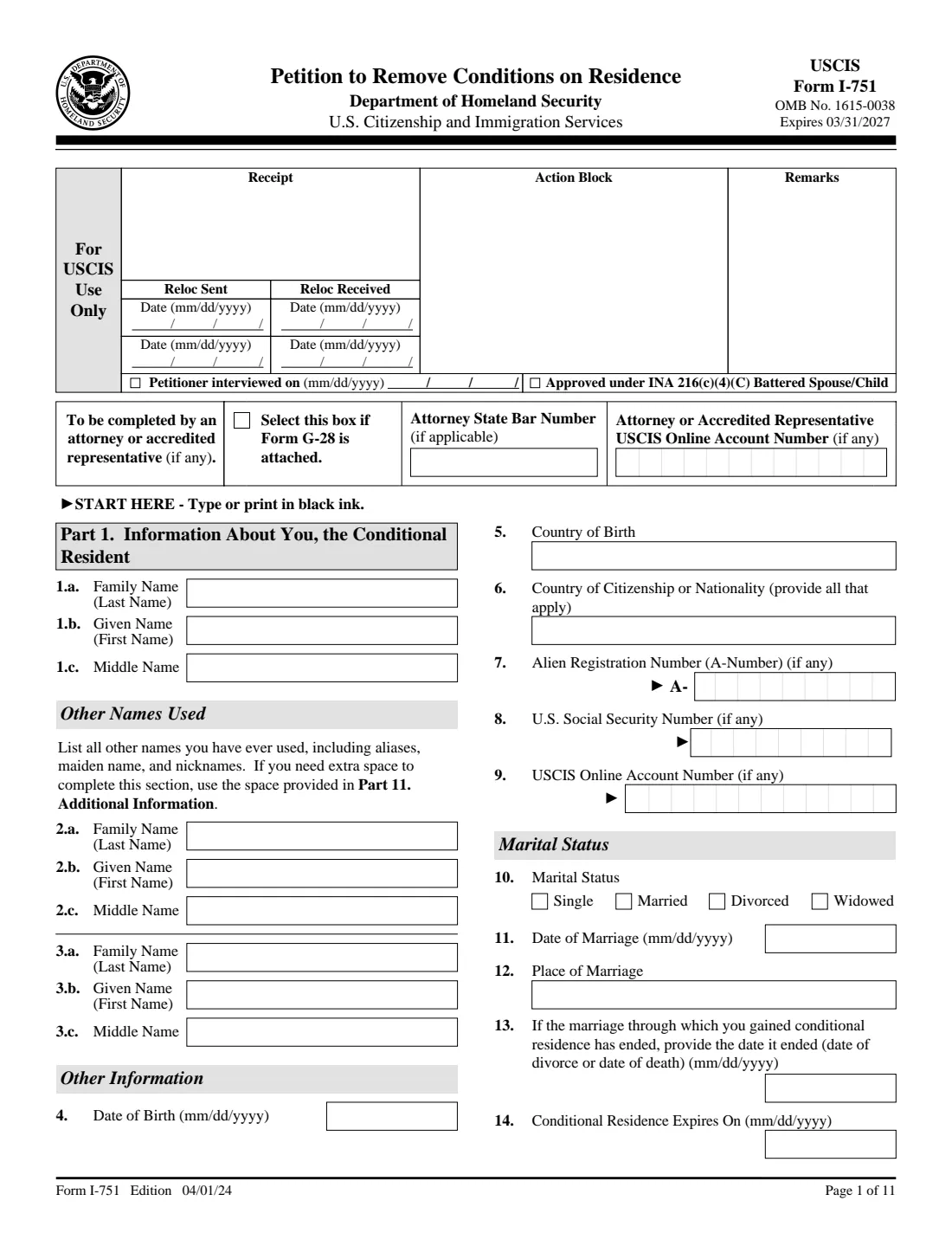
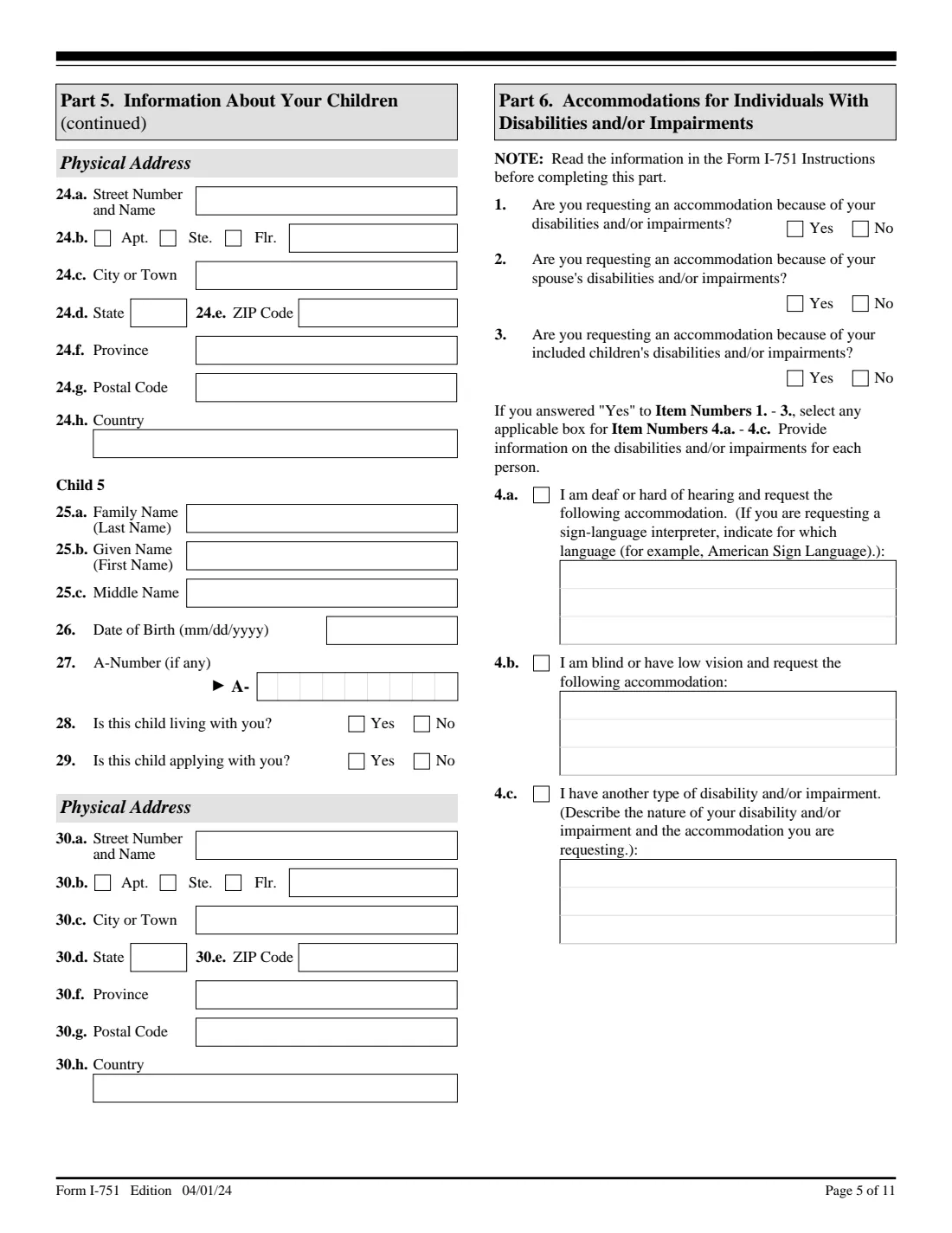
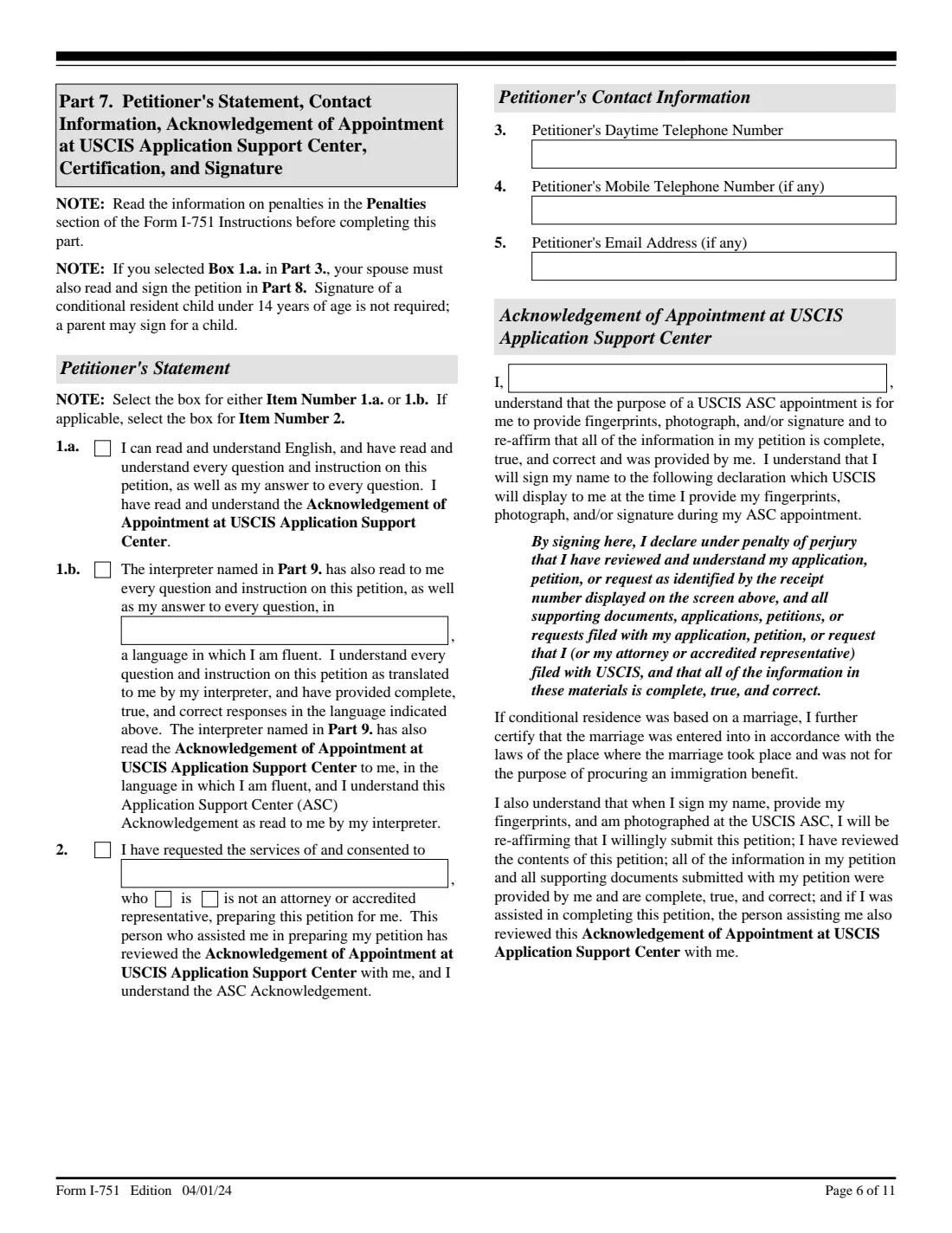
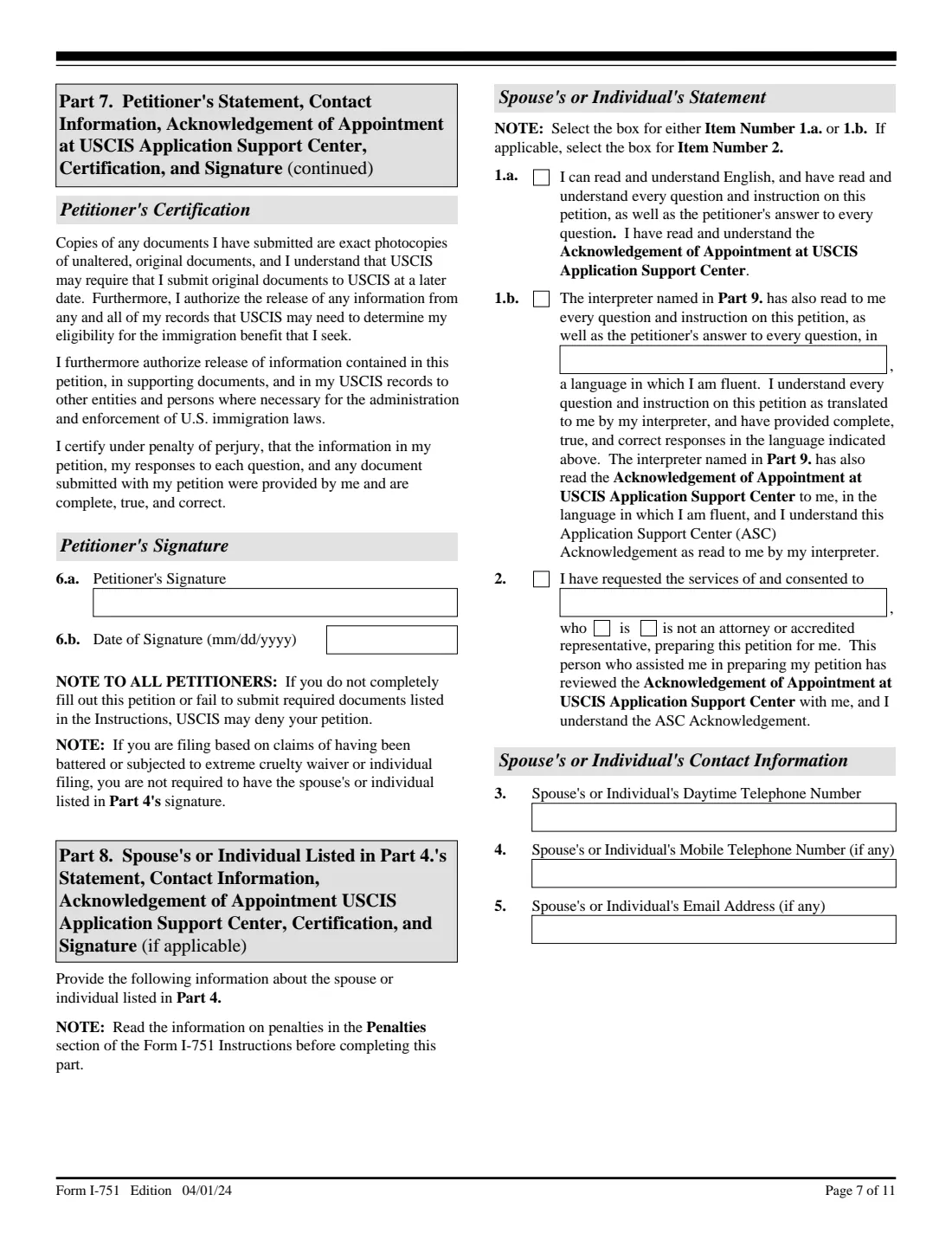
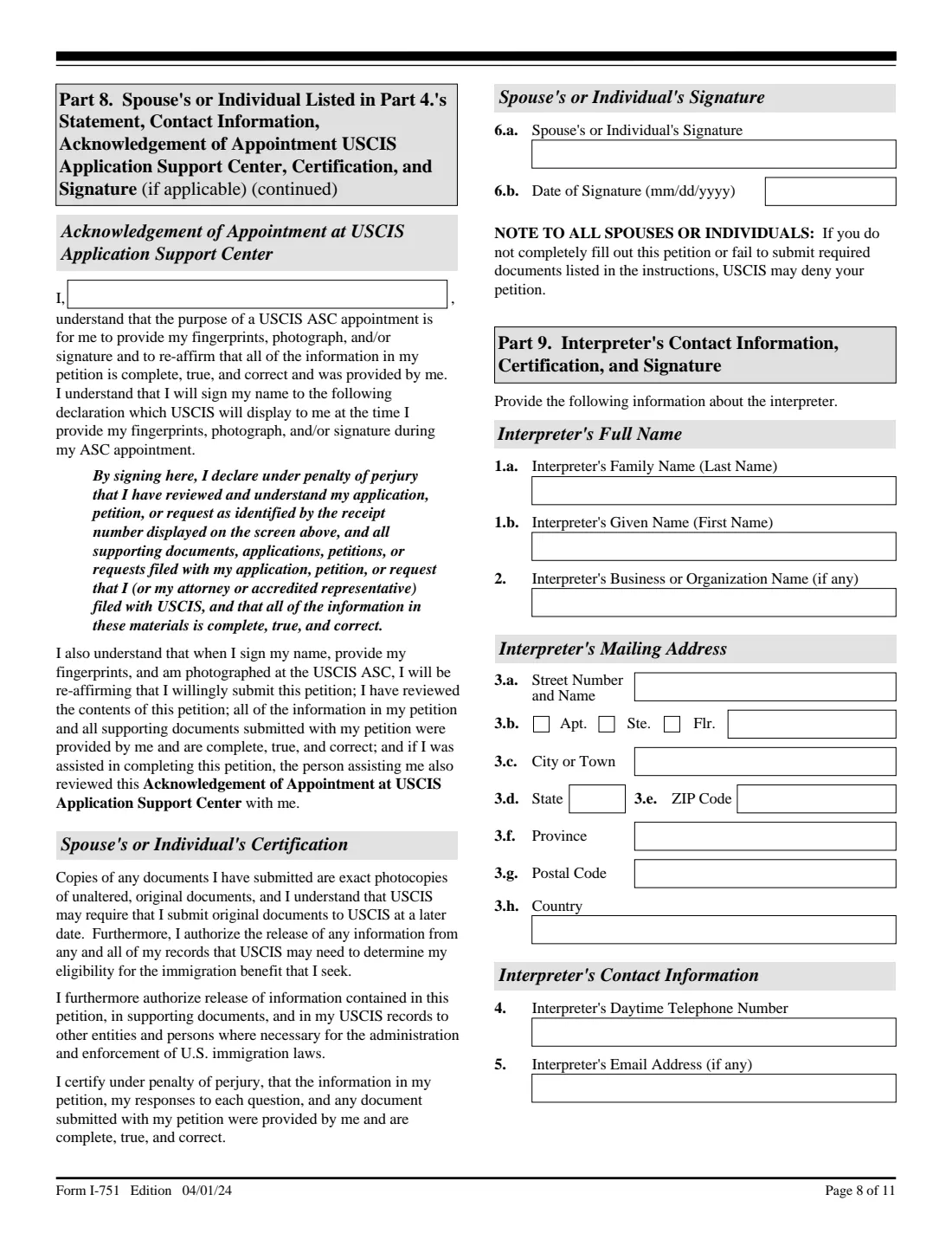
The 2024 edition has 11 pages. FileIt asks for it in 12 parts:
- Attorney or accredited representative (top of page 1)Preparer
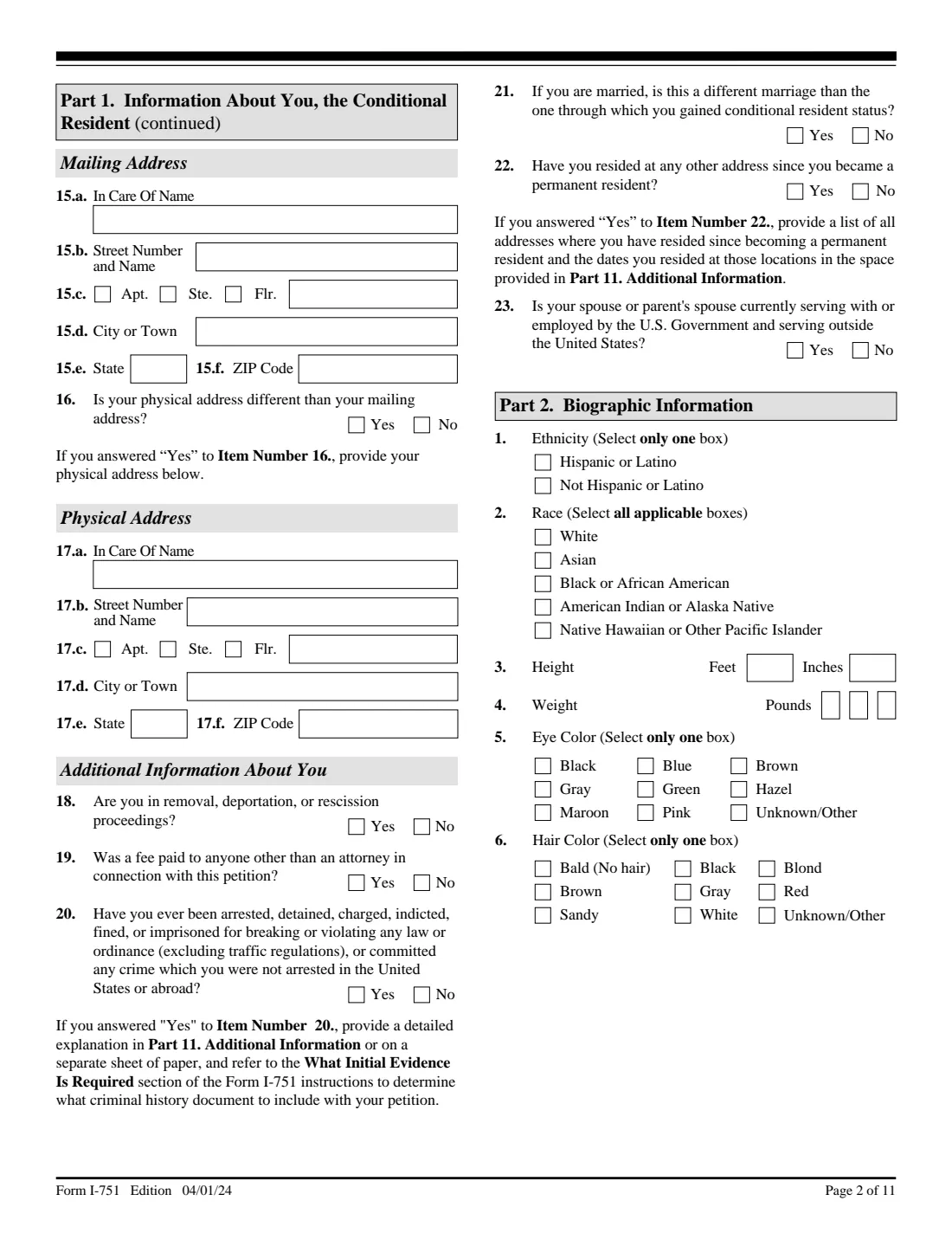
- Part 1. Information about you, the conditional residentConditional resident
- Part 2. Biographic informationConditional resident
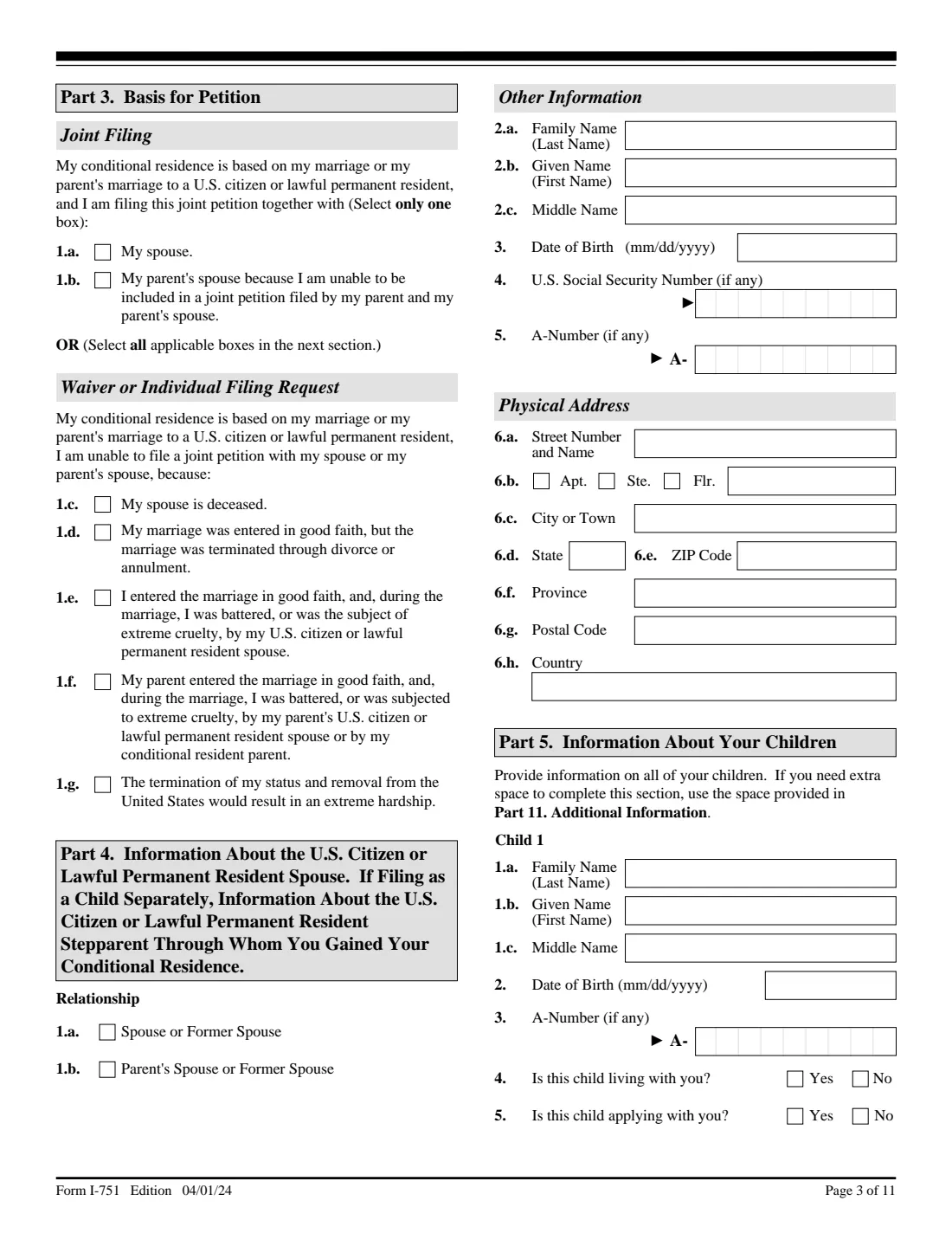
- Part 3. Basis for petitionConditional resident
- Part 4. The U.S. citizen or permanent resident spouse (or stepparent)Conditional resident
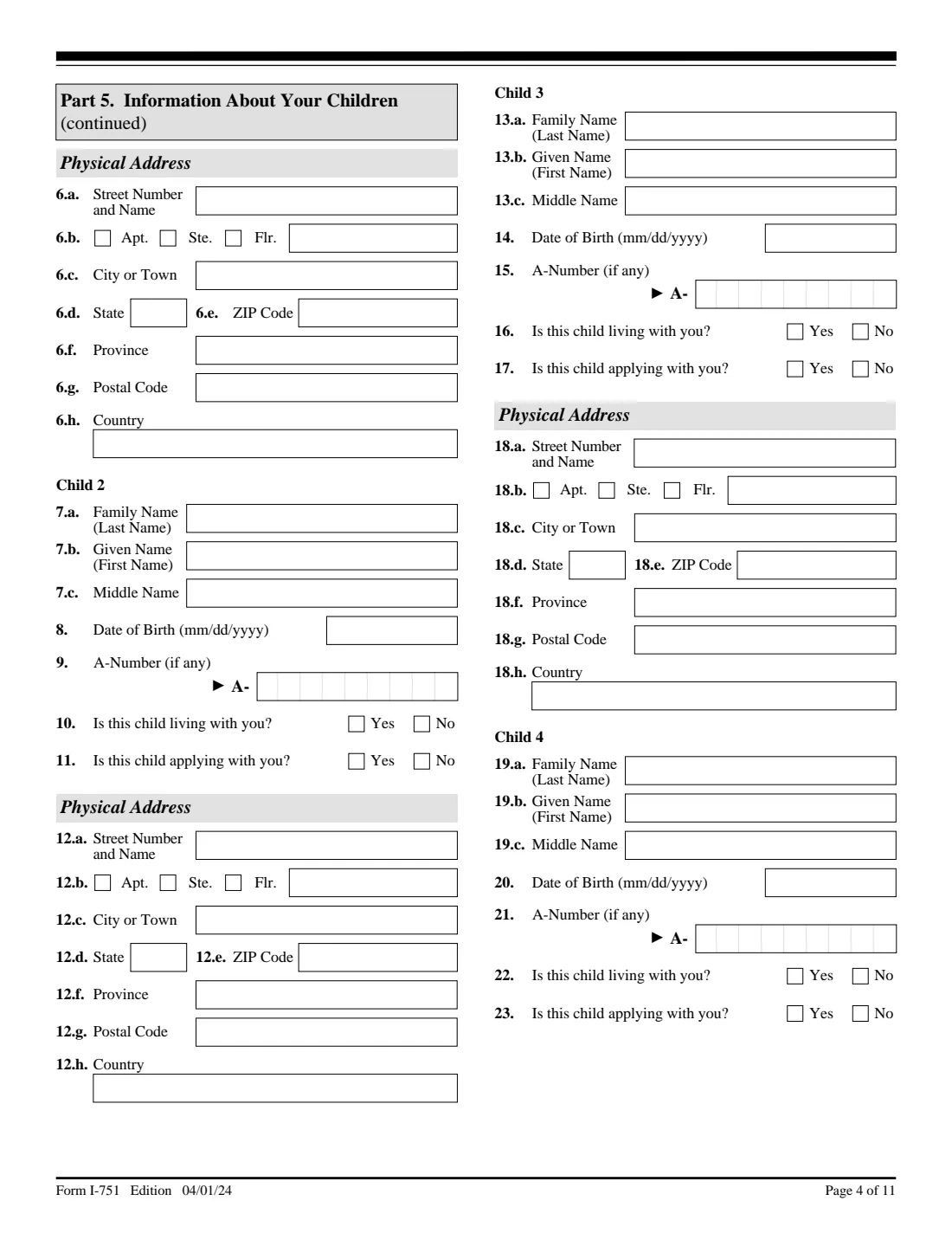
- Part 5. Information about your childrenConditional resident
- Part 6. Accommodations for individuals with disabilities and/or impairmentsConditional resident
- Part 7. Petitioner's statement, contact information and certificationConditional resident
- Part 8. Spouse's (or Part 4 individual's) statement and certificationSpouse (part 4)
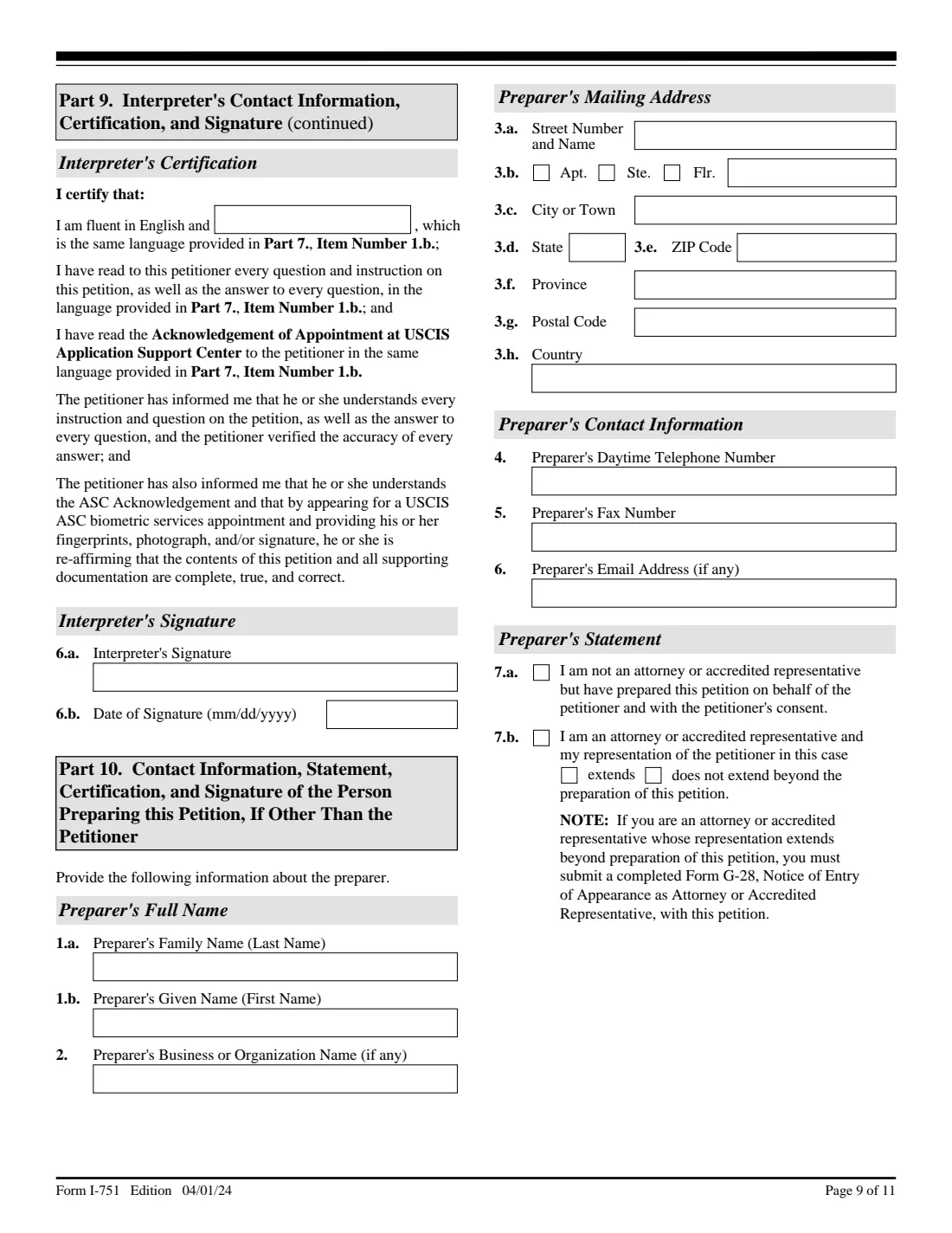
- Part 9. Interpreter's contact information, certification and signatureInterpreter
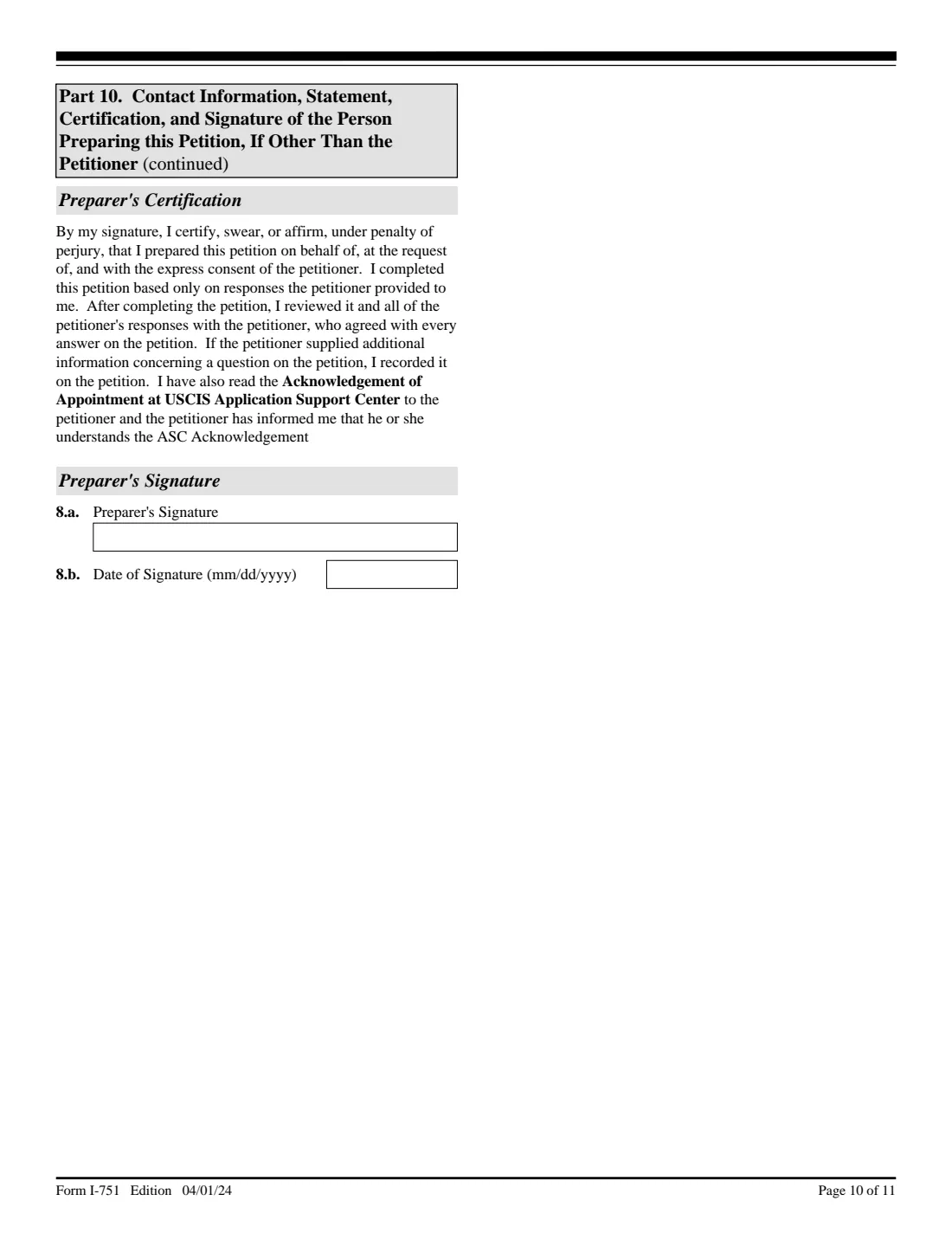
- Part 10. Person preparing this petition, if other than the petitionerPreparer
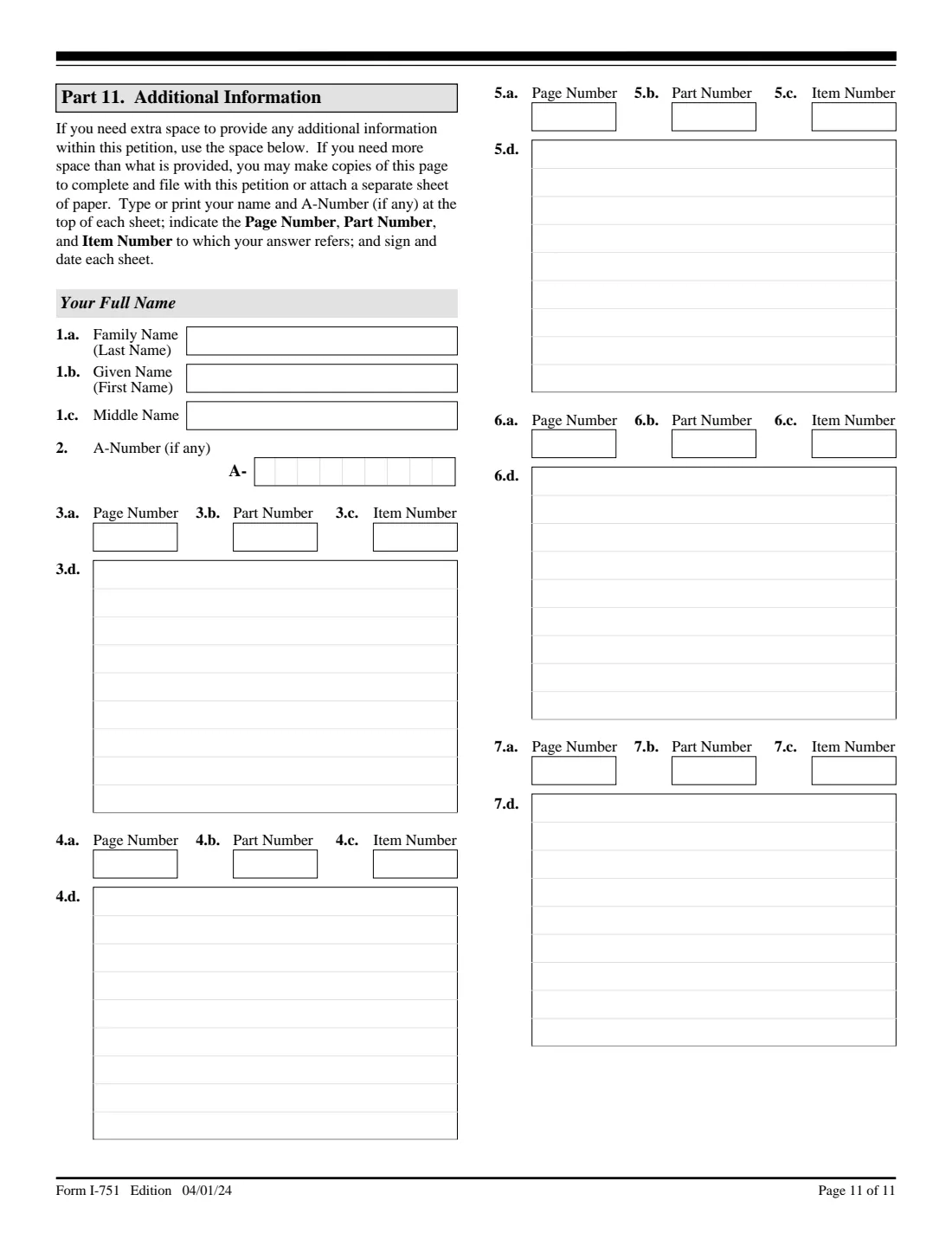
- Part 11. Additional informationConditional resident
How to fill out Form I-751, step by step
1 Part 1. About you
Name and other names, identity numbers, marital status, the marriage date and place, when your conditional residence expires, your mailing and physical addresses, and questions about proceedings, fees paid, arrests and other addresses.
2 Part 2. Biographic information
Ethnicity, race, height, weight, eye and hair color.
3 Part 3. Basis for the petition
A joint petition with your spouse (or your parent's spouse), or a waiver request with every reason that applies.
4 Parts 4 and 5. Spouse and children
The spouse or stepparent through whom you got conditional residence, and up to five children, with whether each lives with you and is applying with you.
5 Parts 6 to 8. Accommodations and statements
Any disability accommodation you need, your statement and contact details, and the spouse's statement and signature for a joint petition.
6 Parts 9 to 11. Helpers and extra space
The interpreter and preparer if anyone helped, and Part 11 for addresses, explanations and anything else, with your name and A-Number printed at the top.
Common mistakes to avoid
- Filing a joint petition before the 90-day window opens.
- Letting the green card expire without filing.
- Filing jointly without the spouse's signature in Part 8.
- Sending too little evidence of a genuine marriage.
- Not listing all your addresses since becoming a permanent resident when item 22 is Yes.
After you fill it out
Print the petition, check every page, sign it by hand (your spouse signs Part 8 for a joint petition), and file it with the evidence as the USCIS Form I-751 page directs.
Keep USCIS's receipt notice with your green card: it is your evidence of continued status while the petition is pending, for the period the notice states.
Attend the biometrics appointment and any interview. FileIt keeps the filled PDF in your vault.
Fill out Form I-751 online with FileIt
- Pick the person. Choose someone from People and FileIt fills in their name, date of birth, address and other details it already knows.
- Answer plain-language questions. One part of the form at a time, with the official help text beside each question — 238 fields in all. Your answers save as you go.
- Check the live preview. Watch your answers land on the real U.S. Citizenship and Immigration Services (USCIS) form, and let FileIt do any worksheet arithmetic.
- Generate the official PDF. FileIt prints your answers into the agency’s own PDF and files it in that person’s folder in your vault.
FileIt fills the form — it never files or submits anything for you. Deliver the finished form to whoever asked for it, the way the form’s instructions say.
Start Form I-751 now — it’s freeForm I-751: frequently asked questions
When can I file Form I-751?
A joint petition goes in during the 90 days before your conditional green card expires. A waiver request can be filed at any time after you become a conditional resident.
Can I file without my spouse?
Yes, with a waiver: if your spouse died, the marriage ended in divorce or annulment, you were battered or subjected to extreme cruelty, or removal would cause extreme hardship. Tick every reason that applies in Part 3.
Can my children be included?
Children who got conditional residence at the same time as you, or within 90 days after, can usually be included in your petition. List all your children in Part 5 and say whether each is applying with you.
What evidence should I send?
Evidence that the marriage was entered in good faith: joint finances, a shared lease or mortgage, children's birth certificates, insurance and similar records. The instructions list examples.
Do I need a waiver if we're still married but separated?
That depends on your circumstances. The instructions explain each basis; if you're unsure, an attorney or accredited representative can advise you.
Can I fill out Form I-751 online with FileIt?
Yes. FileIt guides you through the paper petition and prints your answers on the official USCIS PDF. You print it and sign by hand; FileIt doesn't file it.
Official sources
- Blank form (PDF), published by U.S. Citizenship and Immigration Services (USCIS): https://www.uscis.gov/sites/default/files/document/forms/i-751.pdf
- Official instructions and guidance: https://www.uscis.gov/i-751
- Edition shown on this page: 04/01/24 (OMB 1615-0038, expires 03/31/2027) (checked 2026-10-19).
FileIt is not affiliated with or endorsed by U.S. Citizenship and Immigration Services (USCIS) or any government. This page explains the form in general terms and is not legal, tax or immigration advice. Always read the official instructions, and check that you are using the edition the recipient accepts. Page last reviewed 2026-10-19.