What is CDTFA-230?
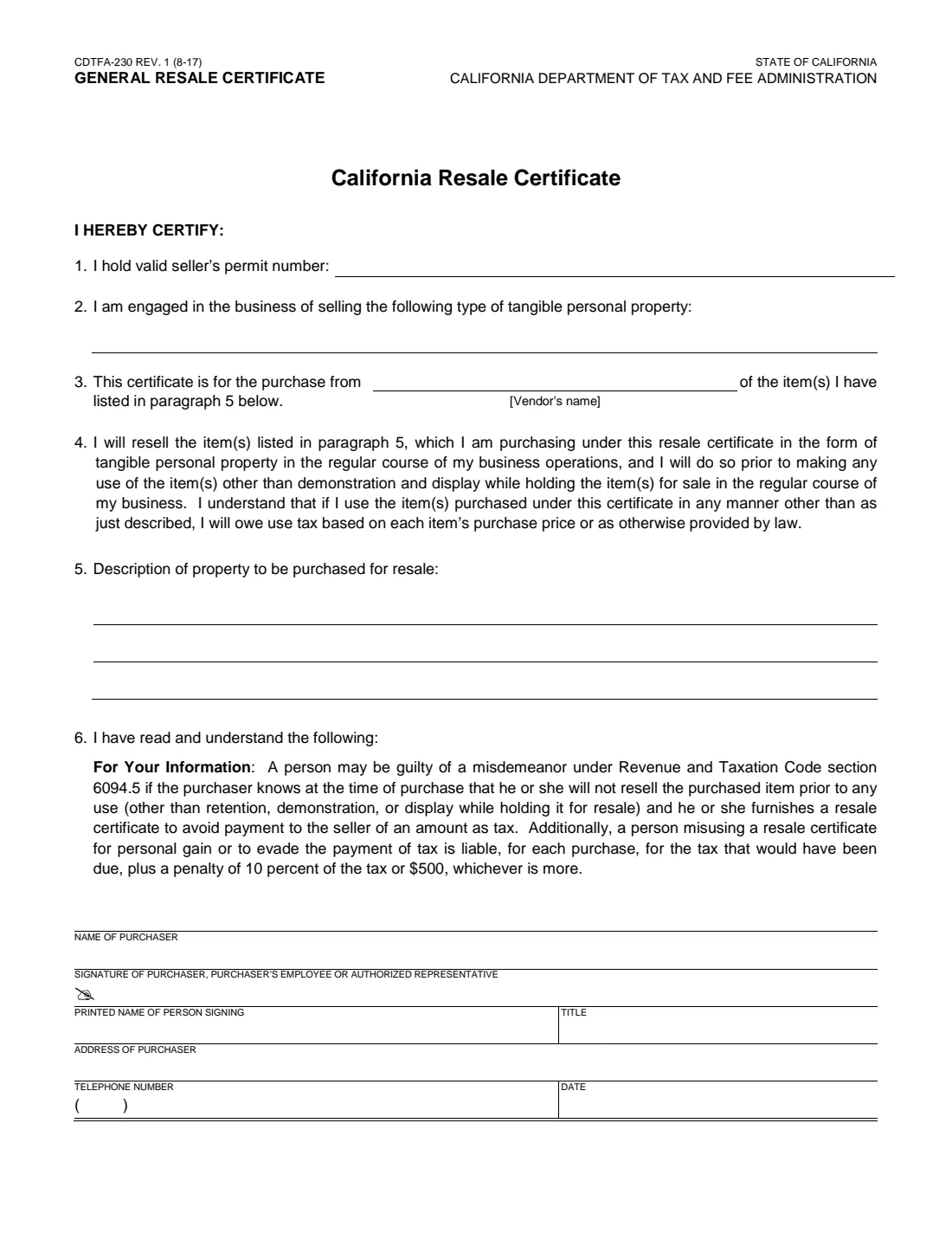
A California business that buys goods to resell gives the vendor a resale certificate. It states your seller's permit number, the kind of property you sell, the vendor's name and a description of the property you're buying for resale, and you sign it. The vendor keeps it; it isn't sent to the CDTFA.
By signing, you certify that you'll resell the items in the regular course of your business before using them for anything other than demonstration and display. The form warns that if you use them any other way you owe use tax on their purchase price, and that misusing a certificate for personal gain or to evade tax makes you liable for the tax plus a penalty of 10 percent of the tax or $500, whichever is more, for each purchase.
FileIt prints your answers onto the CDTFA's own PDF (REV. 1 (8-17)), splits your phone number into its boxes, saves the finished certificate in your vault and can send it to you for an electronic signature.
- Who fills it in
- The buyer, who holds a California seller's permit.
- Who gets it
- The vendor you're buying from. It isn't filed with the CDTFA.
- Who signs
- The purchaser, the purchaser's employee or an authorized representative.
- Misuse penalty
- The tax due plus 10% of the tax or $500, whichever is more, per purchase (as printed on the form).
- Edition
- CDTFA-230 REV. 1 (8-17)
Who needs to fill out CDTFA-230?
- Retailers buying stock from wholesalers or manufacturers.
- Online and market sellers with a California seller's permit buying goods to resell.
- Businesses opening an account with a new supplier who asks for a resale certificate.
When to use CDTFA-230
- When a vendor asks for a resale certificate before selling to you without tax.
- When you open a trade account with a supplier.
- When your business details change and a supplier needs an updated certificate.
What you need before you start
- Your seller's permit number.
- The type of property you sell.
- The vendor's name and a description of what you'll buy from them for resale.
- The purchaser's name, address and phone number, and the name and title of the person signing.
What’s on CDTFA-230
The 2017 edition has 1 page. FileIt asks for it in 2 parts, and it is signed by Purchaser:
- I hereby certifyPurchaser
- Purchaser and signaturePurchaser
How to fill out CDTFA-230, step by step
1 1. Seller's permit number
Enter the permit number the CDTFA issued to your business.
2 2. What you sell
Describe the type of tangible personal property you sell, such as clothing, hardware or auto parts.
3 3. Vendor
Name the seller this certificate is for.
4 5. Property bought for resale
Describe the items you'll buy from this vendor to resell, on up to three lines.
5 Purchaser and signature
Name of the purchaser, the printed name and title of the person signing, the address, phone and date. Then sign.
Common mistakes to avoid
- Using a resale certificate for items you'll use yourself, such as office supplies or equipment: you owe use tax on those.
- Leaving the vendor's name or the description of property blank.
- Entering a permit number that isn't yours or is no longer valid.
- Forgetting to sign the certificate.
After you fill it out
Sign the certificate, on paper or through FileIt's e-signature request.
Give it to the vendor and keep a copy with your records. FileIt saves the PDF in your vault folder.
If you later use an item bought this way for something other than resale, demonstration or display, you owe use tax on it.
Fill out CDTFA-230 online with FileIt
- Pick the person. Choose someone from People and FileIt fills in their name, date of birth, address and other details it already knows.
- Answer plain-language questions. One part of the form at a time, with the official help text beside each question — 15 fields in all. Your answers save as you go.
- Check the live preview. Watch your answers land on the real California Department of Tax and Fee Administration (CDTFA) form, and let FileIt do any worksheet arithmetic.
- Generate the official PDF. FileIt prints your answers into the agency’s own PDF and files it in that person’s folder in your vault. Sign it, or send it for e-signature.
FileIt fills the form — it never files or submits anything for you. Deliver the finished form to whoever asked for it, the way the form’s instructions say.
Start CDTFA-230 now — it’s freeCDTFA-230: frequently asked questions
Do I send the CDTFA-230 to the CDTFA?
No. You give it to the vendor you're buying from, and the vendor keeps it.
What if I end up using an item I bought for resale?
The certificate itself says you'll owe use tax based on the item's purchase price, or as otherwise provided by law.
What happens if a resale certificate is misused?
The form says a person misusing one for personal gain or to evade tax is liable, for each purchase, for the tax that would have been due plus a penalty of 10 percent of the tax or $500, whichever is more. Knowingly giving one for items you won't resell can also be a misdemeanor under Revenue and Taxation Code section 6094.5.
Who can sign it?
The purchaser, the purchaser's employee or an authorized representative, as the signature line says.
Official sources
- Blank form (PDF), published by California Department of Tax and Fee Administration (CDTFA): https://www.cdtfa.ca.gov/DownloadFile.ashx?path=/formspubs/cdtfa230.pdf
- Official instructions and guidance: https://www.cdtfa.ca.gov/DownloadFile.ashx?path=/formspubs/cdtfa230.pdf
- Edition shown on this page: CDTFA-230 REV. 1 (8-17) (checked 2026-10-25).
FileIt is not affiliated with or endorsed by California Department of Tax and Fee Administration (CDTFA) or any government. This page explains the form in general terms and is not legal, tax or immigration advice. Always read the official instructions, and check that you are using the edition the recipient accepts. Page last reviewed 2026-10-25.