What is Form 8888?
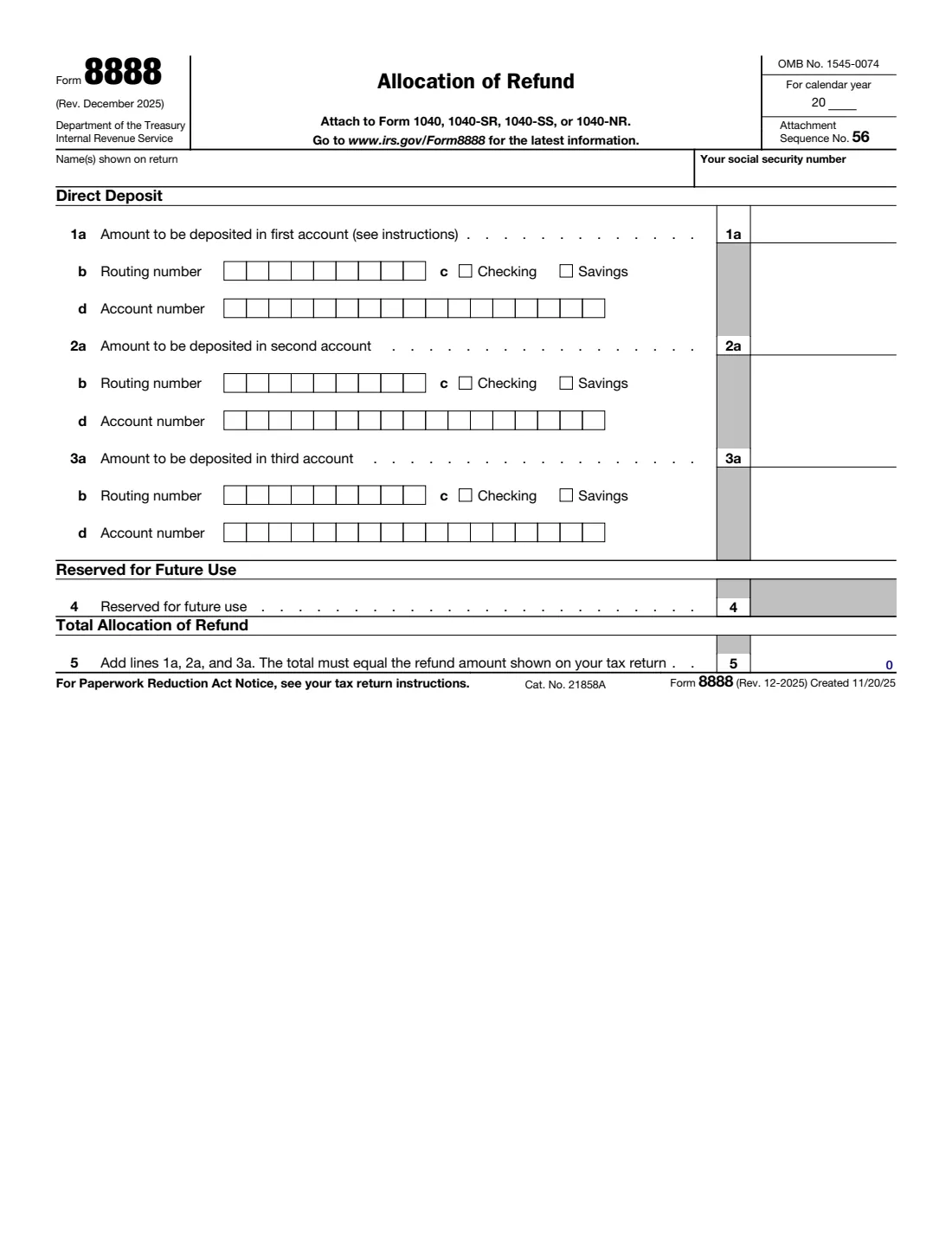
Form 8888, Allocation of Refund, lets you have your federal income tax refund deposited directly into two or three accounts instead of one: for example part into checking, part into savings and part into an IRA. You attach it to your Form 1040, 1040-SR, 1040-SS or 1040-NR. If you want the whole refund in one account, you don't need this form; you request direct deposit on the return itself.
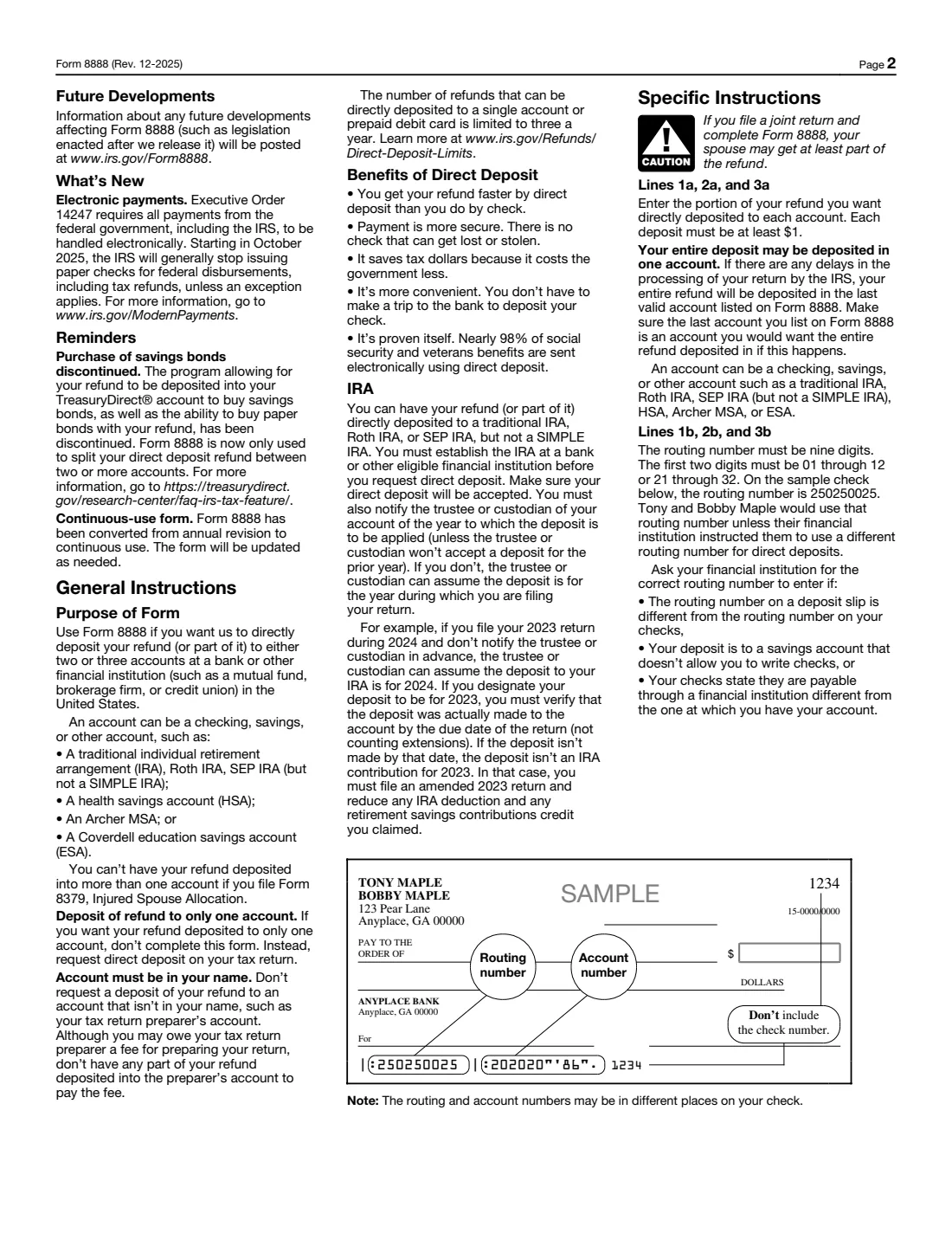
The current edition is Rev. December 2025, now a continuous-use form. The option to buy savings bonds with your refund has been discontinued, so the form is used only to split a direct deposit. The form also notes that, under Executive Order 14247, the IRS generally stopped issuing paper checks for federal disbursements, including refunds, starting in October 2025 unless an exception applies.
FileIt asks for each account in turn, checks the routing numbers and the total against your refund, adds up line 5, and prints everything into the IRS's official PDF, which is saved in your vault. You attach it to your return yourself; FileIt never files anything with the IRS.
- Who fills it
- Individual filers who want their refund split between two or three accounts.
- Filed with
- Your Form 1040, 1040-SR, 1040-SS or 1040-NR, as an attachment (Attachment Sequence No. 56).
- Accounts
- Two or three U.S. accounts in your name: checking, savings, IRA (not SIMPLE), HSA, Archer MSA or Coverdell ESA.
- Minimum deposit
- $1 per account.
- Signatures
- None on the form itself; you sign the tax return.
- Edition
- Rev. December 2025
Who needs to fill out Form 8888?
- Taxpayers who want part of their refund in checking and part in savings.
- People who want to put some of their refund straight into a traditional, Roth or SEP IRA, an HSA, an Archer MSA or a Coverdell ESA.
- Couples filing jointly who want the refund divided between accounts (each account must be in a name on the return, and the bank must accept a joint refund into it).
When to use Form 8888
- When you prepare your federal income tax return and expect a refund you want split between two or three accounts.
- Not when you want everything in one account: use the direct deposit lines on the return instead.
- Not when you file Form 8379, Injured Spouse Allocation: the form says the refund can't then go into more than one account.
What you need before you start
- The tax year, the name(s) on your return and your Social Security number.
- The refund amount from your return, so the deposits add up to it.
- For each account: the nine-digit routing number, the account number (up to 17 letters and numbers) and whether it's checking or savings.
- For an IRA, HSA or brokerage account, your financial institution's advice on whether to check Checking or Savings.
What’s on Form 8888
The 2025 edition has 3 pages. FileIt asks for it in 5 parts:
- The return this refund comes fromTaxpayer
- Line 1: First accountTaxpayer
- Line 2: Second accountTaxpayer
- Line 3: Third accountTaxpayer
- Line 5: Total allocation of refundTaxpayer
How to fill out Form 8888, step by step
1 Header: year, name and SSN
Enter the calendar year of the return, the name(s) shown on the return and your Social Security number.
2 Lines 1 to 3: each account
For each account enter (a) the amount, at least $1; (b) the nine-digit routing number, whose first two digits must be 01 through 12 or 21 through 32; (c) whether it's a checking or savings account, checking only one box; and (d) the account number, up to 17 characters, including hyphens but no spaces, special symbols or check number. The routing number on a deposit slip can differ from the one on your checks, so ask your financial institution if you're unsure.
3 Order matters
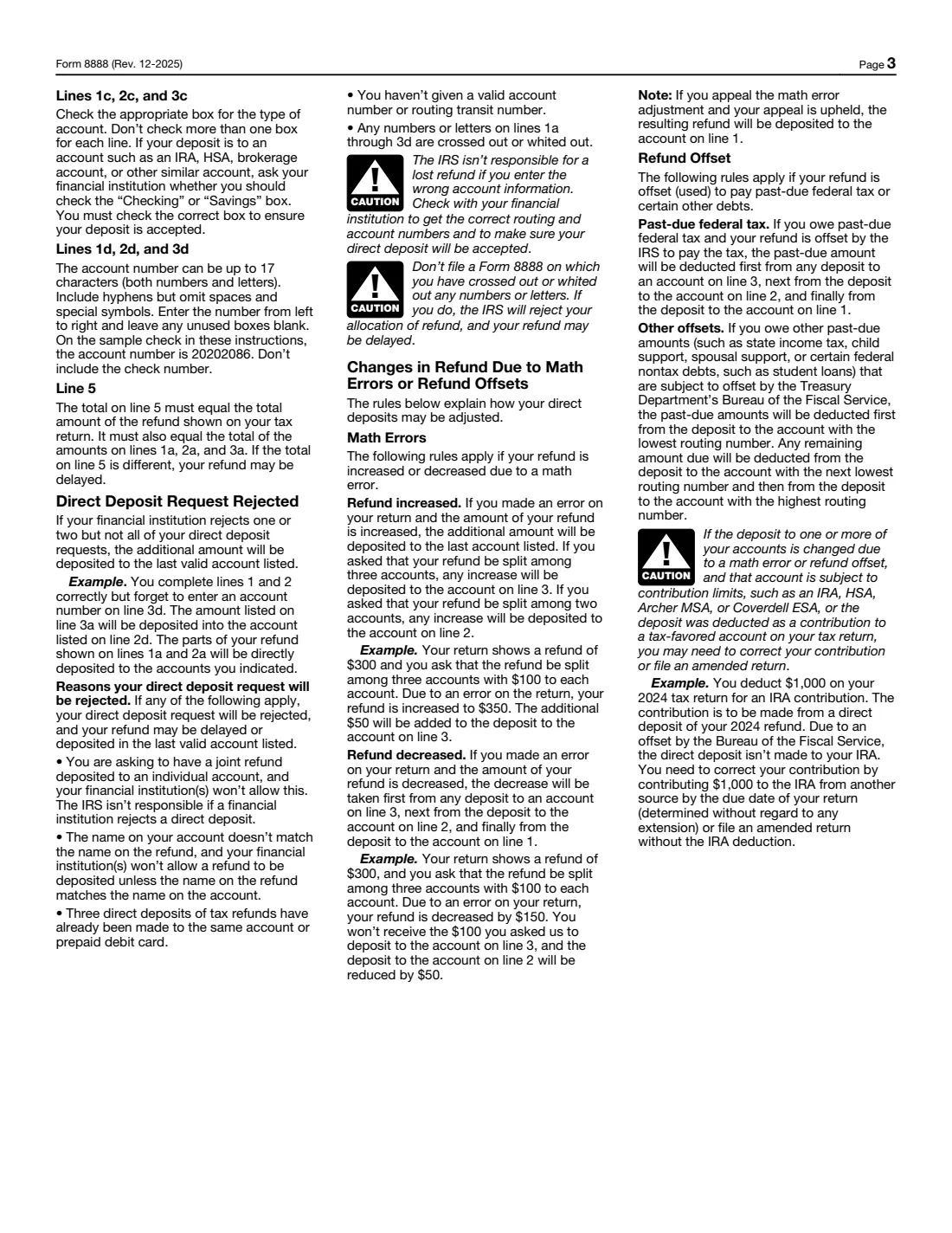
If the IRS has to put the whole refund in one account, for example because of a processing delay or a rejected deposit, it goes to the last valid account listed. If your refund changes because of a math error, an increase goes to the last account, and a decrease (or an offset for past-due federal tax) comes out of line 3 first, then line 2, then line 1.
4 Line 4
Line 4 is reserved for future use. Leave it blank.
5 Line 5: total
Add lines 1a, 2a and 3a. The total must equal the refund on your tax return; if it doesn't, the refund may be delayed. FileIt adds it up and checks it against the refund you enter.
Common mistakes to avoid
- Using Form 8888 for a single account. Request direct deposit on the return instead.
- Sending part of the refund to your tax preparer's account to pay their fee. Every account must be in your name.
- A wrong routing or account number. The form warns the IRS isn't responsible for a lost refund if you enter the wrong account information.
- Crossing out or whiting out numbers. The IRS rejects an allocation with crossed-out or whited-out entries.
- A line 5 total that doesn't match the refund on the return.
- Exceeding the limit: no more than three refunds a year can be deposited into the same account or prepaid debit card.
After you fill it out
Attach Form 8888 to your Form 1040, 1040-SR, 1040-SS or 1040-NR and file the return as usual. FileIt keeps a copy in your vault.
If you deposited to an IRA, tell the trustee or custodian which year the deposit is for; otherwise they can treat it as a contribution for the year you file. If it's for the prior year, make sure the deposit actually arrives by the return's due date (not counting extensions).
If part of the refund is offset or reduced, check whether a contribution to an IRA, HSA, Archer MSA or ESA is affected; you may need to make it up from another source or amend the return.
Fill out Form 8888 online with FileIt
- Pick the person. Choose someone from People and FileIt fills in their name, date of birth, address and other details it already knows.
- Answer plain-language questions. One part of the form at a time, with the official help text beside each question — 17 fields in all. Your answers save as you go.
- Check the live preview. Watch your answers land on the real Internal Revenue Service (IRS) form, and let FileIt do any worksheet arithmetic.
- Generate the official PDF. FileIt prints your answers into the agency’s own PDF and files it in that person’s folder in your vault.
FileIt fills the form — it never files or submits anything for you. Deliver the finished form to whoever asked for it, the way the form’s instructions say.
Start Form 8888 now — it’s freeForm 8888: frequently asked questions
Can I split my tax refund into more than one account?
Yes. Form 8888 lets you have it deposited into two or three accounts at banks or other financial institutions in the United States.
Can I still buy savings bonds with my refund?
No. The form says the program for buying savings bonds with a refund has been discontinued, and Form 8888 is now used only to split a direct-deposit refund.
Can part of my refund go into my IRA or HSA?
Yes: a traditional, Roth or SEP IRA (not a SIMPLE IRA), an HSA, an Archer MSA or a Coverdell ESA. The IRA must already be set up, and you should tell the trustee or custodian which year the deposit is for.
What happens if one of my deposits is rejected?
The amount for a rejected account is deposited into the last valid account listed on the form.
Does Form 8888 need a signature?
No. It has no signature line; it's attached to your tax return, which you sign.
Can I use Form 8888 with Form 8379?
No. The form says you can't have your refund deposited into more than one account if you file Form 8379, Injured Spouse Allocation.
Official sources
- Blank form (PDF), published by Internal Revenue Service (IRS): https://www.irs.gov/pub/irs-pdf/f8888.pdf
- Official instructions and guidance: https://www.irs.gov/forms-pubs/about-form-8888
- Edition shown on this page: Rev. December 2025 (Created 11/20/25) (checked 2026-10-01).
FileIt is not affiliated with or endorsed by Internal Revenue Service (IRS) or any government. This page explains the form in general terms and is not legal, tax or immigration advice. Always read the official instructions, and check that you are using the edition the recipient accepts. Page last reviewed 2026-10-01.