What is Form 8300?
Any person in a trade or business who receives more than $10,000 in cash in one transaction, or in two or more related transactions, must report it on Form 8300. The form is shared by the IRS and the Financial Crimes Enforcement Network (FinCEN), and the information goes to both. 'Cash' includes U.S. and foreign currency and, in some transactions, cashier's checks, bank drafts, traveler's checks and money orders; the instructions define it in detail.
File by the 15th day after the date the cash was received. Since January 1, 2024, a business that must e-file its other information returns (at least 10 of them, other than Form 8300, in a year) must also e-file Form 8300, through FinCEN's BSA E-Filing System. A business under that threshold may file this paper form instead. You must also give each person named on the form a written or electronic statement by January 31 of the next year.
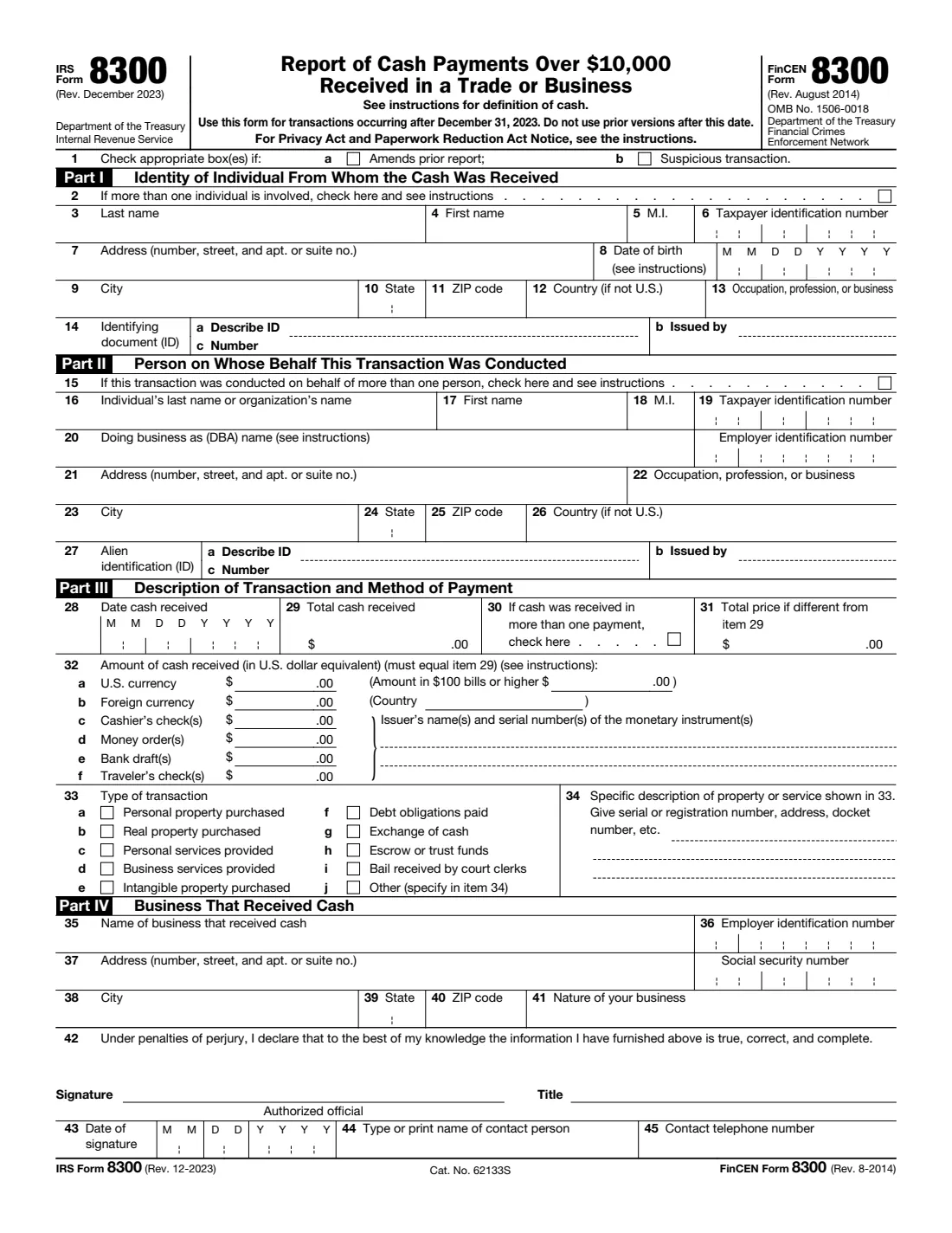
FileIt fills in the IRS's own paper PDF, IRS Rev. December 2023: up to three individuals and three persons on whose behalf the transaction was made, the payment breakdown, the transaction type and the business that received the cash. It checks that line 32 adds up to line 29 and that your descriptions fit, and saves the form in your vault. FileIt doesn't e-file through BSA E-Filing.
- Who files
- Any trade or business that receives more than $10,000 in cash in one transaction or related transactions.
- Deadline
- By the 15th day after the cash was received (the next business day if that is a weekend or legal holiday).
- How
- E-file through FinCEN's BSA E-Filing System if you must e-file your other information returns; otherwise you may mail this paper form.
- Paper filing address
- Internal Revenue Service, Detroit Federal Building, P.O. Box 32621, Detroit, MI 48232.
- Statement
- Give each person named a written or electronic statement by January 31 of the following year.
- Edition
- IRS Form 8300 (Rev. December 2023), FinCEN Form 8300 (Rev. 8-2014)
Who needs to fill out Form 8300?
- Car, boat and aircraft dealers, jewelers, real estate businesses and other sellers paid large amounts in cash.
- Professionals, such as attorneys or contractors, paid more than $10,000 in cash for services.
- Businesses receiving cash in installments or related transactions that total more than $10,000 within 12 months.
- Clerks of federal and state criminal courts receiving cash bail, and bail bondsmen.
- Any business that wants to report a suspicious cash transaction voluntarily, even under $10,000.
When to use Form 8300
- Within 15 days of receiving more than $10,000 in cash in one transaction.
- Within 15 days of the payment that takes related cash payments over $10,000 within 12 months.
- To amend an earlier report: tick 'Amends prior report' and complete the whole form again.
What you need before you start
- Each payer's name, address, date of birth, occupation and TIN, and the ID document you examined (type, issuer and number).
- The same details for anyone on whose behalf the transaction was conducted, or an organization's name and EIN.
- The date the cash was received, the total, and how much came in each form (U.S. currency, foreign currency, cashier's checks and so on).
- The issuer and serial number of every cashier's check, money order, bank draft or traveler's check.
- What was bought or paid for, with a serial or registration number, address or docket number.
- Your business's name, EIN (and the owner's SSN for a sole proprietorship), address and a contact person.
What’s on Form 8300
The 2023 edition has 2 pages. FileIt asks for it in 11 parts, and it is signed by Business that received the cash:
- Line 1: Type of reportBusiness that received the cash
- Part I: Individual from whom the cash was receivedBusiness that received the cash
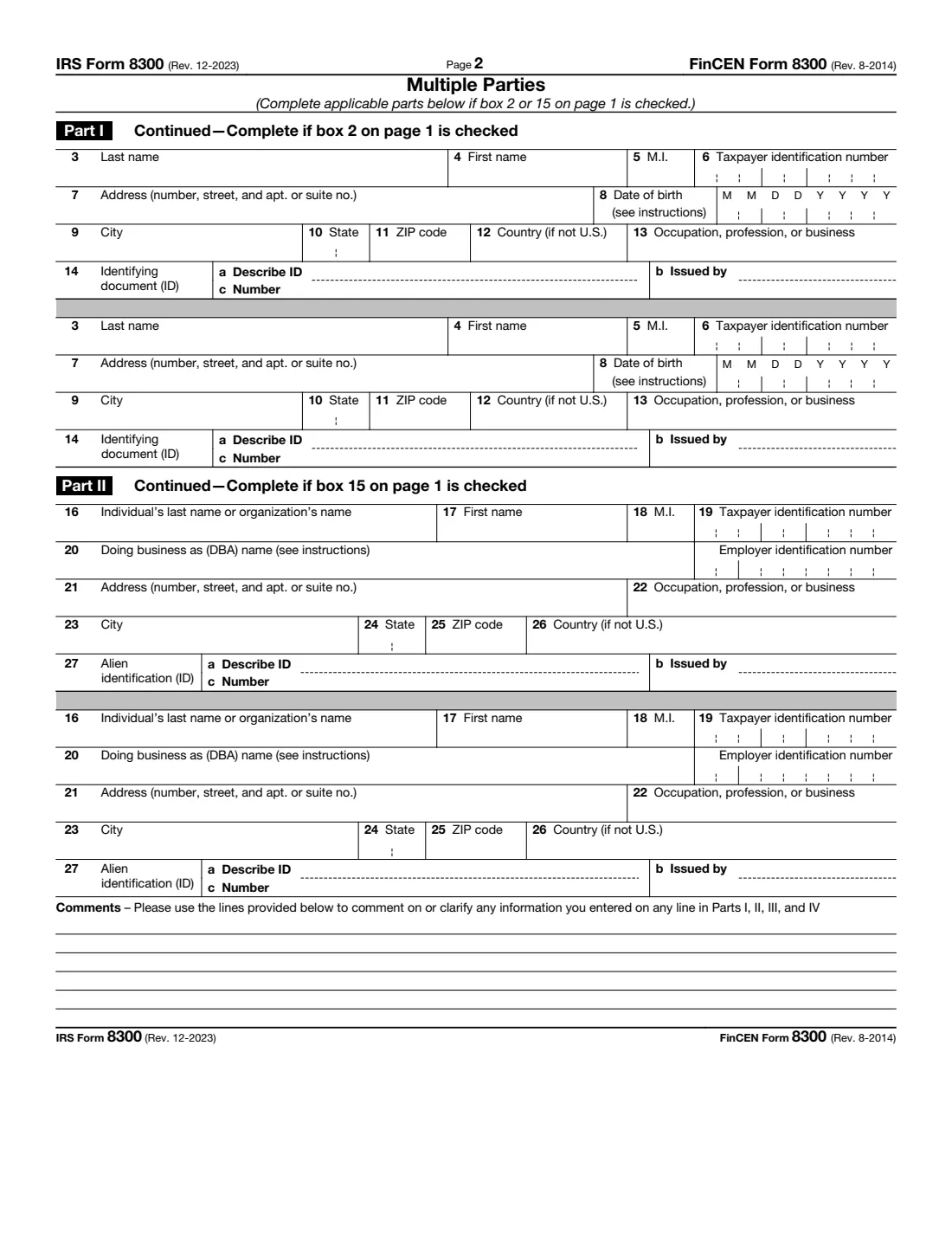
- Part I continued: second individual (page 2)Business that received the cash
- Part I continued: third individual (page 2)Business that received the cash
- Part II: Person on whose behalf the transaction was conductedBusiness that received the cash
- Part II continued: second person (page 2)Business that received the cash
- Part II continued: third person (page 2)Business that received the cash
- Part III: Transaction and method of paymentBusiness that received the cash
- Part IV: Business that received cashBusiness that received the cash
- Line 42-45: Signature and contactBusiness that received the cash
- Comments (page 2)Business that received the cash
How to fill out Form 8300, step by step
1 Line 1 and Part I: Who paid
Tick 1a for an amended report or 1b for a suspicious transaction. In Part I give the individual from whom you received the cash. Verify their name and address against an ID normally accepted for cashing checks, and complete all three ID items. If more than one individual was involved, FileIt adds them on page 2 and ticks box 2.
2 Part II: On whose behalf
Skip it if the individual in Part I acted on their own behalf. Otherwise give the person or organization the transaction was for: an organization's name and EIN, or an individual's name and TIN. Item 27 is for someone not required to furnish a TIN. A second person goes on page 2, and FileIt ticks box 15.
3 Part III: The transaction
Enter the date and total of the cash, tick box 30 for several payments, and give the total price if it was different. Break the cash down on line 32, which must add up to line 29. Tick up to three transaction types on line 33, and describe the property or service on line 34.
4 Part IV: Your business
The name, EIN, address and nature of the business that received the cash. A sole proprietorship enters the owner's SSN too. Be specific about the nature of your business, such as 'jewelry dealer', not 'store'.
5 Signature and comments
An individual authorized by the business signs under penalties of perjury, with their title and the date, and names a contact person. Use the comments for anything that needs explaining, such as what was suspicious.
Common mistakes to avoid
- Filing late: the 15-day clock starts on the date the cash is received.
- Filing on paper when your business has to e-file its other information returns. That counts as failing to file in the required manner.
- Not adding up related payments: several smaller cash payments for one transaction can trigger the report.
- Leaving out part of the identifying document (type, issuer or number), which can stop the form being processed.
- Using vague descriptions such as 'businessperson', 'self-employed' or 'store'.
- Telling a named person that you marked the transaction suspicious, or sending them a statement for a voluntary suspicious-activity report.
After you fill it out
Sign and date the form and mail it to the IRS paper-filing address in the instructions, unless you must e-file through FinCEN's BSA E-Filing System. A late paper report needs 'LATE' written at the center top of page 1.
By January 31 of the following year, give each person named on the form a written or electronic statement with your contact's name, phone number and address, the total cash reported, and that the information was given to the IRS. The instructions advise against giving them a copy of the form itself.
Keep a copy of the form and the statement. FileIt saves the completed form in your vault.
Fill out Form 8300 online with FileIt
- Pick the person. Choose someone from People and FileIt fills in their name, date of birth, address and other details it already knows.
- Answer plain-language questions. One part of the form at a time, with the official help text beside each question — 132 fields in all. Your answers save as you go.
- Check the live preview. Watch your answers land on the real Internal Revenue Service (IRS) and Financial Crimes Enforcement Network (FinCEN) form, and let FileIt do any worksheet arithmetic.
- Generate the official PDF. FileIt prints your answers into the agency’s own PDF and files it in that person’s folder in your vault. Sign it, or send it for e-signature.
FileIt fills the form — it never files or submits anything for you. Deliver the finished form to whoever asked for it, the way the form’s instructions say.
Start Form 8300 now — it’s freeForm 8300: frequently asked questions
Can I file Form 8300 on paper?
Only if you aren't required to e-file your other information returns. Since 2024, a business that files at least 10 information returns of other types in a year must e-file Form 8300 through FinCEN's BSA E-Filing System.
Does a cashier's check count as cash?
Sometimes. A cashier's check, bank draft, traveler's check or money order with a face amount of $10,000 or less counts as cash in certain transactions, such as retail sales of consumer durables. The instructions define it in full.
What if the customer pays in installments?
Add up related payments. Once the cash received for one transaction or related transactions goes over $10,000 within 12 months, report it within 15 days of the payment that took it over.
Do I tell the customer I filed it?
Yes. By January 31 of the next year, give each named person a statement that the information was reported. But don't mention that you flagged it as suspicious, and don't send a statement for a voluntary suspicious-activity report.
Can FileIt file it for me?
No. FileIt fills in the official paper form and keeps it in your vault. You mail it yourself, or e-file through BSA E-Filing if you must.
Official sources
- Blank form (PDF), published by Internal Revenue Service (IRS) and Financial Crimes Enforcement Network (FinCEN): https://www.irs.gov/pub/irs-pdf/f8300.pdf
- Official instructions and guidance: https://www.irs.gov/pub/irs-pdf/i8300.pdf
- Edition shown on this page: IRS Form 8300 (Rev. December 2023), FinCEN Form 8300 (Rev. 8-2014), OMB No. 1506-0018 (checked 2026-10-25).
FileIt is not affiliated with or endorsed by Internal Revenue Service (IRS) and Financial Crimes Enforcement Network (FinCEN) or any government. This page explains the form in general terms and is not legal, tax or immigration advice. Always read the official instructions, and check that you are using the edition the recipient accepts. Page last reviewed 2026-10-25.