
What is Form 1127?
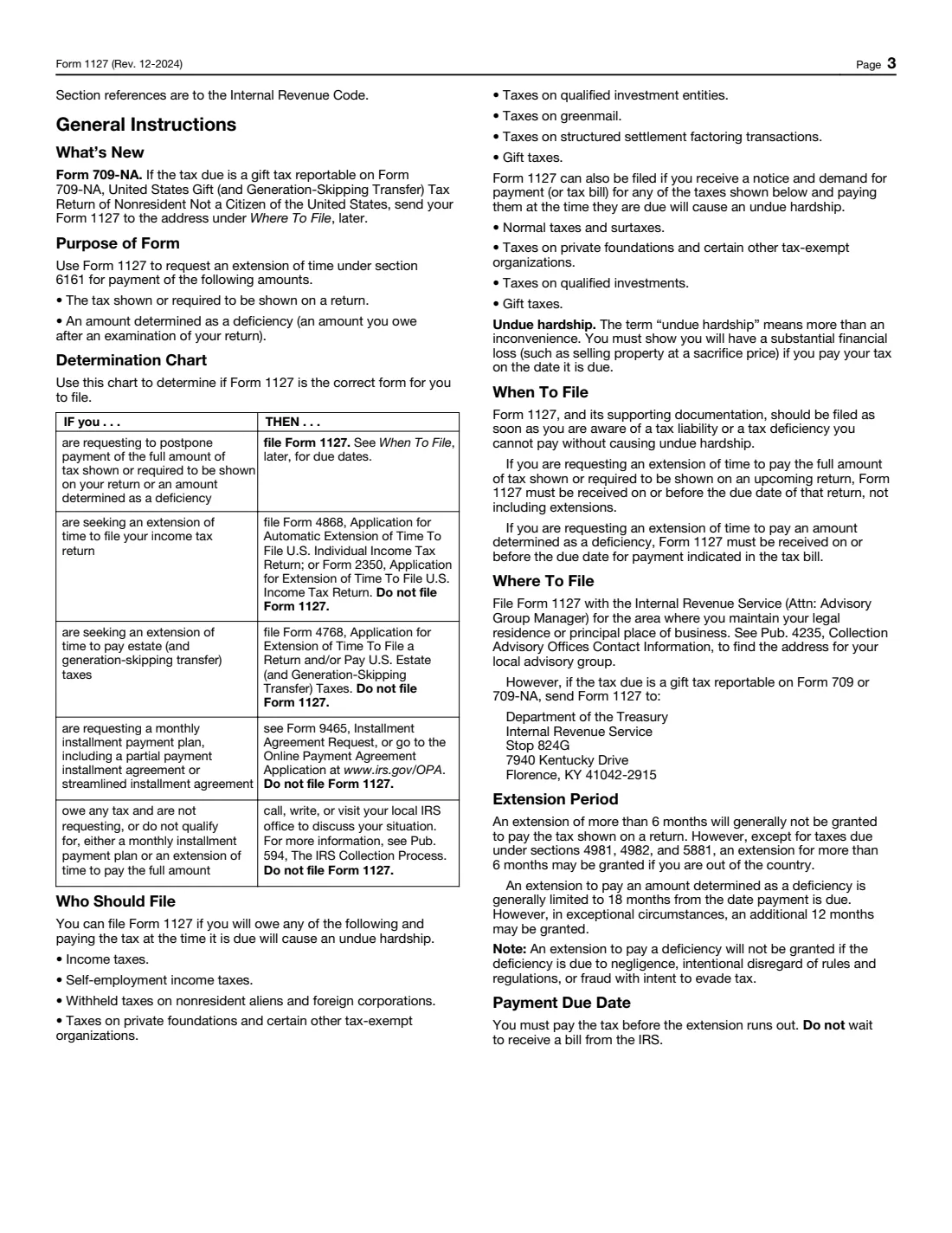
Form 1127 asks the IRS to let you pay a tax, or a deficiency the IRS has determined, after its due date because paying on time would cause undue hardship. The instructions set a high bar: you must show you would sustain a substantial financial loss if forced to pay on the due date, for example by having to sell property at a sacrifice price. Simply not having the cash at hand is generally not enough.
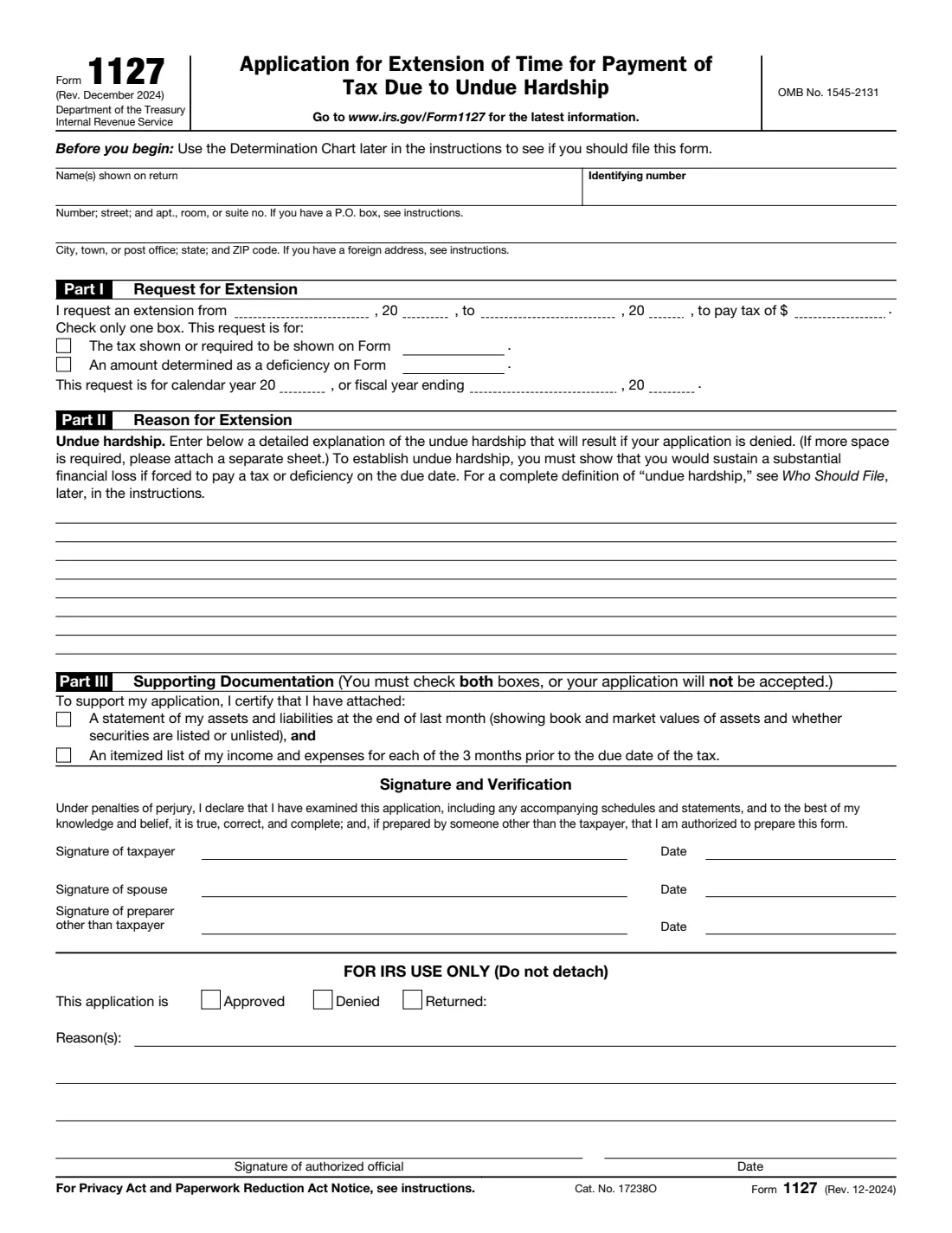
It is a one-page request. You state the dates and the amount, say whether it's tax shown on a return or a deficiency, explain the hardship in detail, and certify that you've attached two things: a statement of your assets and liabilities at the end of last month, and an itemized list of your income and expenses for each of the three months before the due date. The form says your application won't be accepted without both. If granted, the extension is generally up to 6 months for tax on a return or 18 months for a deficiency, and interest still runs.
FileIt walks you through each part, pre-fills your name from the People in your vault, prints the dates in the form's split day and year boxes, fits your explanation onto the ruled lines, and checks that both supporting boxes are ticked. The result is the IRS's own PDF, saved in your vault and ready to sign with FileIt eSignature, including your spouse on a joint return. You mail it yourself; FileIt never files anything with the IRS.
- Who fills it
- Individuals (and spouses on a joint return) and others who owe a covered tax and face undue hardship; check the Determination Chart first.
- Sent to
- The IRS Advisory Group Manager for where you live or do business (see Pub. 4235); gift tax requests go to Florence, KY.
- When
- Received by the due date of the return (not including extensions), or by the payment due date on the tax bill for a deficiency.
- Signatures
- Taxpayer, spouse on a joint return, and any paid preparer.
- Edition
- Rev. December 2024
- Agency
- Internal Revenue Service (IRS), Department of the Treasury
Who needs to fill out Form 1127?
- Taxpayers who would have to sell property at a sacrifice price, or otherwise take a substantial financial loss, to pay tax on the due date.
- People who owe a deficiency the IRS has determined and face the same kind of hardship paying it.
- Married couples with a joint return, who apply together and both sign.
- People owing income, self-employment or gift tax, among the other taxes listed under Who Should File in the instructions.
When to use Form 1127
- As soon as you know you can't pay without undue hardship. The IRS must receive it by the due date of the return (not including extensions), or by the payment due date on the bill for a deficiency.
- When an installment agreement or a regular extension to file doesn't solve the problem. Form 4868 extends only the time to file, not to pay.
- Not for estate tax (use Form 4768) or a monthly payment plan (use Form 9465 or the Online Payment Agreement).
What you need before you start
- The name(s) and identifying number shown on the return, and your current address.
- The original due date, the date you want to pay by, and the amount of tax.
- The form number the tax is on (for example 1040, 709 or 706), or the form the deficiency was determined on.
- The calendar year, or the end date of your fiscal year.
- A detailed explanation of the substantial financial loss you'd suffer by paying on time.
- A statement of your assets and liabilities at the end of last month, and an itemized list of income and expenses for each of the 3 months before the due date.
What’s on Form 1127
The 2024 edition has 4 pages. FileIt asks for it in 6 parts, and it is signed by Taxpayer and Spouse (joint return):
- TaxpayerTaxpayer
- Spouse (joint return)Spouse (joint return)
- Name line as printedTaxpayer
- Part I: Request for extensionTaxpayer
- Part II: Reason for extensionTaxpayer
- Part III: Supporting documentationTaxpayer
How to fill out Form 1127, step by step
1 Name, number and address
Enter the name shown on the return and the identifying number, usually your Social Security number. For a joint return, switch on the spouse part so both names print on the name line and your spouse can sign. Add your street address and city, state and ZIP, or a foreign address.
2 Part I: Request for extension
Give the date the extension runs from (usually the original due date), the date you'll pay by, and the amount of tax. FileIt prints the month and day in the long box and the year in the small 20__ box. Then pick one: tax shown or required to be shown on a form, or a deficiency, with the form number. Finish with the calendar year or the fiscal year end.
3 Part II: Reason for extension
Explain in detail the undue hardship that would result if the IRS denies the request. Be specific about the loss: what you would have to sell, its value, and what you'd realistically get. Your text prints on the 9 ruled lines; FileIt tells you if it needs a separate sheet.
4 Part III: Supporting documentation
Tick both boxes to certify you've attached the statement of assets and liabilities (with book and market values, and whether securities are listed or unlisted) and the itemized monthly income and expenses for the 3 months before the due date. The form says the application won't be accepted unless both are checked.
5 Signature and verification
You sign under penalties of perjury, and so does your spouse on a joint return. A paid preparer signs the preparer line by hand.
Common mistakes to avoid
- Describing inconvenience or a tight month rather than a substantial financial loss. Undue hardship means more than that.
- Checking only one Part III box or forgetting the attachments, which means the application won't be accepted.
- Sending it too late. The IRS must receive it by the due date, not just have it mailed by then.
- Asking for more time than the limits allow: generally 6 months for tax on a return, 18 months for a deficiency.
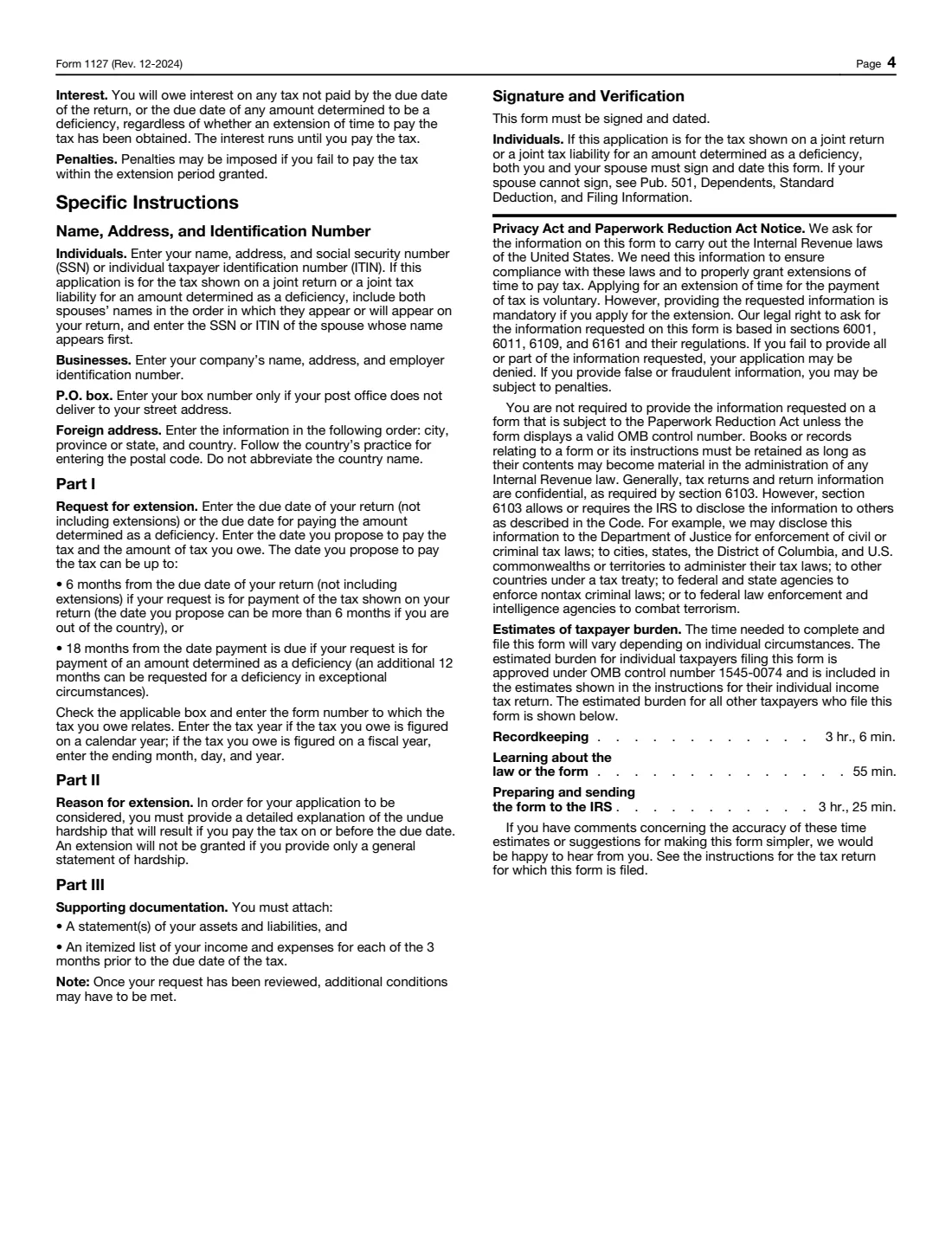
- Thinking interest stops. It keeps running on the unpaid tax during the extension.
- Using Form 1127 when you need a monthly payment plan (Form 9465) or more time to file (Form 4868 or 2350).
After you fill it out
Download the signed PDF from your vault, attach the statement of assets and liabilities and the three months of income and expenses, and mail it to the IRS Advisory Group Manager for the area where you live or have your main place of business (Pub. 4235 lists the addresses). Gift tax requests go to the Florence, KY address in the instructions. Keep copies of everything.
The IRS reviews the request and marks it approved, denied or returned, as the IRS-use block on the form shows.
If approved, pay before the extension runs out. The instructions say not to wait for a bill, and that penalties may apply if you miss it. Interest runs until you pay. If denied, pay as soon as you can or look at a payment plan.
Fill out Form 1127 online with FileIt
- Pick the person. Choose someone from People and FileIt fills in their name, date of birth, address and other details it already knows.
- Answer plain-language questions. One part of the form at a time, with the official help text beside each question — 24 fields in all. Your answers save as you go.
- Check the live preview. Watch your answers land on the real Internal Revenue Service (IRS) form, and let FileIt do any worksheet arithmetic.
- Generate the official PDF. FileIt prints your answers into the agency’s own PDF and files it in that person’s folder in your vault. Sign it, or send it for e-signature.
FileIt fills the form — it never files or submits anything for you. Deliver the finished form to whoever asked for it, the way the form’s instructions say.
Start Form 1127 now — it’s freeForm 1127: frequently asked questions
Can I fill out Form 1127 online?
Yes. FileIt guides you through the form and prints your answers into the official IRS PDF, saved in your vault, ready to sign. Filling forms is available on every FileIt account, including the free plan. You mail it yourself.
What counts as undue hardship?
According to the instructions, you must show a substantial financial loss if forced to pay on the due date, such as selling property at a sacrifice price. A general lack of funds or inconvenience isn't enough.
How long can the extension be?
Generally up to 6 months from the due date for tax shown on a return (more if you're out of the country), and up to 18 months for a deficiency, with an additional 12 months possible in exceptional circumstances.
Do I still pay interest?
Yes. The instructions say you owe interest on any tax not paid by the due date, whether or not you get an extension, until you pay.
Is this the same as Form 4868?
No. Form 4868 extends the time to file a return, not to pay. Form 1127 is specifically about paying later because of undue hardship.
What must I attach?
A statement of your assets and liabilities at the end of last month, and an itemized list of your income and expenses for each of the 3 months before the due date. Both boxes in Part III must be checked.
Official sources
- Blank form (PDF), published by Internal Revenue Service (IRS): https://www.irs.gov/pub/irs-pdf/f1127.pdf
- Official instructions and guidance: https://www.irs.gov/forms-pubs/about-form-1127
- Edition shown on this page: Rev. December 2024 (checked 2026-10-19).
FileIt is not affiliated with or endorsed by Internal Revenue Service (IRS) or any government. This page explains the form in general terms and is not legal, tax or immigration advice. Always read the official instructions, and check that you are using the edition the recipient accepts. Page last reviewed 2026-10-19.