What is R185 (Trust Income) Statement of income from trust?
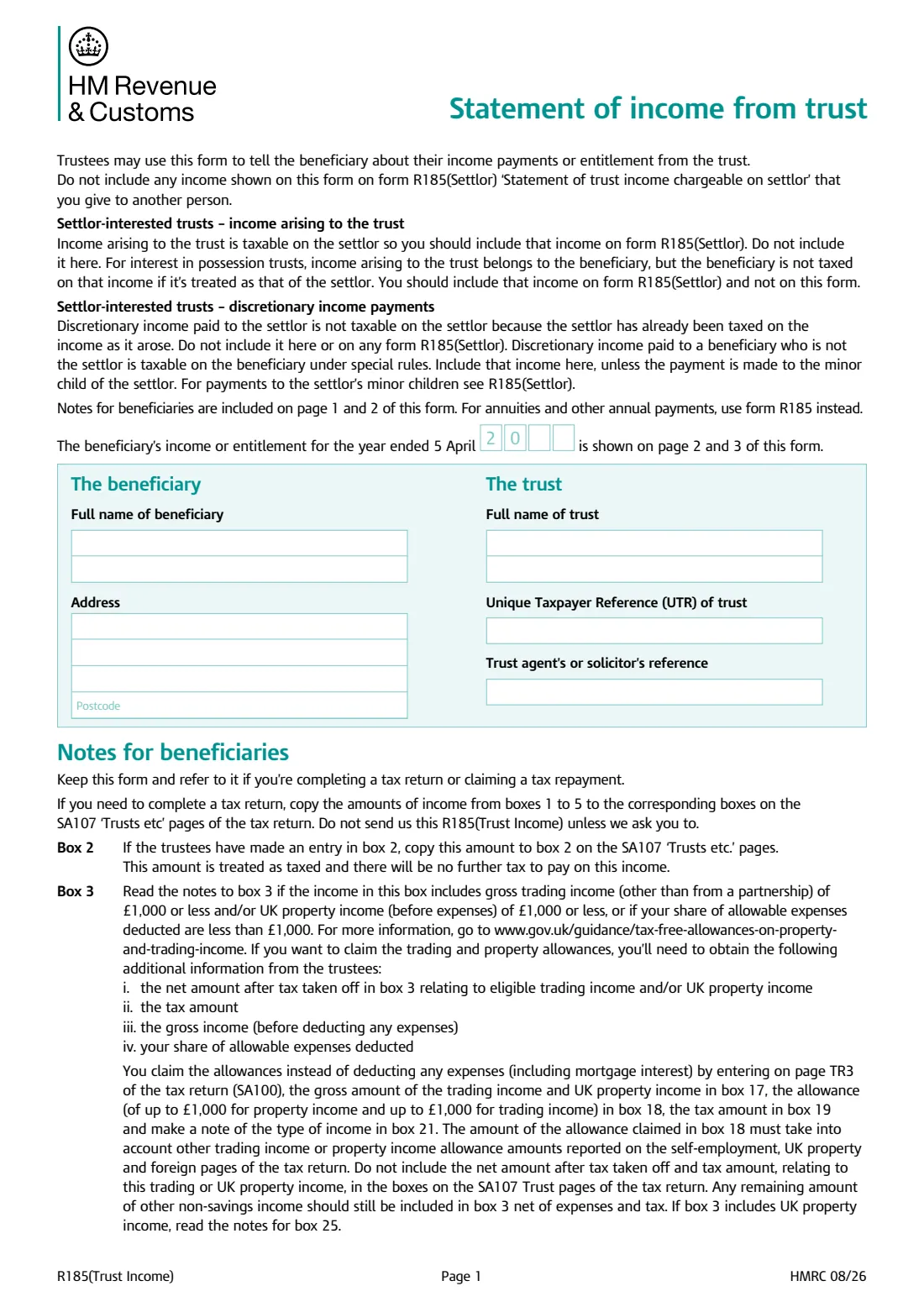
Trustees use form R185 (Trust Income) to tell a beneficiary about the income they were paid, or were entitled to, from the trust for a tax year, and the tax already paid or credited on it. HMRC says beneficiaries should keep it safe: they need it for a tax return or a claim for a tax repayment.
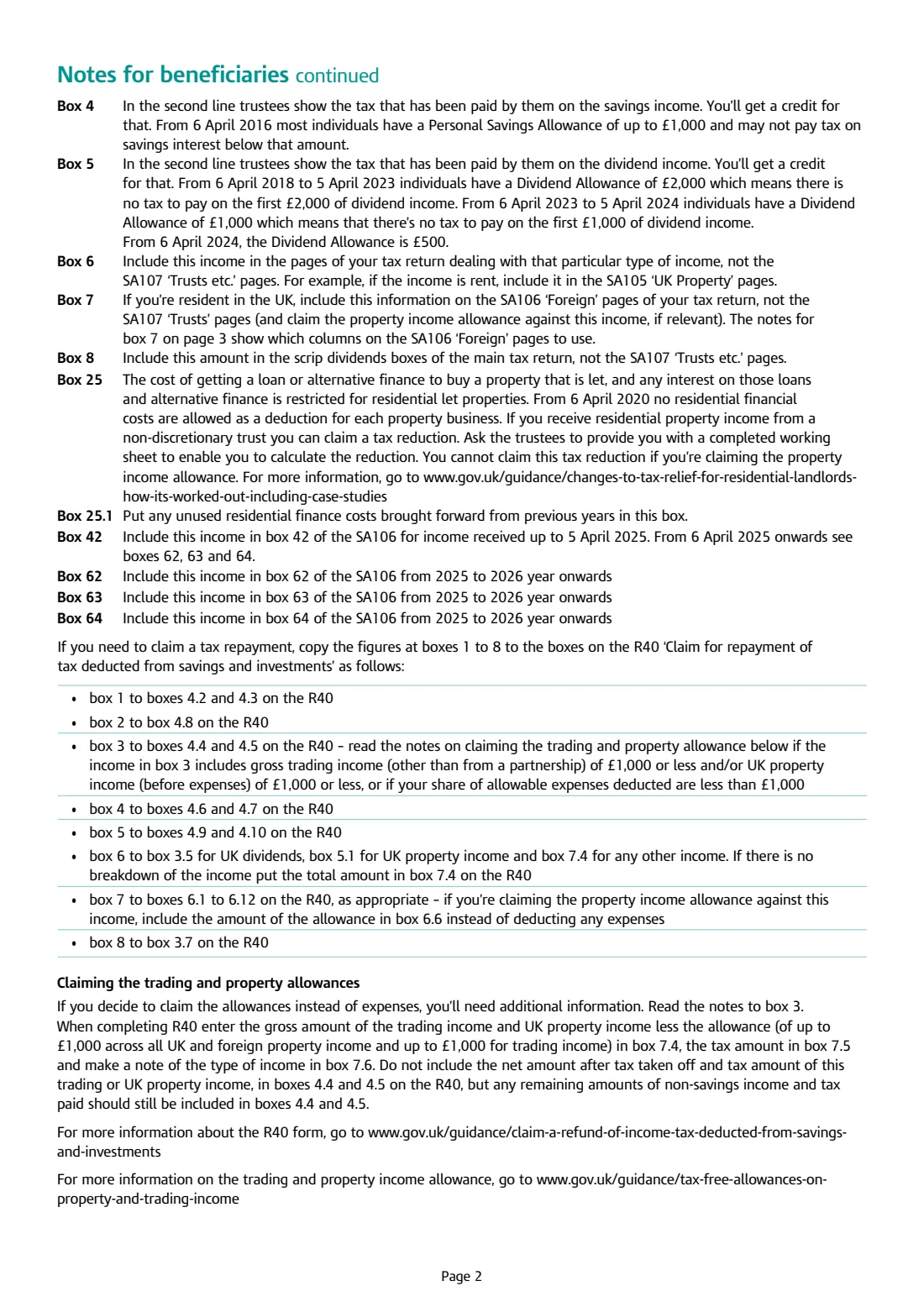
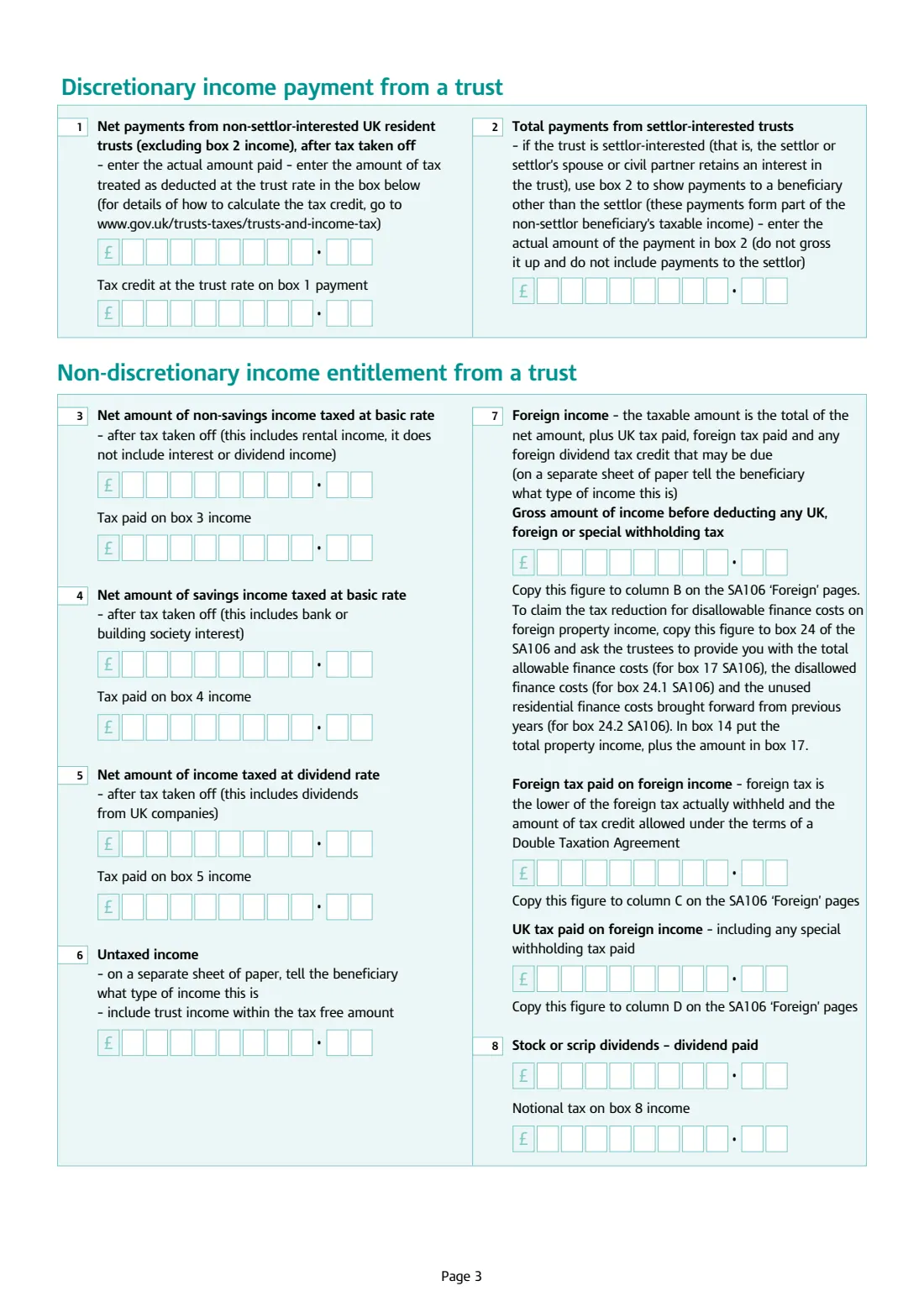
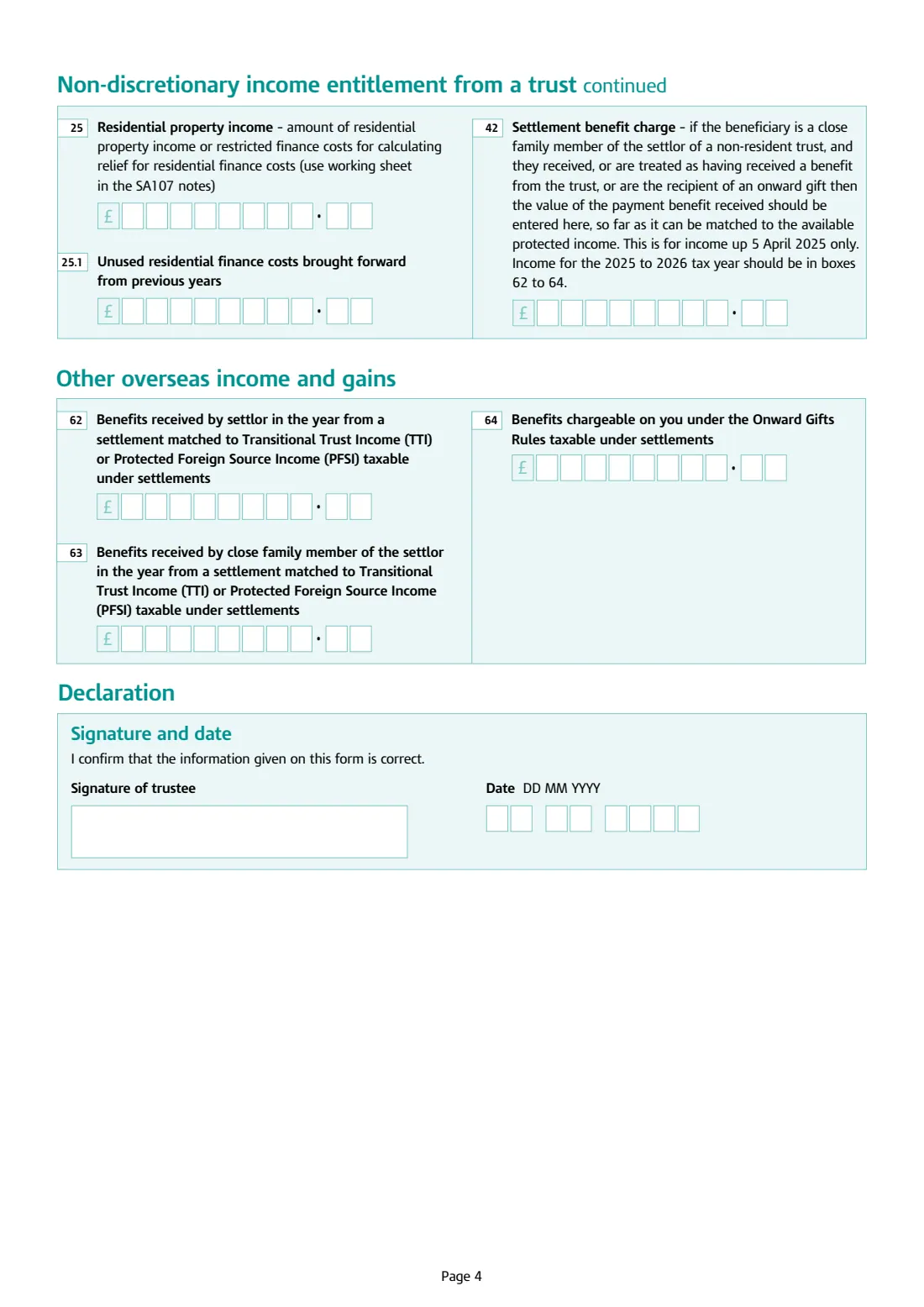
Page 1 gives the tax year and the beneficiary's and trust's details; pages 1 and 2 are notes for the beneficiary; pages 3 and 4 have the boxes: discretionary payments with the tax credit at the trust rate (boxes 1 and 2), non-discretionary income by type (boxes 3 to 8), residential property income and finance costs (25, 25.1), the settlement benefit charge (42), other overseas income and gains (62 to 64), and the trustee's declaration.
FileIt prints each amount right-aligned into HMRC's pound and pence boxes, and fills the 08/26 edition of HMRC's own PDF. It doesn't work out any figures: trustees enter what their records show. FileIt never sends anything to HMRC or to the beneficiary.
- Who fills it
- The trustees
- Given to
- Each beneficiary, not to HMRC
- Beneficiary uses it for
- SA107 'Trusts etc' pages, or an R40 repayment claim
- Period
- One tax year ending 5 April
- Signature
- A trustee
- Edition
- R185(Trust Income) HMRC 08/26
Who needs to fill out R185 (Trust Income) Statement of income from trust?
- Trustees of a discretionary trust who made income payments to beneficiaries.
- Trustees of an interest in possession trust whose beneficiaries are entitled to its income.
- Agents or solicitors preparing statements for trustees.
- Not for income chargeable on the settlor (R185 (Settlor)), or for annuities and other annual payments (form R185).
When to use R185 (Trust Income) Statement of income from trust
- After the end of the tax year, once the trust's income and tax for the year are known.
- Whenever a beneficiary needs the figures for their tax return or a repayment claim.
What you need before you start
- The trust's name and Unique Taxpayer Reference (UTR).
- The beneficiary's full name and address.
- The trust's income and tax figures for the beneficiary for the year, by type.
- For foreign income, the type of income, to tell the beneficiary on a separate sheet.
What’s on R185 (Trust Income) Statement of income from trust
The 2026 edition has 4 pages. FileIt asks for it in 6 parts, and it is signed by Trustee:
- Tax year, beneficiary and trustTrustee
- Discretionary income payment from a trustTrustee
- Non-discretionary income entitlement from a trustTrustee
- Residential property and settlement benefit chargeTrustee
- Other overseas income and gainsTrustee
- DeclarationTrustee
How to fill out R185 (Trust Income) Statement of income from trust, step by step
1 Year, beneficiary and trust
The tax year ending 5 April, the beneficiary's name and address, and the trust's name, UTR and any agent's reference.
2 Discretionary payments
Box 1 for net payments from non-settlor-interested UK resident trusts with the tax credit at the trust rate; box 2 for payments from settlor-interested trusts, not grossed up.
3 Non-discretionary income
Boxes 3 to 8: non-savings, savings and dividend income with the tax paid, untaxed income, foreign income with foreign and UK tax, and scrip dividends. Then boxes 25, 25.1 and 42, and boxes 62 to 64 for other overseas income and gains.
4 Declaration
A trustee confirms the information is correct, signs and dates the form.
Common mistakes to avoid
- Including income that belongs on the R185 (Settlor) statement.
- Grossing up a box 2 payment, or including payments to the settlor in it.
- Leaving out the separate sheet explaining the type of untaxed (box 6) or foreign (box 7) income.
- Entering amounts without pence: the form has separate pence boxes, so FileIt asks for pounds and pence.
After you fill it out
Download the filled PDF, check the figures against the trust's records, and sign it (by hand or with FileIt's eSignature).
Give it to the beneficiary. HMRC's notes say not to send it to HMRC unless HMRC asks.
Beneficiaries: keep it in your FileIt vault with your tax papers for the year.
Fill out R185 (Trust Income) Statement of income from trust online with FileIt
- Pick the person. Choose someone from People and FileIt fills in their name, date of birth, address and other details it already knows.
- Answer plain-language questions. One part of the form at a time, with the official help text beside each question — 33 fields in all. Your answers save as you go.
- Check the live preview. Watch your answers land on the real HM Revenue & Customs form, and let FileIt do any worksheet arithmetic.
- Generate the official PDF. FileIt prints your answers into the agency’s own PDF and files it in that person’s folder in your vault. Sign it, or send it for e-signature.
FileIt fills the form — it never files or submits anything for you. Deliver the finished form to whoever asked for it, the way the form’s instructions say.
Start R185 (Trust Income) Statement of income from trust now — it’s freeR185 (Trust Income) Statement of income from trust: frequently asked questions
Do I send the R185 to HMRC?
No. HMRC's notes tell the beneficiary not to send it unless HMRC asks. Trustees give it to the beneficiary, who keeps it for their tax return or repayment claim.
Where does the beneficiary put the figures?
Boxes 1 to 5 go on the SA107 'Trusts etc' pages of the tax return. Box 6 income goes on the pages for that type of income, box 7 on the SA106 'Foreign' pages, and box 8 in the scrip dividends boxes. For an R40 claim, the form's notes list the matching boxes.
Does FileIt calculate the tax credit?
No. Trustees enter the figures from the trust's records; FileIt prints them in the right boxes.
Why does FileIt ask for pence?
Each amount on the form has eight pound boxes and two pence boxes. Entering pounds and pence (like 1234.00) keeps every digit in the right box.
Official sources
- Blank form (PDF), published by HM Revenue & Customs: https://assets.publishing.service.gov.uk/media/6a857a03c9205b515d421e94/r185trust_income.pdf
- Official instructions and guidance: https://www.gov.uk/government/publications/trusts-and-estates-statement-of-income-from-trust-r185-trust-income
- Edition shown on this page: R185(Trust Income) HMRC 08/26 (checked 2026-10-25).
FileIt is not affiliated with or endorsed by HM Revenue & Customs or any government. This page explains the form in general terms and is not legal, tax or immigration advice. Always read the official instructions, and check that you are using the edition the recipient accepts. Page last reviewed 2026-10-25.