What is IHT402 transfer of unused nil rate band?
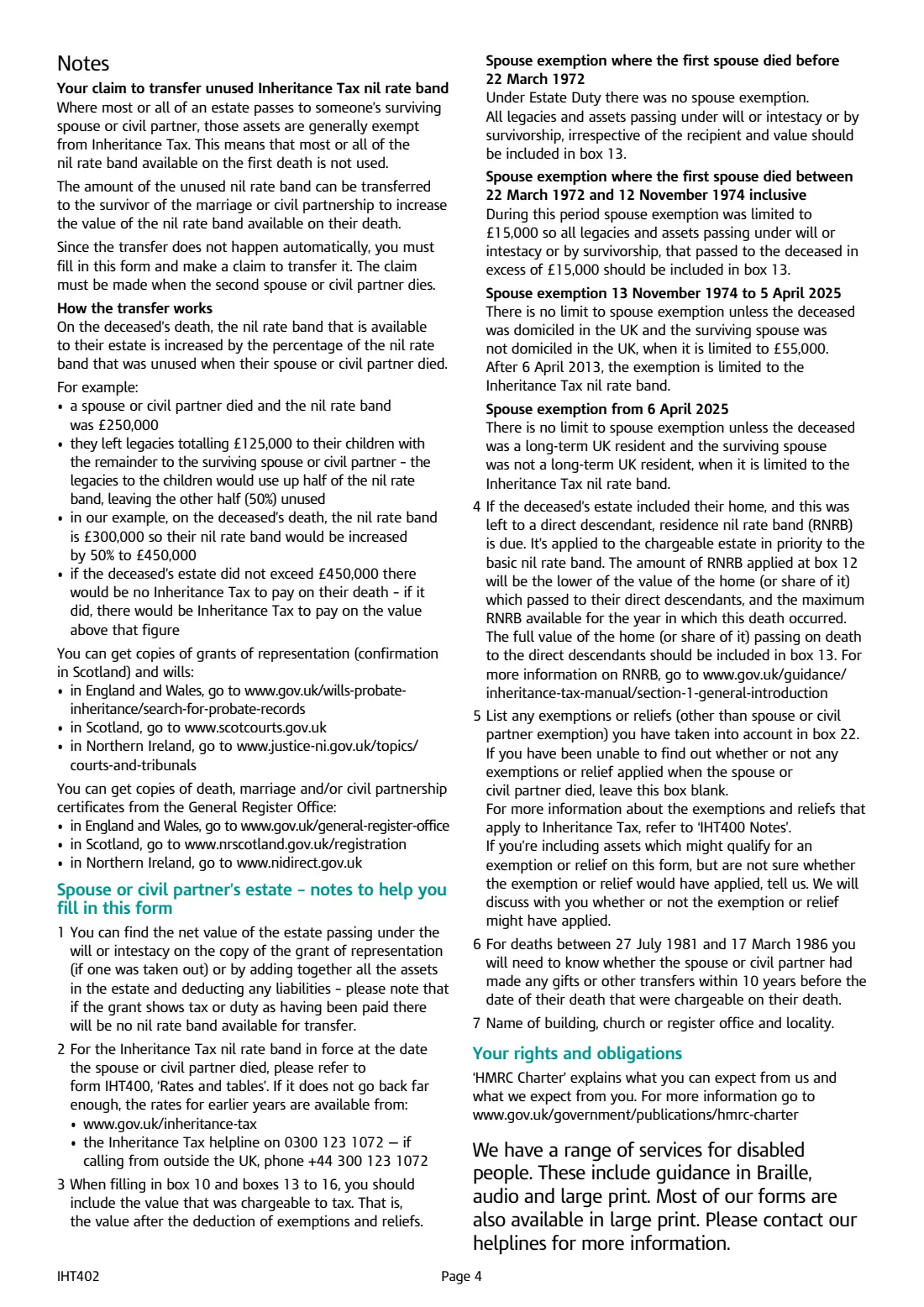
When someone dies and most or all of their estate passes to their husband, wife or civil partner, it is generally exempt from Inheritance Tax — so much of their nil rate band goes unused. That unused percentage can be transferred to the survivor's estate when they die, increasing the nil rate band available then. The transfer doesn't happen automatically: the executor claims it on schedule IHT402, sent with form IHT400.
The form records the first spouse's or civil partner's details, then works out how much of their nil rate band was used by legacies to other people, jointly owned assets, trusts, gifts with reservation and chargeable gifts in the 7 years before death. The unused amount becomes a percentage, and that percentage is applied to the nil rate band at the second death. For example, if half was unused and today's nil rate band is £325,000, the second estate's nil rate band grows by £162,500.
FileIt asks for the figures in plain language, does the form's own arithmetic — box 11 through box 21, including the 4-decimal percentage that must not be rounded up, and the final figure rounded up to the pound — and prints everything into HMRC's official IHT402 PDF. You check it, attach it to the IHT400 and send it yourself.
- Who fills it
- The executor or administrator of the person who has died now
- Sent with
- Form IHT400 (the Inheritance Tax account)
- Deadline
- Within 24 months after the end of the month in which the deceased died
- Who qualifies
- The deceased died on or after 9 October 2007, and their spouse or civil partner died before them
- Edition
- HMRC 04/25
- Helpline
- Inheritance Tax helpline 0300 123 1072 (+44 300 123 1072 from outside the UK)
Who needs to fill out IHT402 transfer of unused nil rate band?
- Executors and administrators of an estate where the deceased's husband, wife or civil partner died first.
- Families dealing with a widow's, widower's or surviving civil partner's estate that needs a full IHT400 account.
- Solicitors and probate practitioners claiming the transferable nil rate band for a client's estate.
- Only where the deceased died on or after 9 October 2007 and the first estate didn't use all of its nil rate band.
When to use IHT402 transfer of unused nil rate band
- When you complete form IHT400 for the second estate and want to add the first spouse's unused nil rate band.
- You must send it no later than 24 months after the end of the month in which the deceased died. The form's example: first death 15 May 2006, second death 10 October 2007, send by 31 October 2009.
- Use form IHT436 as well if you're also claiming the first spouse's unused residence nil rate band.
What you need before you start
- The deceased's name, date of death and Inheritance Tax reference (if known).
- The first spouse's or civil partner's name, date of death, last address, and the date and place of the marriage or civil partnership.
- Copies of the grant of representation (confirmation in Scotland) or, if there was none, the death certificate; the will and any codicils; and any deed of variation.
- The net value of the first estate and the nil rate band in force when they died (see 'Rates and tables' in the IHT400 notes).
- Details and values of legacies and assets that went to anyone other than the surviving spouse, jointly owned assets, trust assets, gifts with reservation and chargeable gifts in the 7 years before death.
- Any residence nil rate band used on the first estate (deaths on or after 6 April 2017).
- Any exemptions or reliefs (other than spouse or civil partner exemption) taken into account, such as charity exemption.
What’s on IHT402 transfer of unused nil rate band
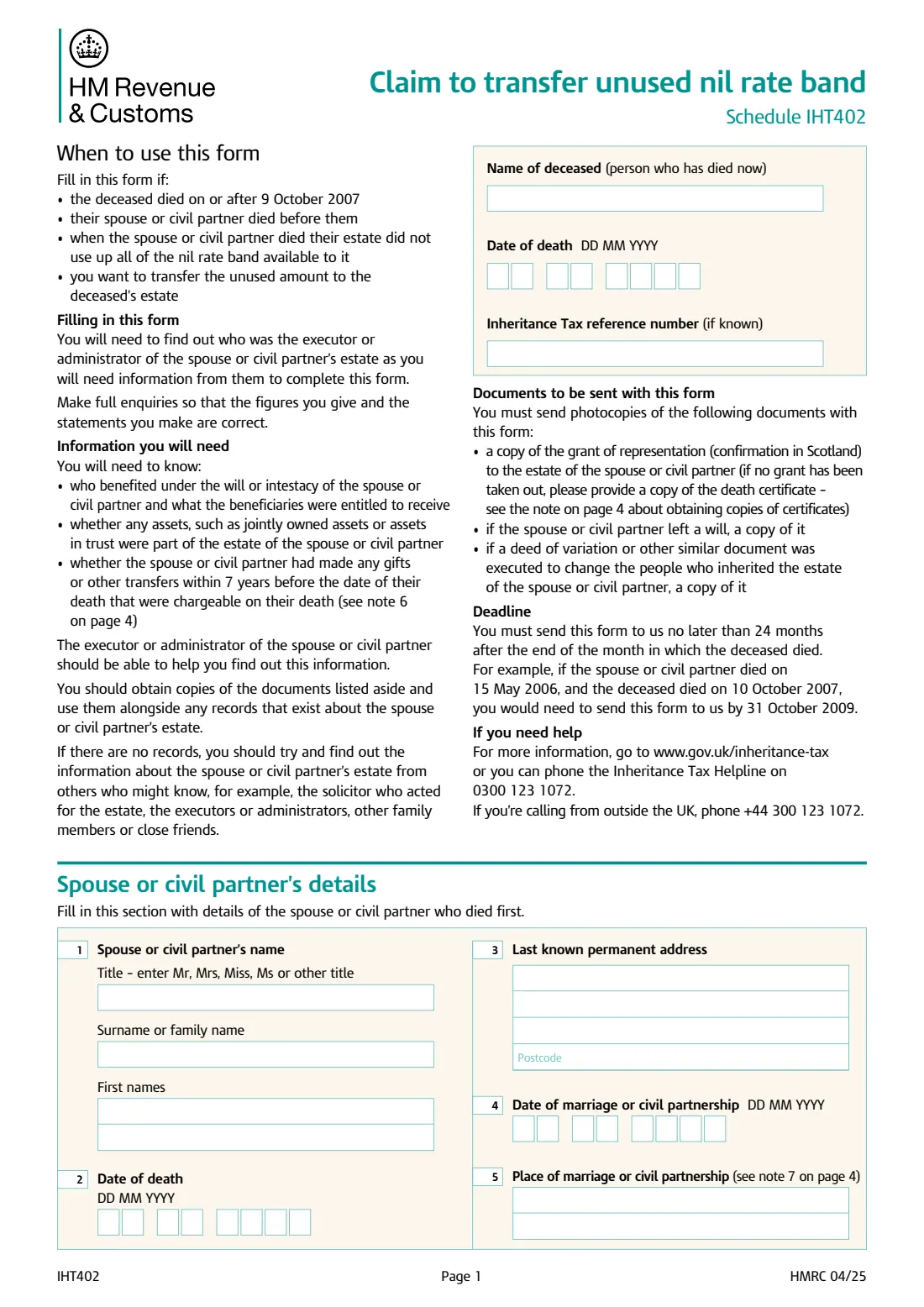
The 2025 edition has 4 pages. FileIt asks for it in 7 parts:
- The person who has died nowExecutor or administrator
- Spouse or civil partner who died first (1 to 8)Executor or administrator
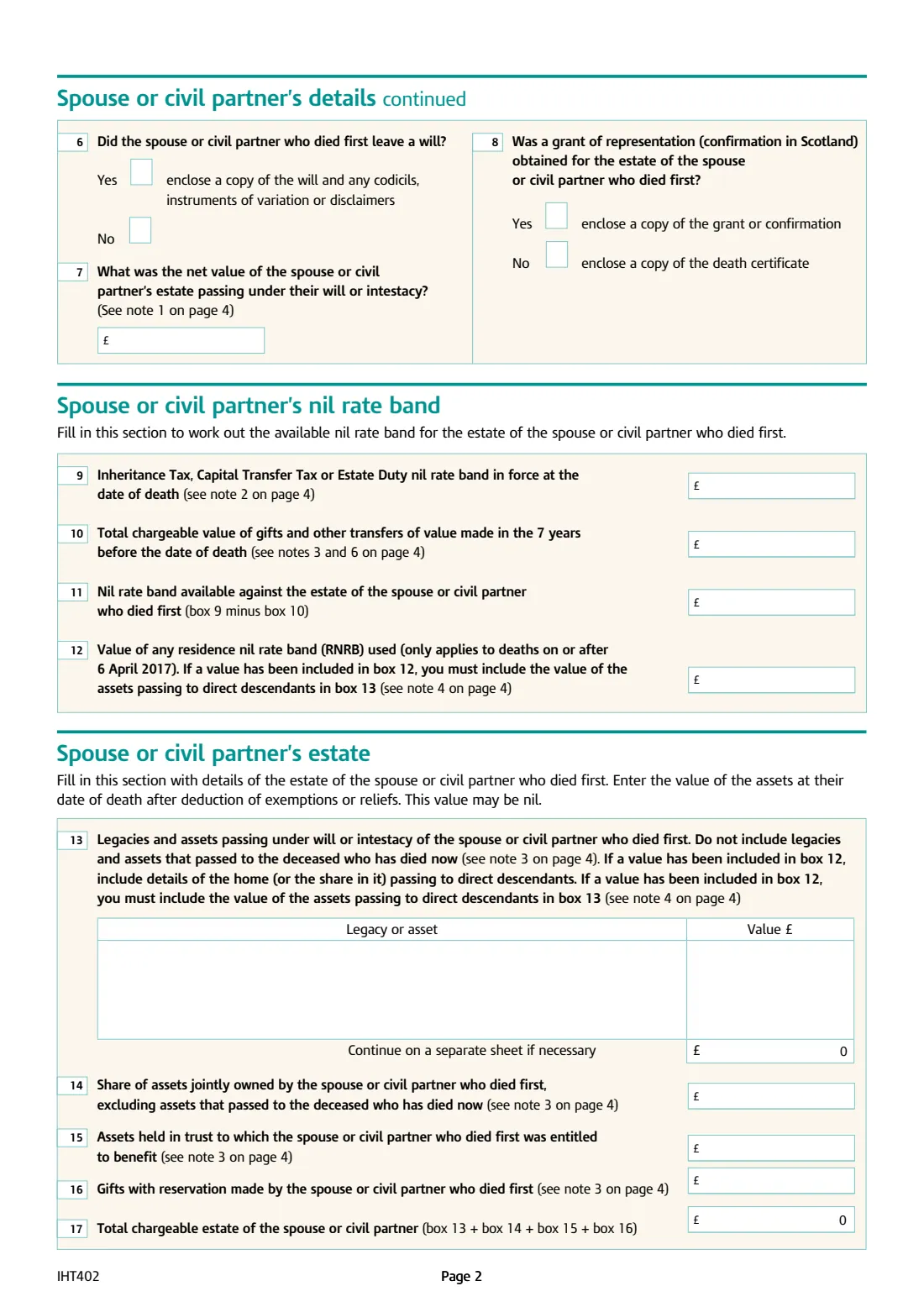
- Spouse or civil partner's nil rate band (9 to 12)Executor or administrator
- Spouse or civil partner's estate (13 to 17)Executor or administrator
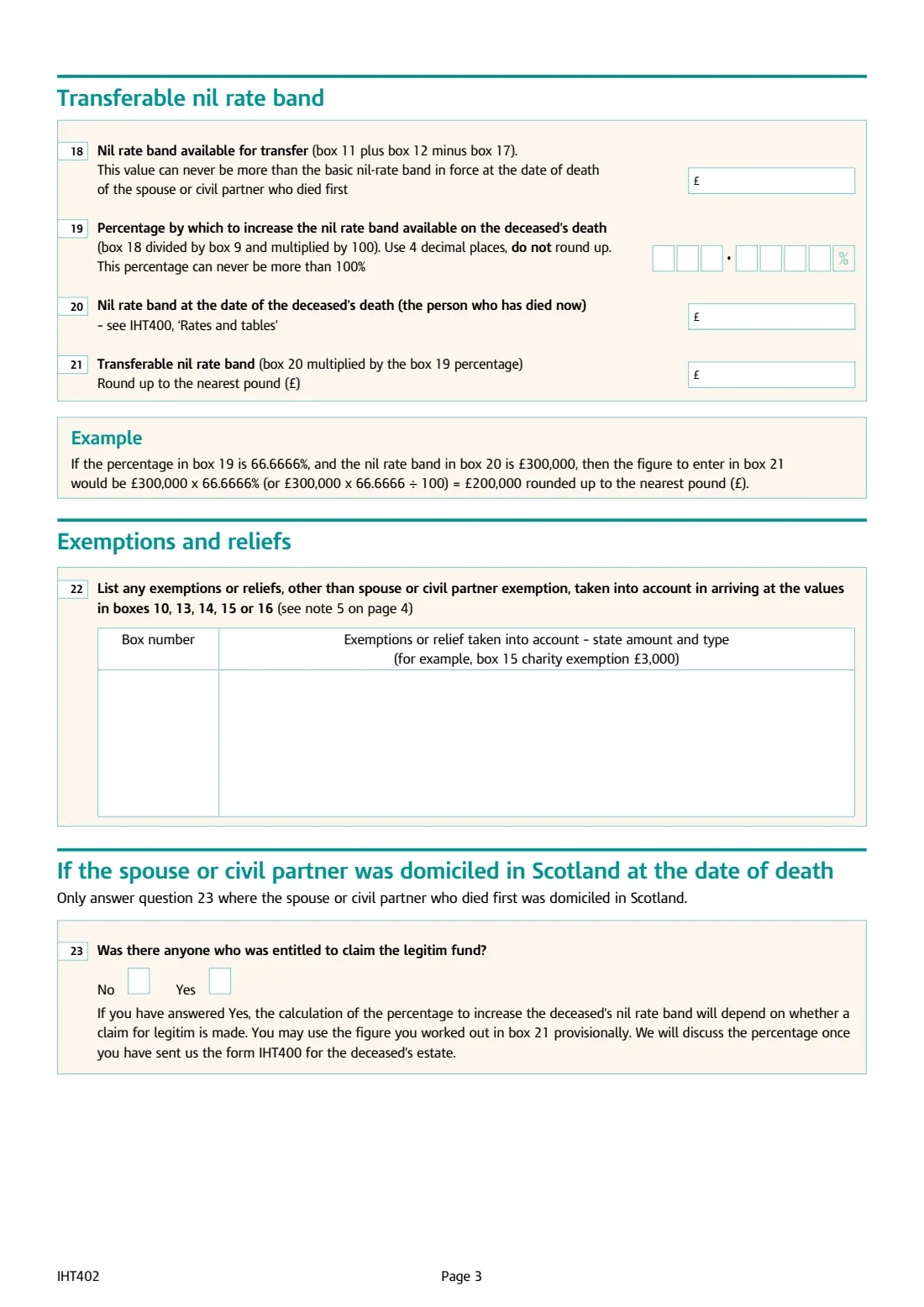
- Transferable nil rate band (18 to 21)Executor or administrator
- Exemptions and reliefs (22)Executor or administrator
- If the spouse or civil partner was domiciled in Scotland (23)Executor or administrator
How to fill out IHT402 transfer of unused nil rate band, step by step
1 The person who has died now
Name, date of death and the Inheritance Tax reference number if you have one. FileIt can pre-fill the name from the person's record in your vault.
2 Spouse or civil partner's details (1 to 8)
The first spouse's or civil partner's name, date of death, last known permanent address, and the date and place of the marriage or civil partnership (the building, church or register office and locality). Say whether they left a will (enclose a copy with codicils, instruments of variation or disclaimers), the net value of the estate passing under the will or intestacy, and whether a grant was obtained (enclose the grant, or the death certificate if not).
3 The nil rate band available on the first death (9 to 12)
Box 9 is the Inheritance Tax, Capital Transfer Tax or Estate Duty nil rate band in force at the first death. Box 10 is the chargeable value of gifts made in the 7 years before that death (10 years for deaths between 27 July 1981 and 17 March 1986). FileIt works out box 11 (9 minus 10). Box 12 is any residence nil rate band used, which only applies to deaths on or after 6 April 2017.
4 The first estate (13 to 17)
List legacies and assets that passed to anyone other than the deceased who has died now, at their chargeable value after exemptions and reliefs. Add the share of jointly owned assets, trust assets they were entitled to benefit from, and gifts with reservation. FileIt totals box 13 and box 17. The notes explain special rules on spouse exemption for first deaths before 22 March 1972 and between 22 March 1972 and 12 November 1974.
5 Transferable nil rate band (18 to 21)
FileIt works out box 18 (box 11 plus box 12 minus box 17, never more than box 9), box 19 (box 18 as a percentage of box 9, to 4 decimal places without rounding up, never more than 100%) and, once you enter today's nil rate band in box 20, box 21 — box 20 multiplied by the box 19 percentage, rounded up to the nearest pound.
6 Exemptions and reliefs (22) and Scotland (23)
List any exemptions or reliefs other than spouse or civil partner exemption that you took into account in boxes 10, 13, 14, 15 or 16, with the box number, type and amount. Question 23 is only for a first spouse domiciled in Scotland: whether anyone was entitled to claim the legitim fund.
Common mistakes to avoid
- Using the form when the deceased died before 9 October 2007, or when the spouse or civil partner did not die first.
- Including assets that passed to the surviving spouse — box 13 and box 14 exclude anything that went to the deceased who has died now.
- Rounding the box 19 percentage up. Use 4 decimal places and do not round up; box 21 is then rounded up to the pound.
- Entering values before exemptions and reliefs. Boxes 10 and 13 to 16 take the chargeable value.
- Forgetting the copies HMRC asks for: the grant (or death certificate), the will and any deed of variation.
- Missing the 24-month deadline after the end of the month of death.
After you fill it out
Check the figures against the first estate's papers and the arithmetic FileIt has done, then print the PDF.
Send it with form IHT400 and the copies of the grant or death certificate, the will and any deed of variation, as the form lists. FileIt does not send anything to HMRC.
Keep a copy in the deceased's FileIt folder with the rest of the estate papers.
Fill out IHT402 transfer of unused nil rate band online with FileIt
- Pick the person. Choose someone from People and FileIt fills in their name, date of birth, address and other details it already knows.
- Answer plain-language questions. One part of the form at a time, with the official help text beside each question — 43 fields in all. Your answers save as you go.
- Check the live preview. Watch your answers land on the real HMRC form, and let FileIt do any worksheet arithmetic.
- Generate the official PDF. FileIt prints your answers into the agency’s own PDF and files it in that person’s folder in your vault.
FileIt fills the form — it never files or submits anything for you. Deliver the finished form to whoever asked for it, the way the form’s instructions say.
Start IHT402 transfer of unused nil rate band now — it’s freeIHT402 transfer of unused nil rate band: frequently asked questions
What is IHT402?
It's HMRC's schedule for claiming the unused Inheritance Tax nil rate band of a husband, wife or civil partner who died first, so it can be added to the nil rate band on the second death. It is sent with form IHT400.
Is the unused nil rate band transferred automatically?
No. The notes on the form say the transfer doesn't happen automatically — you must fill in this form and make the claim when the second spouse or civil partner dies.
How is the transferable amount worked out?
The unused part of the first nil rate band is turned into a percentage (box 19, to 4 decimal places, never more than 100%). That percentage of the nil rate band at the second death (box 20) is the transferable amount (box 21), rounded up to the pound. FileIt does these sums for you.
What is the deadline for IHT402?
You must send it no later than 24 months after the end of the month in which the deceased died.
What if the first spouse died a long time ago?
You can still claim, as long as the second death was on or after 9 October 2007. Use the nil rate band that was in force at the first death, and see the notes on the form for spouse exemption rules before 13 November 1974.
Do I also need IHT436?
Only if you are also claiming the first spouse's unused residence nil rate band (the extra threshold for a home passing to direct descendants). That uses form IHT436 alongside IHT435.
Official sources
- Blank form (PDF), published by HMRC: https://assets.publishing.service.gov.uk/media/67eba2faba01abac8e9fe9af/IHT402.pdf
- Official instructions and guidance: https://www.gov.uk/government/publications/inheritance-tax-claim-to-transfer-unused-nil-rate-band-iht402
- Edition shown on this page: HMRC 04/25 (checked 2026-09-28).
FileIt is not affiliated with or endorsed by HMRC or any government. This page explains the form in general terms and is not legal, tax or immigration advice. Always read the official instructions, and check that you are using the edition the recipient accepts. Page last reviewed 2026-09-28.