What is IHT436 transfer of unused residence nil rate band?
The residence nil rate band (RNRB) is an extra Inheritance Tax threshold when a home, or a share of one, passes to direct descendants such as children and grandchildren. Like the ordinary nil rate band, any RNRB a husband, wife or civil partner didn't use can be transferred to the survivor's estate. IHT436 is HMRC's schedule for claiming that transferable residence nil rate band (TRNRB). You also need form IHT435, which claims the RNRB itself.
What transfers is the unused percentage, not the unused amount. If the first spouse or civil partner died before 6 April 2017, their estate couldn't have used any RNRB, so the whole of it is normally available — unless their estate was over the £2 million taper threshold, which reduces it by £1 for every £2 over. If they died later and some RNRB was used, the form works out what proportion was left.
FileIt asks the few figures you need, works out every calculated box — the tapering, the Residential Enhancement at the first death, and the percentage to 4 decimal places — and prints them digit by digit into HMRC's official IHT436 PDF, ready to send with the rest of the Inheritance Tax account.
- Who fills it
- The executor or administrator of the person who has died now
- Sent with
- Form IHT435 and the Inheritance Tax account
- Send to
- Inheritance Tax, HM Revenue and Customs, BX9 1HT
- Deadline
- Within 24 months after the end of the month in which the deceased died
- Edition
- HMRC 08/22
- Helpline
- 0300 123 1072 (+44 300 123 1072 from outside the UK)
Who needs to fill out IHT436 transfer of unused residence nil rate band?
- Executors claiming the residence nil rate band on an estate where a home passes to direct descendants.
- Where the deceased's husband, wife or civil partner died before them — either before 6 April 2017, or later without using all their RNRB.
- Families of widows, widowers and surviving civil partners whose estate is near or above the Inheritance Tax threshold.
- Solicitors and probate practitioners working out the full RNRB entitlement.
When to use IHT436 transfer of unused residence nil rate band
- When you claim the residence nil rate band on the estate (form IHT435) and want to add the first spouse's unused RNRB.
- You must send it no later than 24 months after the end of the month in which the deceased died.
- After filling it in, use HMRC's residence nil rate band calculator to work out the full entitlement on the deceased's death, as the form says.
What you need before you start
- The deceased's name, date of death and Inheritance Tax reference number.
- The first spouse's or civil partner's name, date and place of marriage or civil partnership, date of death and their estate's Inheritance Tax reference.
- Whether any RNRB was used on their estate.
- If none was used: the total net value of their estate before exemptions and reliefs.
- If some was used: the Default Allowance or Adjusted Allowance on their death and the RNRB actually used — both should be on their estate's Inheritance Tax return.
- The Residential Enhancement for the person who has died now (see the rates below).
What’s on IHT436 transfer of unused residence nil rate band
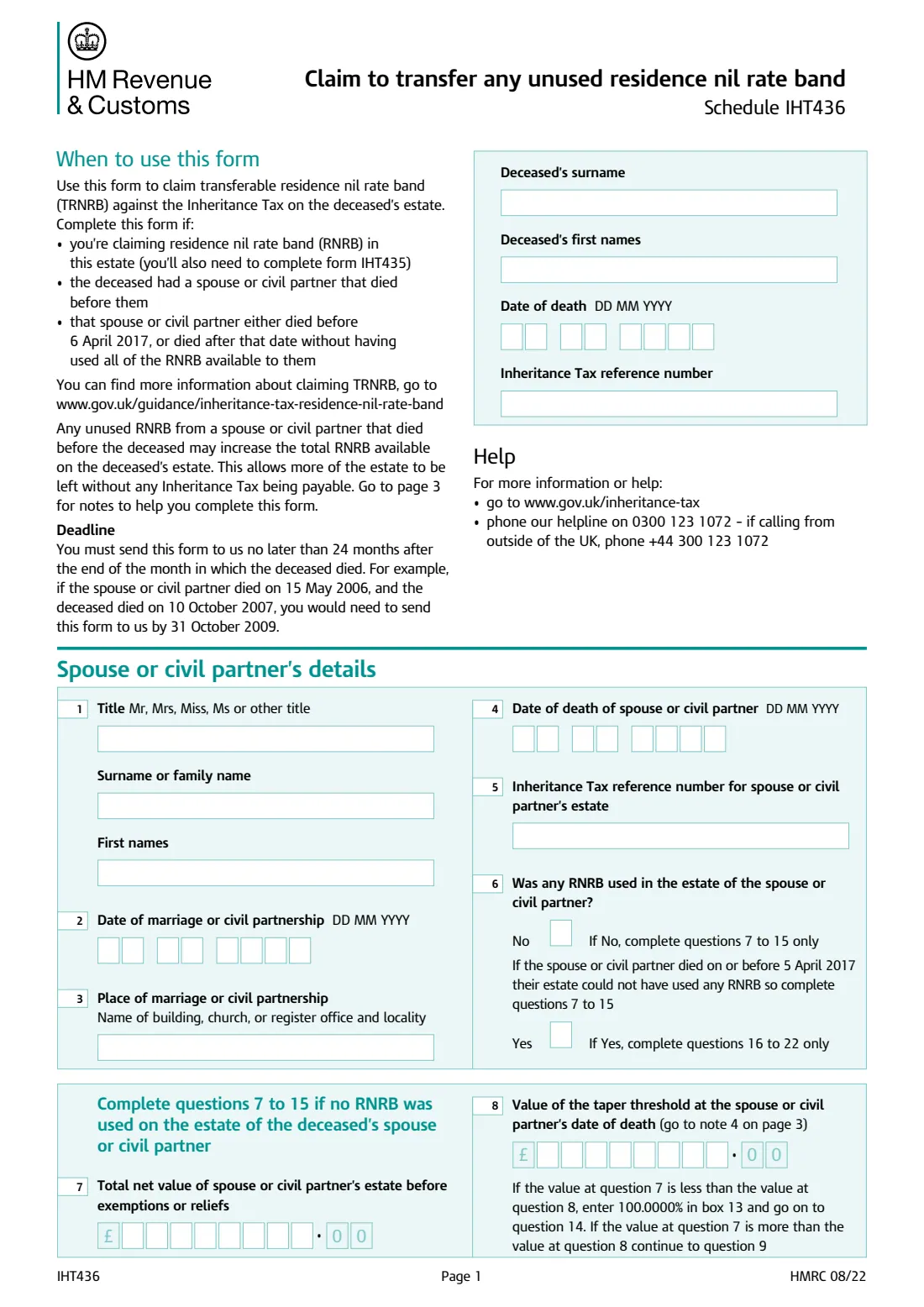
The 2022 edition has 3 pages. FileIt asks for it in 4 parts:
- The person who has died nowExecutor or administrator
- Spouse or civil partner's details (1 to 6)Executor or administrator
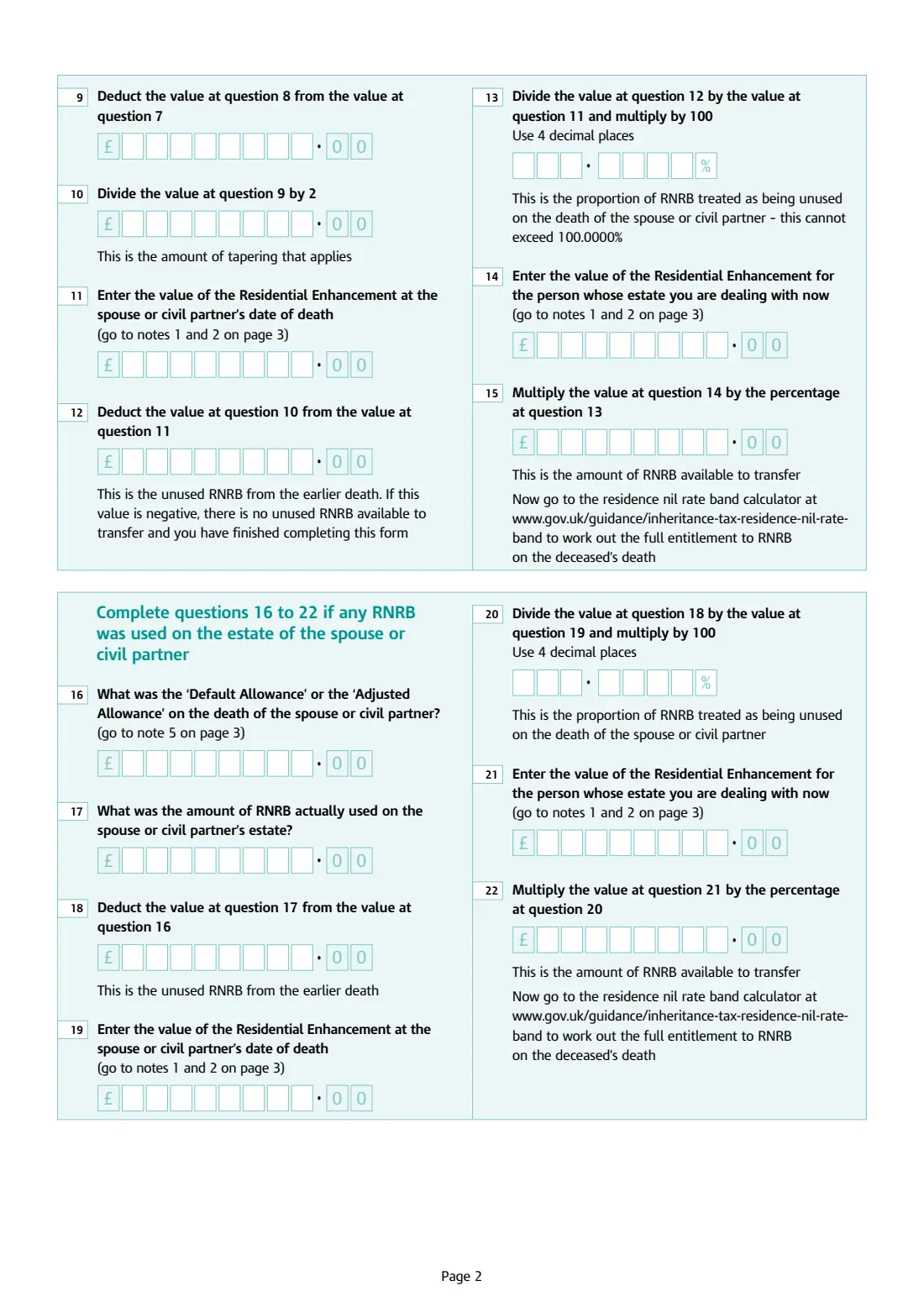
- No RNRB was used on the spouse's estate (7 to 15)Executor or administrator
- Some RNRB was used on the spouse's estate (16 to 22)Executor or administrator
How to fill out IHT436 transfer of unused residence nil rate band, step by step
1 The deceased and their spouse or civil partner (1 to 6)
The deceased's name, date of death and Inheritance Tax reference, then the first spouse's or civil partner's title and names, the date and place of the marriage or civil partnership, their date of death and their estate's Inheritance Tax reference. Question 6 asks whether any RNRB was used on their estate: No takes you to questions 7 to 15, Yes to 16 to 22. If they died on or before 5 April 2017, the answer is always No.
2 No RNRB used (7 to 15)
Enter the total net value of their estate before exemptions or reliefs, and the taper threshold at their death — £2 million from 6 April 2017 to 5 April 2026, and deemed to be £2 million for earlier deaths. If the estate was below the threshold, the proportion at box 13 is 100.0000%. Otherwise FileIt works out the excess (9), the tapering — half the excess (10), the Residential Enhancement at their death (11), the unused RNRB (12) and the unused percentage (13). Enter the Residential Enhancement for the person who has died now at 14; FileIt multiplies it by the percentage at 15.
3 Some RNRB used (16 to 22)
Enter the Default Allowance — or, if tapering applied, the Adjusted Allowance — on the first death, and the RNRB actually used on that estate. FileIt works out the unused RNRB (18), the Residential Enhancement at the first death (19) and the unused proportion (20). Enter the Residential Enhancement for the person who has died now at 21; FileIt works out 22.
4 Rates in the notes
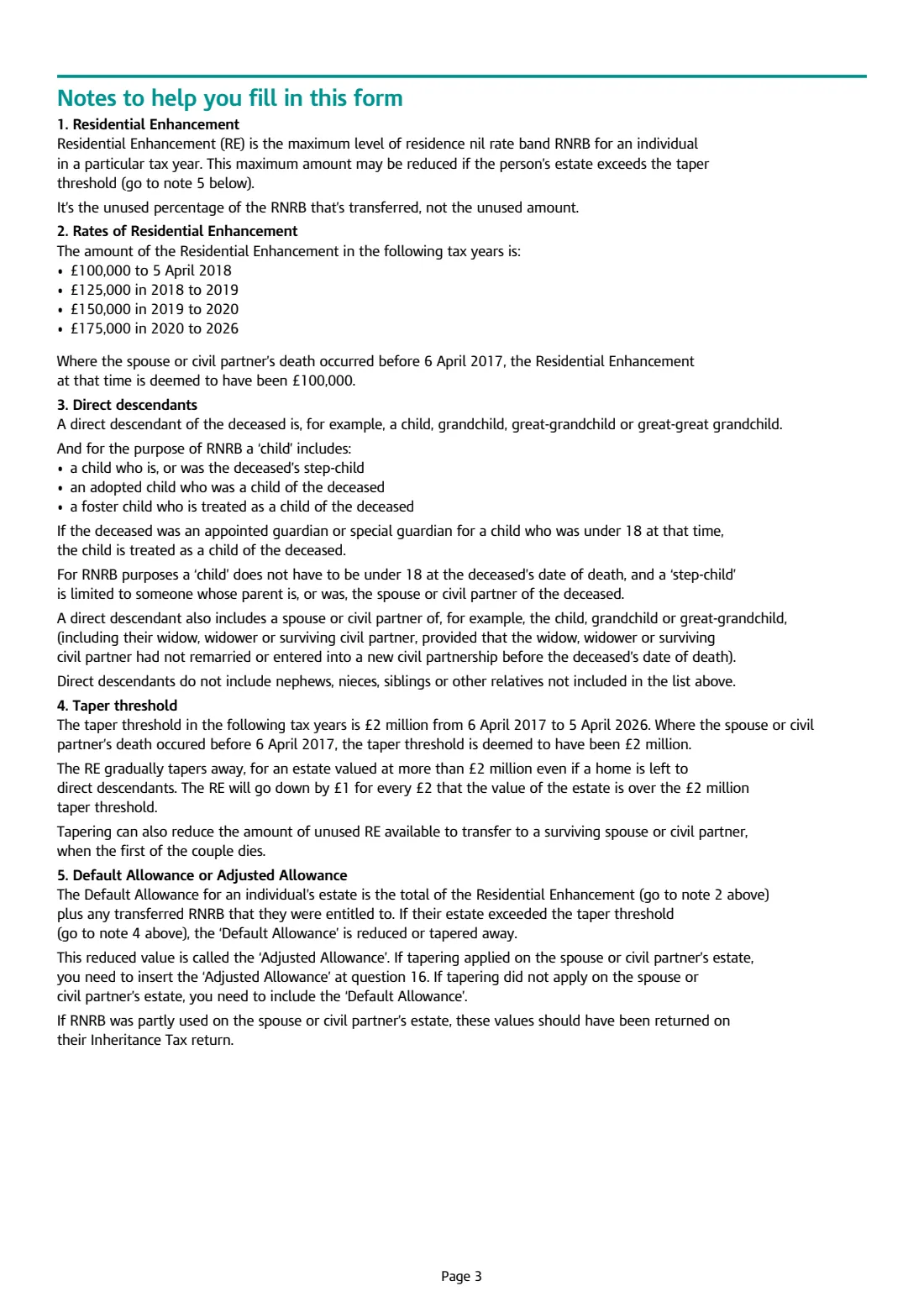
Note 2 lists the Residential Enhancement: £100,000 to 5 April 2018, £125,000 in 2018 to 2019, £150,000 in 2019 to 2020 and £175,000 in 2020 to 2026. Where the first death was before 6 April 2017, it is deemed to have been £100,000. FileIt uses these for boxes 11 and 19 from the first spouse's date of death.
Common mistakes to avoid
- Answering Yes to question 6 when the first spouse died on or before 5 April 2017 — their estate couldn't have used any RNRB.
- Transferring the unused amount instead of the unused percentage. Note 1 says it's the percentage that transfers.
- Forgetting tapering: an estate over £2 million loses £1 of Residential Enhancement for every £2 over.
- Using the Default Allowance at question 16 when tapering applied — use the Adjusted Allowance then.
- Sending IHT436 without IHT435, which claims the RNRB itself.
- Missing the 24-month deadline after the end of the month of death.
After you fill it out
Check the calculated boxes, then go to HMRC's residence nil rate band calculator to work out the full RNRB on the deceased's death.
Send the form to Inheritance Tax, HM Revenue and Customs, BX9 1HT, with IHT435 and the rest of the account. FileIt does not send anything to HMRC.
Keep a copy with the estate papers in the deceased's FileIt folder.
Fill out IHT436 transfer of unused residence nil rate band online with FileIt
- Pick the person. Choose someone from People and FileIt fills in their name, date of birth, address and other details it already knows.
- Answer plain-language questions. One part of the form at a time, with the official help text beside each question — 28 fields in all. Your answers save as you go.
- Check the live preview. Watch your answers land on the real HMRC form, and let FileIt do any worksheet arithmetic.
- Generate the official PDF. FileIt prints your answers into the agency’s own PDF and files it in that person’s folder in your vault.
FileIt fills the form — it never files or submits anything for you. Deliver the finished form to whoever asked for it, the way the form’s instructions say.
Start IHT436 transfer of unused residence nil rate band now — it’s freeIHT436 transfer of unused residence nil rate band: frequently asked questions
What is IHT436 for?
It claims the transferable residence nil rate band: the part of a husband's, wife's or civil partner's residence nil rate band that wasn't used when they died, added to the estate of the survivor.
Do I need IHT435 as well?
Yes. HMRC says to use IHT436 if you're claiming RNRB on the estate, which you do on form IHT435.
My spouse died before April 2017. Can I still claim?
Yes. Their estate couldn't have used any RNRB, so you answer No at question 6. The Residential Enhancement at their death is deemed to have been £100,000 and the taper threshold £2 million, and the unused proportion is usually 100% unless their estate was over £2 million.
What is the taper threshold?
£2 million. For estates above it, the Residential Enhancement goes down by £1 for every £2 over, which can also reduce the unused RNRB available to transfer.
Where do I send IHT436?
To Inheritance Tax, HM Revenue and Customs, BX9 1HT, United Kingdom, as HMRC's form page says.
Does FileIt calculate the percentage?
Yes. FileIt works out every calculated box from your figures, including the percentage to 4 decimal places, and prints it into the official form's digit boxes.
Official sources
- Blank form (PDF), published by HMRC: https://assets.publishing.service.gov.uk/media/630898a6e90e0729dd8bb41b/IHT436.pdf
- Official instructions and guidance: https://www.gov.uk/government/publications/claim-to-transfer-any-unused-residence-nil-rate-band-iht436
- Edition shown on this page: HMRC 08/22 (checked 2026-09-28).
FileIt is not affiliated with or endorsed by HMRC or any government. This page explains the form in general terms and is not legal, tax or immigration advice. Always read the official instructions, and check that you are using the edition the recipient accepts. Page last reviewed 2026-09-28.