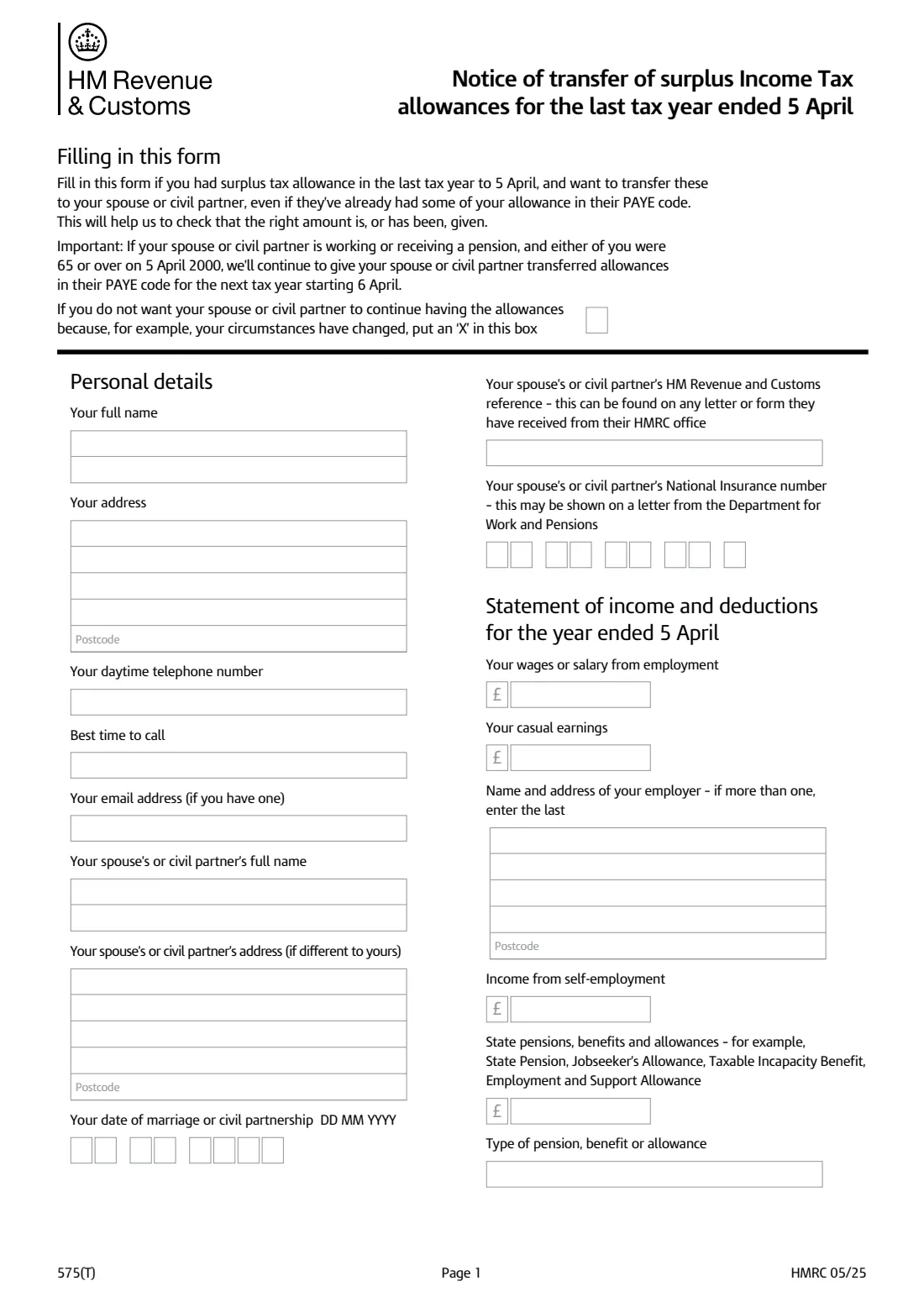
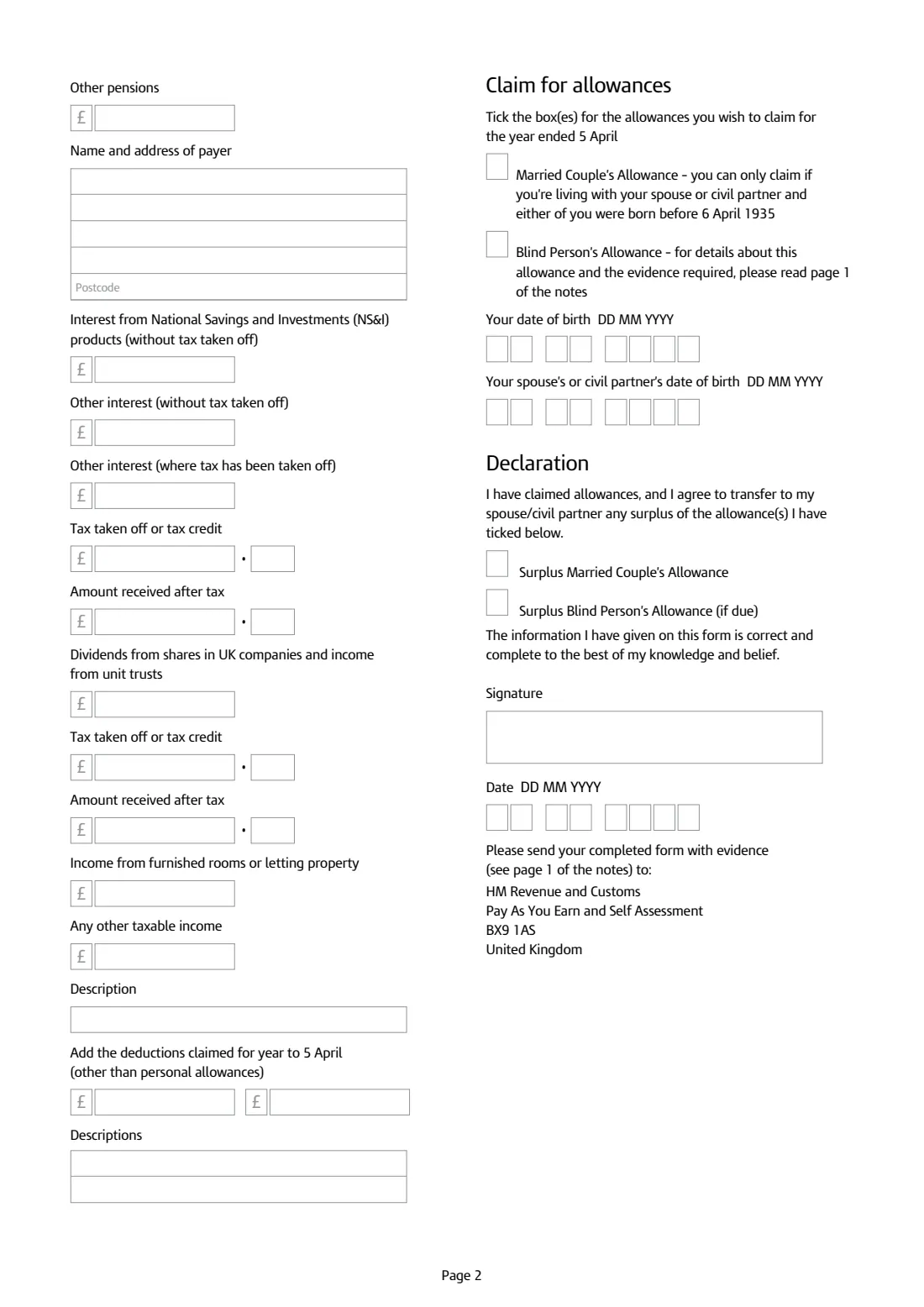
What is Form 575(T)?
Some tax allowances belong to one person but can be shared with a spouse or civil partner when that person's income is too low to use them all. Married Couple's Allowance (for couples where one of you was born before 6 April 1935) and Blind Person's Allowance both work this way. Form 575(T) tells HMRC to move the surplus, the unused part, from the last tax year to your spouse or civil partner.
The form asks for your details and your partner's, a statement of your income and deductions for the year that ended on 5 April, and which allowances you're claiming and transferring. HMRC uses the income figures to work out how much of the allowance is surplus. The notes say you can transfer it even if your partner has already had some of your allowance in their PAYE code.
FileIt asks each question in plain English, prints dates and the National Insurance number into their boxes, and puts your answers onto HMRC's own 575(T) PDF. It checks the claim boxes against the transfer boxes and the Married Couple's Allowance birth date rule. You print it, sign it and post it with any evidence. FileIt never submits anything, and HMRC also offers an online version.
- Who fills it
- The spouse or civil partner with the surplus allowance
- Sent to
- HM Revenue and Customs, Pay As You Earn and Self Assessment, BX9 1AS
- Covers
- The last tax year, ended 5 April
- Allowances
- Married Couple's Allowance and Blind Person's Allowance
- Signatures
- You sign the declaration
- Edition
- 575(T) HMRC 05/25, 2 pages; notes 575(T) Notes
Who needs to fill out Form 575(T)?
- A married person or civil partner entitled to Married Couple's Allowance, where either of you was born before 6 April 1935, whose income was too low to use all of it.
- Someone registered blind (or, in Scotland and Northern Ireland, unable to do work for which eyesight is essential) who can't use all of their Blind Person's Allowance.
- Couples who were married or in a civil partnership and living together at some time during the last tax year.
When to use Form 575(T)
- After the tax year ends on 5 April, for the year just finished.
- Even if your partner has already had part of your allowance in their PAYE code: the form helps HMRC check the right amount.
- To stop transferred allowances continuing into the next year's PAYE code, by ticking the box on page 1.
What you need before you start
- Your name, address, phone number and date of birth.
- Your spouse's or civil partner's name, address if different, HMRC reference, National Insurance number and date of birth, and your date of marriage or civil partnership.
- Your income for the year: wages, earnings, self-employment profit, State Pension and benefits, other pensions, interest, dividends and letting income.
- Any deductions you claim, such as Gift Aid donations.
- Evidence for Blind Person's Allowance, as page 1 of the notes describes.
What’s on Form 575(T)
The 2025 edition has 2 pages. FileIt asks for it in 5 parts, and it is signed by Applicant:
- About this noticeApplicant
- Your detailsApplicant
- Your spouse or civil partnerApplicant
- Statement of income and deductionsApplicant
- Claim for allowances and declarationApplicant
How to fill out Form 575(T), step by step
1 Page 1: personal details
Your name, address, phone, best time to call and email, then your partner's name, address, HMRC reference and National Insurance number, and the date you married or formed your civil partnership. The box at the top is only for stopping transferred allowances continuing into next year's PAYE code.
2 Statement of income and deductions
Your income for the year ended 5 April, before tax unless the box says otherwise: wages (and your last employer), casual earnings, self-employment profit, State Pension and taxable benefits, other pensions with the payer's name and address, interest, dividends, letting income and any other taxable income. Enter only your share of joint savings. The 'tax taken off' boxes have a separate pence box.
3 Deductions
Payments you can claim tax relief on, such as Gift Aid donations, legally binding maintenance payments where one of you was born before 6 April 1935, or employment expenses, with a description.
4 Claim and declaration
Tick the allowances you claim, give both dates of birth, then tick the surplus you agree to transfer. You sign and date the declaration that the information is correct and complete.
Common mistakes to avoid
- Ticking a surplus to transfer without claiming that allowance first.
- Claiming Married Couple's Allowance when neither of you was born before 6 April 1935.
- Including your partner's pensions or income: the statement is your own income only.
- Including untaxable income, such as ISA interest or NS&I Savings Certificates.
- Forgetting the evidence for Blind Person's Allowance.
After you fill it out
Print the form, sign and date the declaration.
Post it with any evidence to HM Revenue and Customs, Pay As You Earn and Self Assessment, BX9 1AS, United Kingdom. FileIt doesn't send anything for you.
HMRC works out the surplus and adjusts your partner's tax. Keep a copy in FileIt with your P60 and pension statements.
Fill out Form 575(T) online with FileIt
- Pick the person. Choose someone from People and FileIt fills in their name, date of birth, address and other details it already knows.
- Answer plain-language questions. One part of the form at a time, with the official help text beside each question — 71 fields in all. Your answers save as you go.
- Check the live preview. Watch your answers land on the real HM Revenue & Customs form, and let FileIt do any worksheet arithmetic.
- Generate the official PDF. FileIt prints your answers into the agency’s own PDF and files it in that person’s folder in your vault. Sign it, or send it for e-signature.
FileIt fills the form — it never files or submits anything for you. Deliver the finished form to whoever asked for it, the way the form’s instructions say.
Start Form 575(T) now — it’s freeForm 575(T): frequently asked questions
What is form 575(T)?
It's HMRC's notice to transfer surplus Married Couple's Allowance or Blind Person's Allowance from the last tax year to your spouse or civil partner.
Who can claim Married Couple's Allowance?
The notes say it may be claimed if you or your spouse or civil partner was born before 6 April 1935, and (for marriages and civil partnerships from 5 December 2005) you lived together for all or part of the tax year.
Can I transfer Blind Person's Allowance to a partner who isn't blind?
Yes. The notes say that if you can't use all of your allowance yourself, you can transfer the surplus to your spouse or civil partner even if they're not blind.
Does HMRC tell my partner about my income?
The notes say that if you give notice to transfer, HMRC may have to tell your spouse or civil partner how your taxable income is made up.
Can I do this online instead?
Yes. GOV.UK offers an online version as well as the postal form.
Official sources
- Blank form (PDF), published by HM Revenue & Customs: https://assets.publishing.service.gov.uk/media/684c24bfdf3ce2ce31e3f98a/575T.pdf
- Official instructions and guidance: https://www.gov.uk/government/publications/income-tax-notice-of-transfer-of-surplus-income-tax-allowances-575t
- Edition shown on this page: 575(T) HMRC 05/25 (checked 2026-10-19).
FileIt is not affiliated with or endorsed by HM Revenue & Customs or any government. This page explains the form in general terms and is not legal, tax or immigration advice. Always read the official instructions, and check that you are using the edition the recipient accepts. Page last reviewed 2026-10-19.