What is Form CA5603?
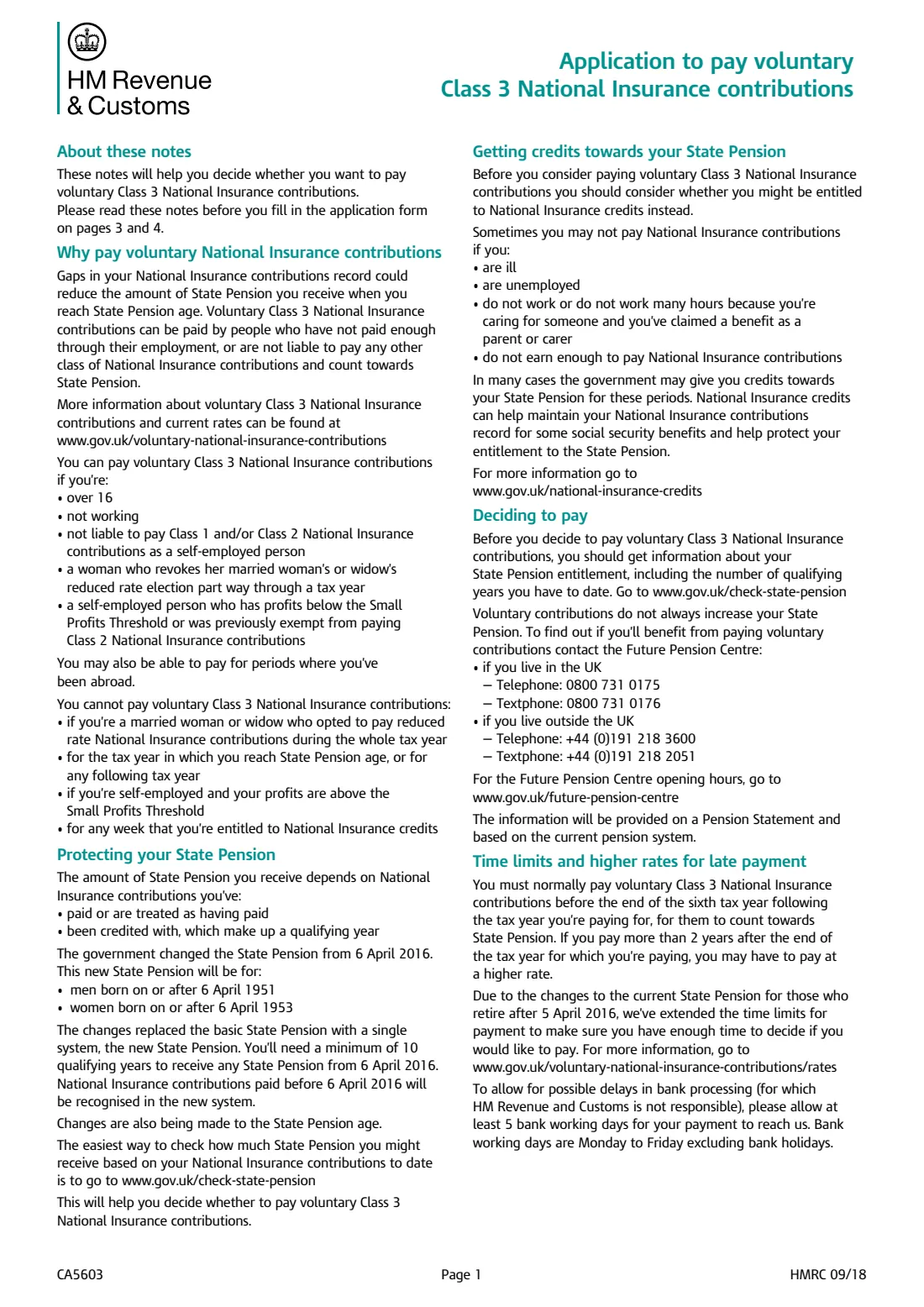
Your State Pension depends on your National Insurance record: the number of qualifying years you have. If you're not working, or not paying enough through work or self-employment, there can be gaps. Voluntary Class 3 contributions can fill them. Form CA5603 is how you ask HMRC to set up regular payments for the current tax year and future years, by monthly Direct Debit or by a bill every quarter.
Before deciding, the notes suggest checking your State Pension forecast and whether you could get National Insurance credits instead, because voluntary contributions don't always increase your pension. The Future Pension Centre can tell you whether paying would help.
FileIt asks the questions in plain English, prints your National Insurance number, dates, bank account and sort code into their boxes on HMRC's own CA5603 PDF, and shows the Direct Debit instruction only if you choose to pay that way. You print it, sign it and post pages 3 and 4. FileIt never submits anything.
- Who fills it
- Anyone over 16 who wants to pay voluntary Class 3 contributions regularly
- Sent to
- National Insurance Contributions and Employer Office, HM Revenue and Customs, BX9 1AN
- Ways to pay
- Monthly Direct Debit, or a quarterly bill (July, October, January and April)
- Covers
- The current tax year and future years (GOV.UK). Past gaps are paid another way
- Signatures
- You sign the declaration. The account holder signs the Direct Debit instruction
- Edition
- CA5603 HMRC 09/18, 4 pages (form on pages 3 and 4)
Who needs to fill out Form CA5603?
- People not working, and not getting National Insurance credits, who want to keep building their State Pension.
- Self-employed people with profits below the Small Profits Threshold.
- Women revoking a married woman's or widow's reduced rate election part way through a tax year.
- People who know they'll have a gap in the current tax year and prefer regular payments to one lump sum.
When to use Form CA5603
- To start regular payments for the current tax year and future ones. GOV.UK says Direct Debit payments usually start in May.
- After checking your State Pension forecast and whether National Insurance credits would cover the gap.
- Not for the tax year you reach State Pension age or later years: the notes say you can't pay for those.
What you need before you start
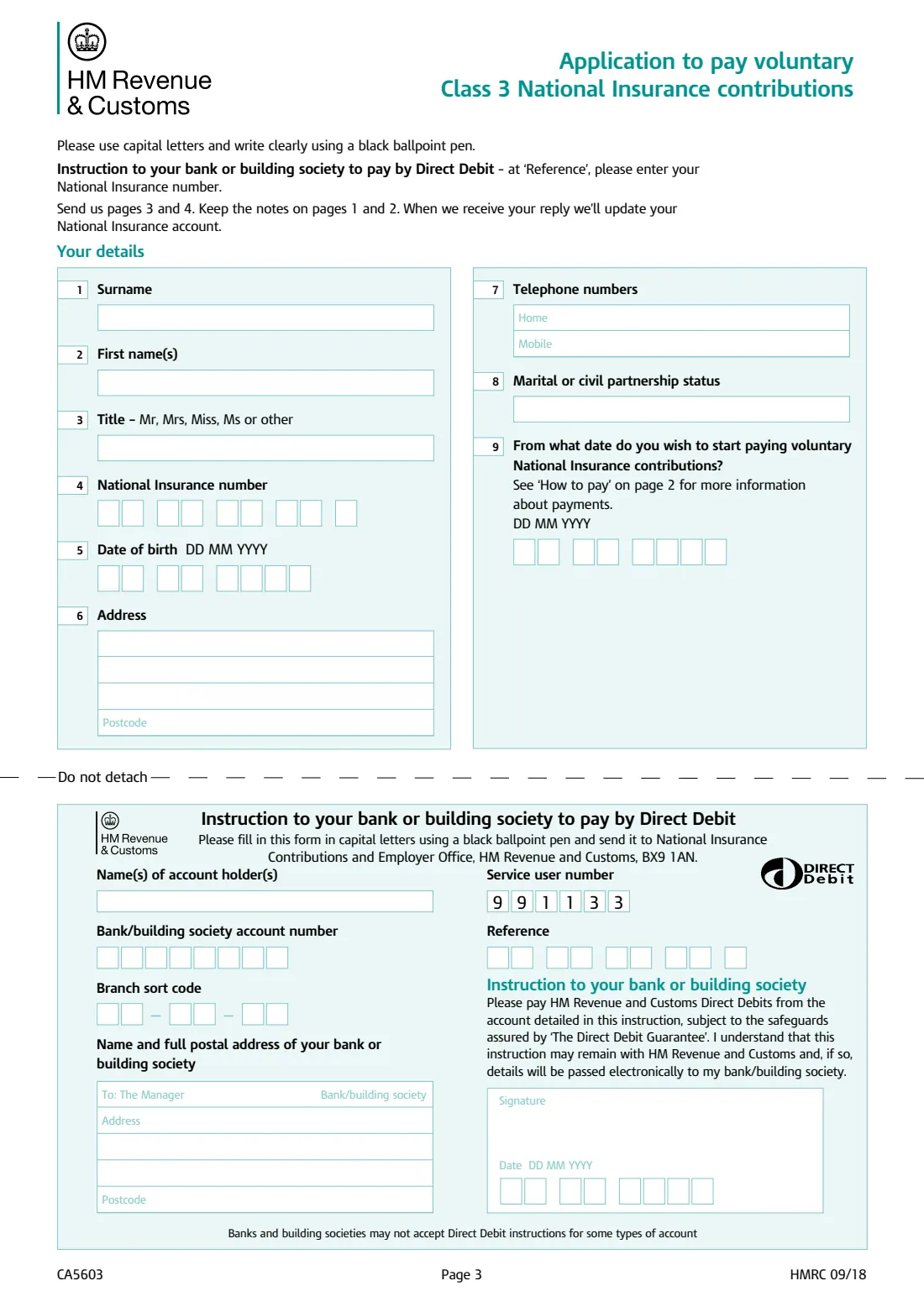
- Your name, title, National Insurance number, date of birth, address, phone numbers and marital or civil partnership status.
- The date you want to start paying.
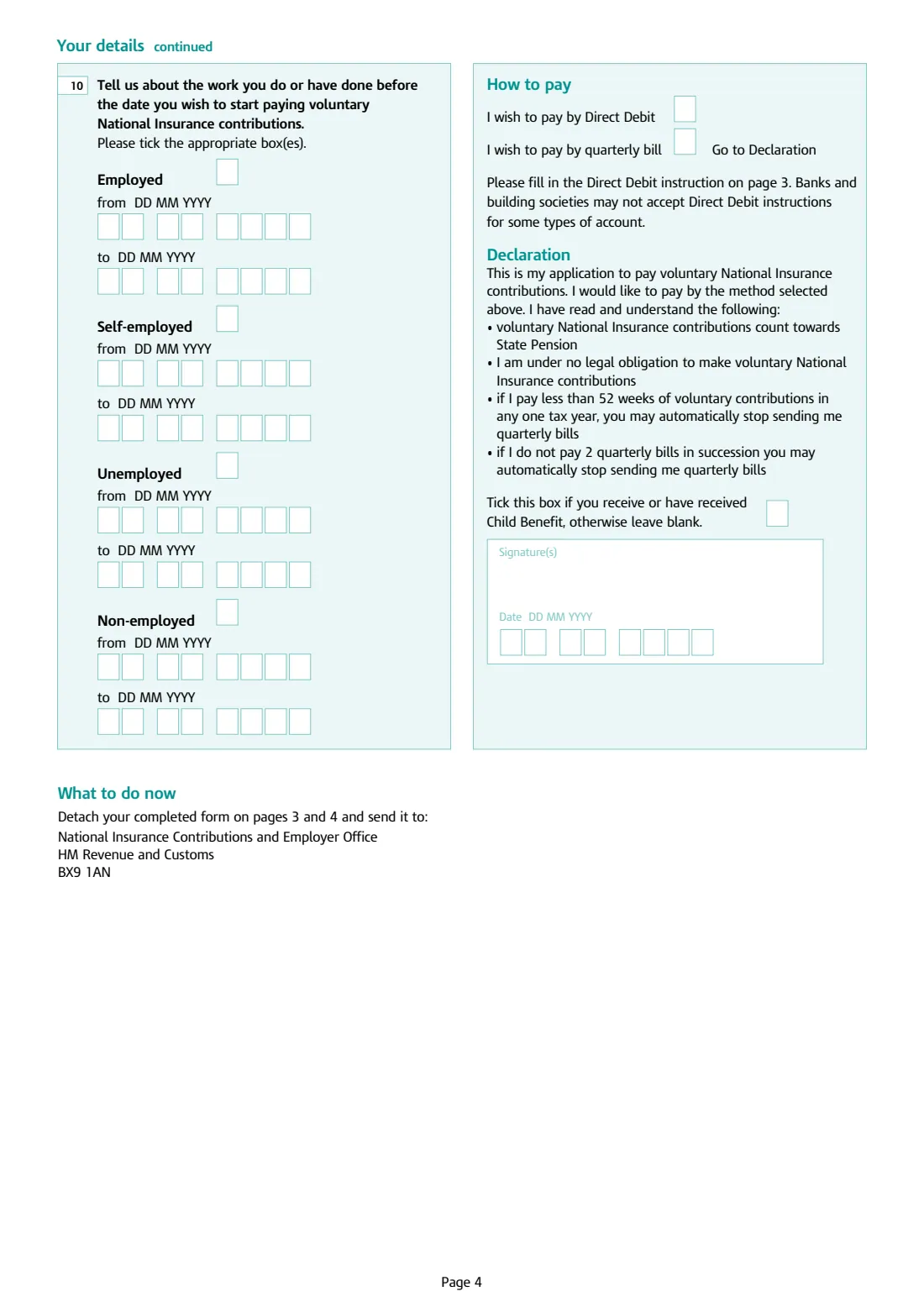
- The dates of your work before then: employed, self-employed, unemployed or not working.
- For Direct Debit: the account holder's name, account number, sort code and the bank or building society's name and address.
What’s on Form CA5603
The 2018 edition has 4 pages. FileIt asks for it in 4 parts, and it is signed by Applicant:
- Your detailsApplicant
- 10. Your work before the start dateApplicant
- How to payApplicant
- Instruction to your bank or building society to pay by Direct DebitApplicant
How to fill out Form CA5603, step by step
1 Your details (questions 1 to 9)
Your surname, first names, title, National Insurance number, date of birth, address, home and mobile numbers and marital or civil partnership status. Question 9 is the date you want to start paying from.
2 Your work (question 10)
Tick each kind of work you did before the start date, employed, self-employed, unemployed or non-employed, and give the from and to dates.
3 How to pay
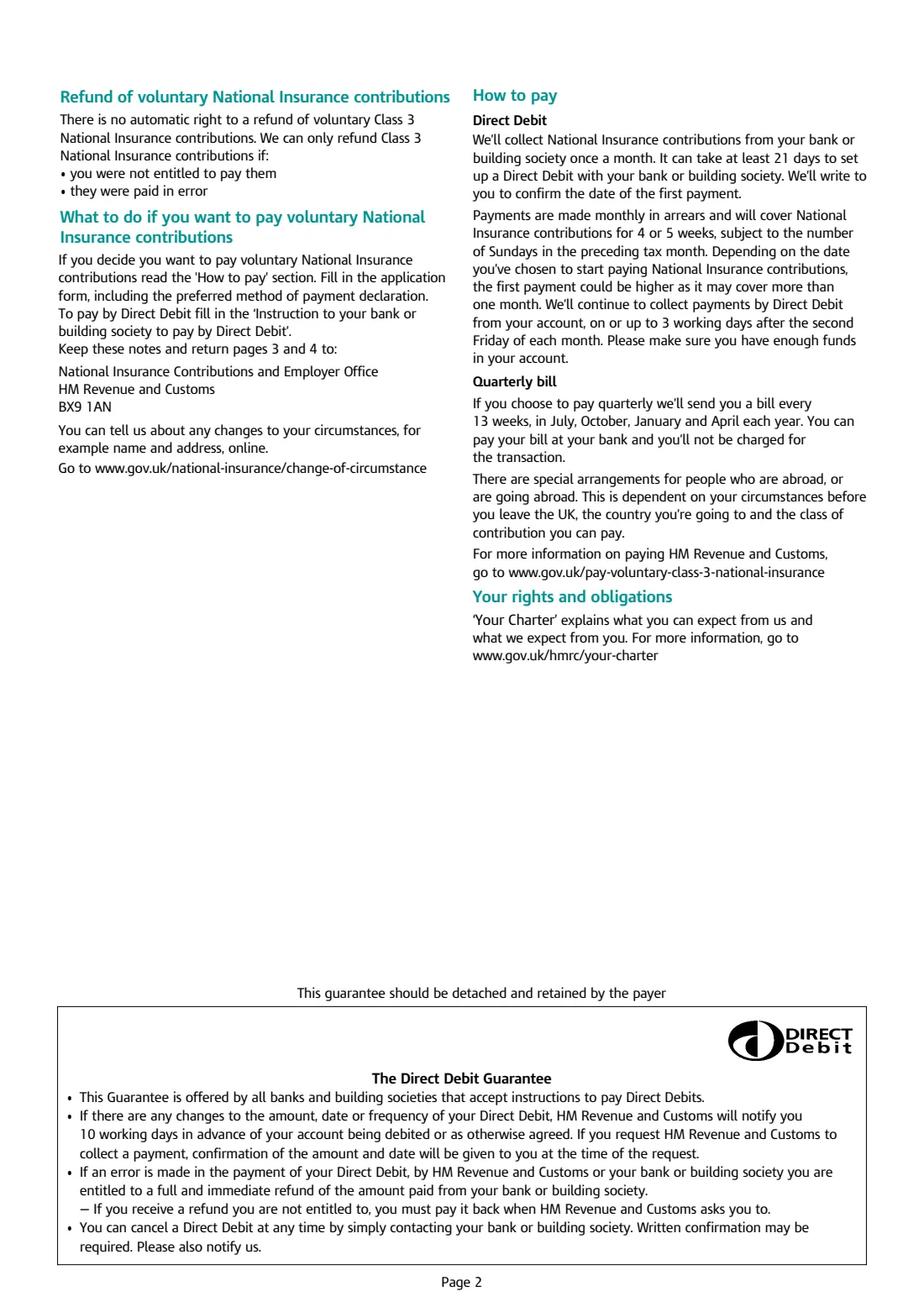
Choose monthly Direct Debit or a quarterly bill. Direct Debit is collected monthly in arrears, around the second Friday of each month, and takes at least 21 days to set up. A quarterly bill arrives every 13 weeks.
4 Declaration
You confirm that voluntary contributions count towards State Pension, that you're under no legal obligation to pay them, and that HMRC may stop quarterly bills if you pay fewer than 52 weeks in a tax year or miss 2 bills in a row. Tick the box if you get or have had Child Benefit, then sign and date.
5 Direct Debit instruction
Only if you pay by Direct Debit: the account holder's name, the account number, sort code and the bank's name and address. Your National Insurance number is the reference. The account holder signs and dates it.
Common mistakes to avoid
- Paying voluntary contributions without first checking your forecast and whether you could get credits instead.
- Choosing a start date in an earlier tax year for a Direct Debit: GOV.UK says Direct Debit covers the current and future tax years only.
- Leaving out the work history in question 10.
- Forgetting the account holder's signature on the Direct Debit instruction.
- Sending pages 1 and 2 instead of keeping them: they hold the notes and the Direct Debit Guarantee.
After you fill it out
Print pages 3 and 4, sign the declaration and, for Direct Debit, have the account holder sign the instruction.
Post them to National Insurance Contributions and Employer Office, HM Revenue and Customs, BX9 1AN. FileIt doesn't send anything for you.
HMRC writes to confirm when payments will start and how much they'll be. Payments show on your bank statement as 'HMRC NI-DD'. Keep a copy, and the Direct Debit Guarantee, in FileIt.
Fill out Form CA5603 online with FileIt
- Pick the person. Choose someone from People and FileIt fills in their name, date of birth, address and other details it already knows.
- Answer plain-language questions. One part of the form at a time, with the official help text beside each question — 42 fields in all. Your answers save as you go.
- Check the live preview. Watch your answers land on the real HM Revenue & Customs form, and let FileIt do any worksheet arithmetic.
- Generate the official PDF. FileIt prints your answers into the agency’s own PDF and files it in that person’s folder in your vault. Sign it, or send it for e-signature.
FileIt fills the form — it never files or submits anything for you. Deliver the finished form to whoever asked for it, the way the form’s instructions say.
Start Form CA5603 now — it’s freeForm CA5603: frequently asked questions
What is form CA5603?
It's HMRC's application to pay voluntary Class 3 National Insurance contributions regularly, by monthly Direct Debit or quarterly bill.
Will paying voluntary contributions increase my State Pension?
Not always. The notes say voluntary contributions don't always increase your State Pension. Check your forecast on GOV.UK, or contact the Future Pension Centre to find out if you'd benefit.
Can I use CA5603 to pay for past years?
GOV.UK says Direct Debit is only for the current tax year and future years. For past gaps, it lists other ways to pay, such as online through the State Pension forecast service or by bank transfer with a reference number.
When will my Direct Debit start?
GOV.UK says to allow 21 days to set it up and that payments usually start in May. HMRC writes to tell you when payments will be taken and how much.
Can I stop paying?
Yes. The notes say you're under no legal obligation to pay, and you can cancel a Direct Debit at any time through your bank. HMRC stops collecting when you reach State Pension age or have paid the maximum.
Official sources
- Blank form (PDF), published by HM Revenue & Customs: https://assets.publishing.service.gov.uk/media/5bab4c6e40f0b605084c952c/CA5603.pdf
- Official instructions and guidance: https://www.gov.uk/pay-voluntary-class-3-national-insurance
- Edition shown on this page: CA5603 HMRC 09/18 (checked 2026-10-19).
FileIt is not affiliated with or endorsed by HM Revenue & Customs or any government. This page explains the form in general terms and is not legal, tax or immigration advice. Always read the official instructions, and check that you are using the edition the recipient accepts. Page last reviewed 2026-10-19.