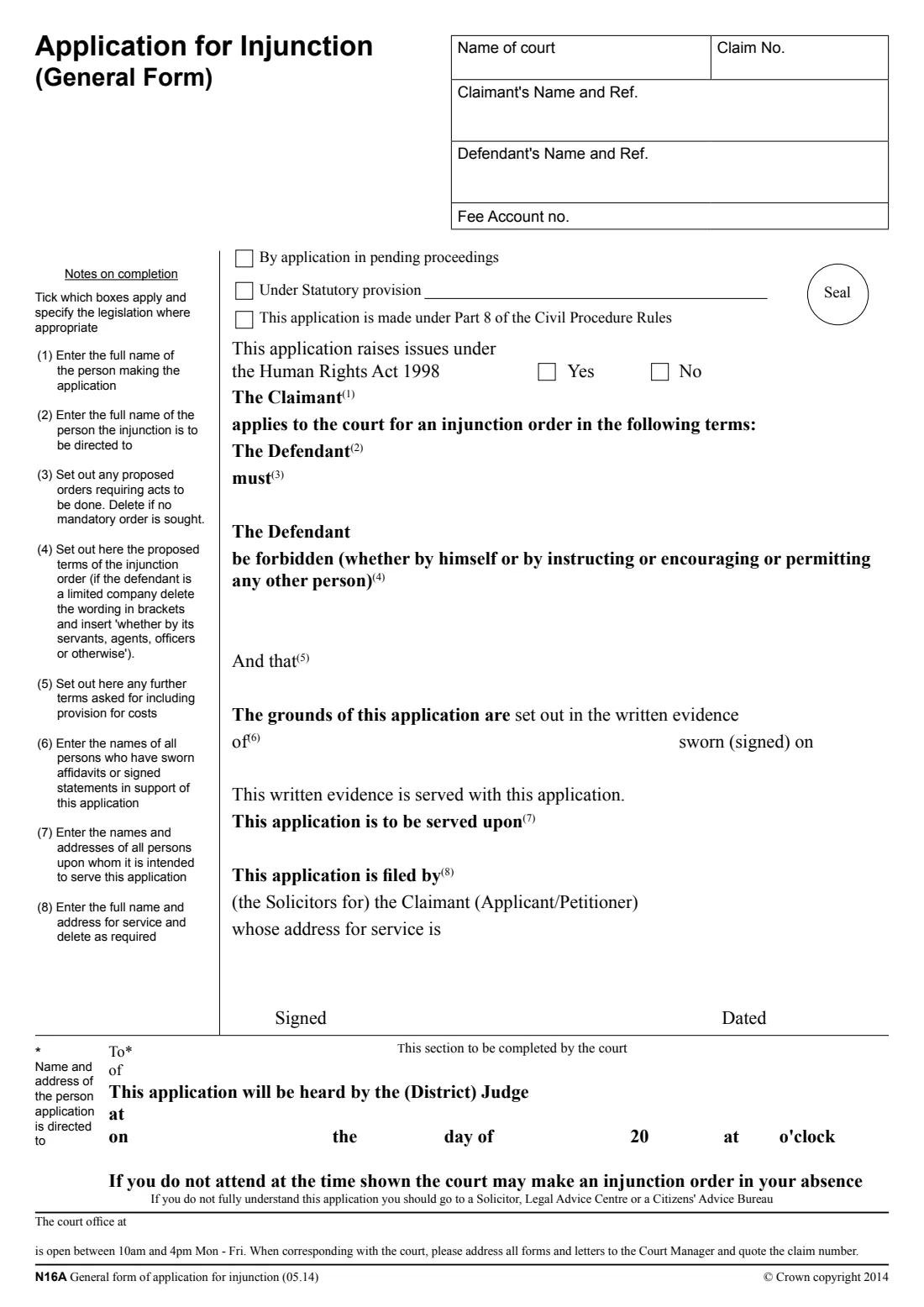
What is N16A Application for injunction?
An injunction is a court order that tells a person to do something (a mandatory order) or not to do something (a prohibitory order). Form N16A is the general application for one in the County Court or High Court in England and Wales, used in existing proceedings, under a particular statute, or as a Part 8 claim.
On one page you name the claimant applying and the defendant the order is aimed at, set out the exact terms you're asking for, list any further terms such as costs, name the people whose sworn or signed evidence supports the application, and say who the application will be served on and where documents should be sent to you. The bottom of the form is completed by the court with the hearing details.
FileIt asks for each part in plain language, keeps your wording inside the form's boxes and prints it into HMCTS's official N16A PDF. It doesn't decide whether an injunction is right for you or draft the order's terms. You sign the form by hand or with FileIt's eSignature and file it with the court yourself.
- Who fills it
- The claimant (applicant), or their solicitor
- Filed with
- The County Court or High Court dealing with the case
- Supporting evidence
- Affidavits or signed witness statements, served with it
- Hearing
- The court fills in the judge, place, date and time
- Edition
- N16A (05.14)
Who needs to fill out N16A Application for injunction?
- Someone asking a civil court to stop another person doing something, such as trespassing or harassing them.
- A claimant who needs the defendant to take a positive step, like removing an obstruction.
- Parties to existing County Court or High Court proceedings who want an injunction within them.
- Solicitors applying on a client's behalf.
When to use N16A Application for injunction
- When you're applying for a general civil injunction, in pending proceedings, under a statutory provision or under CPR Part 8.
- Once you have the written evidence ready to serve with the application.
- Not for family injunctions such as non-molestation or occupation orders, which use form FL401.
What you need before you start
- The court name and claim number, if a claim has already been issued.
- The full names and references of the claimant and defendant.
- The legislation you rely on, if the application is under a statutory provision.
- The exact terms of the order you want: what the defendant must do, and what they must not do.
- The names of everyone who has sworn an affidavit or signed a statement in support, and the date.
- The names and addresses of everyone you'll serve, and your address for service.
What’s on N16A Application for injunction
The 2014 edition has 1 page. FileIt asks for it in 6 parts, and it is signed by Applicant:
- Court and case detailsApplicant
- How the application is madeApplicant
- A mandatory order (the defendant must do something)Applicant
- A prohibitory order (the defendant must not do something)Applicant
- Further terms, evidence and serviceApplicant
- Filed by and address for serviceApplicant
How to fill out N16A Application for injunction, step by step
1 Court and parties
Name the court, the claim number if there is one, the claimant and defendant with references, and any fee account number.
2 How the application is made
Tick whether it's in pending proceedings, under a statutory provision (name it), or a Part 8 claim, and say whether it raises Human Rights Act 1998 issues.
3 The order you want
Set out any mandatory order (the defendant must...) and any prohibitory order (the defendant be forbidden...). FileIt lets you switch each one on, and asks for at least one.
4 Further terms and costs
Add anything else you're asking for under 'And that', including provision for costs.
5 Evidence and service
Name the people whose written evidence sets out the grounds, the date it was sworn or signed, and everyone the application is to be served on.
6 Filed by, address and signature
Give the full name of whoever files it and the address for service, then sign and date. Cross out by hand any printed words that don't apply.
Common mistakes to avoid
- Leaving the terms vague: the court needs to know exactly what the defendant must or must not do.
- Forgetting to serve the written evidence with the application.
- Not naming the statute when ticking 'Under Statutory provision'.
- Using N16A for a family injunction instead of FL401.
- Leaving the printed bracketed wording in place for a limited company defendant instead of crossing it out and adding 'whether by its servants, agents, officers or otherwise'.
After you fill it out
Sign and date the form, file it with the court with your evidence and the fee (or a Help with Fees application). FileIt doesn't file it for you.
The court completes the hearing details at the foot. Serve the application and evidence on everyone listed.
Keep the application, evidence and any order in the case's FileIt folder.
Fill out N16A Application for injunction online with FileIt
- Pick the person. Choose someone from People and FileIt fills in their name, date of birth, address and other details it already knows.
- Answer plain-language questions. One part of the form at a time, with the official help text beside each question — 22 fields in all. Your answers save as you go.
- Check the live preview. Watch your answers land on the real HM Courts & Tribunals Service form, and let FileIt do any worksheet arithmetic.
- Generate the official PDF. FileIt prints your answers into the agency’s own PDF and files it in that person’s folder in your vault. Sign it, or send it for e-signature.
FileIt fills the form — it never files or submits anything for you. Deliver the finished form to whoever asked for it, the way the form’s instructions say.
Start N16A Application for injunction now — it’s freeN16A Application for injunction: frequently asked questions
What's the difference between a mandatory and a prohibitory order?
A mandatory order requires the defendant to do something, such as removing a fence. A prohibitory order forbids them from doing something, such as entering your property. N16A has room for both.
Can I use N16A for domestic abuse?
Family injunctions such as non-molestation and occupation orders use form FL401, not N16A.
Do I need evidence with the application?
The form says the grounds are set out in written evidence that is served with the application, so you name who made the affidavits or witness statements and when.
Who fills in the hearing date?
The court. The section at the bottom of the form, with the judge, place, date and time, is for the court to complete.
Can FileIt draft the injunction terms?
No. FileIt prints the terms you write into the official form and checks they fit the boxes. It doesn't give legal advice; a solicitor or advice agency can help with the wording.
Official sources
- Blank form (PDF), published by HM Courts & Tribunals Service: https://assets.publishing.service.gov.uk/media/602a5c30e90e07056841fdca/n16a-eng.pdf
- Official instructions and guidance: https://www.gov.uk/government/publications/form-n16a-application-for-injunction-general-form
- Edition shown on this page: N16A (05.14) (checked 2026-10-19).
FileIt is not affiliated with or endorsed by HM Courts & Tribunals Service or any government. This page explains the form in general terms and is not legal, tax or immigration advice. Always read the official instructions, and check that you are using the edition the recipient accepts. Page last reviewed 2026-10-19.