What is IHT404 jointly owned assets?
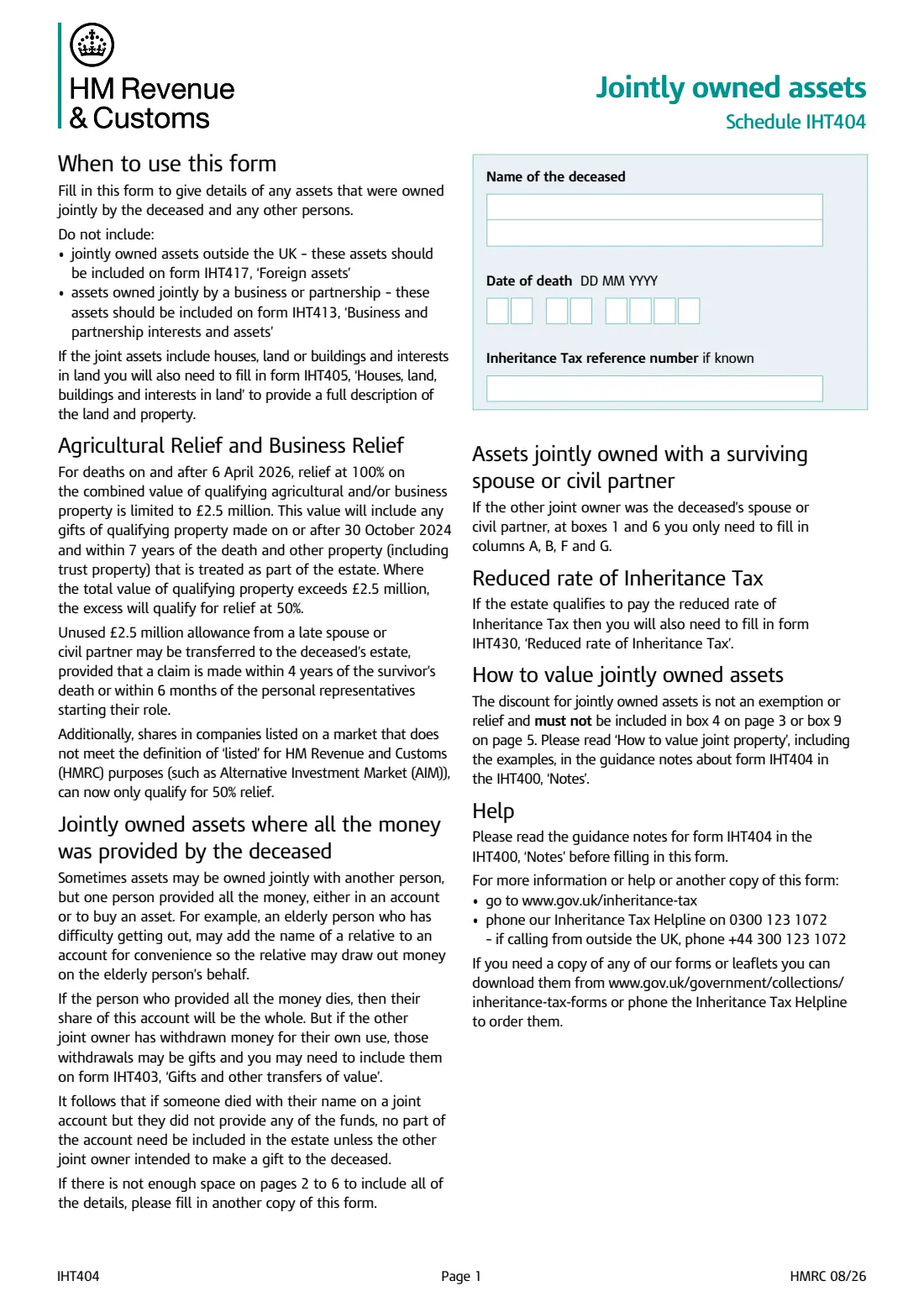
Many people own their home, bank accounts or other belongings jointly with a spouse, partner or family member. When a joint owner dies, only their share counts towards their estate, and some joint assets pass straight to the surviving owners. Schedule IHT404 is where the IHT400 account sets all this out.
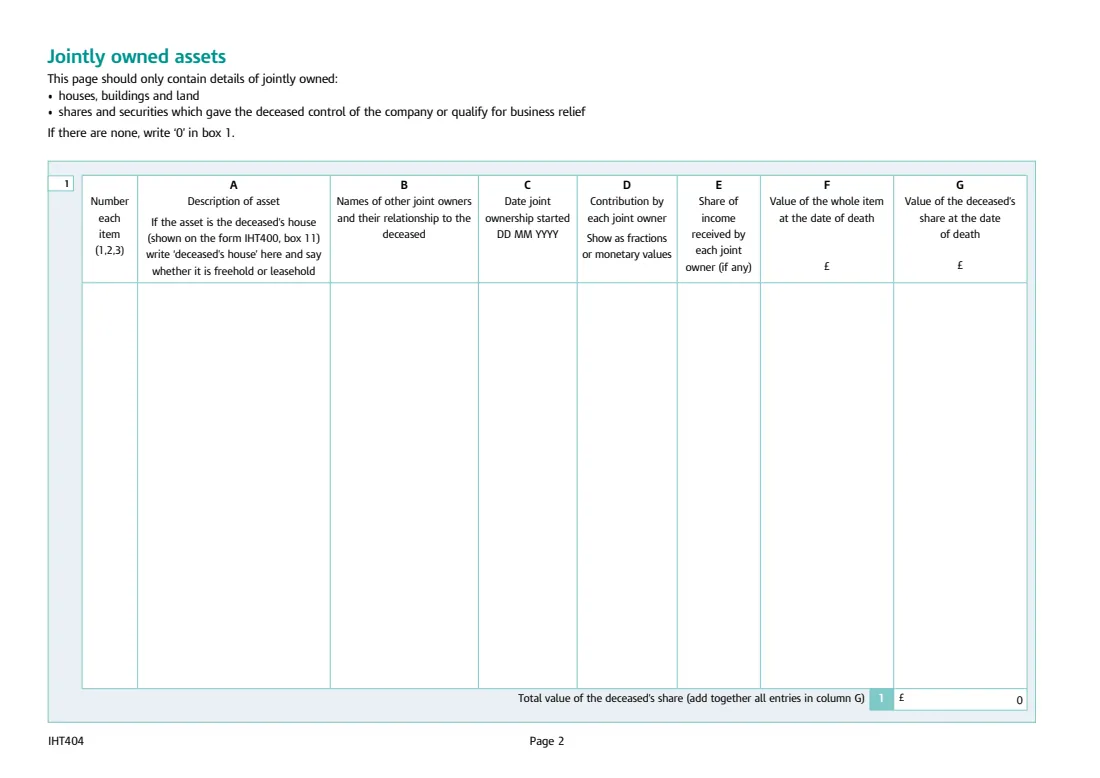
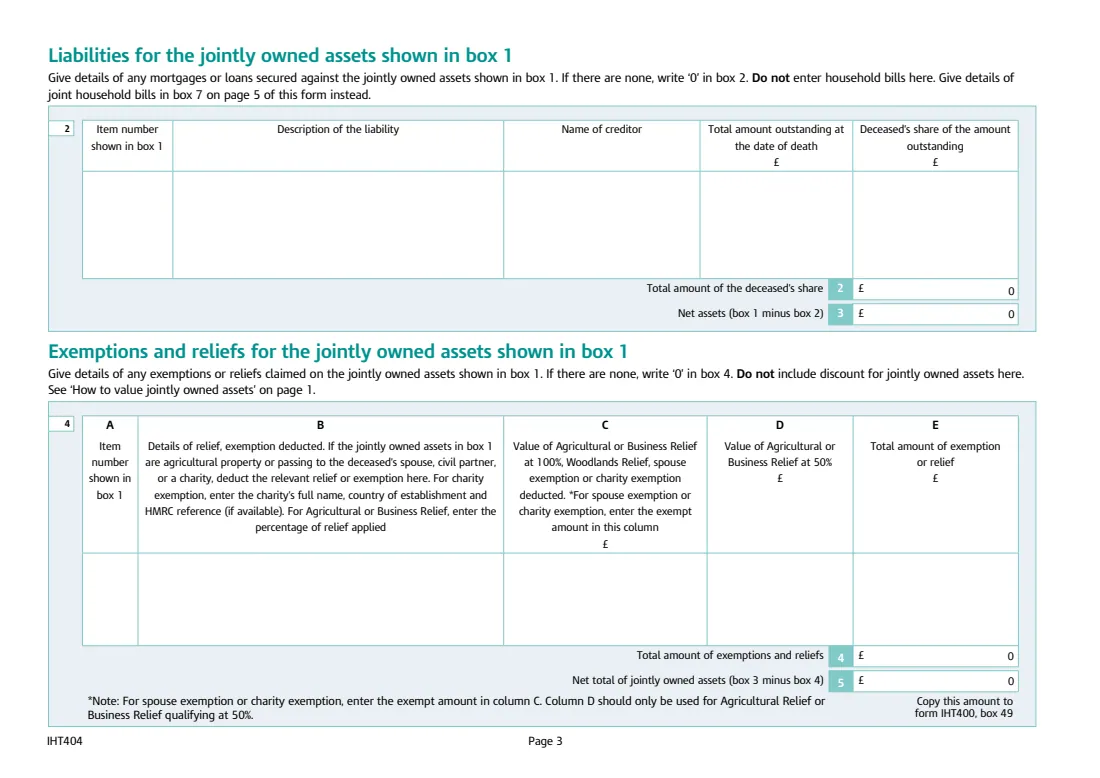
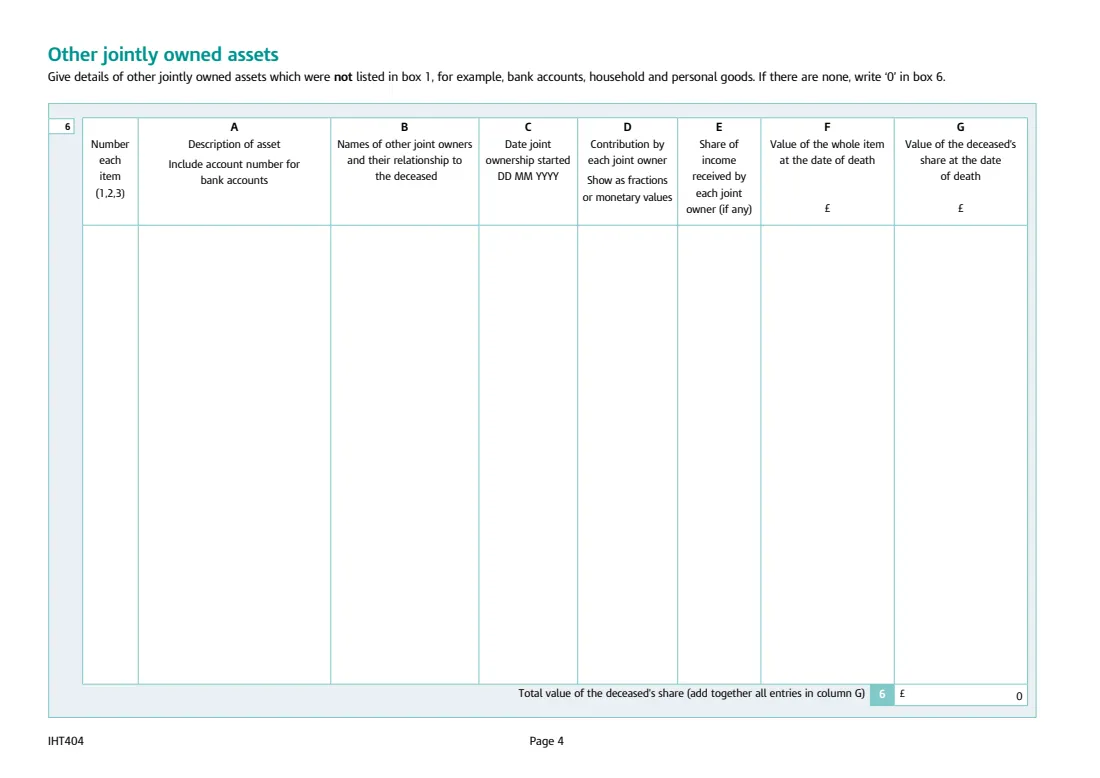
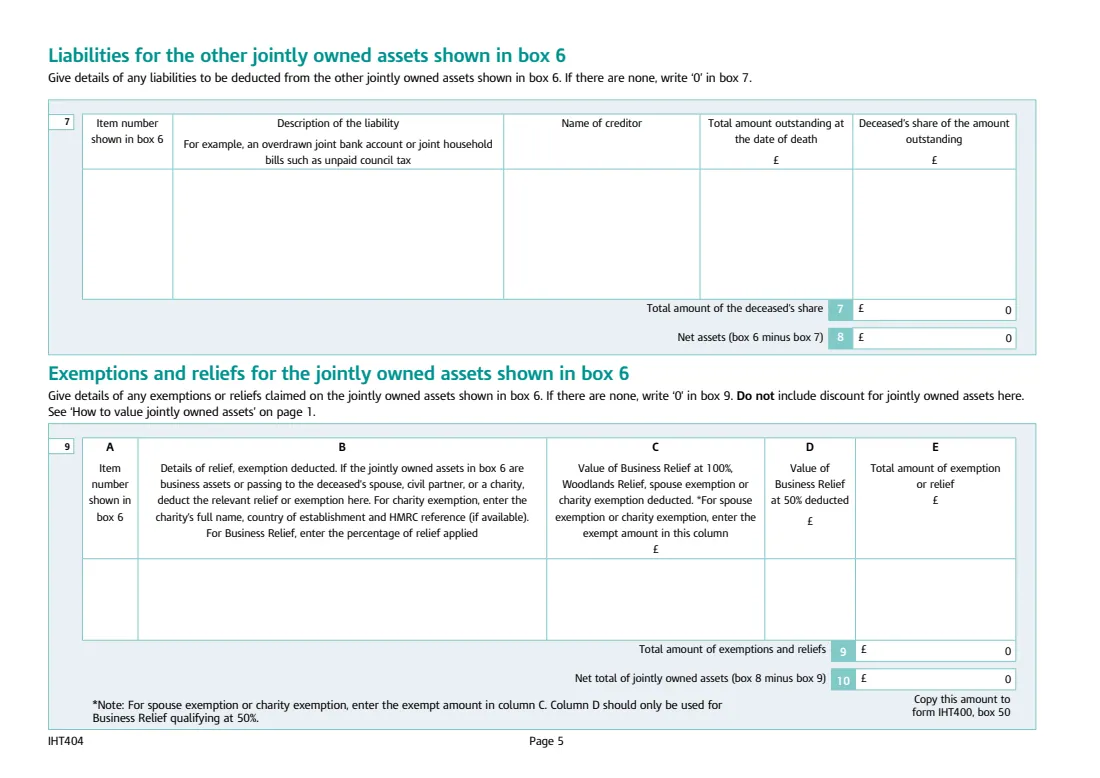
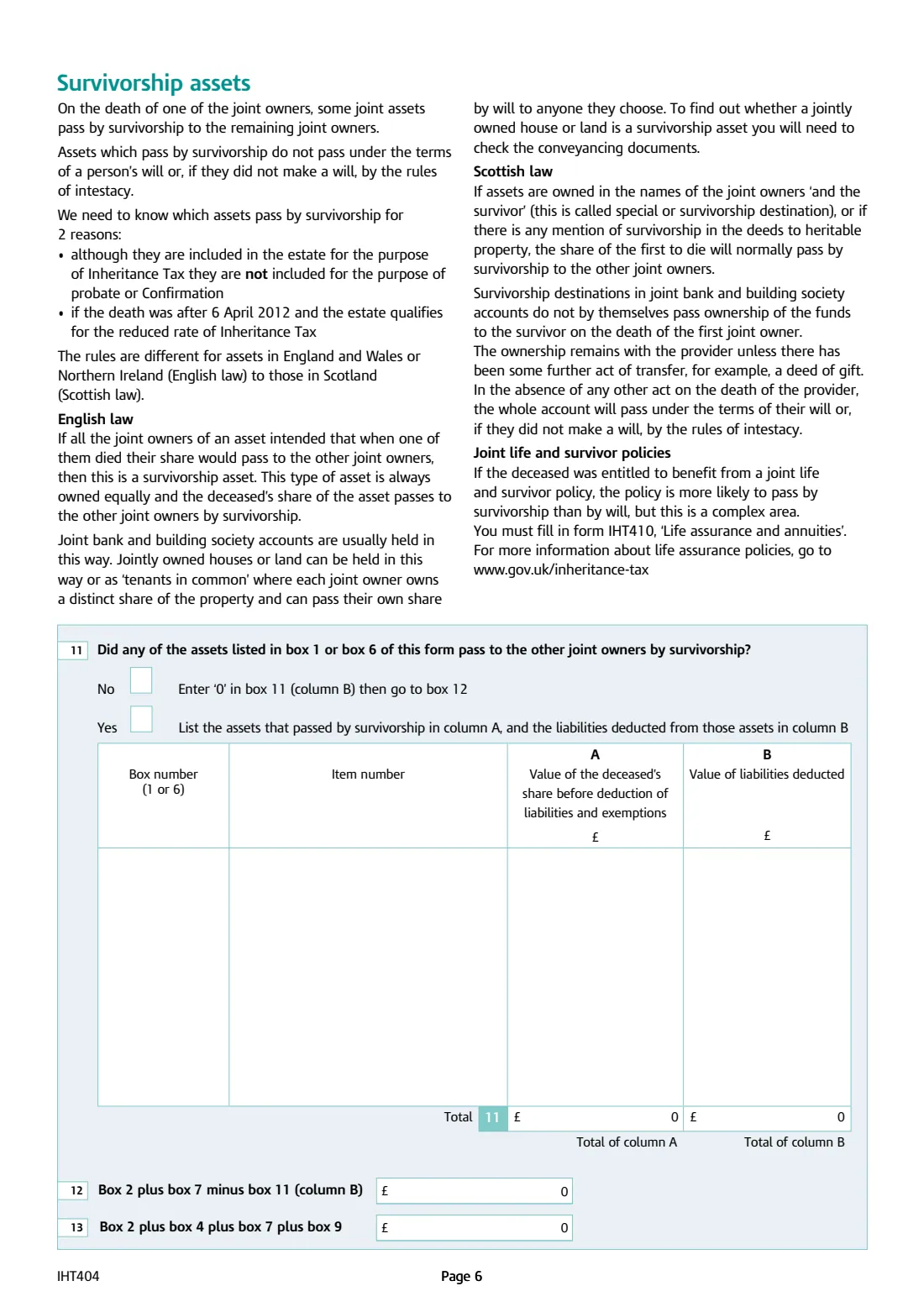
Box 1 lists jointly owned houses, buildings and land, and shares that gave the deceased control of a company or qualify for Business Relief. Box 6 lists everything else, such as joint bank accounts and household goods. For each one you give the other owners, when the joint ownership started, who contributed what, the value of the whole item and the deceased's share. Then come any debts secured on those assets, exemptions and reliefs such as spouse exemption, and which assets passed by survivorship.
FileIt numbers the assets, totals every column and works out all thirteen boxes, including the figures to copy to IHT400 boxes 49 and 50. It then fills HMRC's own August 2026 IHT404, whose middle pages are printed sideways.
- Who fills it
- The executor or administrator preparing form IHT400
- Totals go to
- Box 5 to IHT400 box 49, box 10 to IHT400 box 50
- Room for
- 6 assets in box 1, 9 in box 6, 11 survivorship lines
- Spouse as joint owner
- Only columns A, B, F and G are needed in boxes 1 and 6
- Edition
- HMRC 08/26 (updated September 2026)
- Helpline
- Inheritance Tax helpline 0300 123 1072
Who needs to fill out IHT404 jointly owned assets?
- Executors of anyone who owned a home, land or a bank account jointly with someone else.
- Estates where the deceased was a joint owner with a spouse or civil partner, a child, a sibling or a business associate.
- Not for joint assets outside the UK (IHT417) or assets owned jointly by a business or partnership (IHT413).
When to use IHT404 jointly owned assets
- Once you know the value of each joint asset at the date of death and the deceased's share of it.
- When working out whether joint assets passed by survivorship or under the will, which matters for probate and the reduced rate of tax.
- Alongside IHT405 if a joint asset is a house, land or a building.
What you need before you start
- A description of each joint asset (with account numbers for bank accounts) and the names of the other owners.
- When the joint ownership began, and how much each owner contributed.
- The value of the whole asset at the date of death and of the deceased's share.
- Details of any mortgage, loan, overdraft or joint bill and the deceased's share of it.
- Any spouse, charity, agricultural or business relief claimed on the joint assets.
- The deeds or account terms showing whether assets passed by survivorship.
What’s on IHT404 jointly owned assets
The 2026 edition has 6 pages. FileIt asks for it in 6 parts:
- The person who has diedExecutor or administrator
- 1 Jointly owned houses, buildings, land and controlling shareholdingsExecutor or administrator
- 2 to 5 Liabilities, exemptions and reliefs for the assets in box 1Executor or administrator
- 6 Other jointly owned assetsExecutor or administrator
- 7 to 10 Liabilities, exemptions and reliefs for the assets in box 6Executor or administrator
- 11 to 13 Survivorship assetsExecutor or administrator
How to fill out IHT404 jointly owned assets, step by step
1 About the deceased
Name, date of death and IHT reference. FileIt can pre-fill the name from your vault.
2 Box 1: houses, land and controlling shares
Up to 6 assets, each with its description, other owners, start date, contributions, income shares, whole value and the deceased's share. FileIt numbers them and totals column G.
3 Boxes 2 to 5: debts and reliefs on box 1
Mortgages or loans secured on those assets, then exemptions and reliefs. Spouse or charity exemption goes in column C. FileIt works out the net figure for IHT400 box 49.
4 Box 6: other joint assets
Up to 9 other assets, such as joint bank accounts and household goods, in the same columns as box 1.
5 Boxes 7 to 10: debts and reliefs on box 6
Joint overdrafts and household bills such as unpaid council tax, then exemptions and reliefs. FileIt works out the figure for IHT400 box 50.
6 Boxes 11 to 13: survivorship
Which assets passed automatically to the other owners, with their value and the debts deducted. FileIt works out boxes 12 and 13 from the earlier totals.
Common mistakes to avoid
- Including the whole value instead of the deceased's share in column G.
- Taking the discount for jointly owned assets as a relief in box 4 or 9, which the form says not to do.
- Putting household bills in box 2 instead of box 7.
- Putting jointly owned foreign or business assets here instead of on IHT417 or IHT413.
- Assuming a joint house passed by survivorship without checking whether it was held as tenants in common.
After you fill it out
Check the shares and totals, then download the filled PDF.
Copy box 5 to IHT400 box 49 and box 10 to box 50, and send IHT404 with the rest of the IHT400 account. FileIt doesn't send anything to HMRC.
Keep the deeds, account letters and valuations with the schedule in the deceased's FileIt folder.
Fill out IHT404 jointly owned assets online with FileIt
- Pick the person. Choose someone from People and FileIt fills in their name, date of birth, address and other details it already knows.
- Answer plain-language questions. One part of the form at a time, with the official help text beside each question — 240 fields in all. Your answers save as you go.
- Check the live preview. Watch your answers land on the real HMRC form, and let FileIt do any worksheet arithmetic.
- Generate the official PDF. FileIt prints your answers into the agency’s own PDF and files it in that person’s folder in your vault.
FileIt fills the form — it never files or submits anything for you. Deliver the finished form to whoever asked for it, the way the form’s instructions say.
Start IHT404 jointly owned assets now — it’s freeIHT404 jointly owned assets: frequently asked questions
What if the other joint owner was the deceased's spouse?
The form says you only need to fill in columns A, B, F and G in boxes 1 and 6. Spouse exemption is then shown in column C of the exemptions table.
What does 'passed by survivorship' mean?
The deceased's share went automatically to the other joint owners rather than under the will or intestacy. Joint bank accounts and houses held as joint tenants usually pass this way. Houses held as tenants in common don't.
Can I deduct a discount because the asset was jointly owned?
Not as an exemption or relief. The form says the discount for jointly owned assets must not go in box 4 or box 9. See 'How to value joint property' in the IHT400 notes.
Why are some pages sideways?
HMRC prints the big tables on pages 2 to 5 in landscape. Each cell holds a few short lines in the form's own typeface, so FileIt tells you if an entry is too long or uses a letter the form can't print.
Does anyone sign IHT404?
No. The declaration on IHT400 covers all the schedules.
Official sources
- Blank form (PDF), published by HMRC: https://assets.publishing.service.gov.uk/media/6aaba5372f29b388848185dd/IHT404-08-26fill.pdf
- Official instructions and guidance: https://www.gov.uk/government/publications/inheritance-tax-jointly-owned-assets-iht404
- Edition shown on this page: HMRC 08/26 (checked 2026-10-19).
FileIt is not affiliated with or endorsed by HMRC or any government. This page explains the form in general terms and is not legal, tax or immigration advice. Always read the official instructions, and check that you are using the edition the recipient accepts. Page last reviewed 2026-10-19.