What is IHT407 household and personal goods?
Everything the deceased owned personally, from furniture and clothes to cars and paintings, forms part of their estate. On the full IHT400 account, these belongings are valued on schedule IHT407. Valuable items are listed one by one. Everything else goes in as a single total.
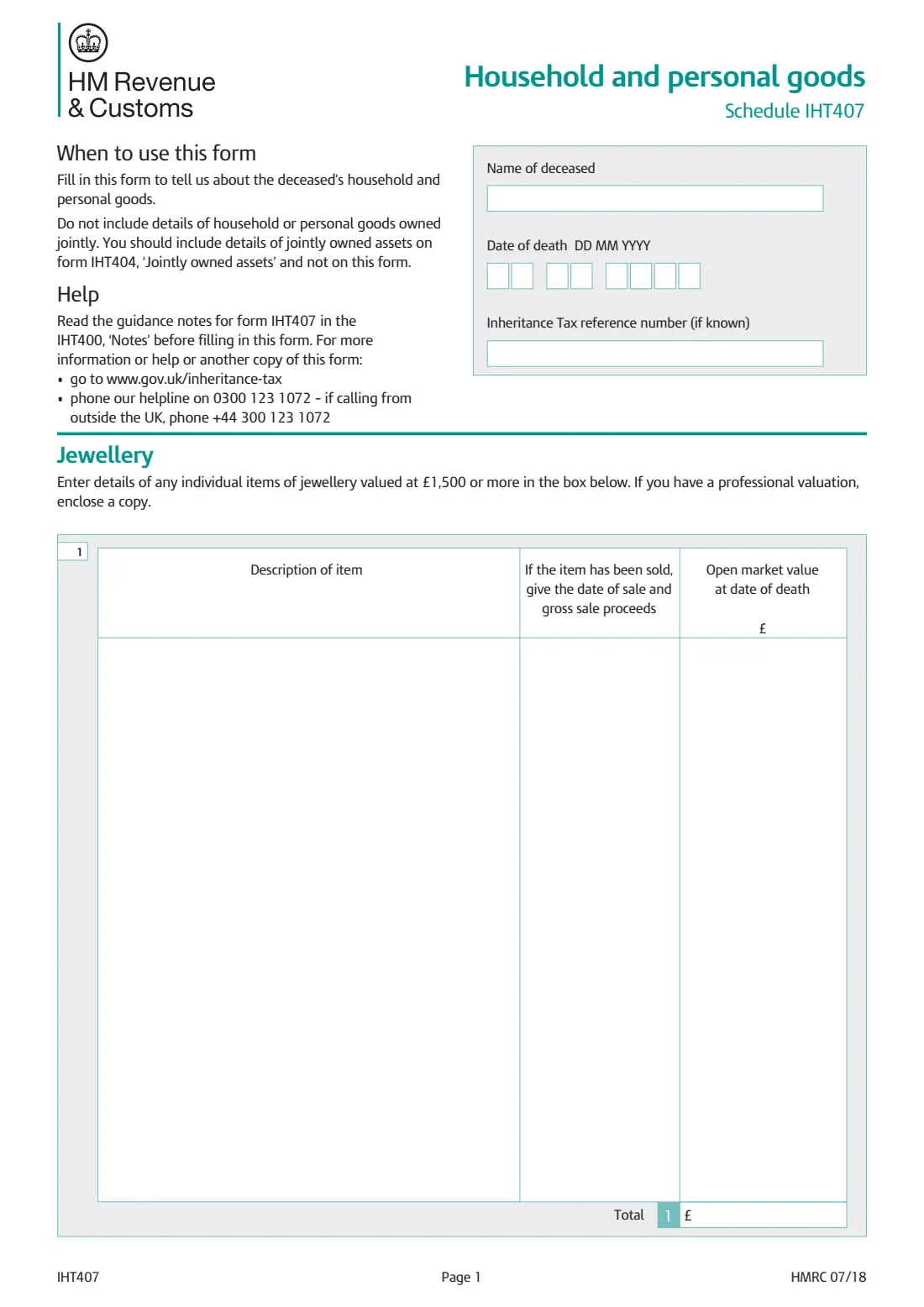
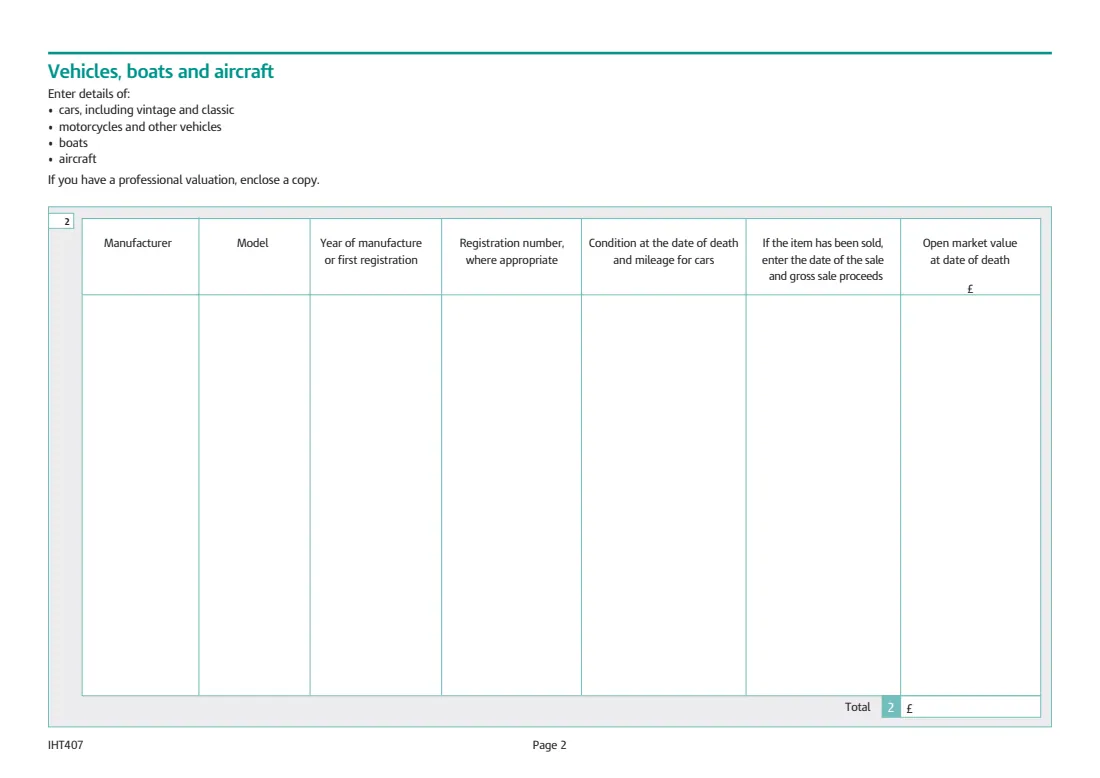
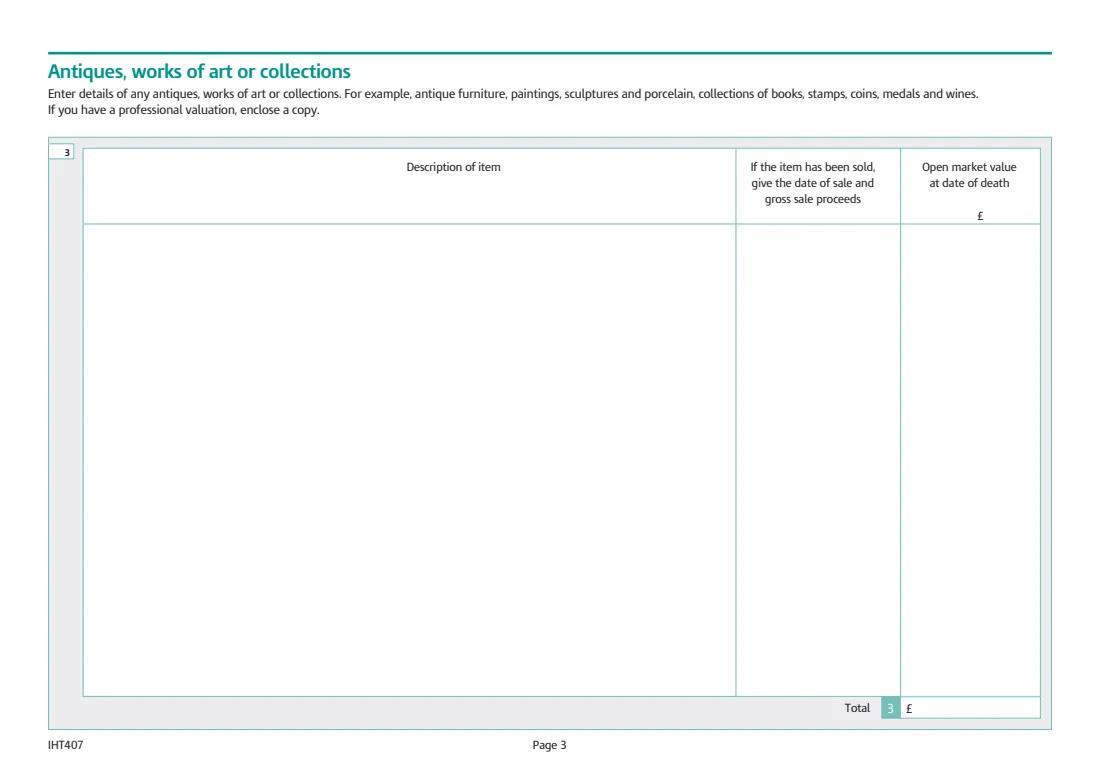
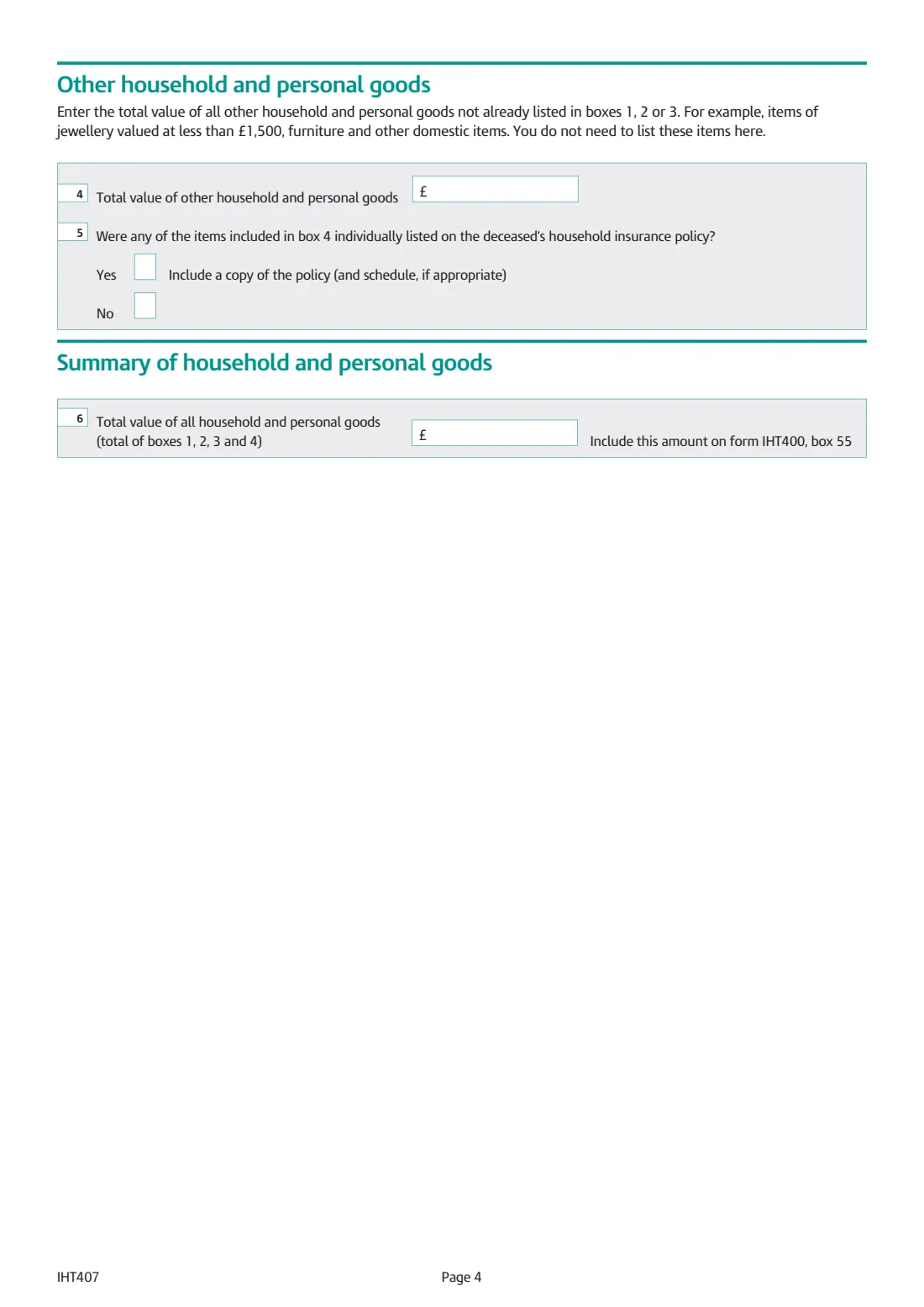
The form has three lists. The first is individual pieces of jewellery worth £1,500 or more. The second is cars, motorcycles, other vehicles, boats and aircraft, with their make, model, registration, condition and mileage. The third is antiques, works of art and collections, such as paintings, porcelain, stamps, coins, medals or wine. A fourth box takes the combined value of all other household and personal goods, and the form asks whether any of those were individually listed on the household insurance.
FileIt shows only as many lines as you need, adds up each list and the grand total for IHT400 box 55, and prints it all neatly into HMRC's own IHT407 PDF.
- Who fills it
- The executor or administrator preparing form IHT400
- Total goes to
- IHT400 box 55 (box 6 of this schedule)
- Jewellery listed if
- An item is worth £1,500 or more
- Room for
- 23 jewellery items, 19 vehicles, 20 antiques or collections
- Edition
- HMRC 07/18
- Helpline
- Inheritance Tax helpline 0300 123 1072
Who needs to fill out IHT407 household and personal goods?
- Executors and administrators preparing an IHT400 account for any estate. Nearly everyone owns household goods.
- Estates with valuable jewellery, classic cars, boats, artwork or collections that need listing individually.
- Not for goods owned jointly with someone else. Those go on IHT404.
When to use IHT407 household and personal goods
- Once you've valued the contents of the home and any valuable items, ideally with a professional valuation for anything significant.
- After any sale, so you can show the date and gross proceeds against the item.
- If a list runs out of lines, fill in another copy of the form.
What you need before you start
- The deceased's name, date of death and IHT reference, if known.
- A description and open market value for each piece of jewellery worth £1,500 or more.
- Make, model, year, registration, condition and mileage for each vehicle, boat or aircraft.
- Descriptions and values for antiques, works of art and collections.
- A total value for everything else, and the household insurance policy if items were listed on it.
- Copies of any professional valuations.
What’s on IHT407 household and personal goods
The 2018 edition has 4 pages. FileIt asks for it in 5 parts:
- The person who has diedExecutor or administrator
- 1 JewelleryExecutor or administrator
- 2 Vehicles, boats and aircraftExecutor or administrator
- 3 Antiques, works of art or collectionsExecutor or administrator
- 4 to 6 Other household and personal goods, and the totalExecutor or administrator
How to fill out IHT407 household and personal goods, step by step
1 About the deceased
Name, date of death and Inheritance Tax reference, pre-filled from your vault where possible.
2 Box 1: jewellery
Each item worth £1,500 or more, with its value at the date of death and, if sold, the date and gross proceeds. FileIt warns you if an item is under £1,500, as that belongs in box 4.
3 Box 2: vehicles, boats and aircraft
Manufacturer, model, year, registration, condition (and mileage for cars), any sale, and the open market value.
4 Box 3: antiques, works of art and collections
A description and value for each item or collection, with sale details if it has been sold.
5 Boxes 4 to 6: everything else and the total
One figure for all other goods, whether any were individually listed on the household insurance, and the grand total FileIt works out for IHT400 box 55.
Common mistakes to avoid
- Including jointly owned goods, which belong on IHT404.
- Listing every small item. Only jewellery of £1,500 or more is listed. The rest goes in the box 4 total.
- Using insurance or replacement values instead of open market value at the date of death.
- Forgetting to enclose the insurance policy when items were individually listed on it.
- Leaving out sale proceeds for items already sold.
After you fill it out
Check the values and download the filled PDF.
Copy box 6 to IHT400 box 55 and send IHT407 with the IHT400 account, with any valuations and the insurance policy if needed. FileIt doesn't send anything to HMRC.
Keep photos, receipts and valuations in the deceased's FileIt folder alongside the schedule.
Fill out IHT407 household and personal goods online with FileIt
- Pick the person. Choose someone from People and FileIt fills in their name, date of birth, address and other details it already knows.
- Answer plain-language questions. One part of the form at a time, with the official help text beside each question — 274 fields in all. Your answers save as you go.
- Check the live preview. Watch your answers land on the real HMRC form, and let FileIt do any worksheet arithmetic.
- Generate the official PDF. FileIt prints your answers into the agency’s own PDF and files it in that person’s folder in your vault.
FileIt fills the form — it never files or submits anything for you. Deliver the finished form to whoever asked for it, the way the form’s instructions say.
Start IHT407 household and personal goods now — it’s freeIHT407 household and personal goods: frequently asked questions
Do I have to list every item in the house?
No. Only jewellery of £1,500 or more an item, vehicles, boats and aircraft, and antiques, works of art and collections are listed. Everything else goes in as one total in box 4.
What value should I use?
The open market value at the date of death: roughly what the item would have fetched if sold then. That's often much less than its insurance or replacement value.
What if an item has already been sold?
Give the date of sale and the gross sale proceeds in the column provided, alongside its value at the date of death.
Where do jointly owned belongings go?
On schedule IHT404, jointly owned assets, not on IHT407.
Does anyone sign IHT407?
No. The declaration on IHT400 covers all the schedules.
Official sources
- Blank form (PDF), published by HMRC: https://assets.publishing.service.gov.uk/media/5b5ad12e40f0b6339963e92b/IHT407.pdf
- Official instructions and guidance: https://www.gov.uk/government/publications/inheritance-tax-household-and-personal-goods-iht407
- Edition shown on this page: HMRC 07/18 (checked 2026-10-19).
FileIt is not affiliated with or endorsed by HMRC or any government. This page explains the form in general terms and is not legal, tax or immigration advice. Always read the official instructions, and check that you are using the edition the recipient accepts. Page last reviewed 2026-10-19.