What is IHT405 houses and land?
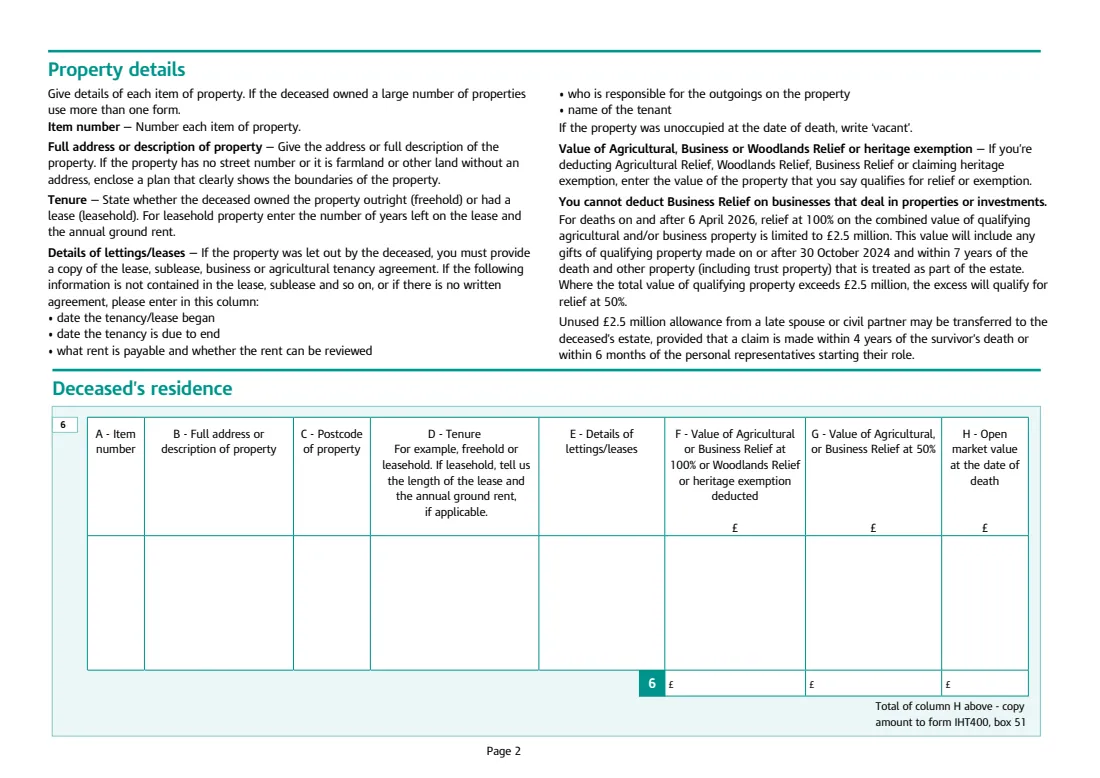
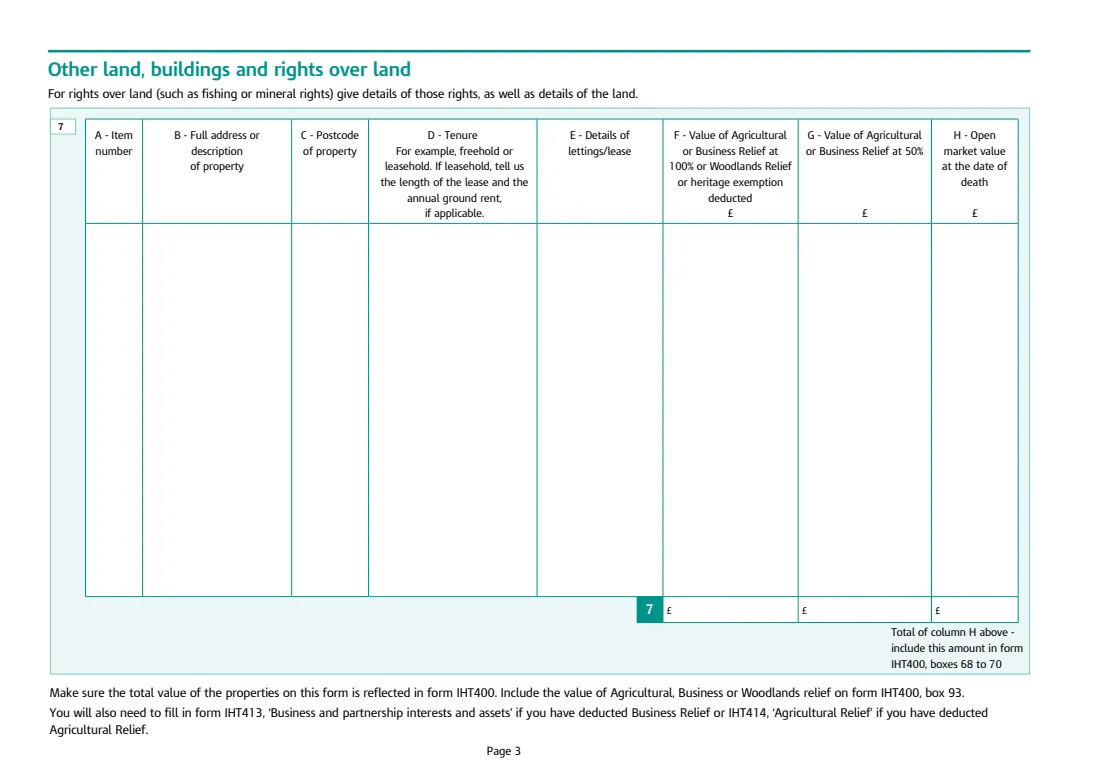
Property is often the largest part of an estate, so the IHT400 account asks for it in detail on schedule IHT405. The deceased's home goes in box 6. Other houses, flats, farmland, buildings and rights over land, such as fishing or mineral rights, go in box 7. For each one you give the address or a description, the tenure, any lettings, and the open market value at the date of death.
Where Agricultural, Business or Woodlands Relief or heritage exemption applies, the form also asks for the value that qualifies. This April 2026 edition has separate columns for relief at 100% and at 50%, reflecting the £2.5 million cap on 100% relief for deaths on and after 6 April 2026. The last page covers anything that affects value, such as damage or development potential, and any sale within 12 months of the death.
FileIt numbers the properties for you, adds up each column, fits long descriptions into the form's cells and prints the result into HMRC's own IHT405 PDF, ready to send with IHT400.
- Who fills it
- The executor or administrator preparing form IHT400
- Totals go to
- Box 6 to IHT400 box 51; box 7 into IHT400 boxes 68 to 70
- Room for
- The residence and 6 other properties, and 2 sales
- Reliefs
- Values at 100% and 50% relief shown in columns F and G (also IHT400 box 93)
- Edition
- HMRC 04/26
- Helpline
- Inheritance Tax helpline 0300 123 1072
Who needs to fill out IHT405 houses and land?
- Executors and administrators of an estate that includes the deceased's home or a share of it.
- Estates with buy-to-let property, holiday homes, farmland, woodland or commercial buildings.
- Estates owning rights over land, such as fishing, shooting or mineral rights.
When to use IHT405 houses and land
- Once you have a valuation of each property at the date of death. Enclose a copy of any professional valuation.
- When a property is being sold, or will be within 12 months of the death, since the sale price may become the value.
- Jointly owned property goes on IHT404 instead.
What you need before you start
- The address or full description of each property, with a plan for land that has no street address.
- Whether it's freehold or leasehold, and for a lease the years left and the ground rent.
- Tenancy or lease agreements for anything that was let, or the key terms if there's no written agreement.
- The open market value at the date of death, and the value qualifying for any relief or exemption.
- Survey, structural or planning reports for anything that affects the value, and insurers' letters for damage.
- Sale details: asking or agreed price, the buyer's relationship to the deceased, and fixtures included.
What’s on IHT405 houses and land
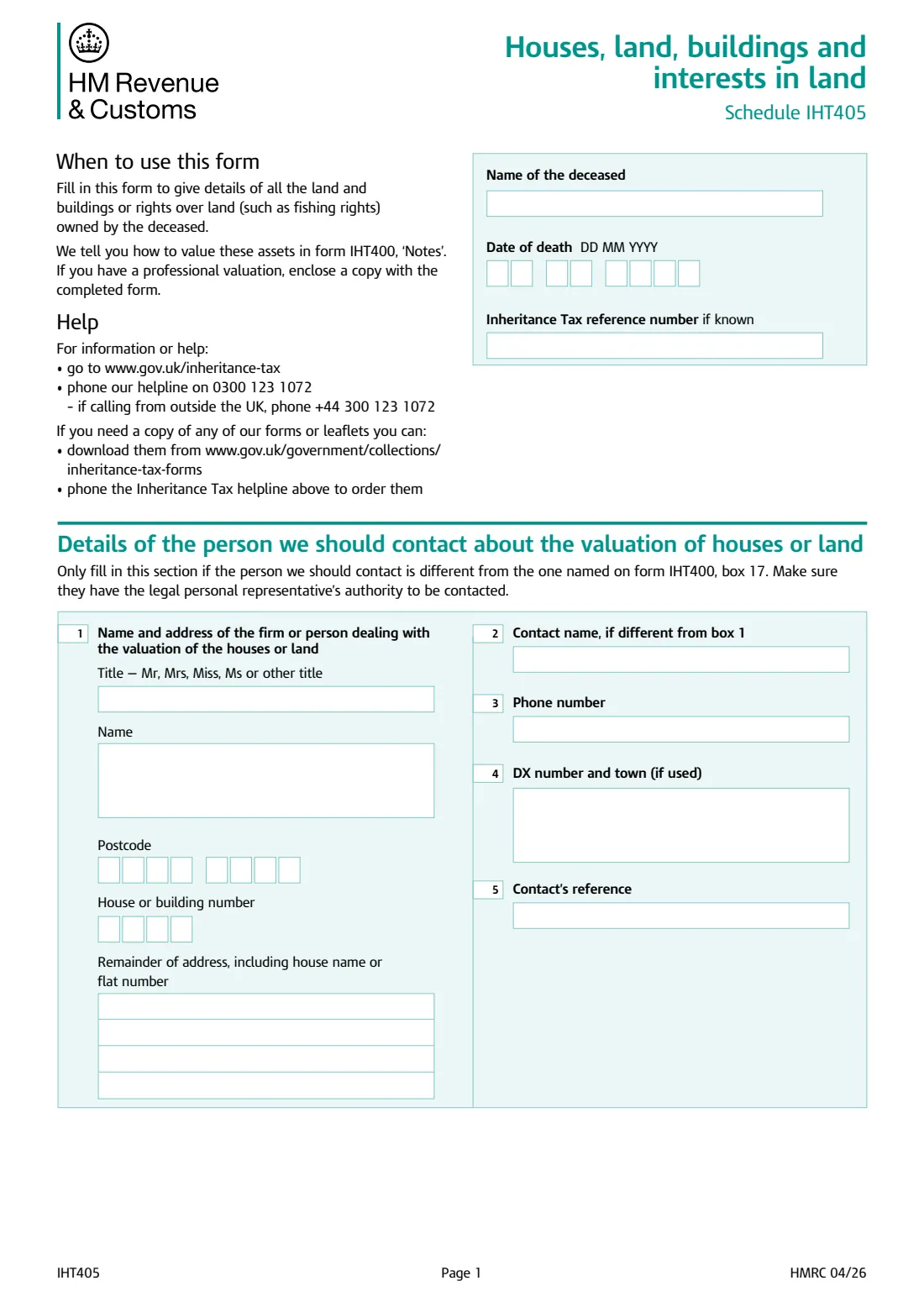
The 2026 edition has 4 pages. FileIt asks for it in 6 parts:
- The person who has diedExecutor or administrator
- The person HMRC should contact about the valuation (1 to 5)Executor or administrator
- 6 The deceased's residenceExecutor or administrator
- 7 Other land, buildings and rights over landExecutor or administrator
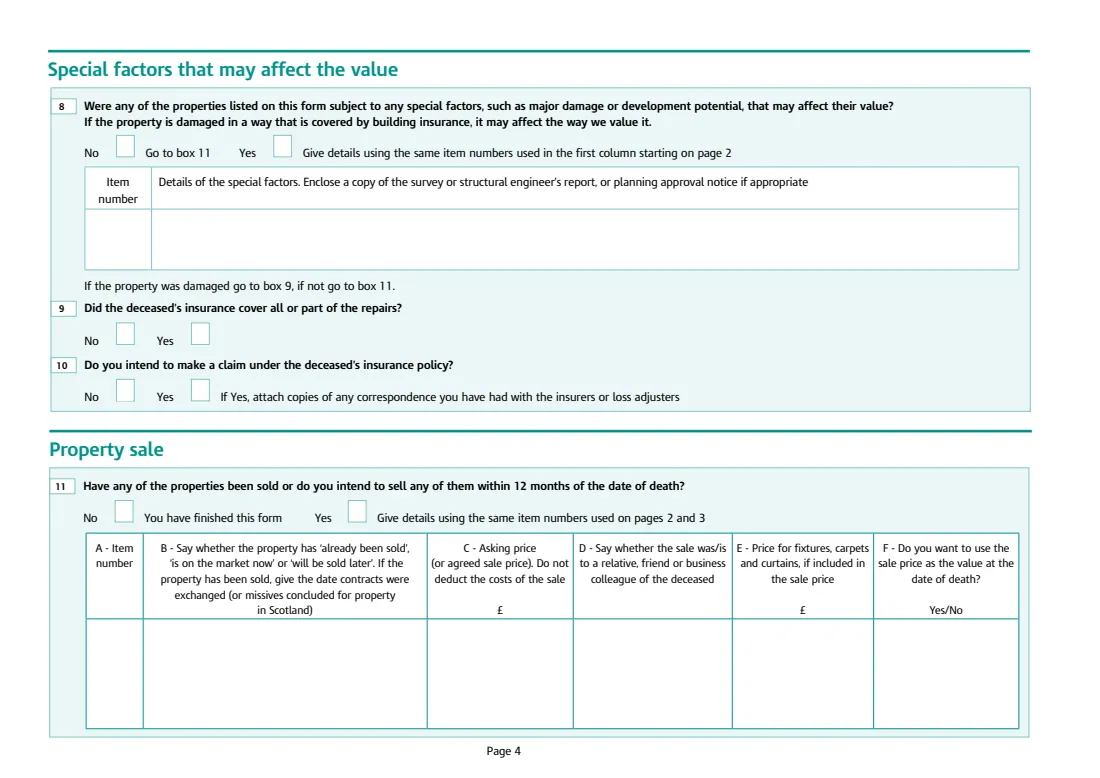
- Special factors that may affect the value (8 to 10)Executor or administrator
- Property sale (11)Executor or administrator
How to fill out IHT405 houses and land, step by step
1 About the deceased
Name, date of death and Inheritance Tax reference, pre-filled from your vault where possible.
2 Valuation contact (1 to 5)
Only if HMRC should talk to someone other than the person in IHT400 box 17 about the valuation, such as the surveyor. Switch this part on to fill it in.
3 The residence (box 6)
The deceased's own home: address, postcode, tenure, lettings, any relief values and the open market value. FileIt totals each column for box 6.
4 Other land and buildings (box 7)
Up to 6 more properties or rights over land, numbered from 2. FileIt totals columns F, G and H for box 7.
5 Special factors (8 to 10)
Anything that may change the value, such as major damage or development potential, with the item number and details. If there was damage, say whether insurance covers the repairs and whether you'll claim.
6 Property sale (11)
For any property sold or to be sold within 12 months: its status, the price, whether the buyer is connected to the deceased, fixtures included, and whether you want the sale price used as the value.
Common mistakes to avoid
- Listing jointly owned property here instead of on IHT404.
- Putting the relief amount in columns F or G. They take the value of the property that qualifies for relief.
- Claiming Business Relief on a business that deals in property or investments, which the form says you can't do.
- Leaving out lettings details, or not writing 'vacant' for an empty property.
- Forgetting a plan for land with no street address.
After you fill it out
Check the values against your valuations and download the filled PDF.
Carry the totals to IHT400 (box 51 and boxes 68 to 70) and any relief to box 93, and fill in IHT413 or IHT414 if you deduct Business or Agricultural Relief. FileIt doesn't send anything to HMRC.
Keep valuations, leases and plans with the schedule in the deceased's FileIt folder.
Fill out IHT405 houses and land online with FileIt
- Pick the person. Choose someone from People and FileIt fills in their name, date of birth, address and other details it already knows.
- Answer plain-language questions. One part of the form at a time, with the official help text beside each question — 101 fields in all. Your answers save as you go.
- Check the live preview. Watch your answers land on the real HMRC form, and let FileIt do any worksheet arithmetic.
- Generate the official PDF. FileIt prints your answers into the agency’s own PDF and files it in that person’s folder in your vault.
FileIt fills the form — it never files or submits anything for you. Deliver the finished form to whoever asked for it, the way the form’s instructions say.
Start IHT405 houses and land now — it’s freeIHT405 houses and land: frequently asked questions
What value do I use for a house?
Its open market value at the date of death: what it would reasonably have sold for then. IHT400 'Notes' explains how to value property, and you can enclose a professional valuation.
What are columns F and G for?
If Agricultural, Business or Woodlands Relief or heritage exemption applies, enter the value of the property that qualifies. Column F is for relief at 100% (or Woodlands Relief or heritage exemption), column G for relief at 50%.
What changed in April 2026?
For deaths on and after 6 April 2026, 100% relief on the combined value of qualifying agricultural and business property is limited to £2.5 million. Above that, the form says relief is at 50%.
Do I need to tell HMRC if I'm selling the house?
Yes. Question 11 asks about any property sold, or to be sold, within 12 months of the death, and whether you want the sale price used as its value.
Who signs IHT405?
No one signs the schedule. The declaration on IHT400 covers it.
Official sources
- Blank form (PDF), published by HMRC: https://assets.publishing.service.gov.uk/media/69e6367559ffffb9ecfcf954/IHT405.pdf
- Official instructions and guidance: https://www.gov.uk/government/publications/inheritance-tax-houses-land-buildings-and-interest-in-land-iht405
- Edition shown on this page: HMRC 04/26 (checked 2026-10-19).
FileIt is not affiliated with or endorsed by HMRC or any government. This page explains the form in general terms and is not legal, tax or immigration advice. Always read the official instructions, and check that you are using the edition the recipient accepts. Page last reviewed 2026-10-19.