What is IHT403 gifts and transfers of value?
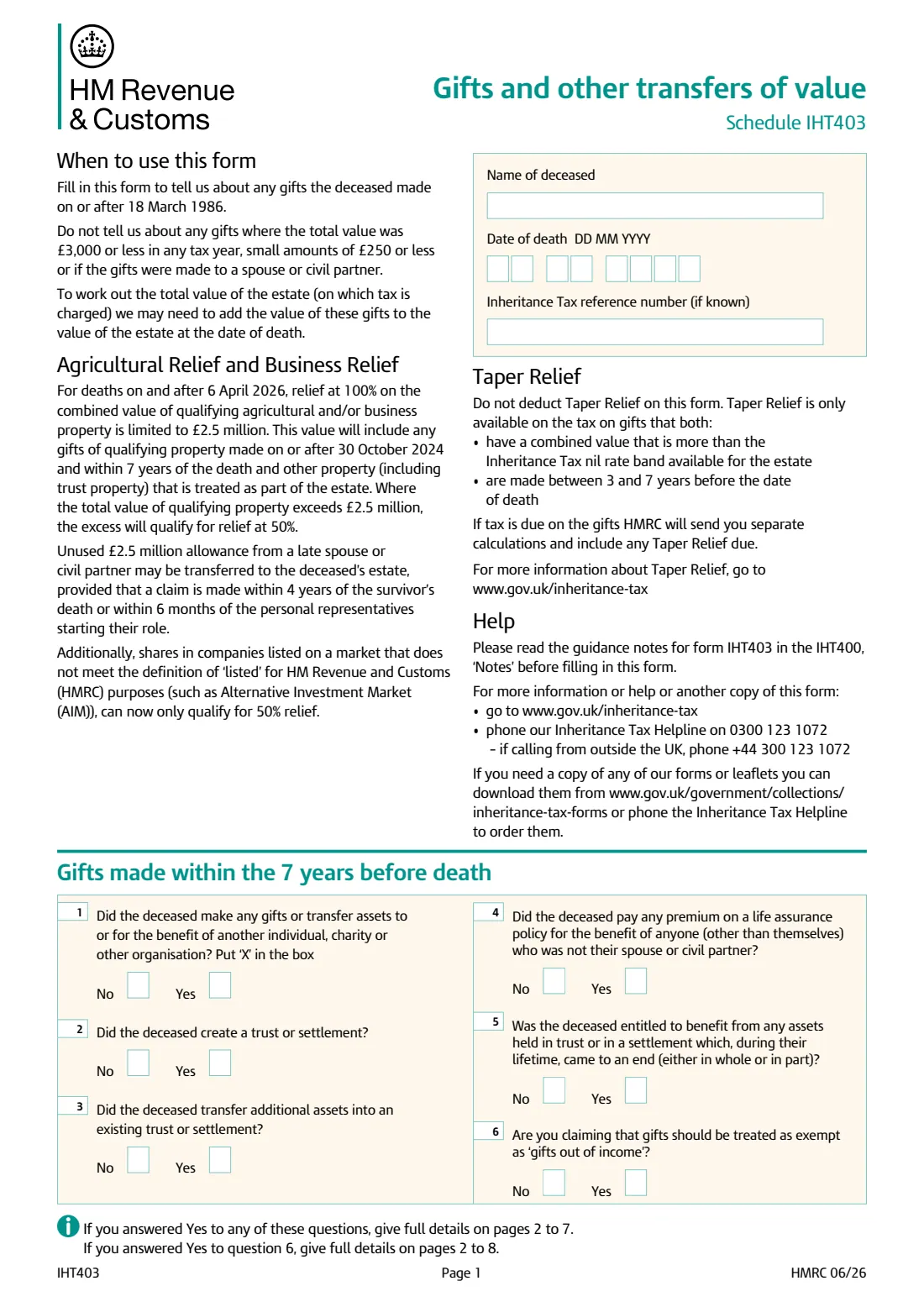
Gifts made during someone's life can still count towards their estate for Inheritance Tax, especially those made in the 7 years before death. Schedule IHT403 is where the IHT400 account records them. That covers outright gifts, transfers into trusts, life insurance premiums paid for someone else, and trust interests that ended during their lifetime.
The schedule also covers gifts with reservation of benefit, such as a house given to a child that the parent carried on living in, and pre-owned assets. It lists chargeable transfers in the 7 years before the earliest gift, and, if you're claiming gifts were normal spending out of income, a year-by-year picture of the deceased's income and outgoings. Small gifts, gifts of £3,000 or less in a tax year and gifts to a spouse or civil partner aren't listed.
FileIt walks through each part, shows only the rows you need, works out each gift's net value, the box totals and each year's income surplus, and fills HMRC's own June 2026 IHT403, whose tables are printed sideways.
- Who fills it
- The executor or administrator preparing form IHT400
- Totals go to
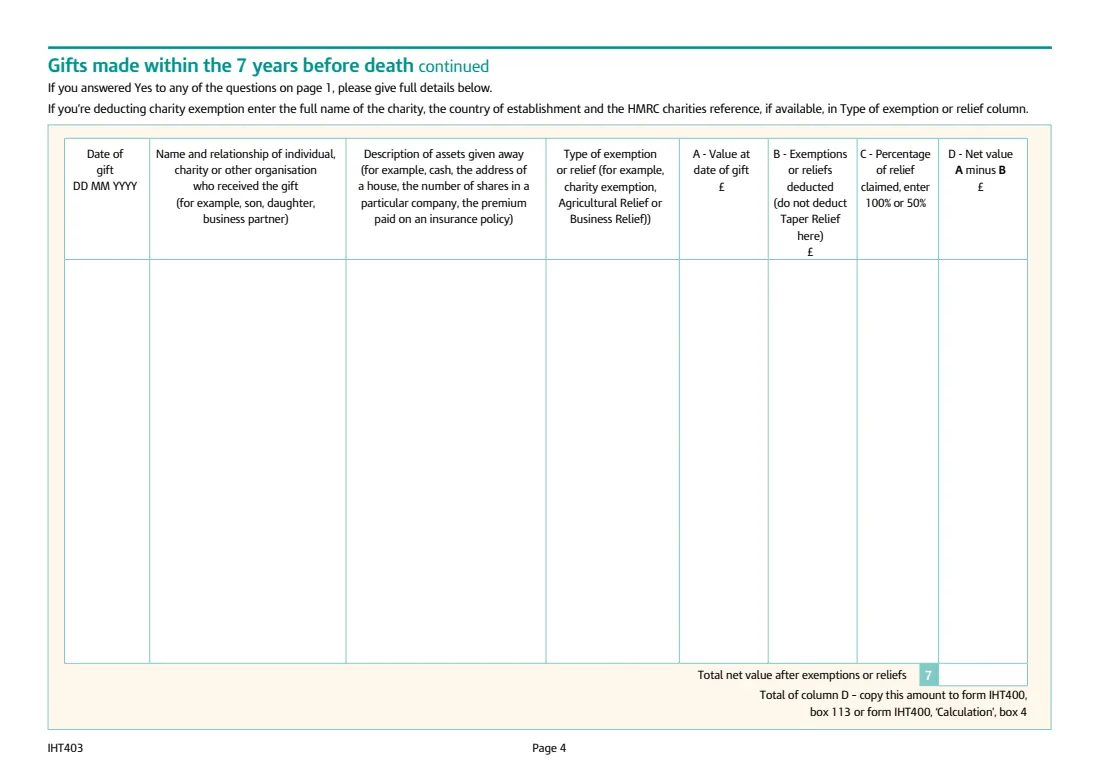
- Box 7 to IHT400 box 113 (or 'Calculation' box 4); box 17 to IHT400 box 104
- Look-back
- Gifts made on or after 18 March 1986, with the main table for the 7 years before death
- Room for
- 15 gifts, 3 gifts with reservation, 4 pre-owned assets, 5 earlier transfers, 8 tax years
- Edition
- HMRC 06/26
- Helpline
- Inheritance Tax helpline 0300 123 1072
Who needs to fill out IHT403 gifts and transfers of value?
- Executors of anyone who gave away money, property or shares in the 7 years before they died.
- Estates where the deceased set up or added to a trust, or paid life insurance premiums for someone else.
- Estates where the deceased gave something away but kept using it, or benefited from assets they once owned.
- Executors claiming that regular gifts were exempt as normal expenditure out of income.
When to use IHT403 gifts and transfers of value
- Once you've gathered bank statements, gift records and letters showing what the deceased gave, when and to whom.
- If you answer Yes to any of the 6 questions on page 1.
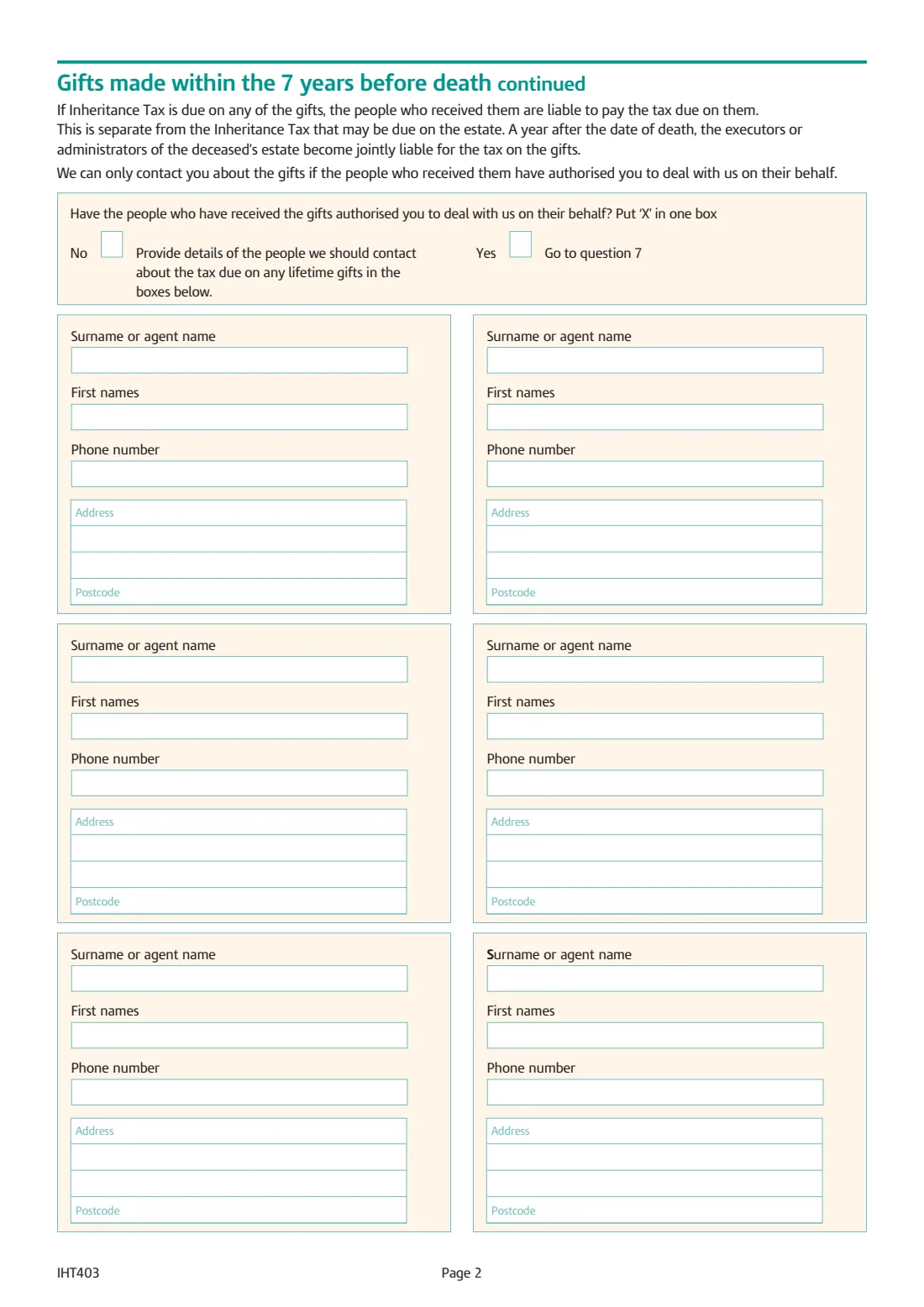
- Recipients may have to pay tax on gifts, so the form also asks whether they've authorised you to deal with HMRC for them.
What you need before you start
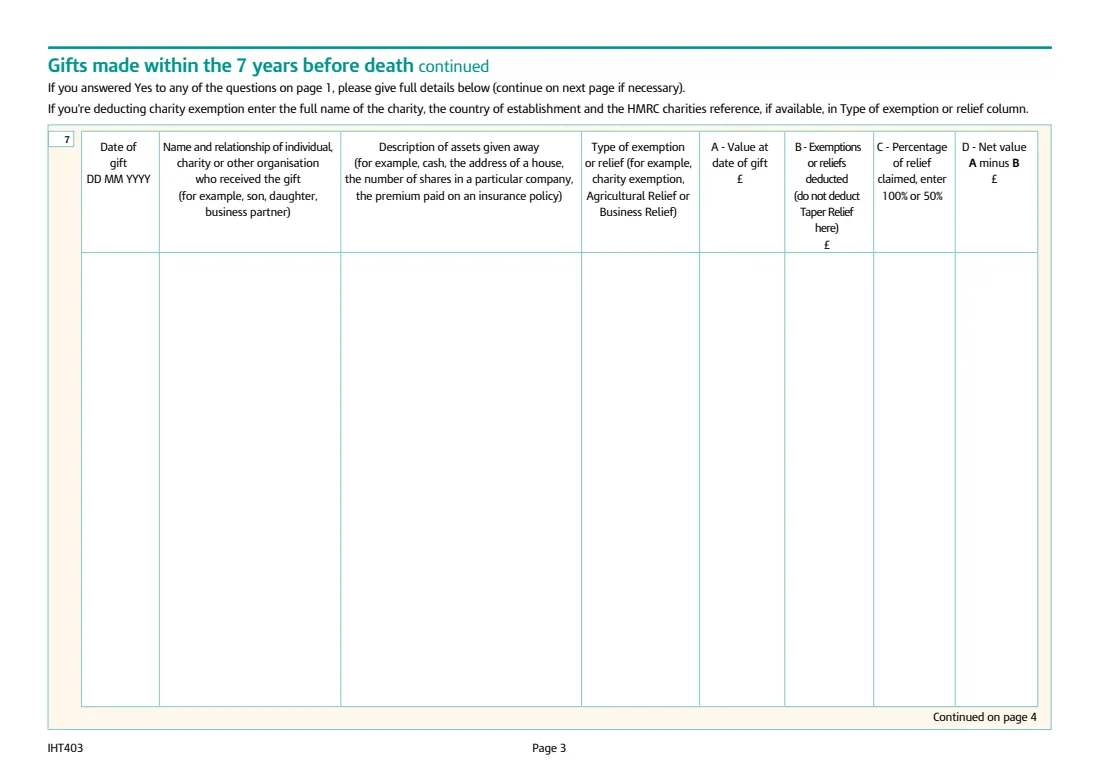
- For each gift: the date, who received it and their relationship, what was given, its value, and any exemption or relief.
- Details of any gift the deceased kept a benefit from, or any pre-owned asset, including any IHT500 election date and POA reference.
- Any chargeable transfers in the 7 years before the earliest listed gift.
- Names, phone numbers and addresses of recipients HMRC should contact, if they haven't authorised you.
- For gifts out of income: the deceased's income, Income Tax and spending for each tax year concerned.
What’s on IHT403 gifts and transfers of value
The 2026 edition has 8 pages. FileIt asks for it in 8 parts:
- The person who has diedExecutor or administrator
- Gifts made within the 7 years before death (1 to 6)Executor or administrator
- Who HMRC should contact about the giftsExecutor or administrator
- 7 Gifts made within the 7 years before deathExecutor or administrator
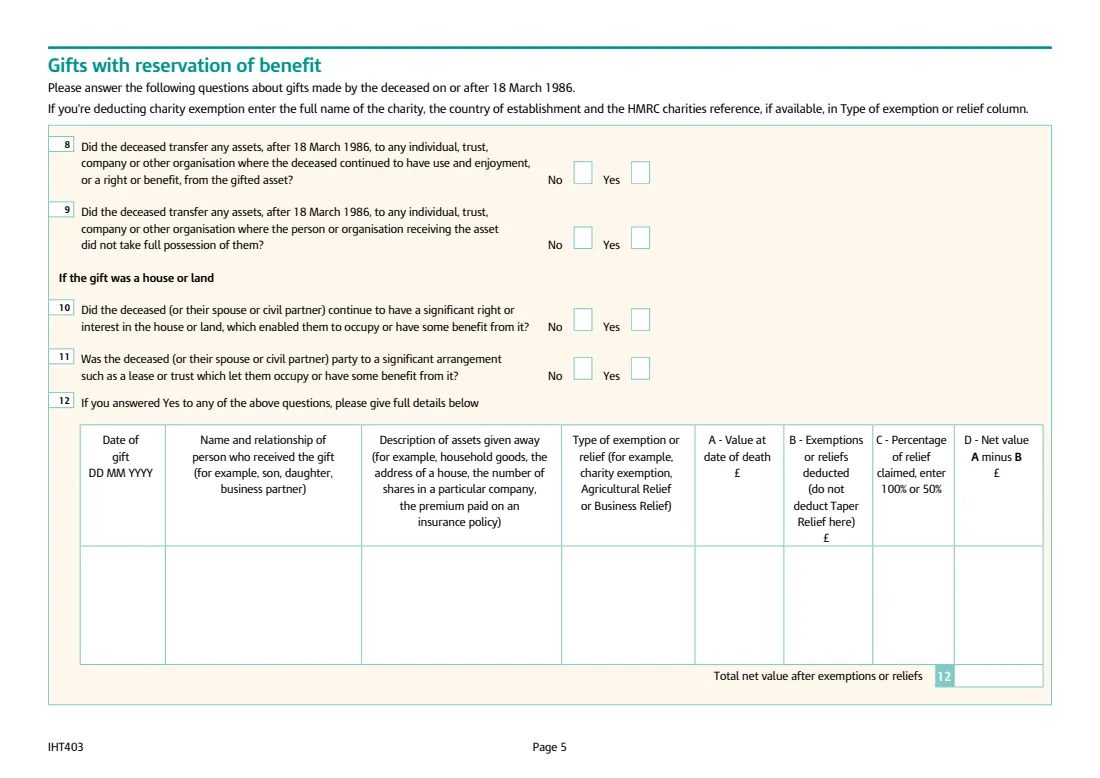
- 8 to 12 Gifts with reservation of benefitExecutor or administrator
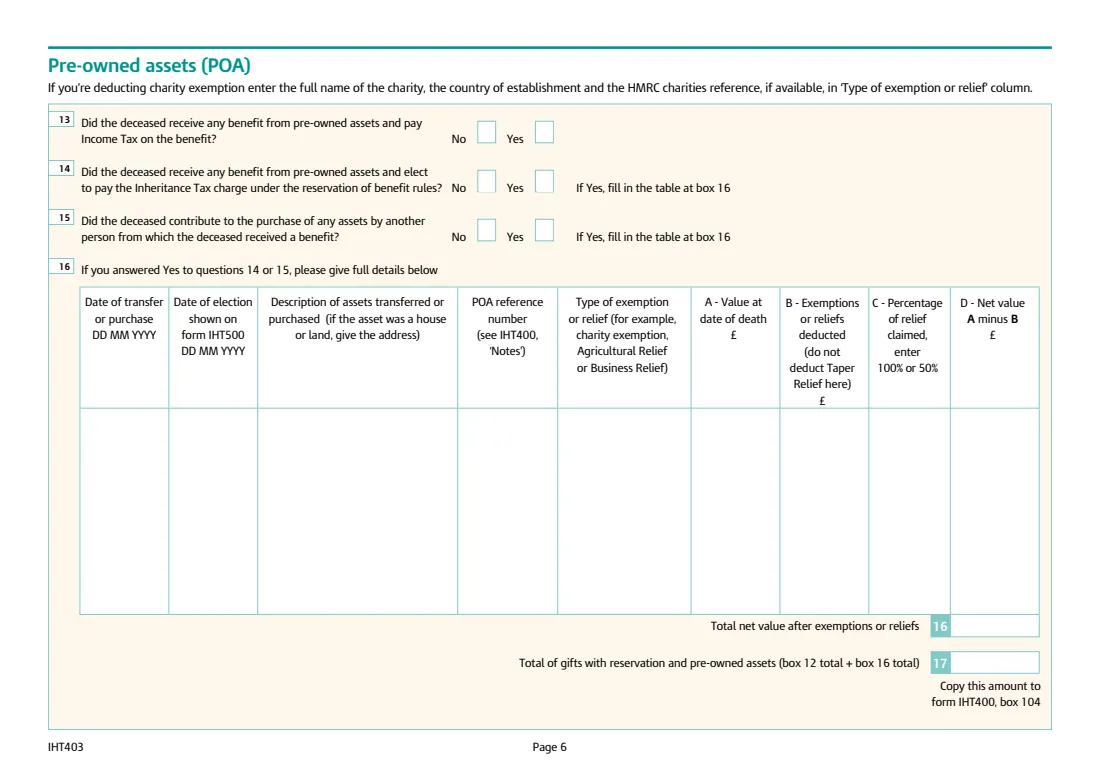
- 13 to 17 Pre-owned assets (POA)Executor or administrator
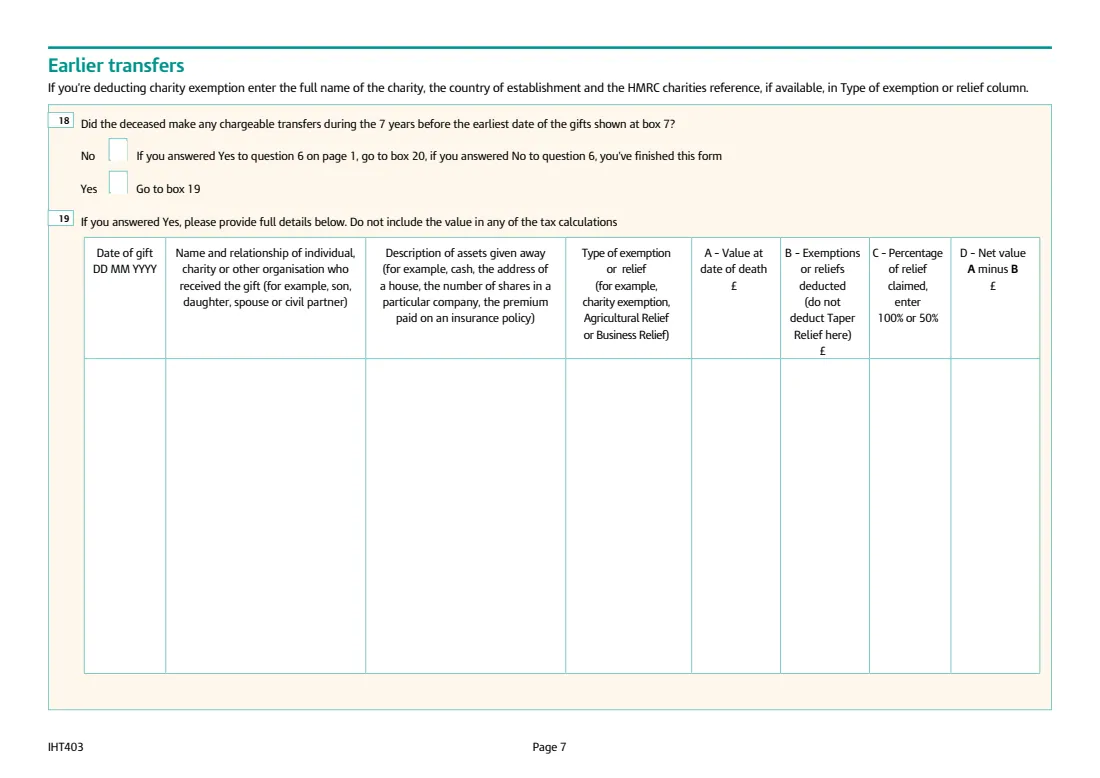
- 18 and 19 Earlier transfersExecutor or administrator
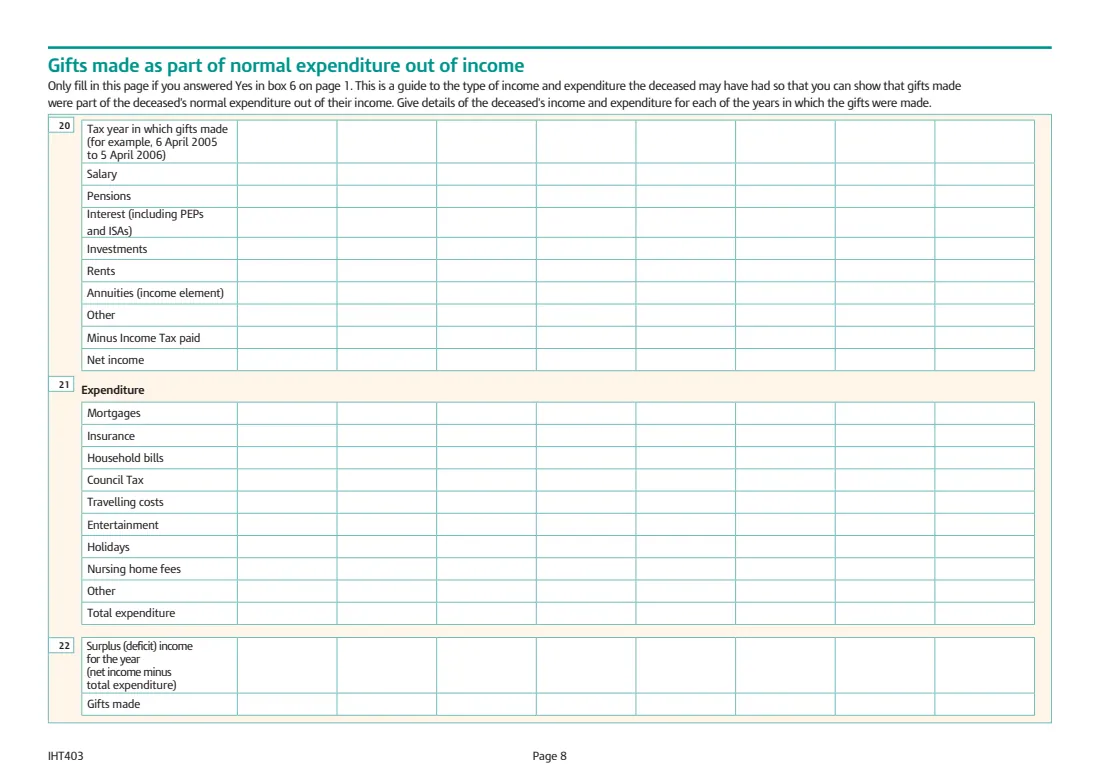
- 20 to 22 Gifts made as part of normal expenditure out of incomeExecutor or administrator
How to fill out IHT403 gifts and transfers of value, step by step
1 About the deceased and questions 1 to 6
Name, date of death and IHT reference, then six yes/no questions about gifts, trusts, life insurance premiums, trust interests that ended, and gifts out of income.
2 Who HMRC should contact
Whether the recipients have authorised you to deal with HMRC. If not, give up to 6 contacts.
3 Box 7: gifts in the 7 years before death
Up to 15 gifts with their date, recipient, description, exemption or relief, value (A), amount deducted (B) and the relief percentage. FileIt works out each net value (D) and the total for IHT400.
4 Boxes 8 to 17: reservation of benefit and pre-owned assets
Questions about gifts the deceased kept a benefit from and assets they benefited from after giving them away or paying towards them, with details of each. FileIt totals boxes 12 and 16 and adds them for box 17.
5 Boxes 18 and 19: earlier transfers
Chargeable transfers in the 7 years before the earliest gift in box 7. They're listed for HMRC's records but aren't added into the tax sums.
6 Boxes 20 to 22: gifts out of income
For each tax year, the deceased's income by type, Income Tax paid and spending by type. FileIt works out net income, total spending and the surplus, and you add the gifts made that year.
Common mistakes to avoid
- Deducting Taper Relief. The form says not to: HMRC works it out if tax is due.
- Listing gifts to a spouse or civil partner, small gifts of £250 or less, or gifts within the £3,000 annual exemption.
- Forgetting gifts where the deceased kept a benefit, such as living rent-free in a house they gave away.
- Claiming gifts out of income without showing they came from surplus income and left the deceased's standard of living unchanged.
- Missing the charity's full name, country and HMRC reference when deducting charity exemption.
After you fill it out
Check each gift and total in the preview, then download the filled PDF.
Copy box 7 to IHT400 box 113 (or 'Calculation' box 4) and box 17 to box 104, and send IHT403 with the IHT400 account. FileIt doesn't send anything to HMRC.
Keep the evidence of the gifts and the deceased's income records in their FileIt folder.
Fill out IHT403 gifts and transfers of value online with FileIt
- Pick the person. Choose someone from People and FileIt fills in their name, date of birth, address and other details it already knows.
- Answer plain-language questions. One part of the form at a time, with the official help text beside each question — 466 fields in all. Your answers save as you go.
- Check the live preview. Watch your answers land on the real HMRC form, and let FileIt do any worksheet arithmetic.
- Generate the official PDF. FileIt prints your answers into the agency’s own PDF and files it in that person’s folder in your vault.
FileIt fills the form — it never files or submits anything for you. Deliver the finished form to whoever asked for it, the way the form’s instructions say.
Start IHT403 gifts and transfers of value now — it’s freeIHT403 gifts and transfers of value: frequently asked questions
Which gifts do I need to list?
Gifts and transfers the deceased made on or after 18 March 1986 that aren't exempt. The main table covers the 7 years before death. Don't list gifts totalling £3,000 or less in a tax year, small gifts of £250 or less, or gifts to a spouse or civil partner.
What is a gift with reservation of benefit?
A gift where the deceased kept using or benefiting from what they gave away, such as giving a house to a child but carrying on living in it. These are reported in boxes 8 to 12.
Should I deduct Taper Relief?
No. The form says Taper Relief isn't deducted on IHT403. If tax is due on the gifts, HMRC will send separate calculations including any Taper Relief.
How do I show gifts were out of normal income?
Answer Yes to question 6 and fill in boxes 20 to 22 for each tax year in which gifts were made: income, Income Tax, spending, and the gifts. FileIt works out the yearly surplus.
Who pays tax on the gifts?
The form explains that the people who received the gifts are liable for any tax due on them, and that a year after the death the executors become jointly liable too.
Official sources
- Blank form (PDF), published by HMRC: https://assets.publishing.service.gov.uk/media/6a38f59a00ff27f06e3efb7e/IHT403-06-26.pdf
- Official instructions and guidance: https://www.gov.uk/government/publications/inheritance-tax-gifts-and-other-transfers-of-value-iht403
- Edition shown on this page: HMRC 06/26 (checked 2026-10-19).
FileIt is not affiliated with or endorsed by HMRC or any government. This page explains the form in general terms and is not legal, tax or immigration advice. Always read the official instructions, and check that you are using the edition the recipient accepts. Page last reviewed 2026-10-19.