What is Vero form 5 (3049e) - business tax return, self-employed?
Tax return form 5 (Veroilmoitus 5, form 3049e in English) is how a business operator or self-employed person in Finland reports their business for income taxation. Vero says business operators and self-employed people file form 5, and asks you to do it in MyTax where possible. This PDF is the paper form for tax year 2025, which you post with its enclosures.
The four pages cover business income, deductible and non-deductible expenses, the business profit or loss, and any request to deduct a loss from capital income. They also cover the division of income between spouses who run the business together and the depreciation of movable fixed assets. Other parts cover cars and vans in private use, cash withdrawals, business use of your home, travel and car-use deductions, and non-deductible interest. The return ends with the business net worth, equity, reserves, wages paid and the choice of how business income is divided.
FileIt asks for each amount once, in euros and cents, and fills Vero's separate € and cent boxes. It adds up total taxable business income, total deductible expenses and the profit or loss, and works through the arithmetic in the travel, car, interest and net-worth parts. It prints everything into Vero's own PDF (VEROH 3049e 1.2025). FileIt never files anything: you print, sign and post it, or enter the same figures in MyTax.
- Who fills it
- Business operators and self-employed persons (sole traders)
- Given to
- Tax Administration, P.O. Box 700, 00052 VERO, or in MyTax (vero.fi/mytax)
- Tax year
- 2025 (edition VEROH 3049e 1.2025)
- Signature
- Signed by hand; Vero reads the paper form by OCR
- Enclosure forms
- Where needed: 62, 18B, 8B, 70 (and 67 for the R&D deduction)
Who needs to fill out Vero form 5 (3049e) - business tax return, self-employed?
- A sole trader (toiminimi) or other self-employed person reporting business income for income taxation.
- Someone registered as self-employed who has to file even if the business was not active.
- Spouses who run a business together and want business income divided between them.
- A business operator who wants the maximum capital income set at 10% of net worth, or all business income taxed as earned income.
When to use Vero form 5 (3049e) - business tax return, self-employed
- Once your accounts for the accounting period (usually the calendar year) are closed. File by the deadline Vero gives you in MyTax.
- Use this edition (1.2025) for tax year 2025. Each tax year has its own form.
- Use MyTax instead if you can. Vero prefers it, and it is the same return.
What you need before you start
- Your Business ID or personal identity code, and the accounting period.
- Your income statement: net sales, grants, other income, private use of business assets, dividends, co-operative surplus and financial income.
- Your expenses: purchases, external services, wages and staff costs, depreciation, entertainment, rent, interest and other costs.
- The balance sheet: fixed, current and financial assets and liabilities, and equity if you keep double-entry books.
- Kilometres and costs for vehicles in private use, and your driver's log.
- Travel days and Vero's tax-exempt travel allowance amounts for the year, if you claim the additional deductions.
- Any enclosure forms you need: 62 (depreciation and reserves), 18B (real estate), 8B (securities), 70 (foreign tax refund).
What’s on Vero form 5 (3049e) - business tax return, self-employed
The 2025 edition has 4 pages. FileIt asks for it in 16 parts, and it is signed by Taxpayer:
- 1 Personal details and tax yearTaxpayer
- 2.1-2.2 Business incomeTaxpayer
- 2.3 Business expenses and profit or lossTaxpayer
- 3-4 Loss deduction and division between spousesTaxpayer
- 5 Depreciation of movable fixed assetsTaxpayer
- 6 Passenger vehicles and vansTaxpayer
- 7 Cash withdrawals and investmentsTaxpayer
- 8 Use of your home for businessTaxpayer
- 9 Increased living expenses on business travelTaxpayer
- 10 Private car used for businessTaxpayer
- 11 Non-deductible interest expensesTaxpayer
- 12 Calculation of net worthTaxpayer
- 13 Type of equityTaxpayer
- 14-16 Reserve, wages paid and capital gainsTaxpayer
- 17 Division of business income and signatureTaxpayer
- Amounts as printed (calculated)Taxpayer
How to fill out Vero form 5 (3049e) - business tax return, self-employed, step by step
1 1. Personal details and tax year
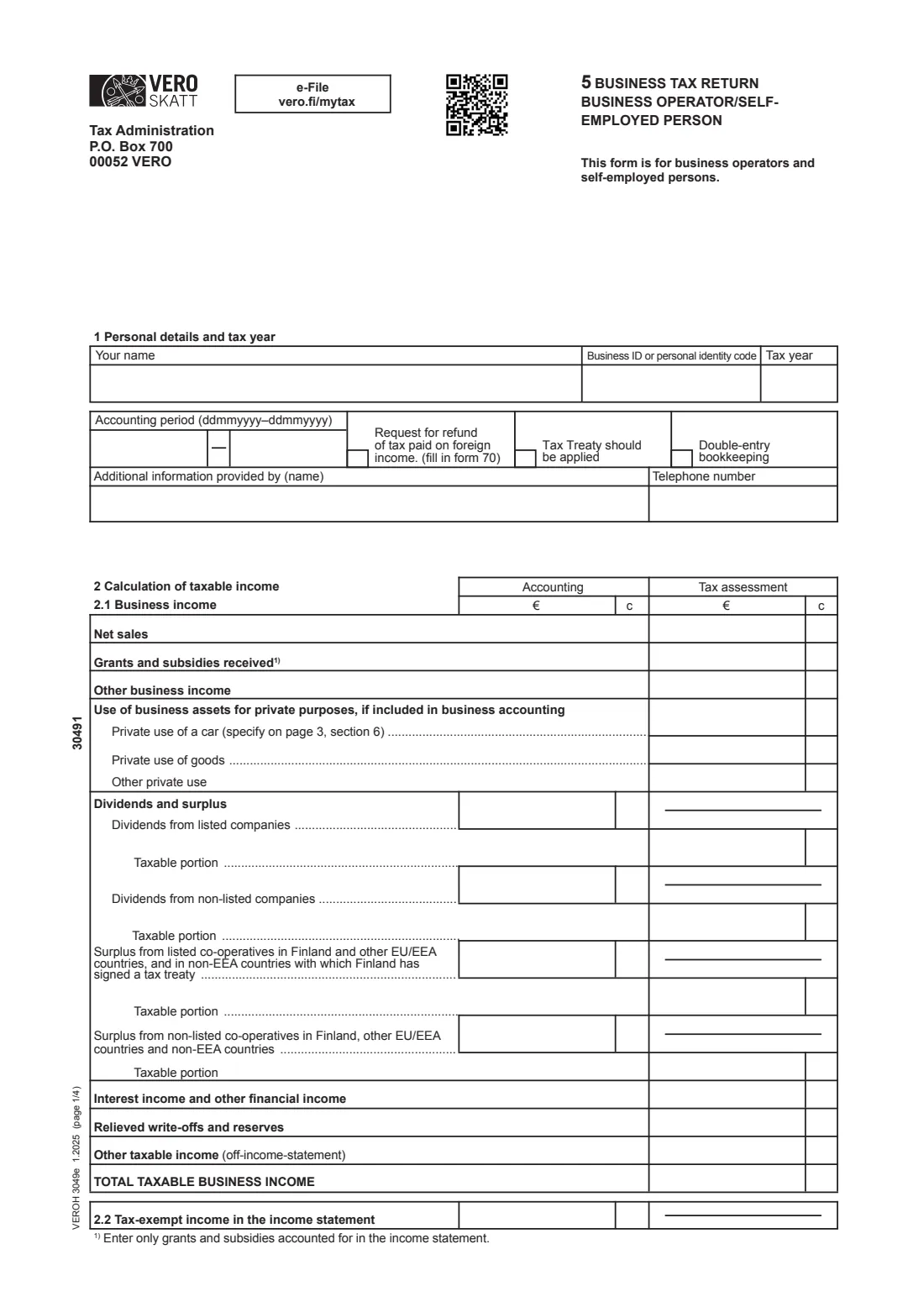
Your name, Business ID or identity code, tax year and accounting period. Tick a request for a refund of foreign tax (with form 70), if a tax treaty should be applied, and whether you keep double-entry books. Add the name and phone number of the person Vero can contact.
2 2.1-2.2 Business income
Net sales, grants and subsidies, other income, and private use of business assets (car, goods, other). Give dividends and co-operative surplus in full, with the taxable portion beside them, then interest, relieved write-offs and reserves, and off-statement income. FileIt adds up the total. Tax-exempt income goes in 2.2.
3 2.3 Business expenses and profit or loss
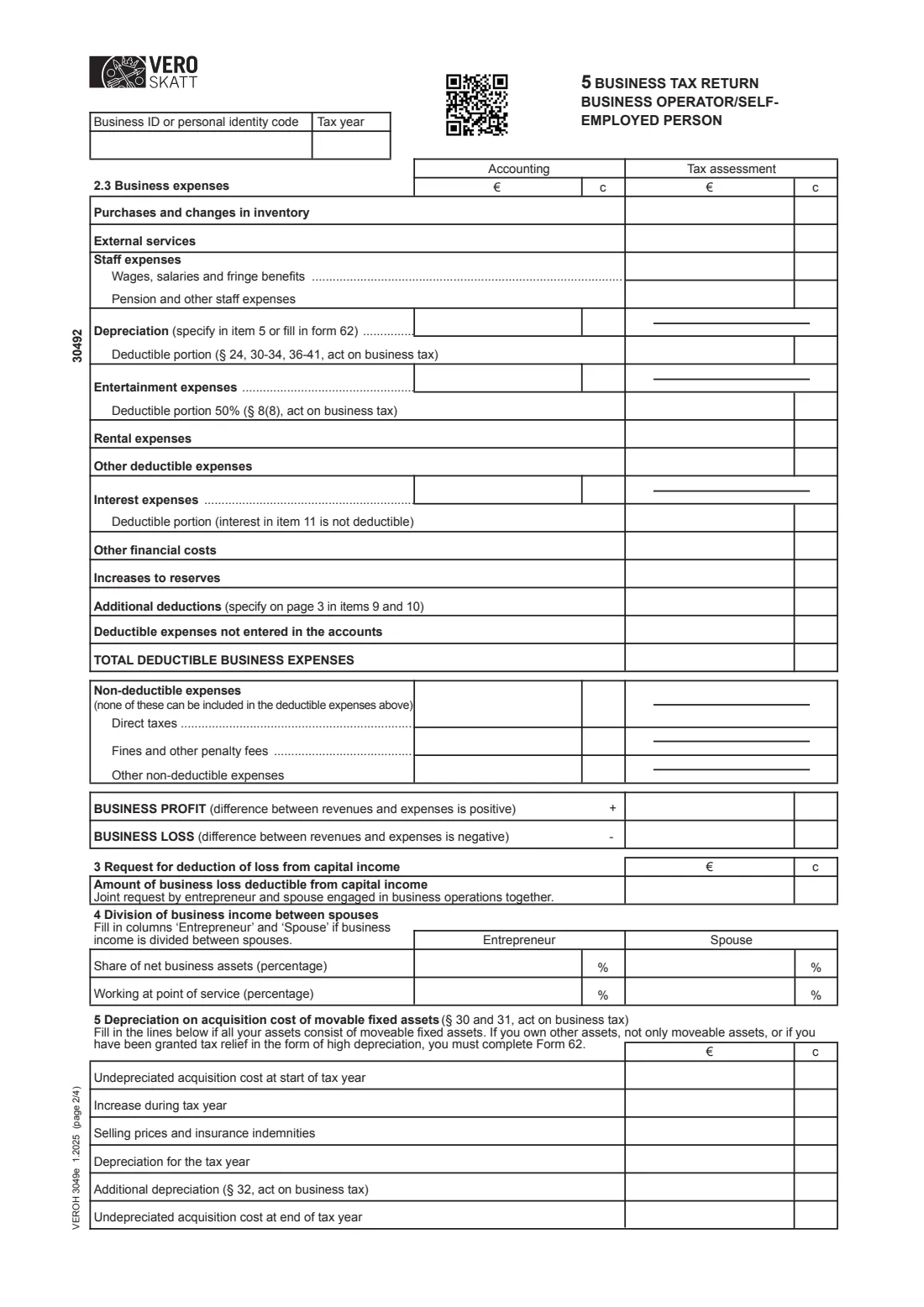
Deductible expenses, with depreciation, entertainment and interest given in full and as the deductible portion. Add the additional deductions from items 9 and 10 and deductible expenses not in the accounts. Non-deductible expenses (direct taxes, fines, others) are listed separately. FileIt works out the total and the business profit or loss.
4 3-5. Loss, spouses and depreciation
Optionally ask for a business loss to be deducted from capital income, or divide business income between spouses by share of assets and work. Fill in item 5 only if all your assets are movable fixed assets. Otherwise use form 62.
5 6-8. Vehicles, cash and your home
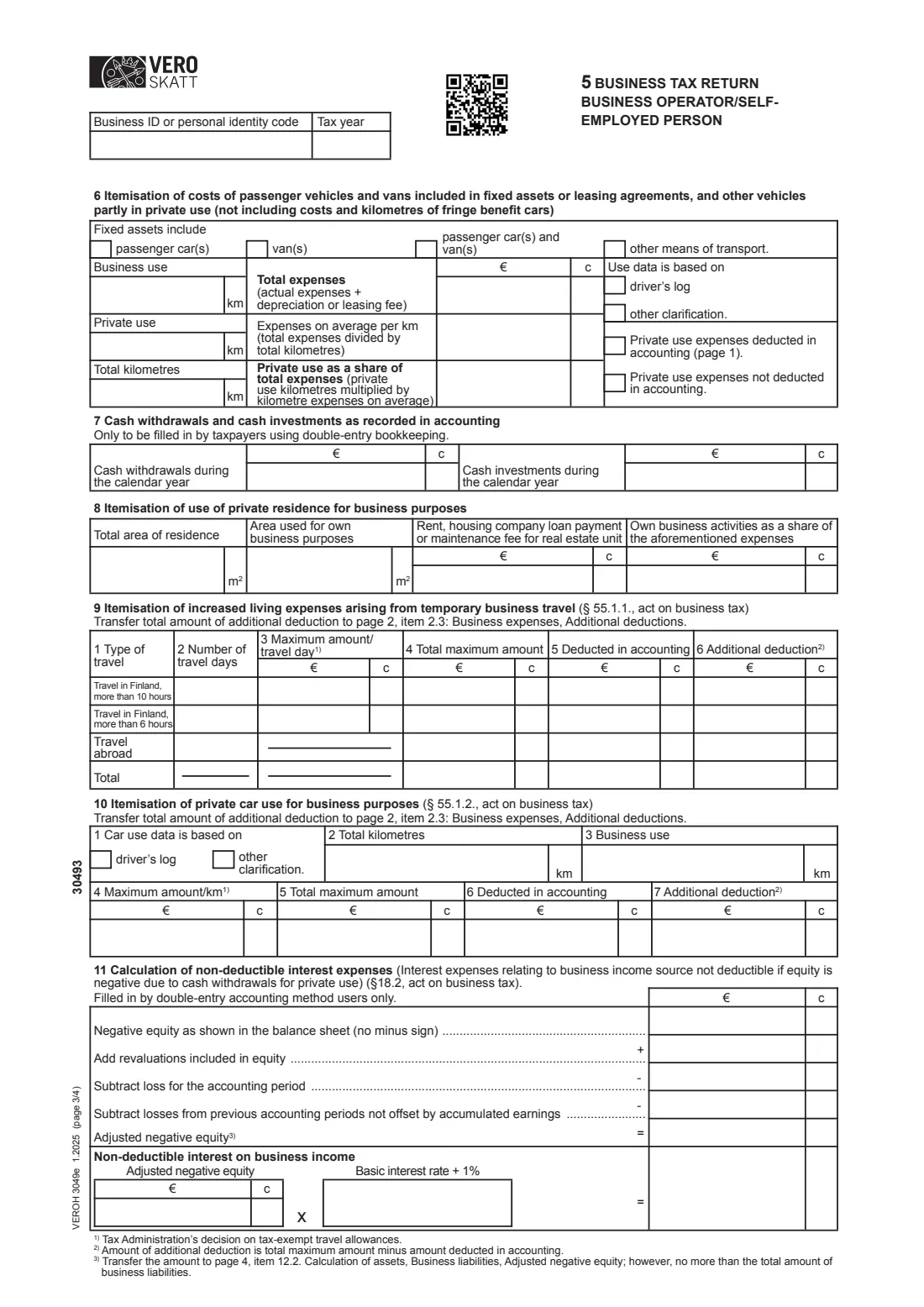
Kilometres and total costs of cars and vans partly in private use, with the private share worked out. Double-entry bookkeepers add cash withdrawals and investments. Then give the area and costs of the part of your home used for the business.
6 9-11. Travel, own car and non-deductible interest
Travel days and the maximum daily amounts, less what was deducted in the accounts, give the additional travel deduction. Business kilometres in your own car times the per-km amount give the car deduction. Negative equity caused by private withdrawals makes part of the interest non-deductible.
7 12-17. Net worth, equity, reserves and signature
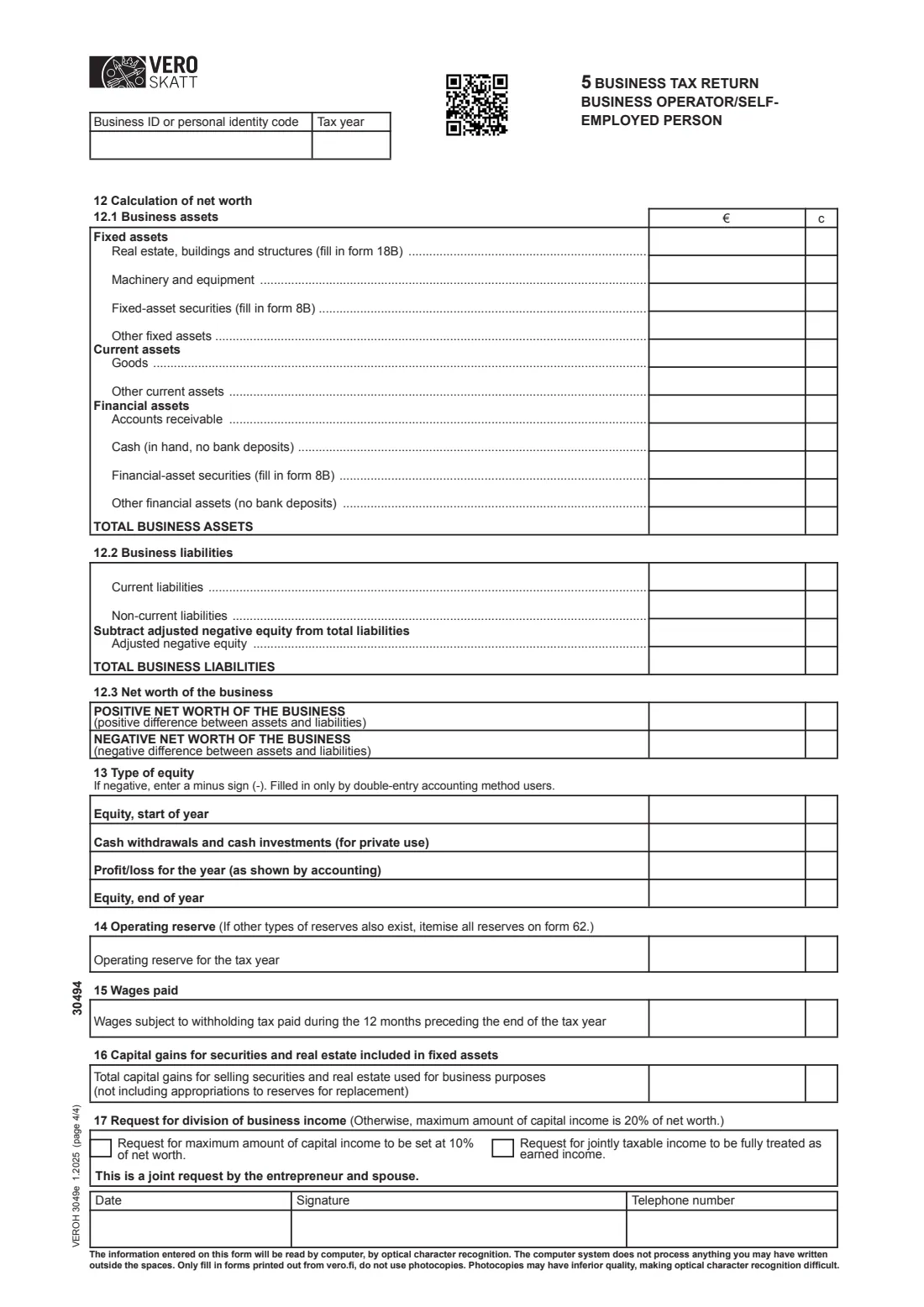
Business assets and liabilities give the net worth, and FileIt adds these up. Then equity for double-entry books, the operating reserve, wages subject to withholding, and capital gains on fixed assets. Choose how business income is divided if you want to (10% capital income, or all as earned income), then date and sign.
Common mistakes to avoid
- Entering a dividend or co-operative surplus only in the Accounting column and not its taxable portion.
- Deducting all entertainment or all interest when only the deductible portion goes in the tax column.
- Filling in item 5 when you also have assets other than movable fixed assets. Form 62 is needed then.
- Forgetting to carry the additional deductions from items 9 and 10 to item 2.3.
- Sending a photocopy. Vero reads the form by OCR and asks for forms printed from vero.fi.
After you fill it out
Check the totals, print the PDF, sign and date it by hand on page 4, and post it with any enclosure forms to the Tax Administration, P.O. Box 700, 00052 VERO. Or enter the same figures in MyTax.
FileIt doesn't file anything with Vero. Keep the PDF in your vault with the year's accounts.
Check your tax decision when it arrives in MyTax.
Fill out Vero form 5 (3049e) - business tax return, self-employed online with FileIt
- Pick the person. Choose someone from People and FileIt fills in their name, date of birth, address and other details it already knows.
- Answer plain-language questions. One part of the form at a time, with the official help text beside each question — 238 fields in all. Your answers save as you go.
- Check the live preview. Watch your answers land on the real Finnish Tax Administration (Verohallinto / Vero) form, and let FileIt do any worksheet arithmetic.
- Generate the official PDF. FileIt prints your answers into the agency’s own PDF and files it in that person’s folder in your vault. Sign it, or send it for e-signature.
FileIt fills the form — it never files or submits anything for you. Deliver the finished form to whoever asked for it, the way the form’s instructions say.
Start Vero form 5 (3049e) - business tax return, self-employed now — it’s freeVero form 5 (3049e) - business tax return, self-employed: frequently asked questions
What is Finnish tax form 5 (3049e)?
It is the business tax return for business operators and self-employed persons (sole traders) in Finland. 3049e is the English version of Veroilmoitus 5.
Can I file form 5 on paper?
Yes. Vero says to use MyTax if possible, but you can post the paper form with its enclosure forms. The return address is on page 1: Tax Administration, P.O. Box 700, 00052 VERO.
Which tax year is this form for?
This edition, VEROH 3049e 1.2025, is for tax year 2025.
Does FileIt calculate the totals?
Yes. It adds up total taxable business income and deductible expenses and works out the profit or loss, depreciation, travel and car deductions, non-deductible interest and net worth, and fills the € and cent boxes.
Does FileIt file the return for me?
No. FileIt fills Vero's official PDF and keeps a copy in your vault. You sign and post it, or file in MyTax.
Official sources
- Blank form (PDF), published by Finnish Tax Administration (Verohallinto / Vero): https://www.vero.fi/contentassets/b6bda4ca4512441c869470c965eaae3b/3049ev25_ws.pdf
- Official instructions and guidance: https://www.vero.fi/en/About-us/contact-us/forms/descriptions/5_business_tax_return_for_business_oper/
- Edition shown on this page: VEROH 3049e 1.2025 (checked 2026-09-28).
FileIt is not affiliated with or endorsed by Finnish Tax Administration (Verohallinto / Vero) or any government. This page explains the form in general terms and is not legal, tax or immigration advice. Always read the official instructions, and check that you are using the edition the recipient accepts. Page last reviewed 2026-09-28.