What is Form T776?
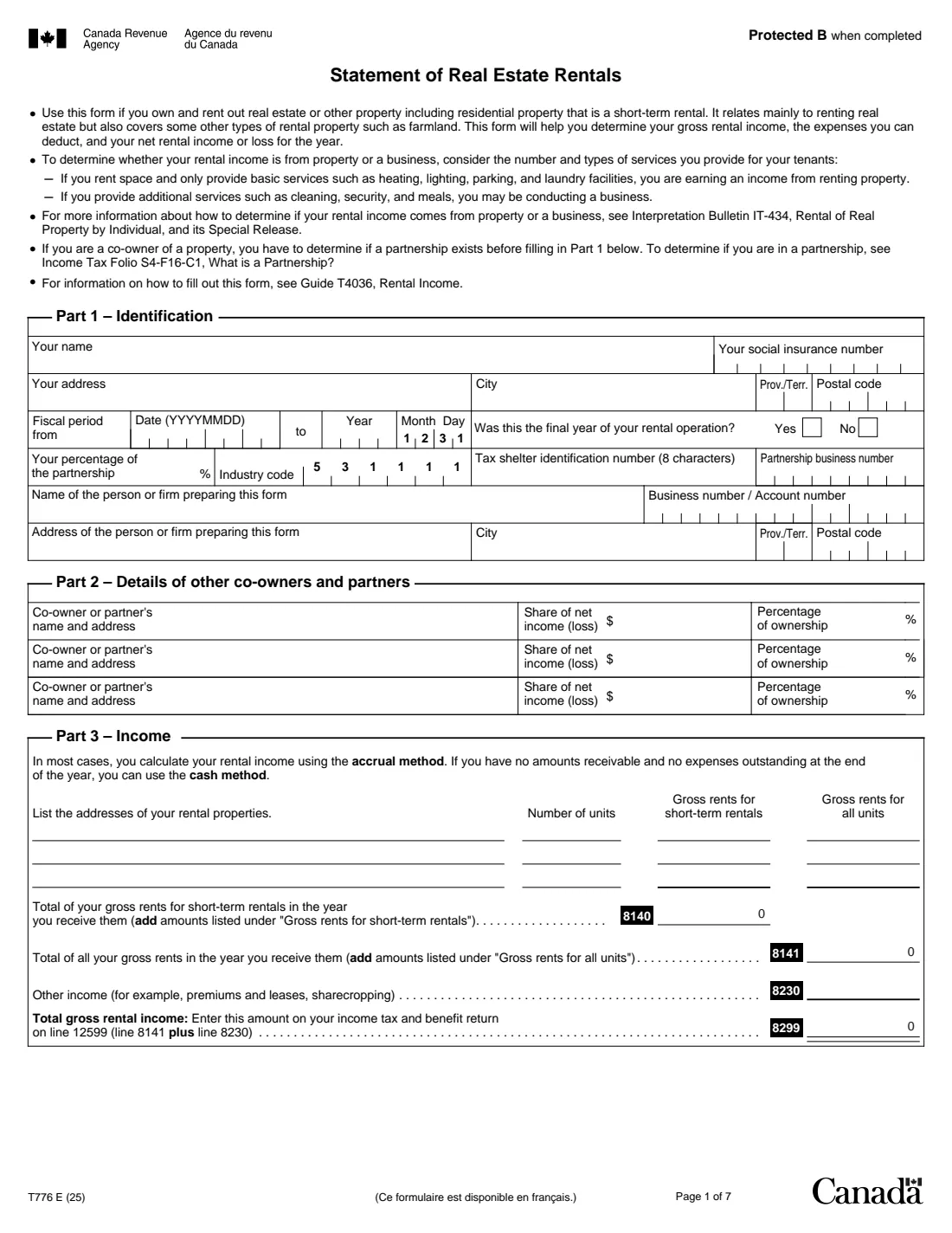
Form T776, Statement of Real Estate Rentals, is the Canada Revenue Agency (CRA) form landlords use to report income from renting out property: a basement suite, a condo, a duplex, a cottage rented to tourists, or farmland. It shows the gross rents for each property, the expenses you can deduct, your share if you co-own the property, and capital cost allowance (CCA) on the building and equipment.
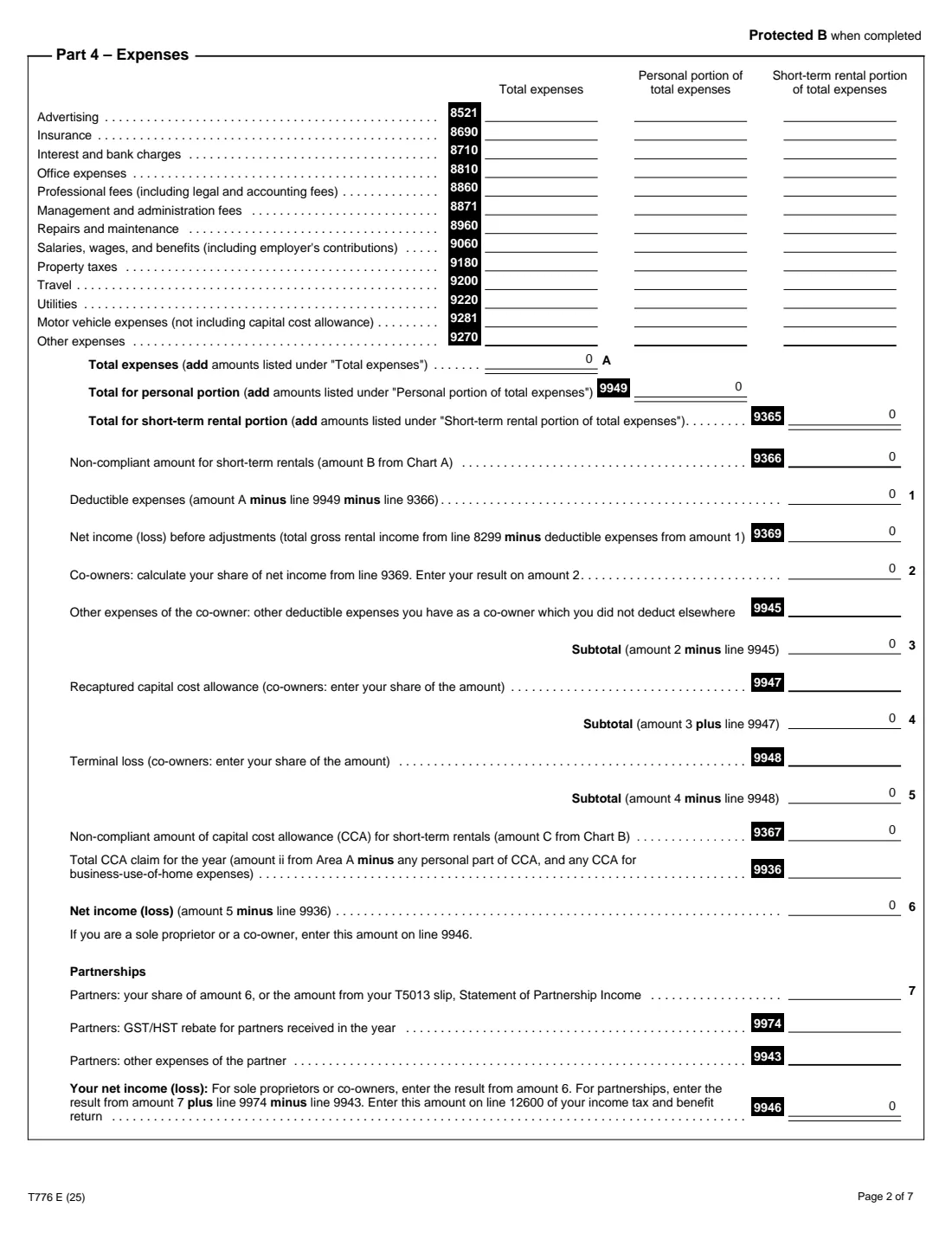
Each expense line has three columns: the total, the personal portion (for example, the part of a house you live in) and the short-term rental portion. Since 2023, expenses of short-term rentals that don't comply with provincial or municipal rules can't be deducted, so Charts A and B work out the non-compliant amounts of expenses and CCA. Co-owners take their share of the net income, then their own expenses, recapture and terminal loss, and CCA, to reach line 9946.
FileIt adds the rents and expense columns, works out the non-compliant amounts, applies your co-ownership share and does the CCA table in Area A, then prints everything into the CRA's own fillable T776 PDF (edition T776 E (25), for 2025). The completed form is saved in your vault. FileIt doesn't file your return: the T776 goes with it.
- Who fills it
- Individuals who rent out real estate, alone, as co-owners or as partners
- Result
- Gross rental income (line 12599) and net rental income or loss (line 12600)
- Short-term rentals
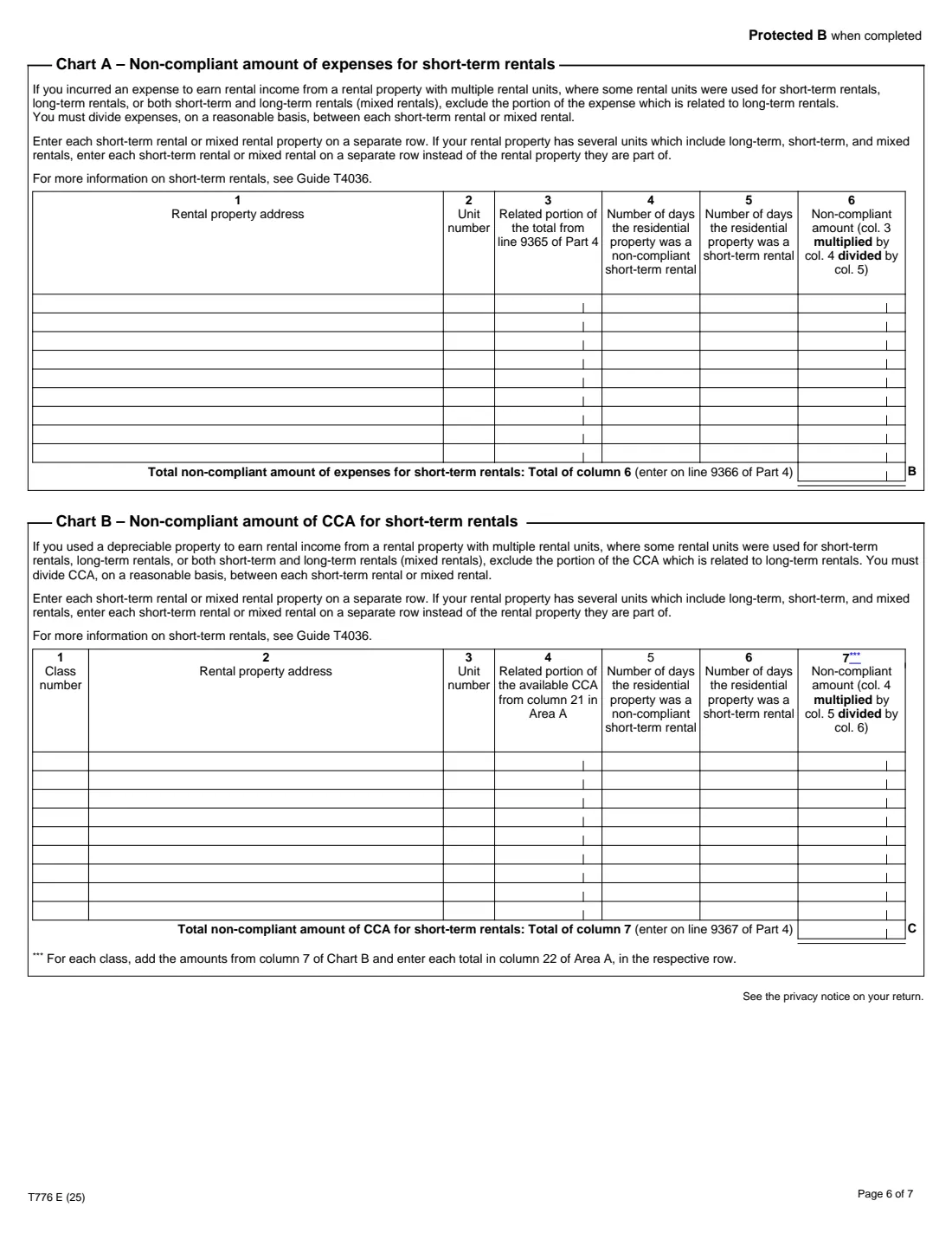
- Charts A and B work out the non-compliant amounts you can't deduct
- Signatures
- None. It goes with your return
- Pages
- 7, including the CCA area and short-term rental charts
- Edition
- T776 E (25), 2025 tax year
Who needs to fill out Form T776?
- Homeowners renting out a basement apartment, a room or a second unit.
- Investors with condos, houses or multi-unit buildings they rent out.
- Owners of cottages or other homes rented short term through platforms.
- Co-owners of a rental property, such as spouses or siblings, each reporting their share.
- People renting out farmland under a lease or sharecropping arrangement.
When to use Form T776
- When you prepare your 2025 return and received rents in 2025. Rental income is reported on a calendar year.
- In the last year of your rental operation (the form asks), for example when you sell the property.
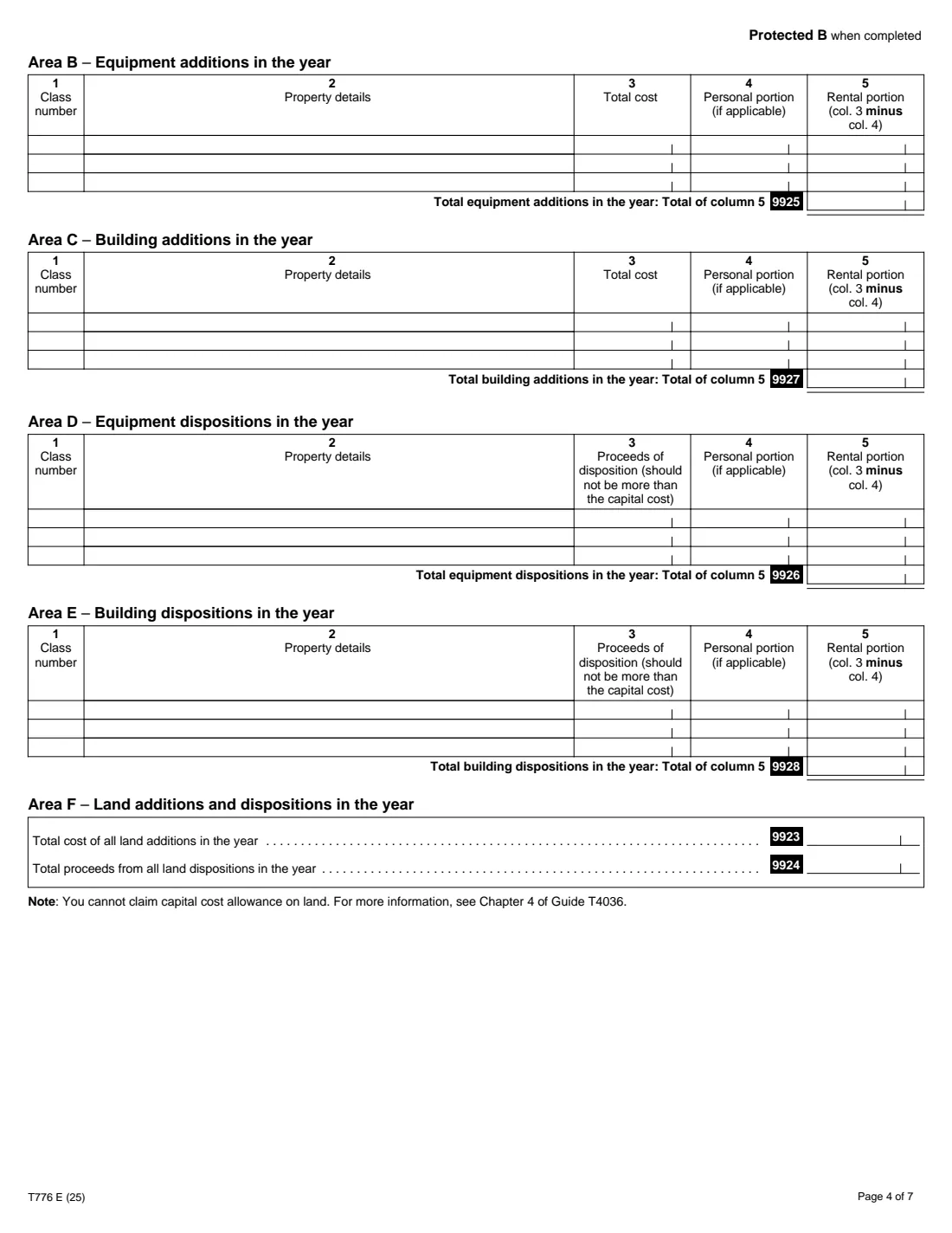
- When you buy or dispose of rental buildings or equipment, for Areas B to F and the CCA calculation.
What you need before you start
- The address and number of units of each rental property, and the rents received.
- Receipts and totals for each expense: insurance, mortgage interest, property taxes, repairs, utilities and so on.
- How you split expenses between personal and rental use, and between short-term and long-term rentals.
- Your ownership percentage, and the other co-owners' or partners' names, shares and percentages.
- Last year's undepreciated capital cost (UCC) for each CCA class, and this year's additions and dispositions.
- For short-term rentals, the days each unit was a short-term rental and the days it didn't comply with local rules.
What’s on Form T776
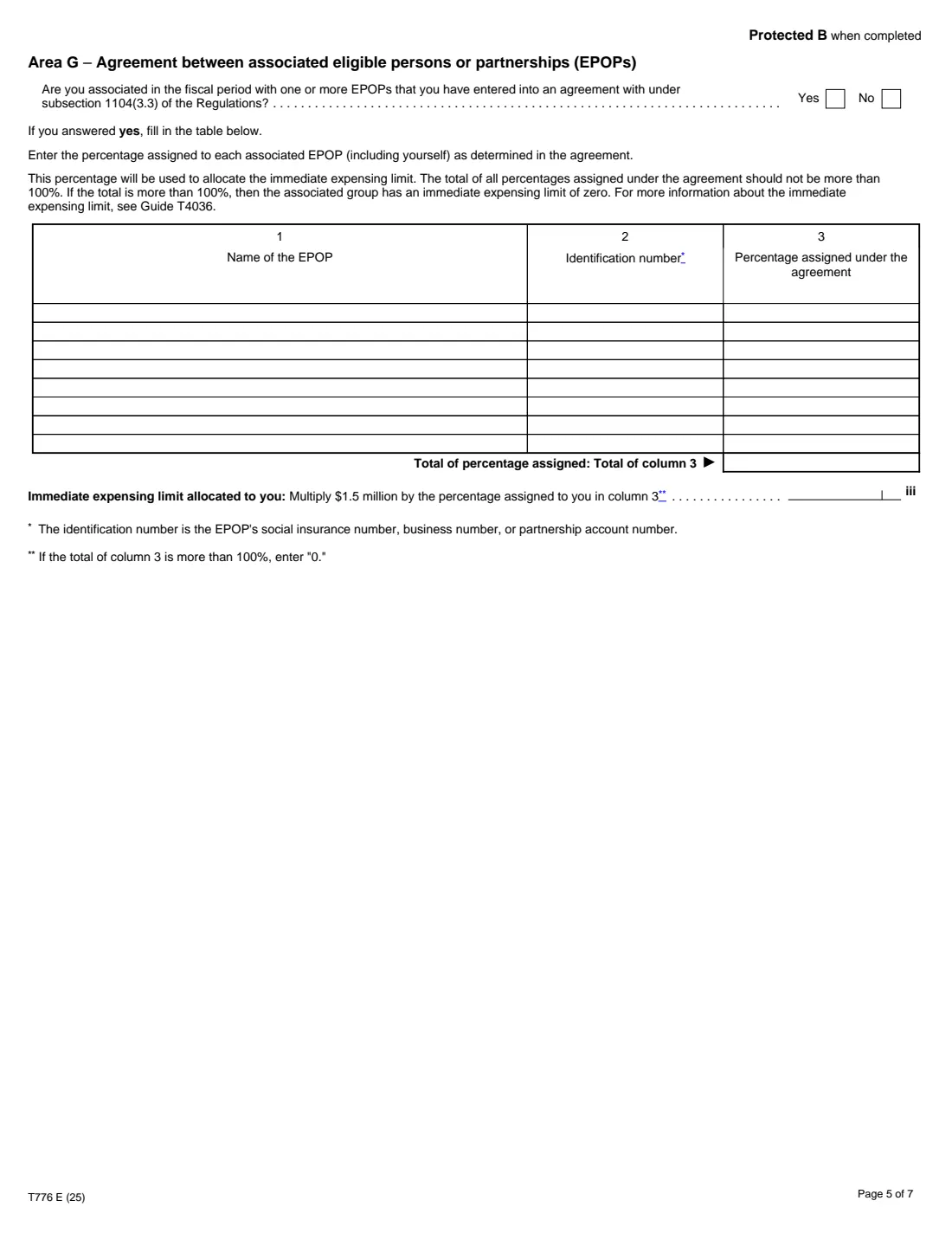
The 2025 edition has 7 pages. FileIt asks for it in 10 parts:
- Part 1 – IdentificationEmployee
- Part 2 – Other co-owners and partnersEmployee
- Part 3 – IncomeEmployee
- Part 4 – ExpensesEmployee
- Part 4 – Net income (loss)Employee
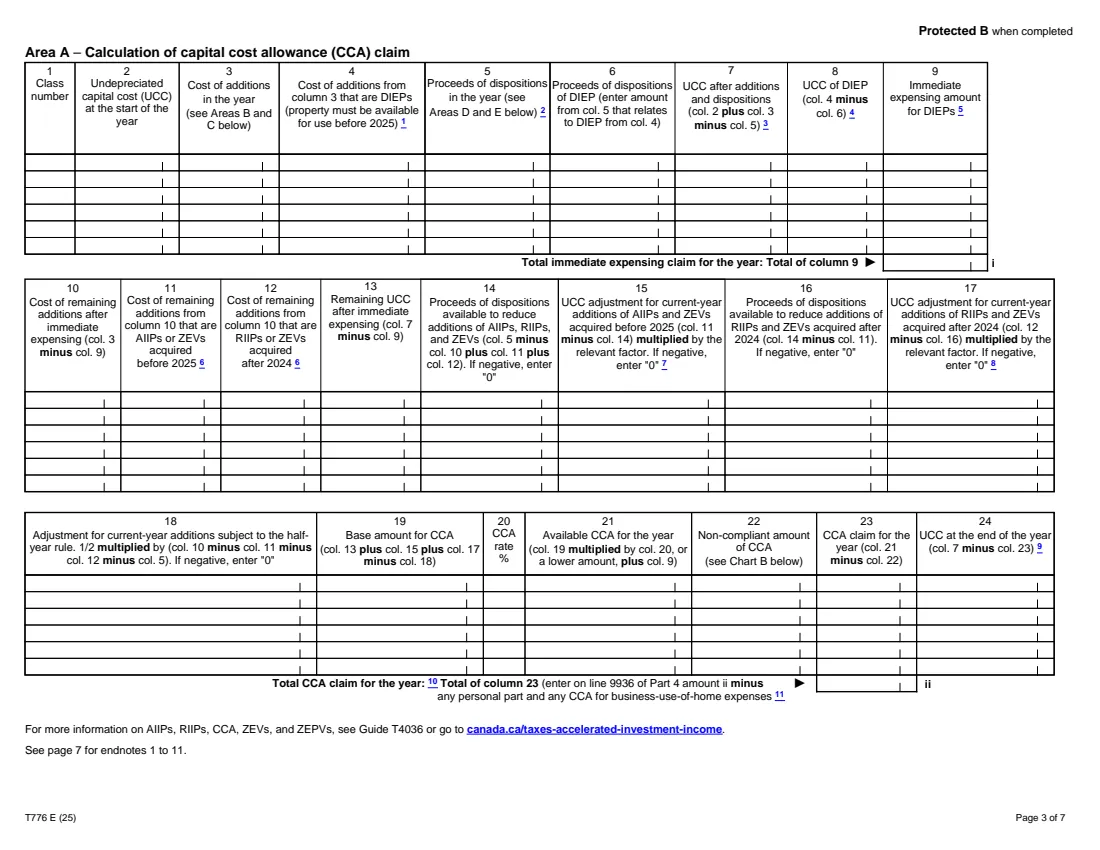
- Area A – Capital cost allowance (CCA)Employee
- Areas B to F – Additions and dispositionsEmployee
- Area G – Agreement between associated EPOPsEmployee
- Chart A – Non-compliant expenses for short-term rentalsEmployee
- Chart B – Non-compliant CCA for short-term rentalsEmployee
How to fill out Form T776, step by step
1 Parts 1 and 2 – Identification and co-owners
Your name, SIN and address, the year (rental periods end on December 31), whether it's your final year, and partnership details if they apply. List up to three other co-owners or partners with their share of net income and ownership percentage.
2 Part 3 – Income
For each property, the address, the number of units, the gross rents from short-term rentals and the gross rents for all units. FileIt totals them on lines 8140 and 8141, adds other income (line 8230) and gives your total gross rental income on line 8299.
3 Part 4 – Expenses
For each expense line, enter the total, the personal portion and the short-term rental portion. FileIt adds the columns, subtracts the personal portion and the non-compliant amount from Chart A, and gives your net income before adjustments (line 9369).
4 Part 4 – Your share
Co-owners give their ownership percentage, and FileIt works out amount 2. Then add your other co-owner expenses, recaptured CCA and terminal loss, and your CCA claim (line 9936). Partners enter their share or the T5013 amount instead. Line 9946 is your net income or loss.
5 Area A to Chart B – CCA and short-term rentals
Area A works out CCA class by class. Enter the class, opening UCC, additions, dispositions and rate, and FileIt does the half-year rule, immediate expensing columns and closing UCC. Charts A and B prorate the short-term rental expenses and CCA by non-compliant days. Chart B's amounts flow into column 22 of Area A for the same class.
Common mistakes to avoid
- Deducting the personal-use part of expenses, such as the part of the house you live in.
- Deducting the principal part of mortgage payments. Only interest is an expense.
- Treating improvements that add lasting value as repairs. They're capital additions for CCA.
- Using CCA to create or increase a rental loss.
- Claiming expenses of a short-term rental that didn't comply with local registration or licensing rules.
- Co-owners each claiming the full expenses instead of their share.
After you fill it out
Enter line 8299 on line 12599 and line 9946 on line 12600 of your 2025 return, and send the T776 with it.
Keep your receipts, leases and CCA records. FileIt saves the filled T776 in your vault, a good place for the property's papers too.
Note the closing UCC in column 24 of Area A: it's next year's opening figure.
Fill out Form T776 online with FileIt
- Pick the person. Choose someone from People and FileIt fills in their name, date of birth, address and other details it already knows.
- Answer plain-language questions. One part of the form at a time, with the official help text beside each question — 468 fields in all. Your answers save as you go.
- Check the live preview. Watch your answers land on the real Canada Revenue Agency (CRA) form, and let FileIt do any worksheet arithmetic.
- Generate the official PDF. FileIt prints your answers into the agency’s own PDF and files it in that person’s folder in your vault.
FileIt fills the form — it never files or submits anything for you. Deliver the finished form to whoever asked for it, the way the form’s instructions say.
Start Form T776 now — it’s freeForm T776: frequently asked questions
Who needs to fill out Form T776?
Anyone who rents out real estate and reports the income as rental income rather than business income, including co-owners and partners.
Can I fill out Form T776 online?
Yes. FileIt adds the rents and expenses, works out the short-term rental charts, your co-ownership share and CCA, and prints the results into the CRA's fillable T776 PDF.
What are non-compliant short-term rentals?
Residential properties rented for periods of less than 90 consecutive days that don't meet the provincial or municipal rules where they're located, such as registration or licensing. Their expenses can't be deducted, and Charts A and B work out how much.
I rent out part of my home. What can I claim?
The rental share of expenses for the whole house, such as utilities, insurance and property taxes, split on a reasonable basis such as floor area. The personal portion column is for the rest.
Should I claim capital cost allowance?
It's optional, and you can claim any amount up to the maximum. CCA on a rental generally can't create or increase a rental loss, and it can lead to recapture when you sell. Guide T4036 explains.
Rental or business income?
If you provide only basic services such as heat, light and laundry, it's usually rental income. Extra services such as cleaning, security or meals can make it a business (Form T2125).
Official sources
- Blank form (PDF), published by Canada Revenue Agency (CRA): https://www.canada.ca/content/dam/cra-arc/formspubs/pbg/t776/t776-fill-25e.pdf
- Official instructions and guidance: https://www.canada.ca/en/revenue-agency/services/forms-publications/forms/t776.html
- Edition shown on this page: T776 E (25) (checked 2026-10-19).
FileIt is not affiliated with or endorsed by Canada Revenue Agency (CRA) or any government. This page explains the form in general terms and is not legal, tax or immigration advice. Always read the official instructions, and check that you are using the edition the recipient accepts. Page last reviewed 2026-10-19.