What is Form T2091(IND)?
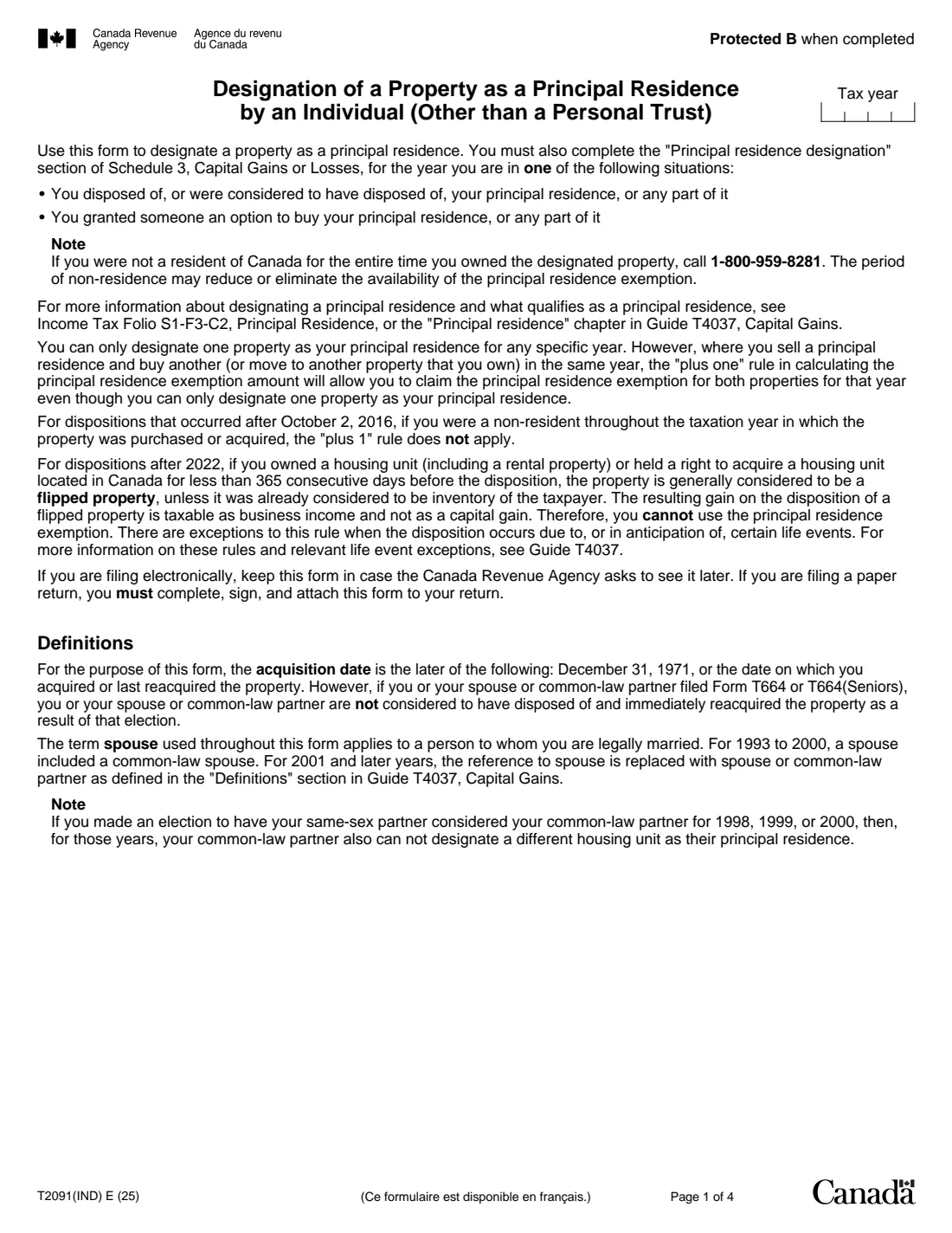
Form T2091(IND), Designation of a Property as a Principal Residence by an Individual (Other than a Personal Trust), is the Canada Revenue Agency (CRA) form you use when you sell your home, or any part of it, are considered to have sold it, or grant someone an option to buy it. It goes with the "Principal residence designation" section of Schedule 3, Capital Gains or Losses, on your return. The principal residence exemption can shelter all or part of the gain on the sale.
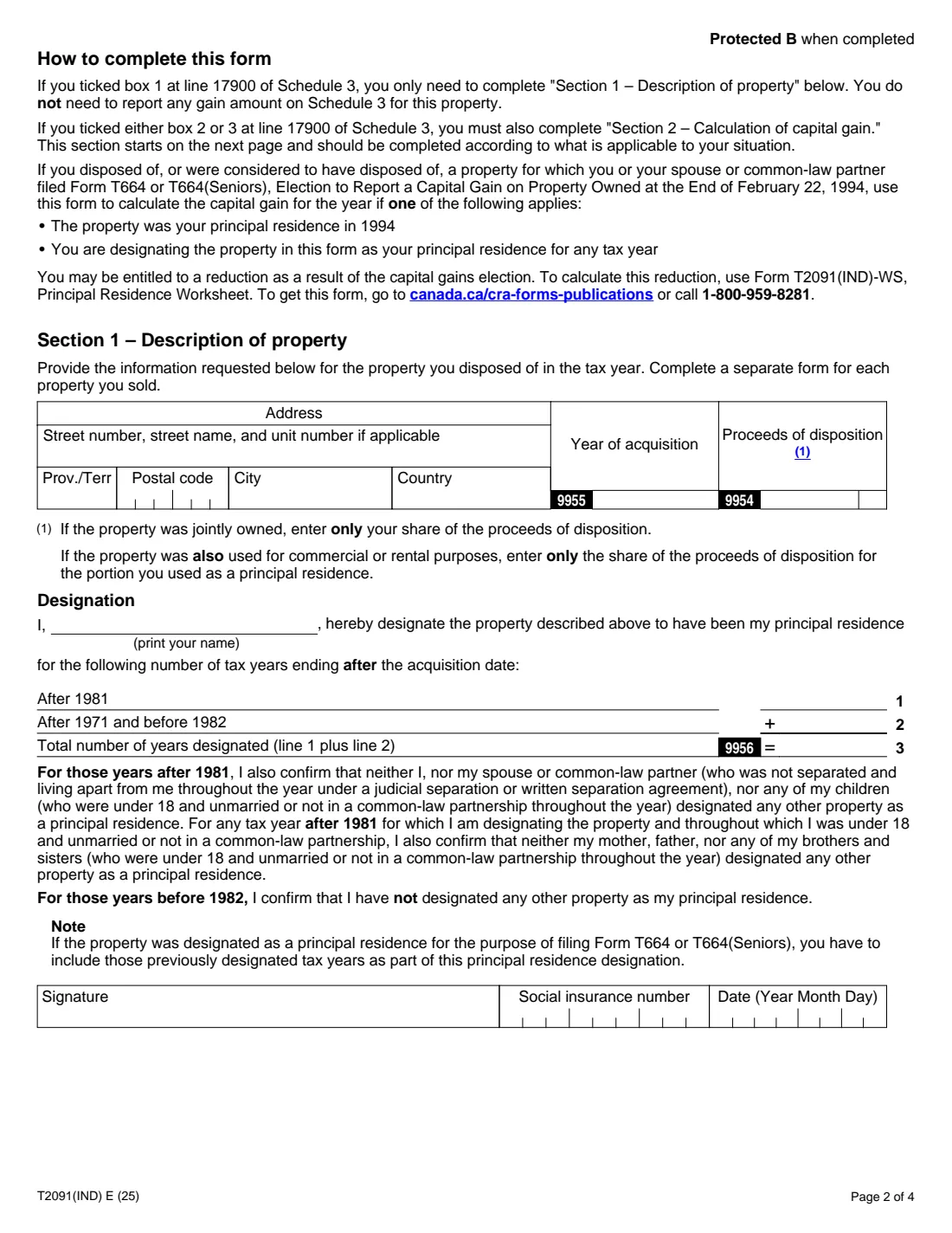
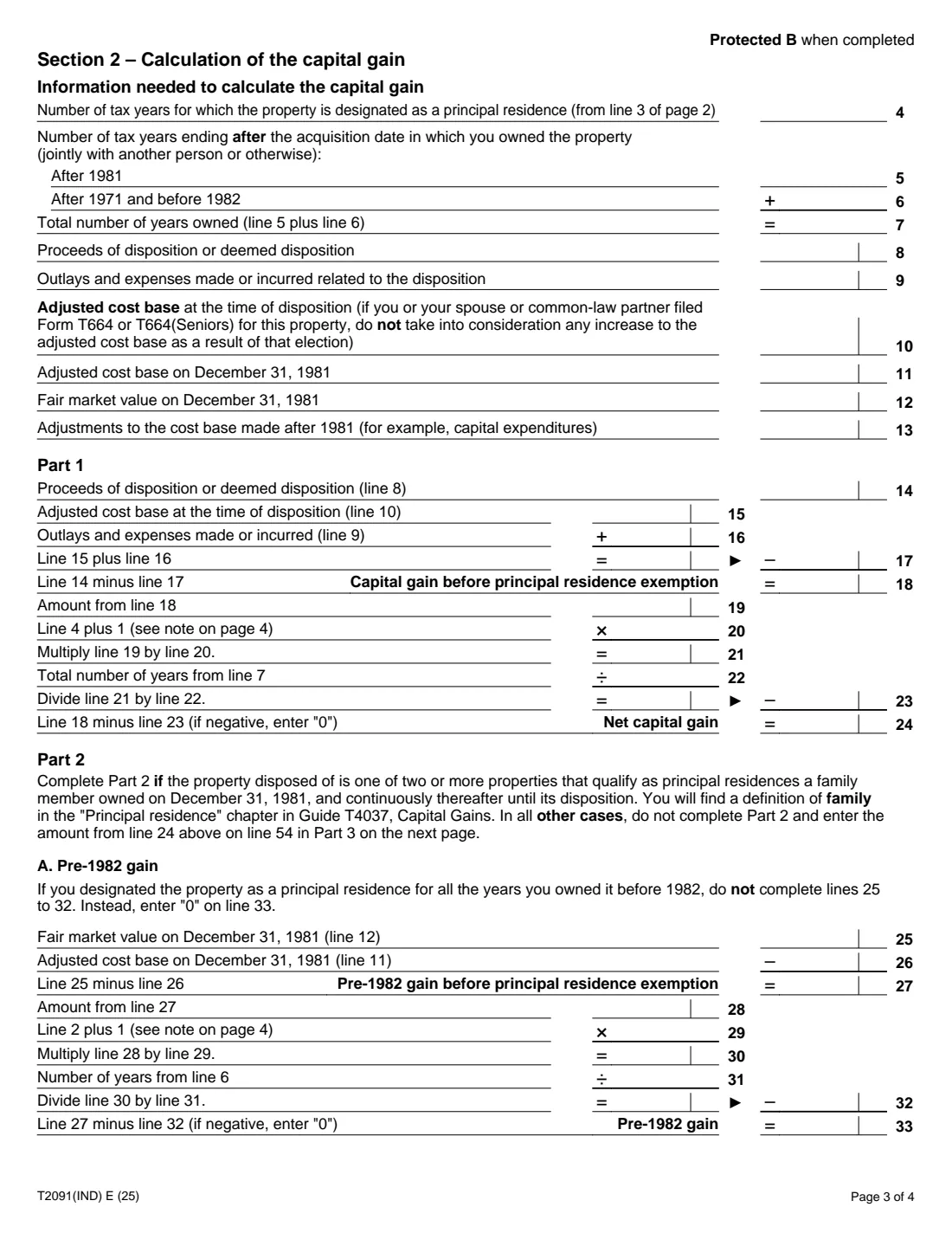
Section 1 describes the property (address, year of acquisition and proceeds) and records how many years you designate it as your principal residence. If you ticked box 1 at line 17900 of Schedule 3 because the home was your principal residence for every year you owned it, that's all you need. If you ticked box 2 or 3, Section 2 works out the taxable part of the gain. The exempt part is the gain × (years designated + 1) ÷ years owned; the extra year is the "plus one" rule. Section 2 also covers homes held since before 1982 and homes on which a T664 capital gains election was filed.
FileIt walks you through the form and prints your answers into the CRA's own fillable PDF (edition T2091(IND) E (25)). Every line of Section 2 is worked out for you, to the cent. The finished PDF is saved in your vault. You print it and sign it by hand, since the CRA doesn't accept electronic signatures on this form. FileIt never files anything for you.
- Who fills it
- An individual who sold, or is considered to have sold, their principal residence, or granted an option to buy it
- Goes with
- Schedule 3, Capital Gains or Losses, line 17900 and, when there's a taxable gain, line 15800
- How many
- A separate form for each property sold
- Signatures
- Your handwritten signature, with your SIN and the date
- Paper or online filing
- Paper return: complete, sign and attach it. Filing electronically: keep it in case the CRA asks
- Edition
- T2091(IND) E (25)
Who needs to fill out Form T2091(IND)?
- Anyone who sold the home they lived in, or part of it, during the year.
- People considered to have sold their home, for example when it changes to a rental property or on emigration (a deemed disposition).
- Anyone who granted someone an option to buy their principal residence.
- Owners who didn't designate the home for every year they owned it, such as families with a cottage and a city home. Section 2 works out the taxable part.
- Owners of a home held since before 1982, or on which a Form T664 capital gains election was filed.
When to use Form T2091(IND)
- For the tax year you sold the property, or were considered to have sold it.
- Alongside the "Principal residence designation" section of Schedule 3 on that year's return.
- Before relying on the exemption for a home owned less than 365 consecutive days. For sales after 2022, the form says such a home is generally a "flipped property": the gain is business income and the exemption can't be used, apart from certain life-event exceptions in Guide T4037.
- If you weren't a resident of Canada for the whole time you owned the property, call the CRA at 1-800-959-8281 first, as the form says. Non-residence can reduce or remove the exemption.
What you need before you start
- The property's address and the year you acquired it.
- The proceeds of disposition: your share if you owned it jointly, and only the principal-residence share if part was rented or used for business.
- How many years you're designating it as your principal residence, after 1981 and from 1972 to 1981.
- How many years you owned it, after 1981 and from 1972 to 1981 (Section 2).
- Selling costs, such as commission and legal fees, and the adjusted cost base (Section 2).
- For a home owned on December 31, 1981: its adjusted cost base and fair market value on that date, and later capital improvements.
- If a T664 or T664(Seniors) election was filed: the reduction from line 66 of Form T2091(IND)-WS.
- Your social insurance number.
What’s on Form T2091(IND)
The 2025 edition has 4 pages. FileIt asks for it in 7 parts:
- Section 1 – Description of propertyEmployee
- DesignationEmployee
- Section 2 – Information needed to calculate the capital gainEmployee
- Section 2, Part 1 – Net capital gainEmployee
- Section 2, Part 2 – Property owned on December 31, 1981Employee
- Section 2, Part 3 – Total capital gainEmployee
- Section 2, Part 4 – Capital gains election (Form T664)Employee
How to fill out Form T2091(IND), step by step
1 Section 1 – Description of property
Enter the tax year, then the property's street address, province or territory, postal code, city and country if it's outside Canada. Give the year of acquisition (line 9955) and the proceeds of disposition (line 9954). If you owned the home jointly, enter only your share. If part of it was also used for rental or business, enter only the share for the part you lived in.
2 Designation
Print your name and enter the number of tax years, ending after the acquisition date, that you designate the property as your principal residence: after 1981 (line 1) and from 1972 to 1981 (line 2). Line 3 is the total. Include any years you designated on Form T664 or T664(Seniors).
By signing, you confirm that for those years after 1981, no one in your family unit designated another property. That means you, your spouse or common-law partner unless you were separated, and your unmarried children under 18. For years before 1982, you confirm you designated no other property.
3 Which box at line 17900 of Schedule 3?
The form says that if you ticked box 1 at line 17900 of Schedule 3, you only complete Section 1 and don't report any gain for this property. If you ticked box 2 or 3, you also complete Section 2, which works out the taxable gain.
4 Section 2 – Information needed
Enter the number of years you owned the property after 1981 (line 5) and from 1972 to 1981 (line 6), your selling costs (line 9) and the adjusted cost base (line 10). If you owned the property before 1982, also enter its adjusted cost base and fair market value on December 31, 1981 (lines 11 and 12), and the adjustments to the cost base made after 1981 (line 13).
5 Part 1 – Net capital gain
FileIt takes the proceeds minus the cost base and selling costs to get the gain before the exemption (line 18). It then works out the exempt part: the gain × (years designated + 1) ÷ years owned (lines 19 to 23). Line 24 is what's left, your net capital gain. The form notes the "plus one" year doesn't apply if you sold after October 2, 2016 and were a non-resident throughout the year you acquired the property.
6 Part 2 – Homes owned since 1981
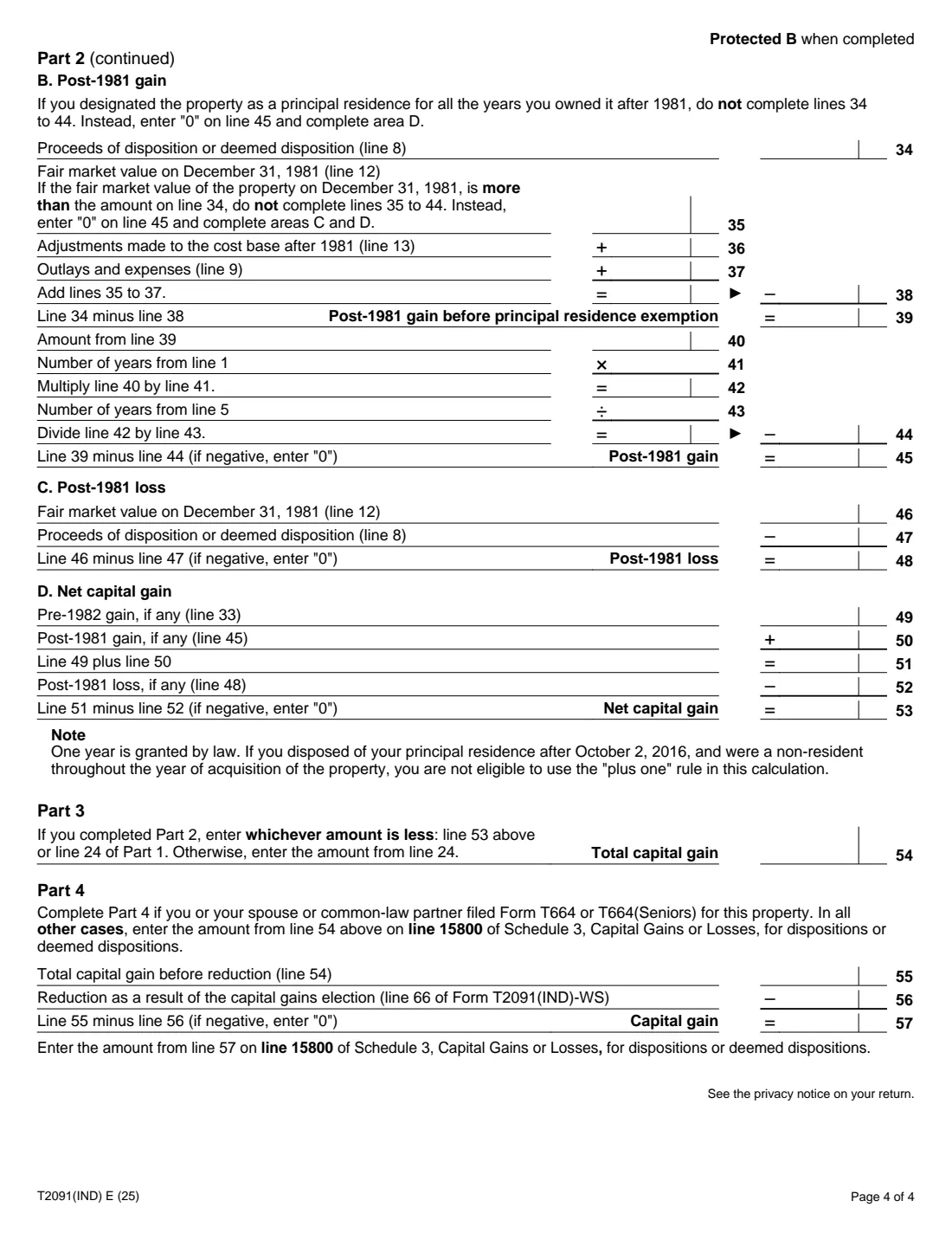
Complete Part 2 only if the property is one of two or more qualifying principal residences a family member owned on December 31, 1981 and kept until the sale. Area A works out a pre-1982 gain, area B a post-1981 gain, area C a post-1981 loss when the 1981 value was higher than the proceeds, and area D the net. The form tells you when to skip areas A and B, and FileIt follows those rules.
7 Parts 3 and 4 – Total capital gain
Line 54 is the lesser of line 53 and line 24 if you completed Part 2, and otherwise line 24. If you or your spouse or partner filed Form T664 or T664(Seniors) for this property, Part 4 subtracts the reduction from Form T2091(IND)-WS. Enter the final amount (line 54 or 57) on line 15800 of Schedule 3.
Common mistakes to avoid
- Designating two properties for the same year. After 1981, a family unit can designate only one.
- Entering the full sale price on a jointly owned home instead of your share.
- Including the rental or business part of a home in the principal-residence proceeds.
- Leaving out years designated on Form T664 or T664(Seniors).
- Claiming the exemption on a home held under 365 days that's treated as a flipped property.
- Adding the "plus one" year when the form's non-resident rule removes it.
- Filing a paper return without the signed form attached.
After you fill it out
Complete the "Principal residence designation" section of Schedule 3. If Section 2 shows a gain, enter it (line 54 or 57) on line 15800 of Schedule 3.
Print the PDF from your FileIt vault and sign it by hand in the Signature box. If you file a paper return, the form says you must complete, sign and attach it. If you file electronically, keep it in case the CRA asks to see it later.
Keep the sale documents, the purchase records and receipts for improvements with the form in your vault. They support the adjusted cost base and the proceeds.
Fill out Form T2091(IND) online with FileIt
- Pick the person. Choose someone from People and FileIt fills in their name, date of birth, address and other details it already knows.
- Answer plain-language questions. One part of the form at a time, with the official help text beside each question — 77 fields in all. Your answers save as you go.
- Check the live preview. Watch your answers land on the real Canada Revenue Agency (CRA) form, and let FileIt do any worksheet arithmetic.
- Generate the official PDF. FileIt prints your answers into the agency’s own PDF and files it in that person’s folder in your vault.
FileIt fills the form — it never files or submits anything for you. Deliver the finished form to whoever asked for it, the way the form’s instructions say.
Start Form T2091(IND) now — it’s freeForm T2091(IND): frequently asked questions
Can I fill out Form T2091(IND) online?
Yes. FileIt guides you through Section 1, the designation and Section 2, works out every line, and prints your answers into the CRA's official fillable T2091(IND) PDF. You then sign it by hand.
Do I need this form if the home was always my principal residence?
You still report the sale and the designation. If you ticked box 1 at line 17900 of Schedule 3, the form says you only complete Section 1 and don't report any gain for the property.
What is the "plus one" rule?
When the exempt part of the gain is worked out, one year is added to the number of years designated. The form explains that this lets you claim the exemption for both homes in a year you sell one and buy another, even though you can designate only one property per year. It doesn't apply if you sold after October 2, 2016 and were a non-resident throughout the year you acquired the property.
Can I sign Form T2091(IND) electronically?
The CRA accepts electronic signatures only on the forms it lists, and the T2091(IND) isn't one of them. Print the form and sign it by hand.
Does the exemption apply to a home I owned less than a year?
For sales after 2022, a home owned for less than 365 consecutive days is generally a flipped property, and the form says you can't use the principal residence exemption on it. Guide T4037 lists the life-event exceptions.
Why is the agency's code T2091(IND) but FileIt's link says T2091-IND?
It's the same form. Web addresses can't use parentheses cleanly, so FileIt writes the code with a hyphen.
Official sources
- Blank form (PDF), published by Canada Revenue Agency (CRA): https://www.canada.ca/content/dam/cra-arc/formspubs/pbg/t2091ind/t2091ind-fill-25e.pdf
- Official instructions and guidance: https://www.canada.ca/en/revenue-agency/services/forms-publications/forms/t2091ind.html
- Edition shown on this page: T2091(IND) E (25) (checked 2026-09-28).
FileIt is not affiliated with or endorsed by Canada Revenue Agency (CRA) or any government. This page explains the form in general terms and is not legal, tax or immigration advice. Always read the official instructions, and check that you are using the edition the recipient accepts. Page last reviewed 2026-09-28.