What is Form T1-M?
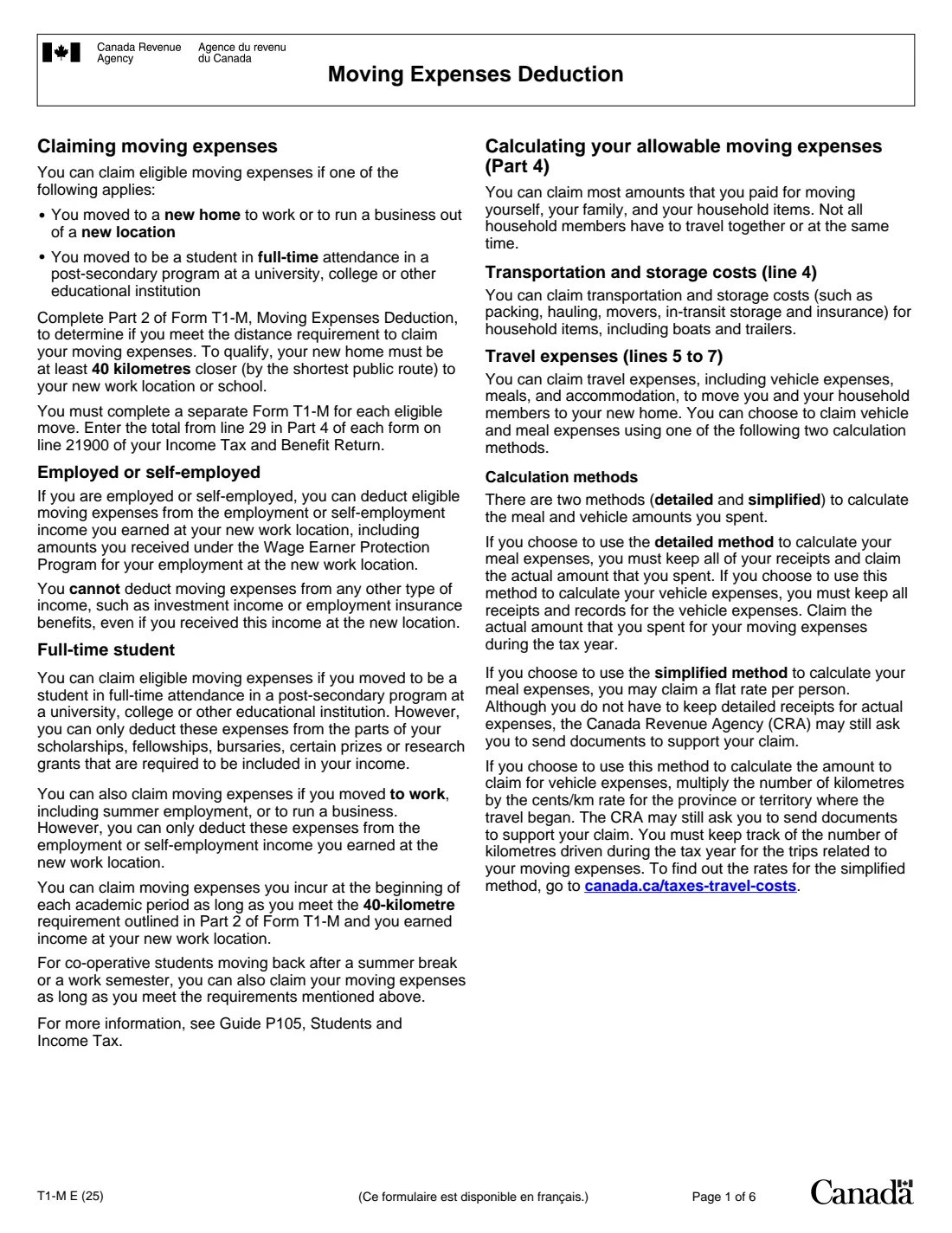
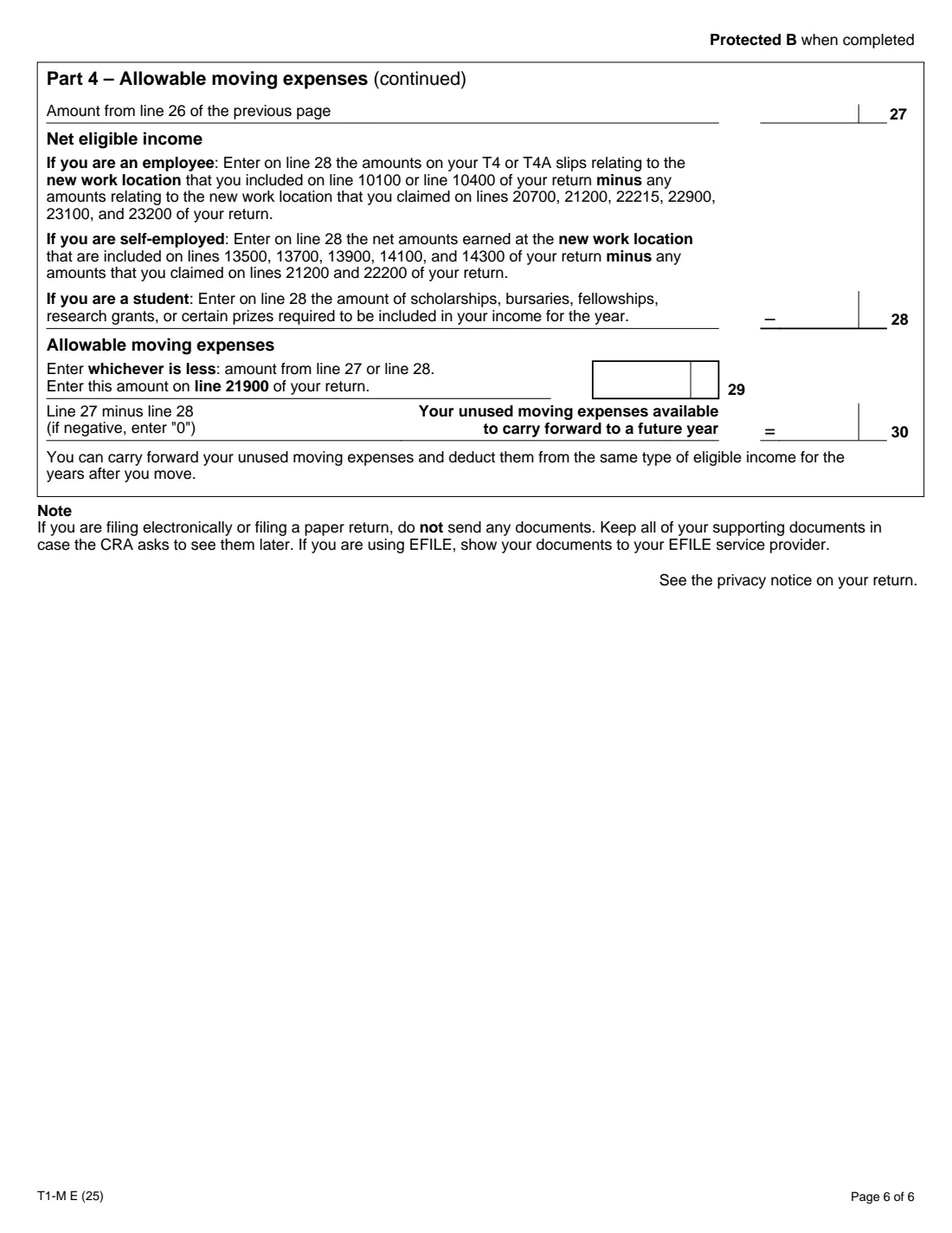
Form T1-M, Moving Expenses Deduction, is the Canada Revenue Agency (CRA) form for claiming what it cost to move to a new home for work, to run a business at a new location, or to study full time at a post-secondary institution. To qualify, your new home has to be at least 40 kilometres closer to the new work location or school, by the shortest public route. You fill out a separate T1-M for each move and enter the result from line 29 on line 21900 of your return.
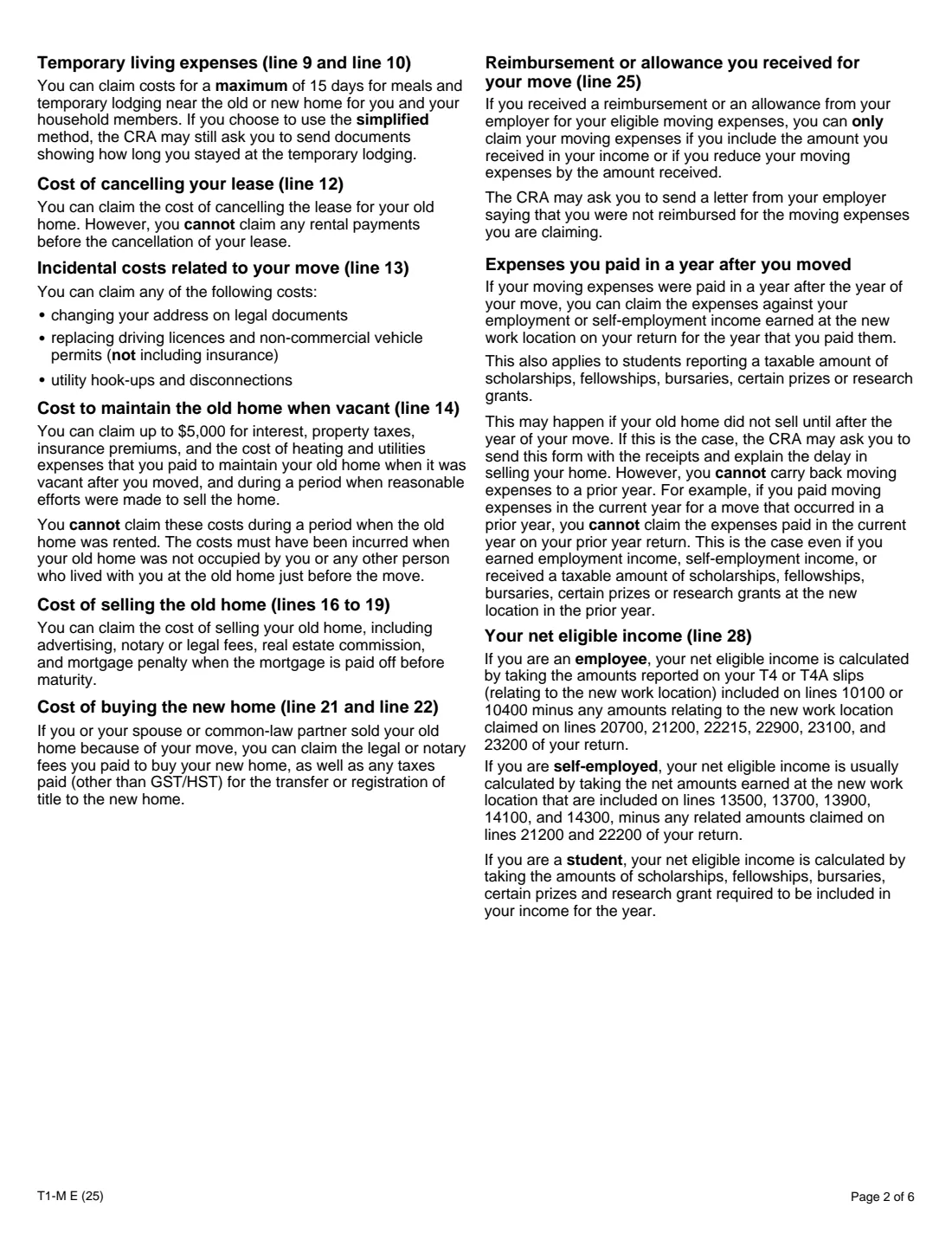
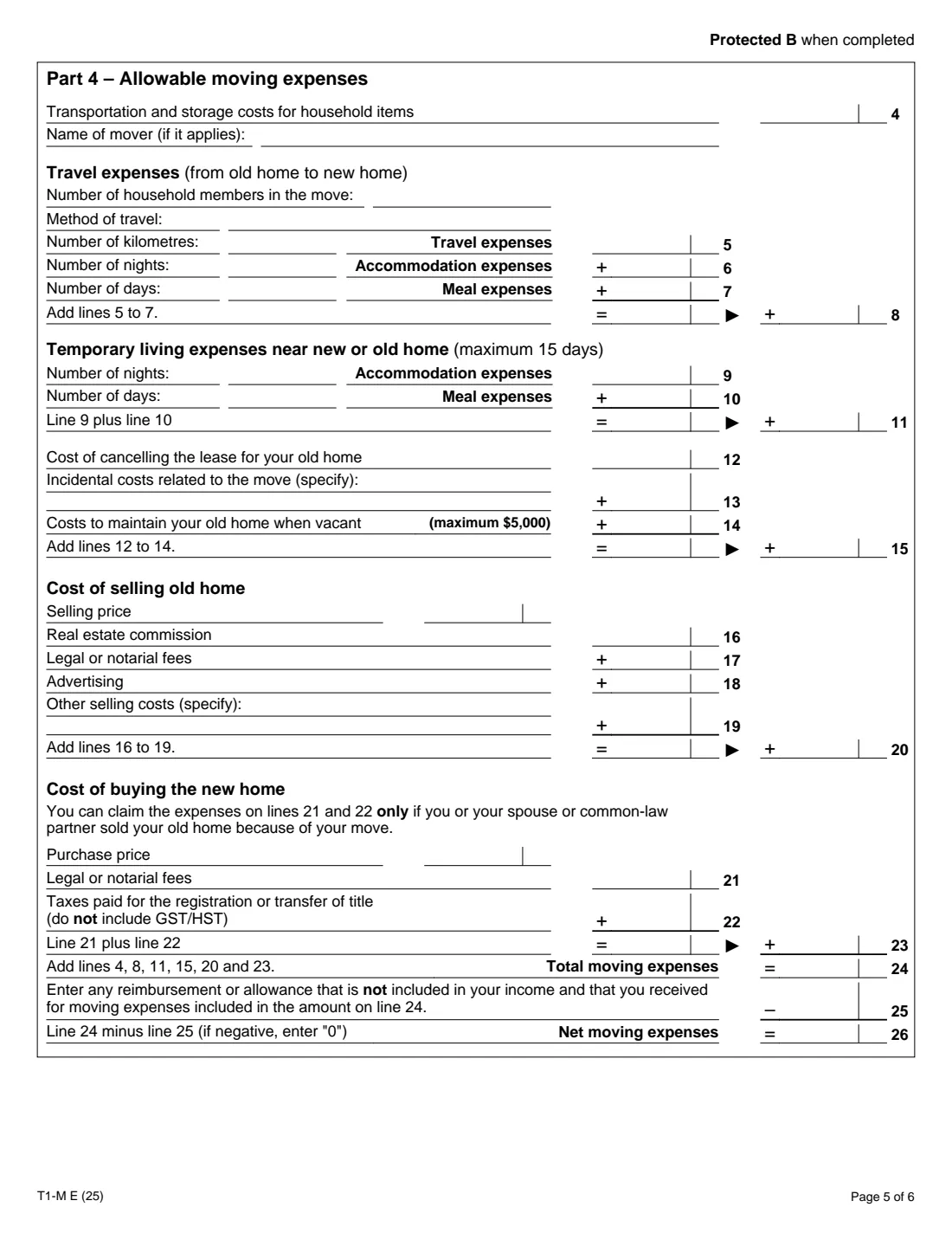
You can claim transportation and storage of household items, travel to the new home (vehicle, accommodation and meals), up to 15 days of temporary living costs, the cost of breaking your old lease, some incidental costs, up to $5,000 for keeping your old home while it sits empty, the costs of selling your old home, and the legal fees and land transfer taxes on a new home if the old one was sold because of the move. The deduction is limited to the income you earned at the new location (or, for students, taxable scholarships and awards), and anything left over carries forward.
FileIt walks you through all four parts and prints your answers into the CRA's own fillable T1-M PDF (edition T1-M E (25)). The distance test, each subtotal, the total, the net amount after reimbursements, your allowable deduction and the carry-forward are worked out for you. The finished PDF is saved in your vault. FileIt doesn't file anything: you enter line 29 on your return and keep the form and receipts with your records.
- Who fills it
- Employees, self-employed people and full-time post-secondary students who moved for work, business or school
- Distance test
- The new home must be at least 40 km closer to the new work location or school
- Result
- Allowable moving expenses for line 21900 of your return, plus any amount to carry forward
- How many
- One form for each move
- Signatures
- None. Don't send it in; keep it with your records
- Edition
- T1-M E (25)
Who needs to fill out Form T1-M?
- Employees who moved to start a job at a new work location, including summer jobs.
- Self-employed people who moved to run their business from a new location.
- Full-time post-secondary students who moved to attend a university, college or other educational institution, and who have taxable scholarships, bursaries, fellowships, prizes or research grants.
- Co-operative students moving back after a summer break or work term, if they meet the same rules.
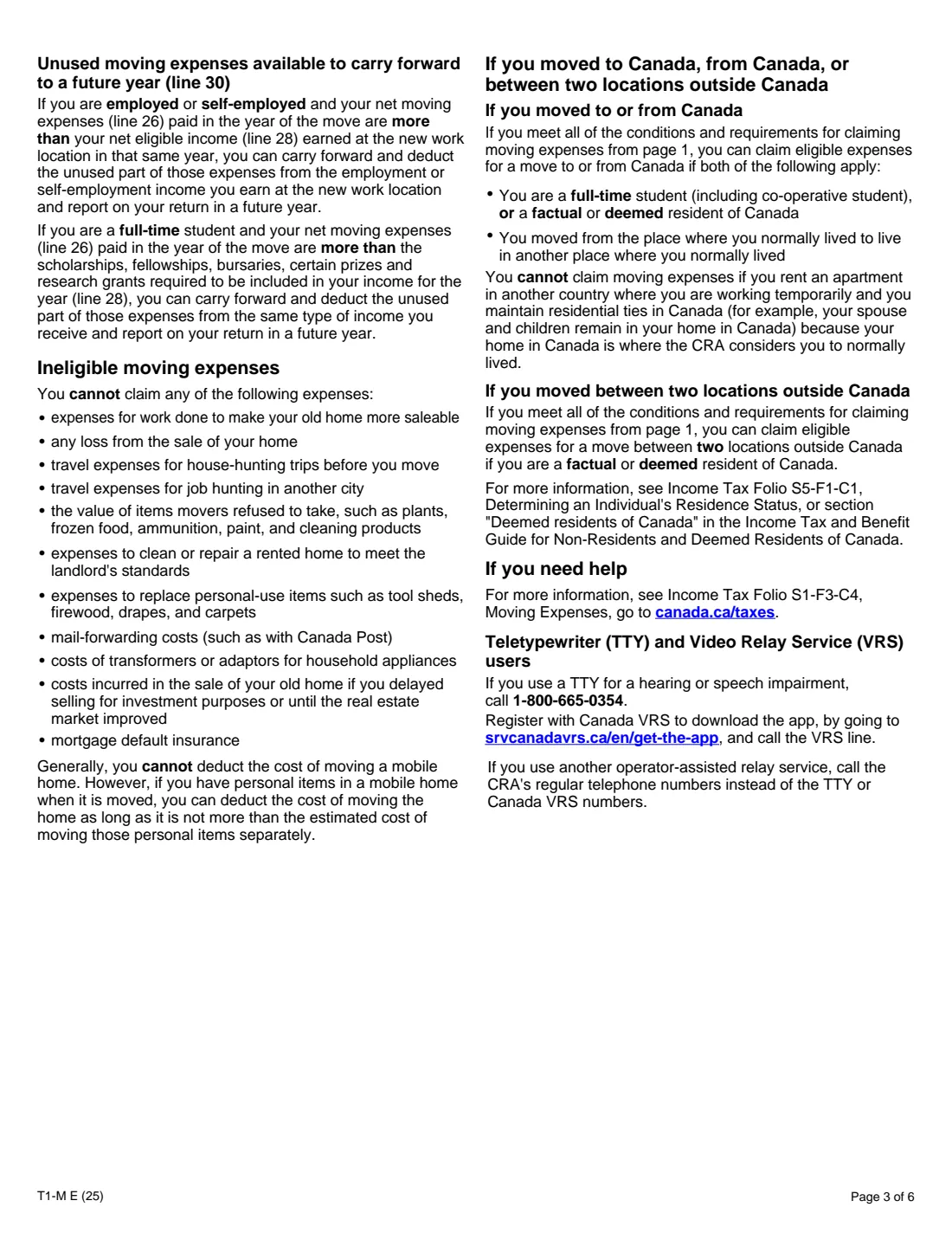
- Factual or deemed residents of Canada, and full-time students, who moved to or from Canada, as the form's instructions describe.
When to use Form T1-M
- When you file your return for the year you paid the moving expenses, usually the year of the move.
- In a later year, if you paid moving expenses after the year you moved (for example when your old home sold later). The form says you can't carry expenses back to an earlier year.
- Every year you have unused moving expenses from line 30 to deduct from the same type of income at the new location.
What you need before you start
- The distances from your old home and from your new home to your new work location or school.
- The date you moved and the date you started work, business or full-time study at the new location.
- Your old and new addresses, and the name and address of your new employer, business or school.
- Receipts for movers, storage, travel, accommodation and meals, or your kilometres and days if you use the CRA's simplified flat rates (published at canada.ca/taxes-travel-costs).
- Your lease-cancellation cost, incidental costs and the costs of keeping your old home while it was vacant.
- Your selling costs: real estate commission, legal or notarial fees, advertising, mortgage prepayment penalty.
- Legal fees and land transfer taxes on the new home, if you sold the old one because of the move.
- Any reimbursement or allowance from your employer that you don't report as income.
- Your net eligible income from the new location (T4/T4A or self-employment amounts), or your taxable scholarships and awards if you're a student.
What’s on Form T1-M
The 2025 edition has 6 pages. FileIt asks for it in 9 parts:
- Part 1 – Taxpayer informationEmployee
- Part 2 – Distance testEmployee
- Part 3 – Details of the moveEmployee
- Part 4 – Transportation and travelEmployee
- Part 4 – Temporary living expenses (maximum 15 days)Employee
- Part 4 – Lease, incidental and vacant-home costsEmployee
- Part 4 – Cost of selling your old homeEmployee
- Part 4 – Cost of buying your new homeEmployee
- Part 4 – Net moving expenses and allowable deductionEmployee
How to fill out Form T1-M, step by step
1 Part 1 – Taxpayer information
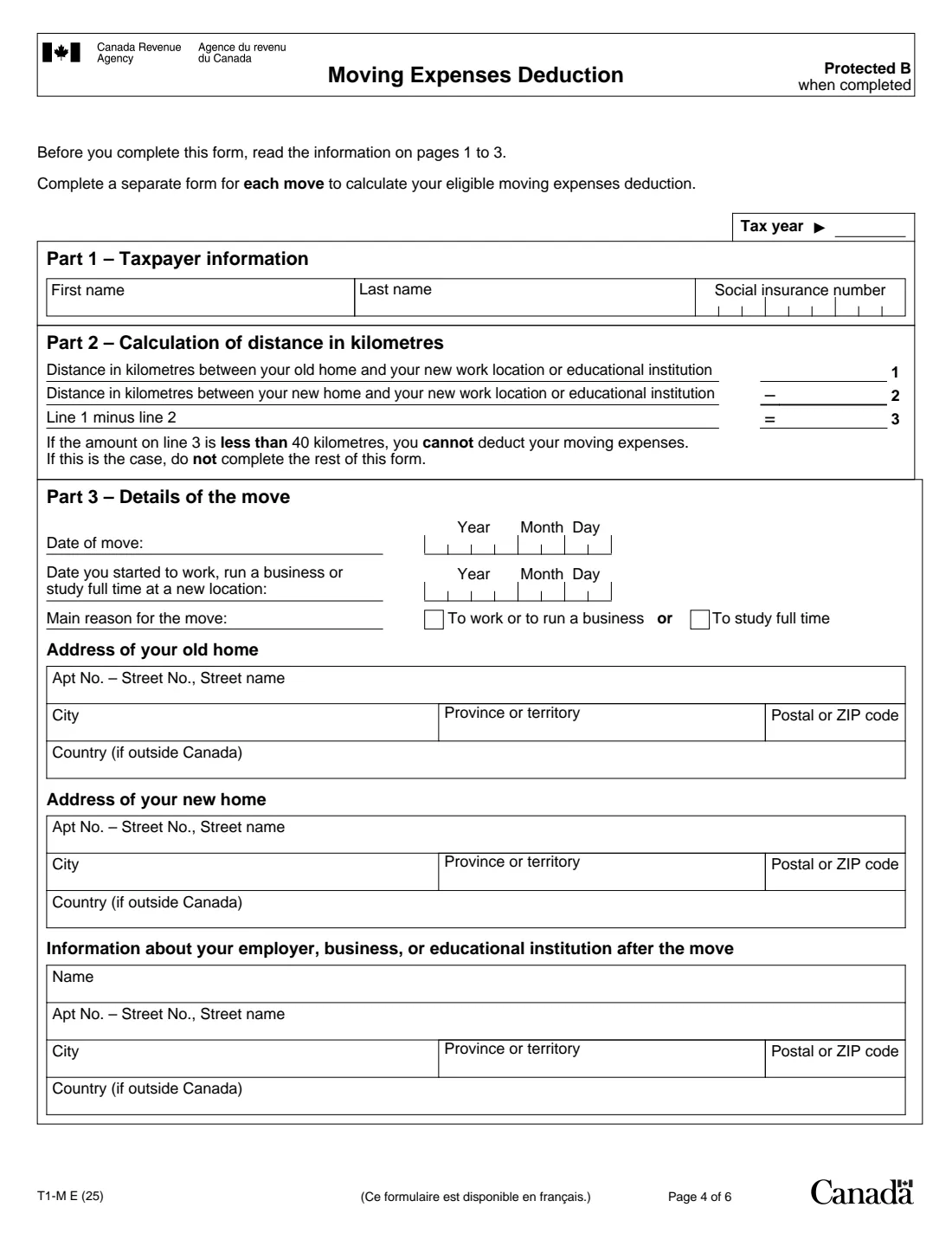
Enter the tax year the claim is for, your first and last name, and your social insurance number.
2 Part 2 – Distance test
Give the distance in kilometres from your old home to your new work location or school (line 1), and from your new home to the same place (line 2). FileIt subtracts them. If line 3 is less than 40 km, the form says you can't deduct moving expenses and should stop there.
3 Part 3 – Details of the move
Enter the date of the move, the date you started working, running a business or studying full time at the new location, and whether the main reason was work or business, or full-time study. Then give the addresses of your old home, your new home and your employer, business or school after the move. The country lines are only for addresses outside Canada.
4 Part 4 – Transportation, travel and temporary living
Line 4 is the cost of moving and storing household items, including boats and trailers, with the mover's name. Lines 5 to 7 are travel from the old home to the new one: the number of household members, the method of travel, kilometres, nights and days, and the travel, accommodation and meal amounts. You can use actual costs with receipts, or the CRA's simplified per-kilometre and per-meal rates.
Lines 9 and 10 are meals and temporary lodging near either home, for up to 15 days.
5 Part 4 – Lease, incidentals and the vacant old home
Line 12 is the cost of cancelling your old lease, but not rent before it was cancelled. Line 13 covers incidental costs such as changing your address on legal documents, replacing driving licences and non-commercial vehicle permits, and utility hook-ups and disconnections. Say what they were on the lines beside it. Line 14 allows up to $5,000 for interest, property taxes, insurance, heating and utilities on the old home while it was vacant and for sale.
6 Part 4 – Selling and buying
For the old home, give the selling price and then the real estate commission, legal or notarial fees, advertising and other selling costs such as a mortgage prepayment penalty (lines 16 to 19). For the new home, enter the legal or notarial fees and the land transfer or registration taxes, not GST/HST (lines 21 and 22). You can claim these only if you or your spouse or partner sold the old home because of the move.
7 Part 4 – Net expenses and your deduction
FileIt adds everything up (line 24). If you received a reimbursement or allowance you don't report as income, enter it on line 25 to get your net moving expenses (line 26). Then enter your net eligible income from the new location on line 28. Line 29, the lesser of the two, is what you deduct on line 21900. Line 30 is what's left to carry forward to future years.
Common mistakes to avoid
- Claiming when the new home isn't at least 40 km closer to the new work location or school.
- Deducting moving expenses from the wrong income. The form allows only employment or self-employment income earned at the new location, or taxable scholarships and awards for students, not investment income or EI benefits.
- Including ineligible costs: work to make the old home more saleable, a loss on the sale, house-hunting or job-hunting trips, mail forwarding, cleaning or repairing a rental, or mortgage default insurance.
- Claiming more than 15 days of temporary living costs, or more than $5,000 for the vacant old home.
- Claiming the new home's legal fees and land transfer tax when the old home wasn't sold because of the move.
- Leaving out a non-taxable reimbursement or allowance from your employer.
- Using one T1-M for two moves. The form asks for a separate form for each move.
After you fill it out
Enter the amount from line 29 on line 21900 of your return. If you made more than one move, add up line 29 from each form.
Don't send the T1-M or your receipts, whether you file electronically or on paper. The form says to keep them in case the CRA asks to see them later, or to show them to your EFILE service provider. FileIt saves the completed PDF in your vault, where you can keep your receipts next to it.
If line 30 shows unused expenses, keep this form. You can deduct that amount from the same type of income in future years.
Fill out Form T1-M online with FileIt
- Pick the person. Choose someone from People and FileIt fills in their name, date of birth, address and other details it already knows.
- Answer plain-language questions. One part of the form at a time, with the official help text beside each question — 73 fields in all. Your answers save as you go.
- Check the live preview. Watch your answers land on the real Canada Revenue Agency (CRA) form, and let FileIt do any worksheet arithmetic.
- Generate the official PDF. FileIt prints your answers into the agency’s own PDF and files it in that person’s folder in your vault.
FileIt fills the form — it never files or submits anything for you. Deliver the finished form to whoever asked for it, the way the form’s instructions say.
Start Form T1-M now — it’s freeForm T1-M: frequently asked questions
Can I fill out Form T1-M online?
Yes. FileIt guides you through Parts 1 to 4, works out every subtotal, your deduction and the carry-forward, and prints them into the CRA's official fillable T1-M PDF. You then enter line 29 on line 21900 of your return.
What is the 40 km rule?
Your new home must be at least 40 kilometres closer to your new work location or school than your old home was, measured by the shortest public route. Part 2 of the form checks this.
Can students claim moving expenses?
Yes, if you moved to study full time in a post-secondary program. You can deduct them only from the taxable part of scholarships, fellowships, bursaries, certain prizes and research grants, or from employment or self-employment income earned at the new location.
Do I send Form T1-M with my return?
No. The form says not to send any documents, whether you file electronically or on paper. Keep the form and your receipts in case the CRA asks for them.
What if my moving expenses are more than my income at the new location?
Line 30 shows the unused amount. You can carry it forward and deduct it from the same type of eligible income in future years.
Can I claim the costs of selling my old home?
Yes: real estate commission, legal or notarial fees, advertising and costs such as a mortgage prepayment penalty. You can't claim costs if you delayed the sale for investment reasons or until the market improved, or a loss on the sale.
My employer reimbursed part of my move. Can I still claim?
Yes, but a reimbursement or allowance that isn't included in your income goes on line 25 and reduces your claim. If it's included in your income, you don't subtract it.
Official sources
- Blank form (PDF), published by Canada Revenue Agency (CRA): https://www.canada.ca/content/dam/cra-arc/formspubs/pbg/t1-m/t1-m-fill-25e.pdf
- Official instructions and guidance: https://www.canada.ca/en/revenue-agency/services/forms-publications/forms/t1-m.html
- Edition shown on this page: T1-M E (25) (checked 2026-09-28).
FileIt is not affiliated with or endorsed by Canada Revenue Agency (CRA) or any government. This page explains the form in general terms and is not legal, tax or immigration advice. Always read the official instructions, and check that you are using the edition the recipient accepts. Page last reviewed 2026-09-28.