What is Form T778?
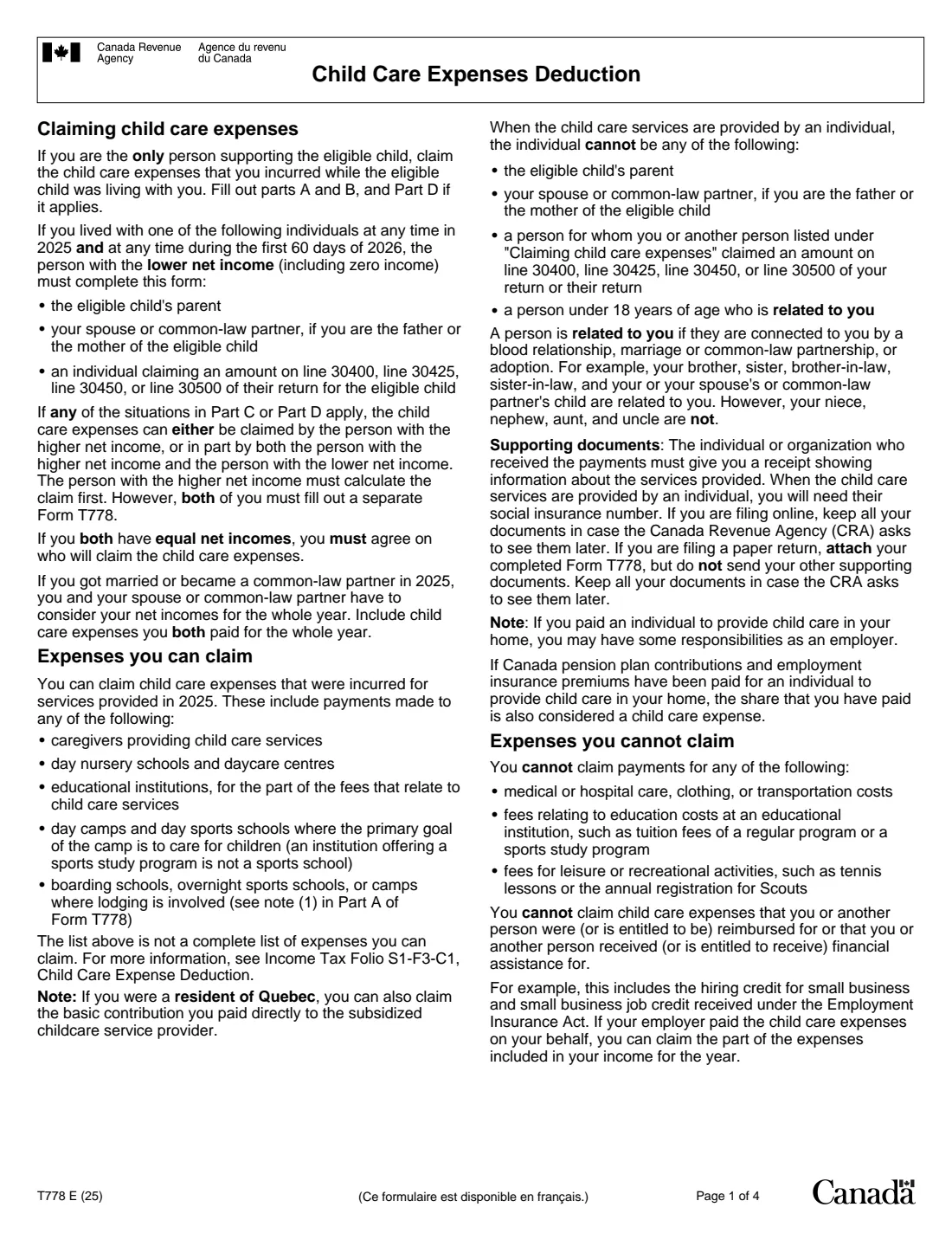
Form T778, Child Care Expenses Deduction, is the Canada Revenue Agency (CRA) form for claiming the cost of looking after your children so that you (or your spouse or partner) could work, run a business, go to school or do funded research. It covers payments to caregivers, daycare centres and nursery schools, day camps and day sports schools, and boarding schools and overnight camps, within the limits the form sets. The result goes on line 21400 of your return.
The deduction is the least of three amounts: a per-child limit ($8,000 for a child born in 2019 or later, $11,000 for a child who qualifies for the disability amount, and $5,000 for a child born from 2009 to 2018), what you actually paid, and two-thirds of your earned income. When two parents or partners live together, the person with the lower net income usually makes the claim. The person with the higher net income can claim only in the situations listed in Part C, such as the other person being in school, unable to care for children because of an infirmity, or in prison. Part D gives students extra room.
FileIt walks you through each part and prints your answers into the CRA's own fillable T778 PDF (edition T778 E (25), for the 2025 tax year). Every calculated line is worked out for you, from the per-child limits through Parts C and D, and printed in dollars and cents. The finished PDF is saved in your vault next to your other tax papers. FileIt doesn't file anything for you: you enter the result on your return, and attach the form if you file on paper.
- Who fills it
- The person claiming child care expenses. When two people live with the child, the lower-income person usually claims, and each claimant fills out their own T778
- Result
- The allowable deduction for line 21400 of your return
- Per-child limits
- $8,000 (born 2019 or later), $11,000 (disability amount), $5,000 (born 2009 to 2018)
- Income limit
- Two-thirds of your earned income
- Signatures
- None. The form is part of your return
- Edition
- T778 E (25), 2025 tax year
Who needs to fill out Form T778?
- Parents who paid a daycare, nursery school, caregiver or babysitter so they could work, run a business or study.
- Families who paid for day camps, day sports schools, boarding schools or overnight camps (up to the weekly limits).
- The spouse or common-law partner with the lower net income, who usually makes the claim when both live with the child.
- The higher-income partner, but only when the other person was in school, had an infirmity, was in prison, or you separated and reconciled as the form describes (Part C).
- Students supporting a child, and couples who were both in school during the year (Part D).
- Anyone claiming for a child with a mental or physical infirmity. There's no age limit for that child, and a higher limit applies when the disability amount can be claimed.
When to use Form T778
- When you prepare your 2025 income tax and benefit return and paid child care for services provided in 2025.
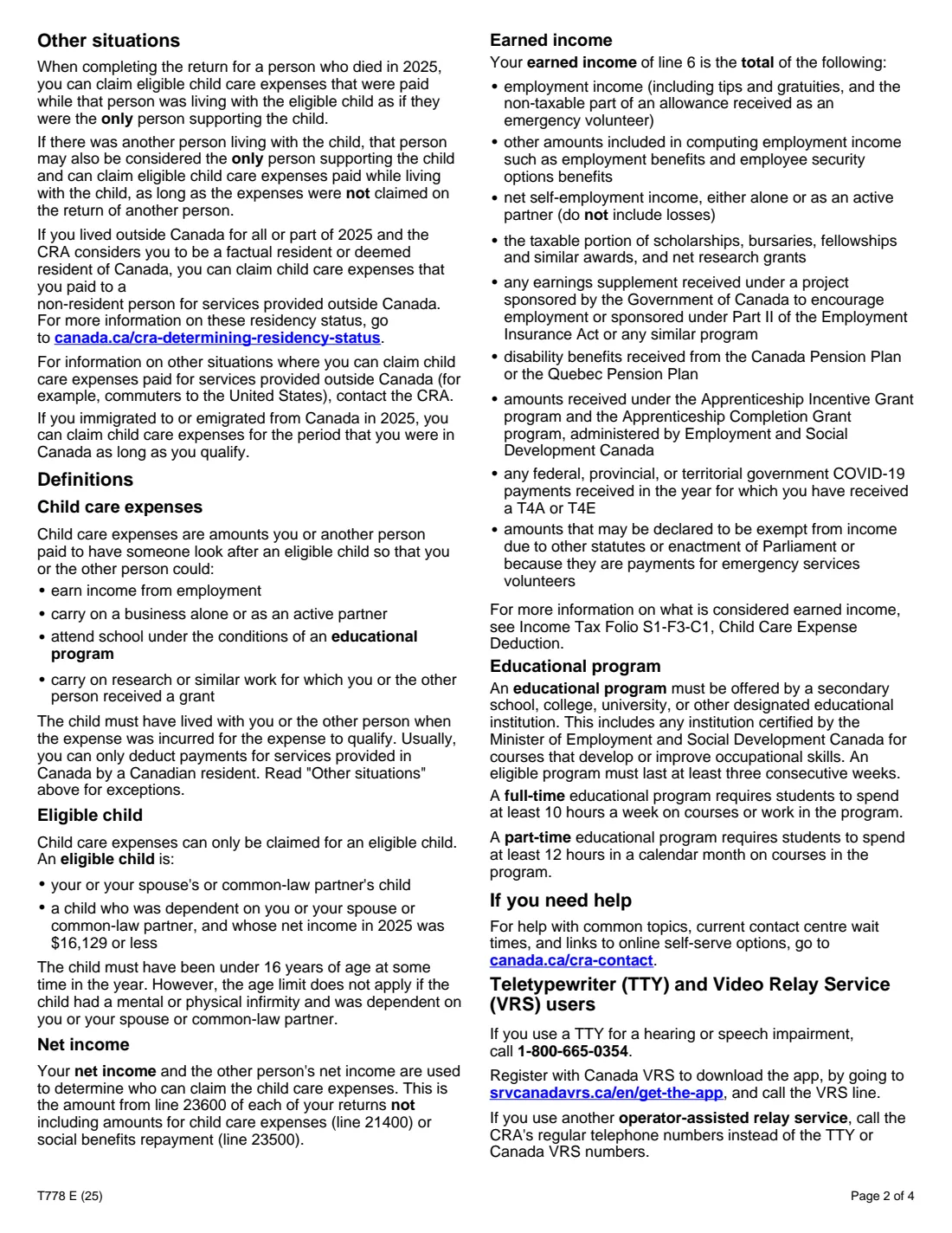
- If you got married or became a common-law partner in 2025: the form says to consider both net incomes and all child care for the whole year.
- If someone died in 2025, the return can claim child care paid while that person lived with the child, as if they were the only person supporting the child.
- If you immigrated to or emigrated from Canada in 2025, for the period you were in Canada.
What you need before you start
- The first name, last name and date of birth of each eligible child.
- Receipts for each payment, showing who was paid and the services provided.
- The social insurance number of any individual you paid (a babysitter or nanny, for example).
- The number of weeks at a boarding school or overnight camp, if any.
- Your earned income for 2025 (employment income, net self-employment income, taxable scholarships and similar amounts).
- For Part C: the other person's name, SIN and net income, and the weeks or months each situation applied. For an infirmity, a statement from a medical doctor or nurse practitioner.
- For Part D: the weeks you were enrolled full-time and the months you were enrolled part-time, and your net income.
- Form T2201, Disability Tax Credit Certificate, for a child on line 2, if it hasn't already been filed.
What’s on Form T778
The 2025 edition has 4 pages. FileIt asks for it in 5 parts:
- Part A – Your eligible childrenEmployee
- Part A – Child care paymentsEmployee
- Part B – Basic limit for child care expensesEmployee
- Part C – You are the person with the higher net incomeEmployee
- Part D – You were enrolled in an educational program in 2025Employee
How to fill out Form T778, step by step
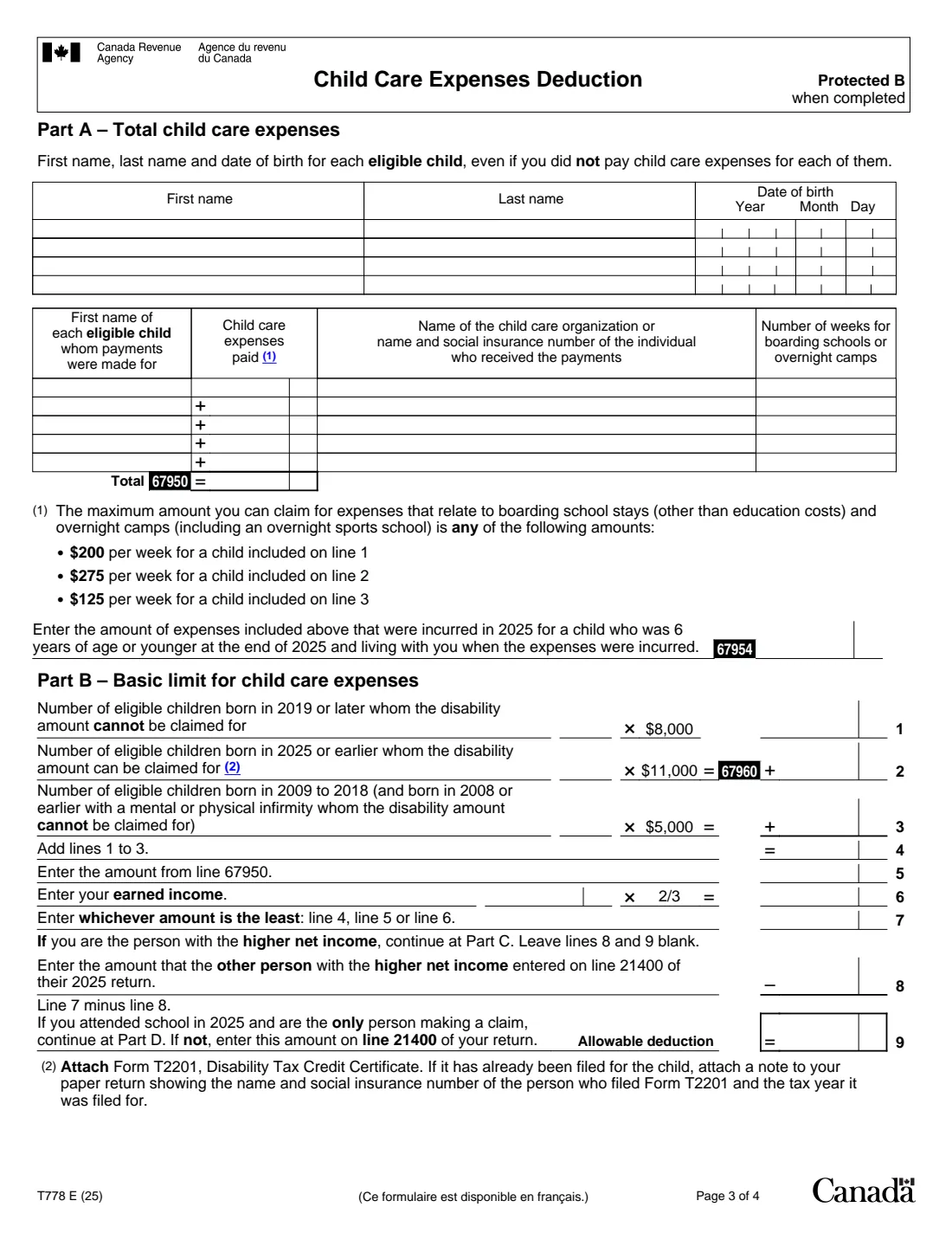
1 Part A – Your eligible children
List every eligible child, even ones you didn't pay child care for. An eligible child is your child or your spouse's or common-law partner's child, or a child who depended on you and had net income of $16,129 or less in 2025. The child must have been under 16 at some time in 2025, unless they had a mental or physical infirmity and depended on you or your spouse or partner.
2 Part A – Child care payments
For each payment, enter the child's first name, the amount, and who was paid: the organization's name, or an individual's name and social insurance number. For boarding schools and overnight camps, also give the number of weeks, because the form caps those at $200, $275 or $125 a week depending on the child's line in Part B. FileIt adds up the total (line 67950).
Then enter how much of that total was for children aged 6 or younger at the end of 2025 who lived with you (line 67954).
3 Part B – Basic limit
Count your eligible children in three groups: born in 2019 or later (line 1, $8,000 each), eligible for the disability amount (line 2, $11,000 each), and born from 2009 to 2018, or earlier with an infirmity but no disability amount (line 3, $5,000 each). Enter your earned income, and FileIt works out two-thirds of it (line 6) and takes the least of the limit, what you paid and that income test (line 7).
If you're the lower-income person and the other person already claimed part of the expenses, their line 21400 amount goes on line 8. Line 9 is then your allowable deduction.
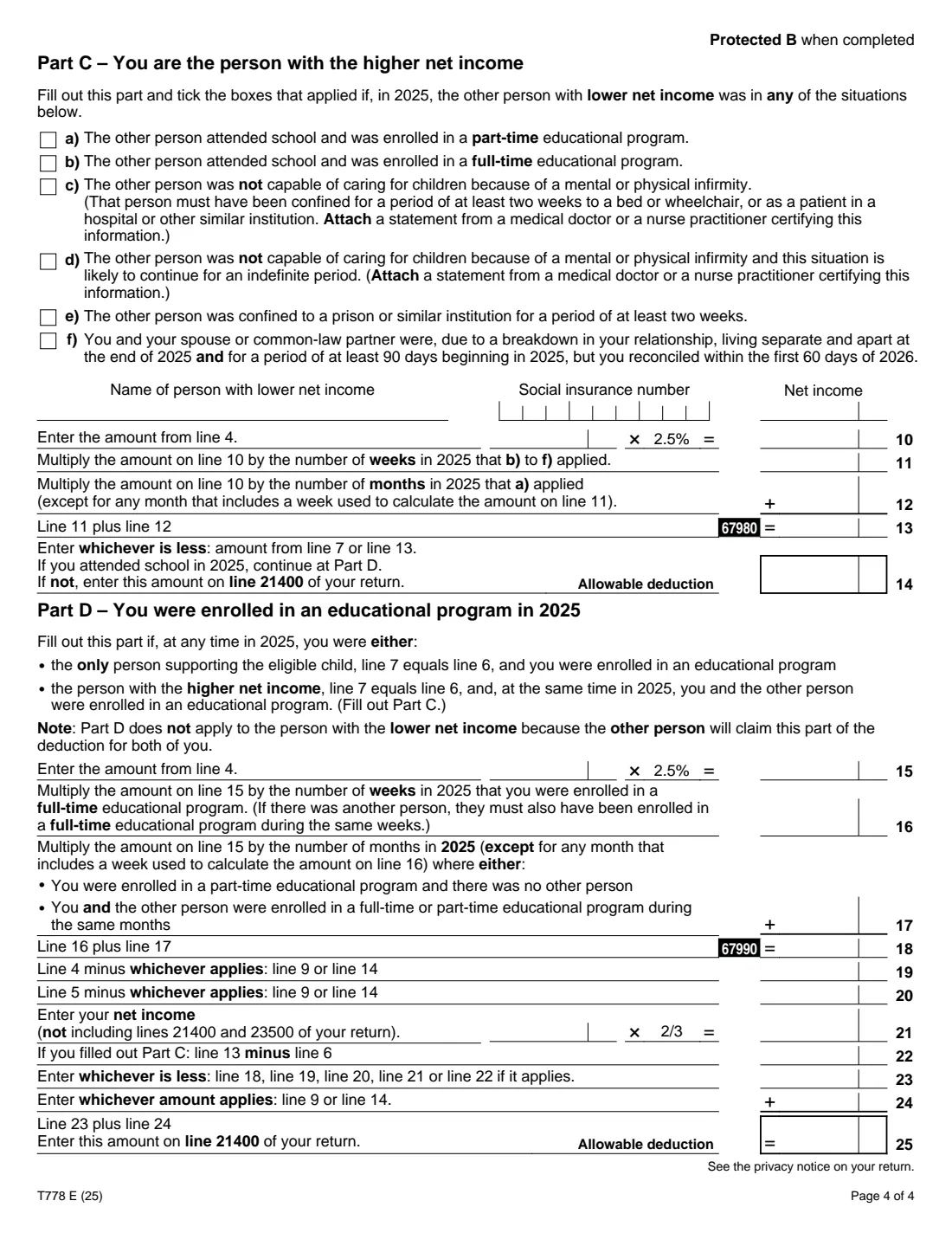
4 Part C – The higher-income person
Fill this part only if the other person was in one of the listed situations in 2025: part-time or full-time school, an infirmity (with a doctor's or nurse practitioner's statement), confinement to a prison, or a separation of 90 days or more followed by reconciliation in the first 60 days of 2026. Give their name, SIN and net income, and the weeks (situations b to f) or months (situation a) that applied.
The weekly limit is 2.5% of line 4. The deduction on line 14 is the lesser of line 7 and the weeks-and-months amount on line 13.
5 Part D – Students
Part D applies if line 7 equals line 6, and either you were the only person supporting the child and were in school, or you're the higher-income person and you were both in school at the same time. Enter your full-time weeks, qualifying part-time months and your net income. FileIt works through lines 15 to 25 and gives your total allowable deduction on line 25.
6 Enter the result on your return
Enter the allowable deduction (line 9, 14 or 25, whichever applies to you) on line 21400 of your return. If you file a paper return, attach the T778. If you file online, keep it with your receipts.
Common mistakes to avoid
- Claiming medical or hospital care, clothing, transportation, tuition for a regular program, or leisure activities like lessons or Scouts fees. The form says these aren't child care expenses.
- Claiming payments to the child's other parent, your spouse or partner, a person claimed as a dependant, or a relative under 18.
- Leaving out the SIN of an individual caregiver.
- Having the higher-income person claim when none of the Part C situations applied.
- Counting boarding school or overnight camp costs above the weekly limits.
- Claiming expenses that were, or could be, reimbursed or covered by financial assistance.
- Leaving a child out of Part A because you didn't pay for their care. The form asks for every eligible child.
After you fill it out
Enter the allowable deduction on line 21400 of your 2025 return. If you file on paper, attach the completed T778, but not your other supporting documents. If you file online, keep the form and your receipts in case the CRA asks to see them. FileIt saves the finished PDF in the person's vault folder, where your receipts can go too.
If you and a spouse or partner both claim, each of you fills out your own T778. The higher-income person works out their claim first.
Keep the child care receipts. The form says the person or organization you paid must give you a receipt, and the CRA can ask to see it later.
Fill out Form T778 online with FileIt
- Pick the person. Choose someone from People and FileIt fills in their name, date of birth, address and other details it already knows.
- Answer plain-language questions. One part of the form at a time, with the official help text beside each question — 80 fields in all. Your answers save as you go.
- Check the live preview. Watch your answers land on the real Canada Revenue Agency (CRA) form, and let FileIt do any worksheet arithmetic.
- Generate the official PDF. FileIt prints your answers into the agency’s own PDF and files it in that person’s folder in your vault.
FileIt fills the form — it never files or submits anything for you. Deliver the finished form to whoever asked for it, the way the form’s instructions say.
Start Form T778 now — it’s freeForm T778: frequently asked questions
Can I fill out Form T778 online?
Yes. FileIt guides you through Parts A to D, does all the arithmetic and prints your answers into the CRA's official fillable T778 PDF. You then enter the deduction on line 21400 of your return.
Who claims child care expenses, me or my spouse?
If you lived with the child's other parent, your spouse or common-law partner, or someone claiming the child as a dependant, the person with the lower net income usually makes the claim. The higher-income person can claim only in the situations listed in Part C, or under Part D if you were both in school. If your net incomes are equal, you agree on who claims.
How much can I claim per child?
For 2025 the limits are $8,000 for each child born in 2019 or later, $11,000 for each child who qualifies for the disability amount, and $5,000 for each child born from 2009 to 2018 (or earlier with an infirmity but no disability amount). Your claim is also capped at what you paid and at two-thirds of your earned income.
Can I claim summer day camp?
Yes. The form lists day camps and day sports schools whose main purpose is caring for children. Overnight camps and boarding schools are claimable too, up to $200, $275 or $125 a week depending on the child.
Can I claim a babysitter or grandparent?
Yes, if they aren't the child's parent, your spouse or partner, someone claimed as a dependant, or a relative under 18. You'll need their social insurance number and a receipt.
Do I send the T778 to the CRA?
Only with a paper return. If you file online, keep the form and your receipts in case the CRA asks for them.
I'm a student with a child. Does anything change?
Possibly. If your earned income limited your claim (line 7 equals line 6), Part D can give extra room based on the weeks you studied full-time or the months you studied part-time.
Official sources
- Blank form (PDF), published by Canada Revenue Agency (CRA): https://www.canada.ca/content/dam/cra-arc/formspubs/pbg/t778/t778-fill-25e.pdf
- Official instructions and guidance: https://www.canada.ca/en/revenue-agency/services/forms-publications/forms/t778.html
- Edition shown on this page: T778 E (25) (checked 2026-09-28).
FileIt is not affiliated with or endorsed by Canada Revenue Agency (CRA) or any government. This page explains the form in general terms and is not legal, tax or immigration advice. Always read the official instructions, and check that you are using the edition the recipient accepts. Page last reviewed 2026-09-28.