What is Form T2062?
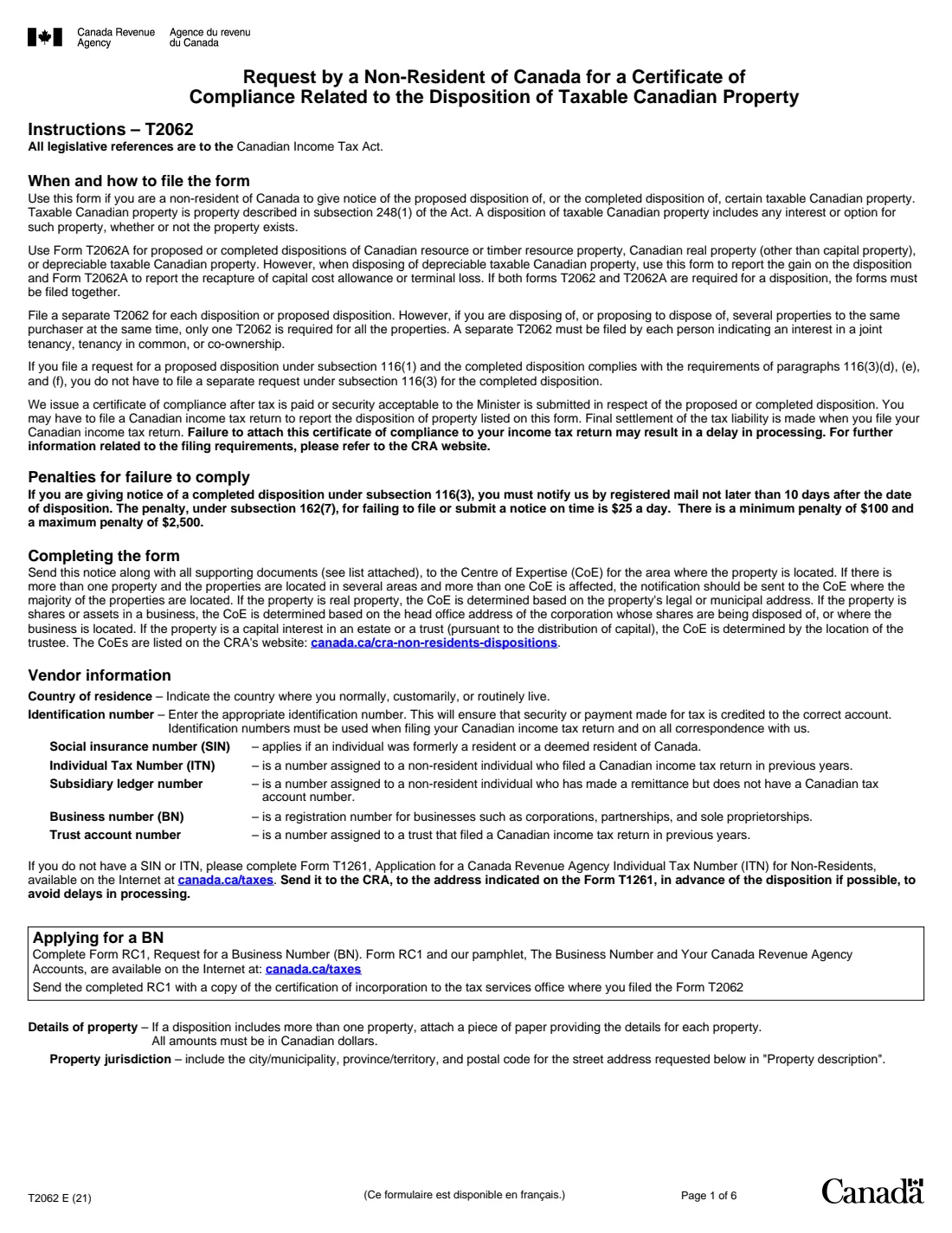
Form T2062, Request by a Non-Resident of Canada for a Certificate of Compliance Related to the Disposition of Taxable Canadian Property, is the Canada Revenue Agency (CRA) form behind what's often called a clearance certificate. When a non-resident sells, or plans to sell, taxable Canadian property, such as real estate in Canada, the purchaser can be liable for tax on the vendor's behalf. Once the CRA is satisfied, it issues a certificate of compliance that settles this.
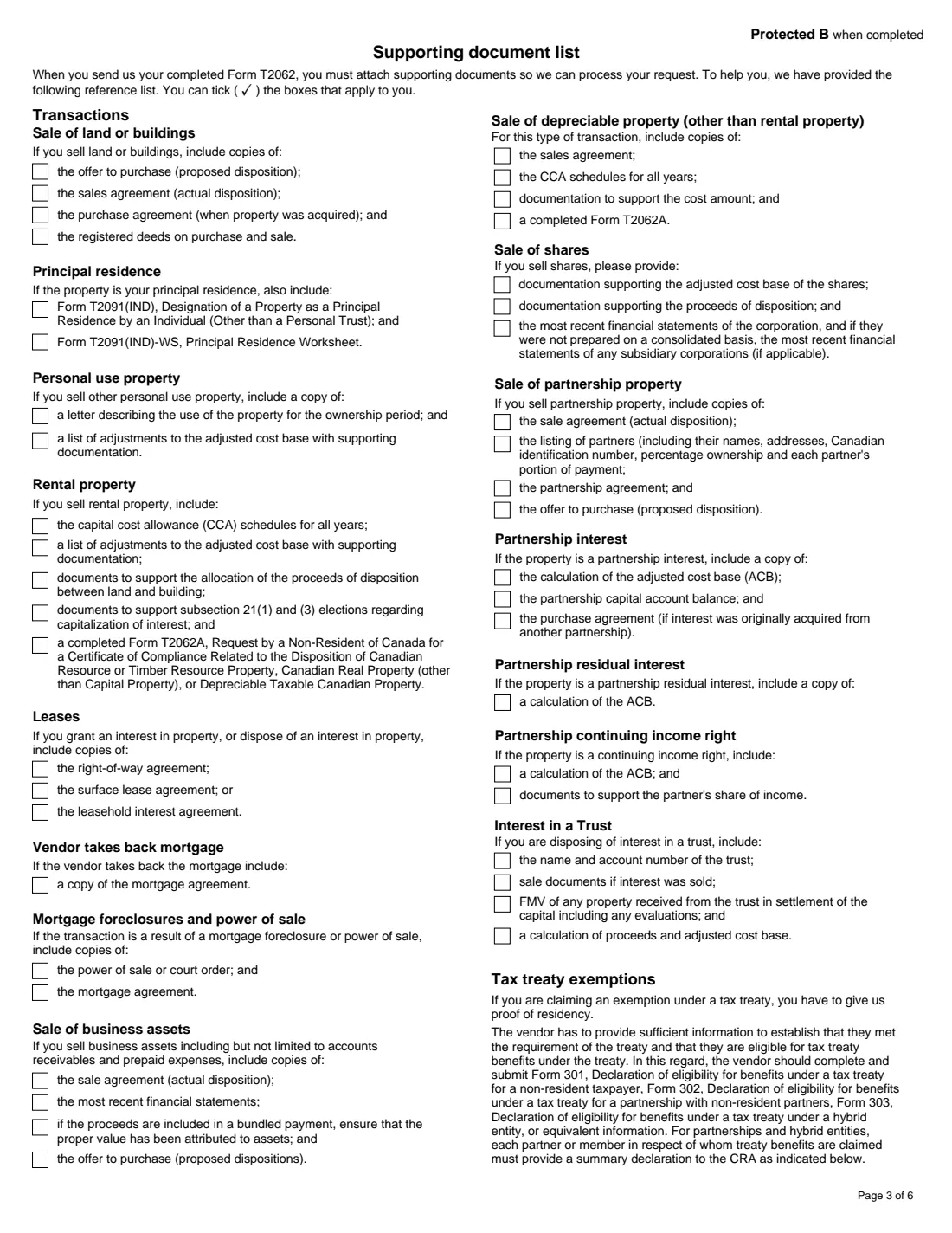
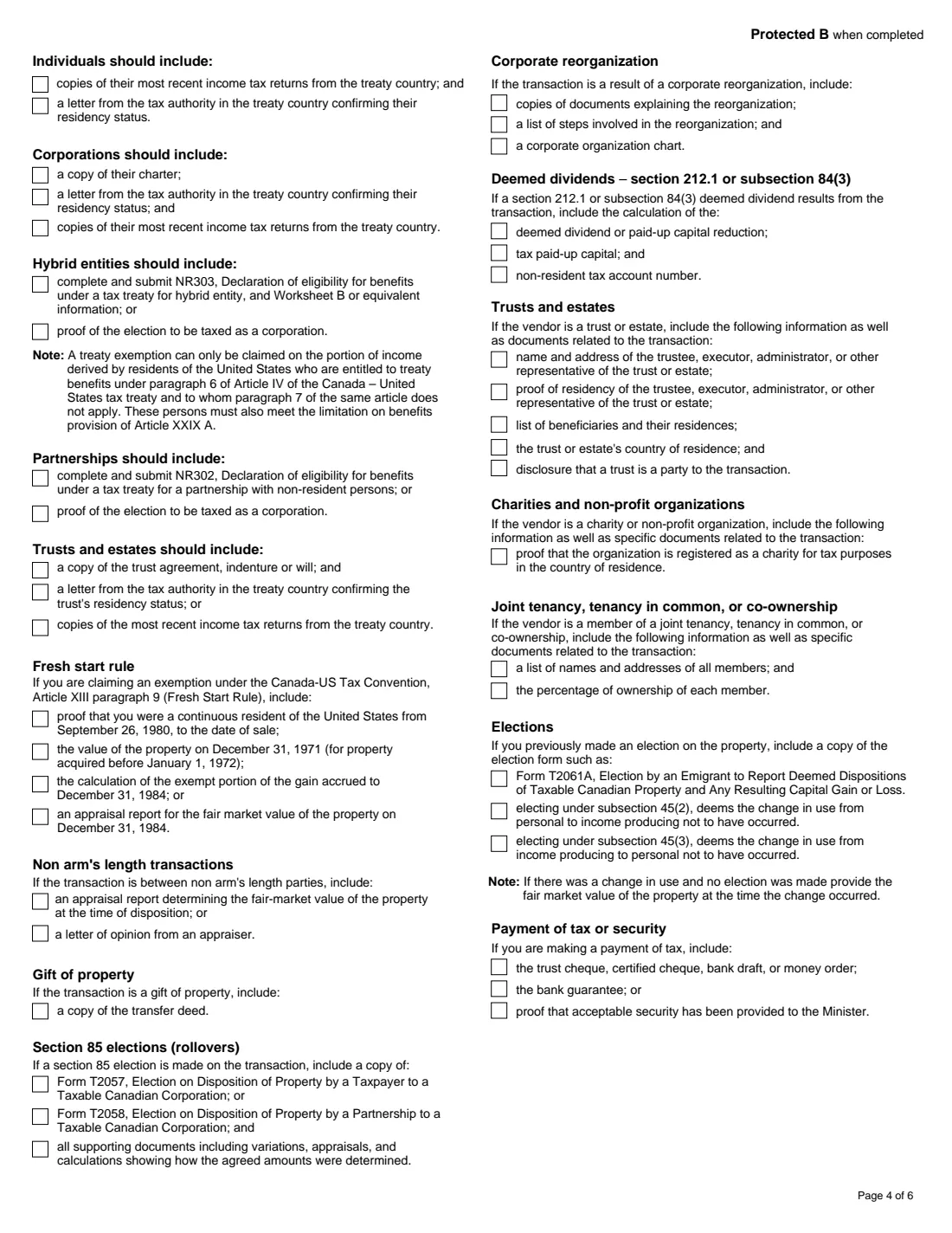
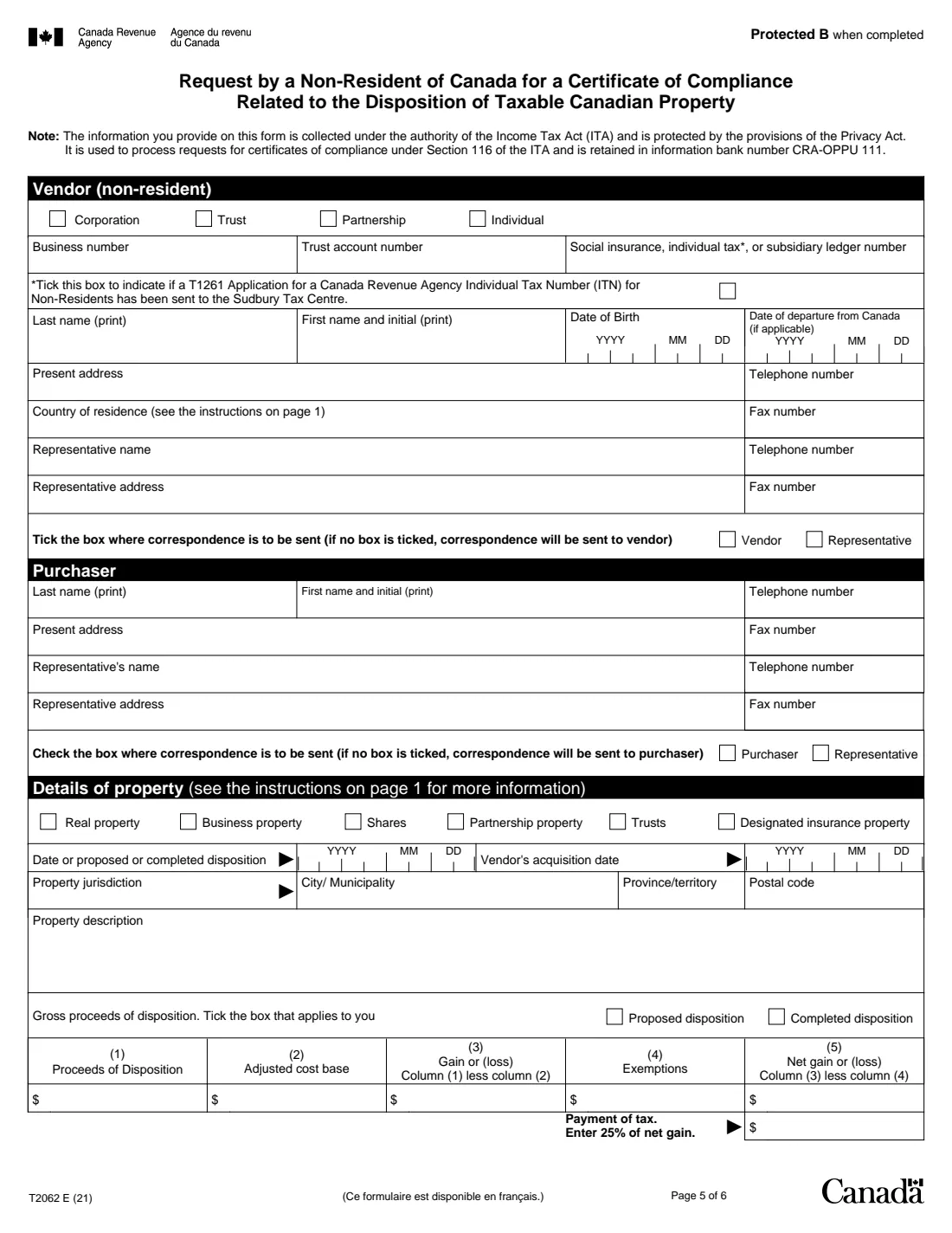
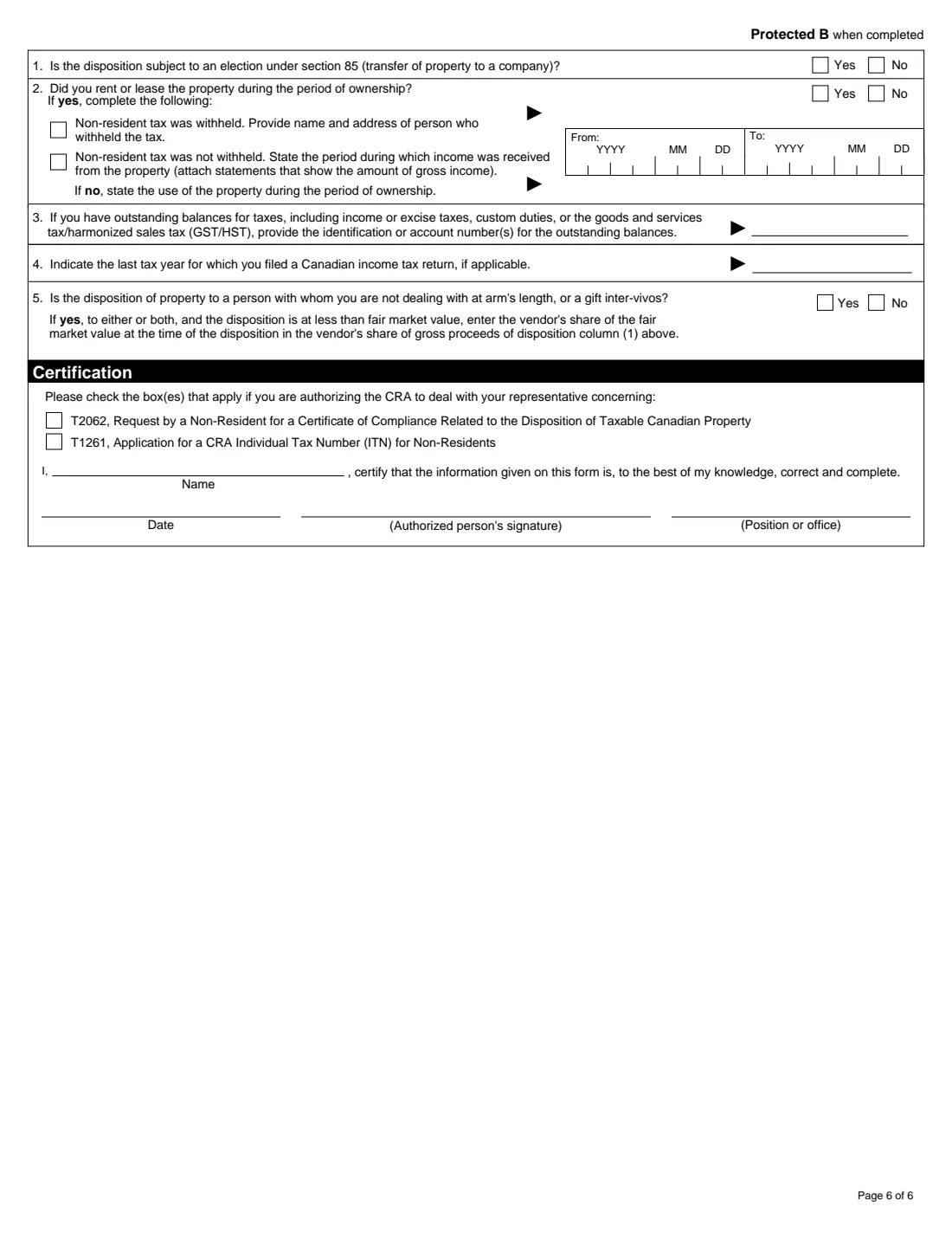
The form has three parts you fill in: the vendor and purchaser (and any representatives), the property (type, dates, location and description) with the proceeds, adjusted cost base, exemptions and gain, and five questions about elections, rental use, outstanding balances, your last Canadian return and non-arm's length dealings. Pages 3 and 4 are a checklist of supporting documents for each kind of transaction, such as purchase and sale agreements, deeds, CCA schedules and treaty residency proof.
FileIt fills in all of it in the CRA's own fillable T2062 PDF (edition T2062 E (21), still the CRA's current version), works out the gain and the 25% payment on the form's last line, and lets you tick the documents you're including. The completed form is saved in your vault, alongside the sale documents. You sign it and send it yourself.
- Who fills it
- The non-resident vendor (an individual, corporation, trust or partnership) or their representative
- Purpose
- A certificate of compliance under section 116 of the Income Tax Act
- Payment line
- 25% of the net gain, worked out on the form
- Signature
- The authorized person signs the certification by hand
- Pages
- 6: instructions, a document checklist and the request
- Edition
- T2062 E (21)
Who needs to fill out Form T2062?
- Non-residents of Canada selling a house, condo, cottage or land in Canada.
- Former residents who moved abroad and are now selling Canadian property.
- Non-resident owners disposing of shares that are taxable Canadian property, or interests in partnerships or trusts.
- Non-resident co-owners, trusts and estates selling Canadian property.
- Representatives such as lawyers or accountants preparing the request for a non-resident client.
When to use Form T2062
- Before a proposed sale, using the expected proceeds, or after a completed sale.
- For a completed disposition, by registered mail no later than 10 days after the date of disposition, as the form's instructions say.
- When a gift or a non-arm's length transfer of taxable Canadian property is made.
What you need before you start
- The vendor's identification: SIN, individual tax number, trust account or business number. Without one, a Form T1261 application for an ITN.
- The purchaser's name and address, and any representatives' contact details.
- The proposed or completed disposition date, the acquisition date and the property's legal description.
- The proceeds of disposition and the adjusted cost base, plus any exemption you claim.
- The documents listed on pages 3 and 4 for your kind of transaction, such as the offer to purchase, the purchase agreement and the registered deeds.
- Proof of tax paid or security, if you're paying or giving security with the request.
What’s on Form T2062
The 2021 edition has 6 pages. FileIt asks for it in 6 parts:
- Vendor (non-resident)Employee
- PurchaserEmployee
- Details of propertyEmployee
- QuestionsEmployee
- Documents you're attachingEmployee
- CertificationEmployee
How to fill out Form T2062, step by step
1 Vendor
Choose whether the vendor is a corporation, trust, partnership or individual, and give the matching identification number. Add names, date of birth and date of departure from Canada (for an individual), address, phone and country of residence. Add a representative if you have one, and choose who the CRA writes to.
2 Purchaser
The purchaser's name and contact details, any representative, and who receives the purchaser's correspondence.
3 Details of property
Tick the type of property, enter the disposition and acquisition dates, the jurisdiction, city, province and postal code, and a description (for real estate, the civic address and legal description). Say whether it's a proposed or completed disposition, then enter the proceeds, adjusted cost base and any exemptions. FileIt works out the gain, the net gain and 25% of the net gain.
4 Questions
Answer the five questions: a section 85 election, whether the property was rented and how non-resident tax on the rent was handled, account numbers for any outstanding balances, the last year you filed a Canadian return, and whether the buyer is non-arm's length or the transfer is a gift.
5 Documents and certification
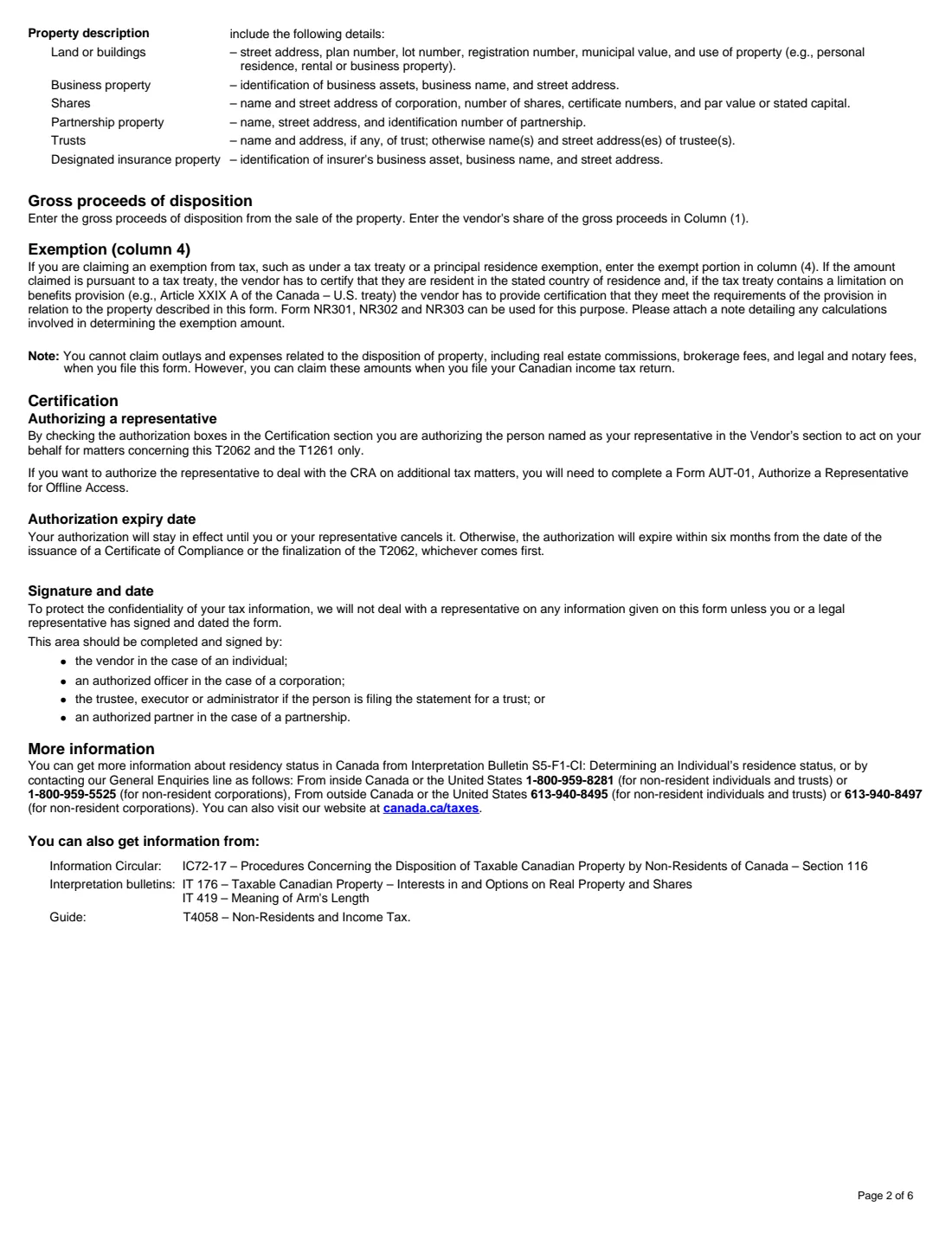
Tick the supporting documents you're including. Then authorize the CRA to deal with your representative if you want, and enter the name, date and position of the person certifying. They sign by hand.
Common mistakes to avoid
- Sending the request without the supporting documents for the transaction, which slows processing.
- Leaving out the vendor's identification number, or not applying for an ITN with Form T1261.
- Using the agreed price when the sale is to a related person below fair market value. Question 5 says to use the vendor's share of fair market value.
- Mixing up proposed and completed dispositions.
- Forgetting to declare rental use and the non-resident tax on the rent (question 2).
After you fill it out
Sign the certification. T2062 isn't on the CRA's list of forms that accept electronic signatures.
Send it with the supporting documents, and any payment or security, as the CRA's instructions on pages 1 and 2 explain.
Keep everything together: FileIt saves the filled form in your vault, and you can store the sale documents and the certificate there when it arrives.
Fill out Form T2062 online with FileIt
- Pick the person. Choose someone from People and FileIt fills in their name, date of birth, address and other details it already knows.
- Answer plain-language questions. One part of the form at a time, with the official help text beside each question — 149 fields in all. Your answers save as you go.
- Check the live preview. Watch your answers land on the real Canada Revenue Agency (CRA) form, and let FileIt do any worksheet arithmetic.
- Generate the official PDF. FileIt prints your answers into the agency’s own PDF and files it in that person’s folder in your vault.
FileIt fills the form — it never files or submits anything for you. Deliver the finished form to whoever asked for it, the way the form’s instructions say.
Start Form T2062 now — it’s freeForm T2062: frequently asked questions
What is a section 116 clearance certificate?
It's the certificate of compliance the CRA issues once a non-resident's disposition of taxable Canadian property is dealt with. Form T2062 is how you ask for it.
Can I fill out Form T2062 online?
Yes. FileIt fills every part of the CRA's fillable T2062, works out the gain and the 25% payment line, and saves the PDF in your vault for you to sign and send.
Why is the payment 25% of the net gain?
That's the amount the form's payment line asks for. The form's instructions say the CRA issues the certificate after tax is paid or security acceptable to the Minister is given.
Is edition 21 still the current form?
Yes. As of October 2026 the CRA's T2062 page still links the 2021 edition, which is the one FileIt uses.
I'm selling my principal residence. Is anything different?
The checklist asks you to include Form T2091(IND) and the principal residence worksheet, and you can claim the exemption in column 4.
Does FileIt submit the request?
No. FileIt fills the form. You sign it and send it to the CRA with your documents.
Official sources
- Blank form (PDF), published by Canada Revenue Agency (CRA): https://www.canada.ca/content/dam/cra-arc/formspubs/pbg/t2062/t2062-fill-21e.pdf
- Official instructions and guidance: https://www.canada.ca/en/revenue-agency/services/forms-publications/forms/t2062.html
- Edition shown on this page: T2062 E (21) (checked 2026-10-19).
FileIt is not affiliated with or endorsed by Canada Revenue Agency (CRA) or any government. This page explains the form in general terms and is not legal, tax or immigration advice. Always read the official instructions, and check that you are using the edition the recipient accepts. Page last reviewed 2026-10-19.