What is Form T1261?
An individual tax number (ITN) is a nine-digit number the Canada Revenue Agency (CRA) issues to non-resident individuals who need an identification number for Canadian tax purposes but aren't eligible for a social insurance number (SIN). Form T1261 is the application. It's the Canadian counterpart of the U.S. Form W-7 for an ITIN.
You might need one to file a Canadian return, to elect under section 216 to report net Canadian rental income, to apply for reduced withholding tax, to sell taxable Canadian property, as an international student without a work permit, for the Underused Housing Tax, or to file a special election or return. The form says not to apply if you have, or can get, a SIN, or if you already have an ITN or a temporary tax number. You send certified copies of your identity documents with it, and the form says to allow six to eight weeks.
FileIt guides you through the application and its checklist and prints your answers into the CRA's own fillable PDF (edition T1261 E (25)), with names and addresses in any European alphabet. The finished PDF is saved in the person's vault folder. You sign it in ink — the form doesn't accept electronic signatures — and mail it yourself; FileIt never submits it. Filling forms is free on every FileIt plan.
- Who fills it
- Non-residents who need a Canadian tax number and aren't eligible for a SIN
- Sent to
- The ITN Unit at the Sudbury Tax Centre, by mail only (no fax or email)
- Documents
- Certified copies of current ID showing your name, date of birth and photo
- Signatures
- Your signature in ink; electronic signatures are not accepted
- Edition
- T1261 E (25)
- Processing
- Six to eight weeks, according to the form
Who needs to fill out Form T1261?
- Non-residents who have to file, or want to file, a Canadian income tax return.
- Non-resident landlords electing under section 216 to report net rental income from Canadian property.
- Non-residents applying to waive or reduce Canadian withholding tax on payments they receive.
- Non-residents selling taxable Canadian property, such as real estate in Canada.
- International students without a work permit who have to file or want to file a Canadian return.
- Non-resident individuals, partners and trustees who must file an Underused Housing Tax return, or who file a special election or return.
- Executors applying for a deceased non-resident.
When to use Form T1261
- As soon as you meet the requirements, so you have the number before you need it.
- Allowing six to eight weeks for the CRA to send your ITN in writing.
- Only if you don't have, and can't get, a SIN, and don't already have an ITN or a temporary tax number.
- With your section 216 return, if that's why you're applying: the form says to send the return with the application.
What you need before you start
- Your legal name exactly as on your documents, your date of birth and country of birth.
- Your home address in the country where you normally live, and a phone number.
- A mailing address and the name of your representative in Canada, if you use one.
- Certified copies of current identity documents, such as a passport or driver's licence, that together show your name, date of birth and photo.
- A certifier: a public notary, lawyer, medical doctor or chartered professional accountant (with membership number). You can't certify your own documents.
- Official translations of any document not in English or French.
- A copy of your study permit if you're an international student, or the death certificate, will and executor's certified photo ID for a deceased applicant.
What’s on Form T1261
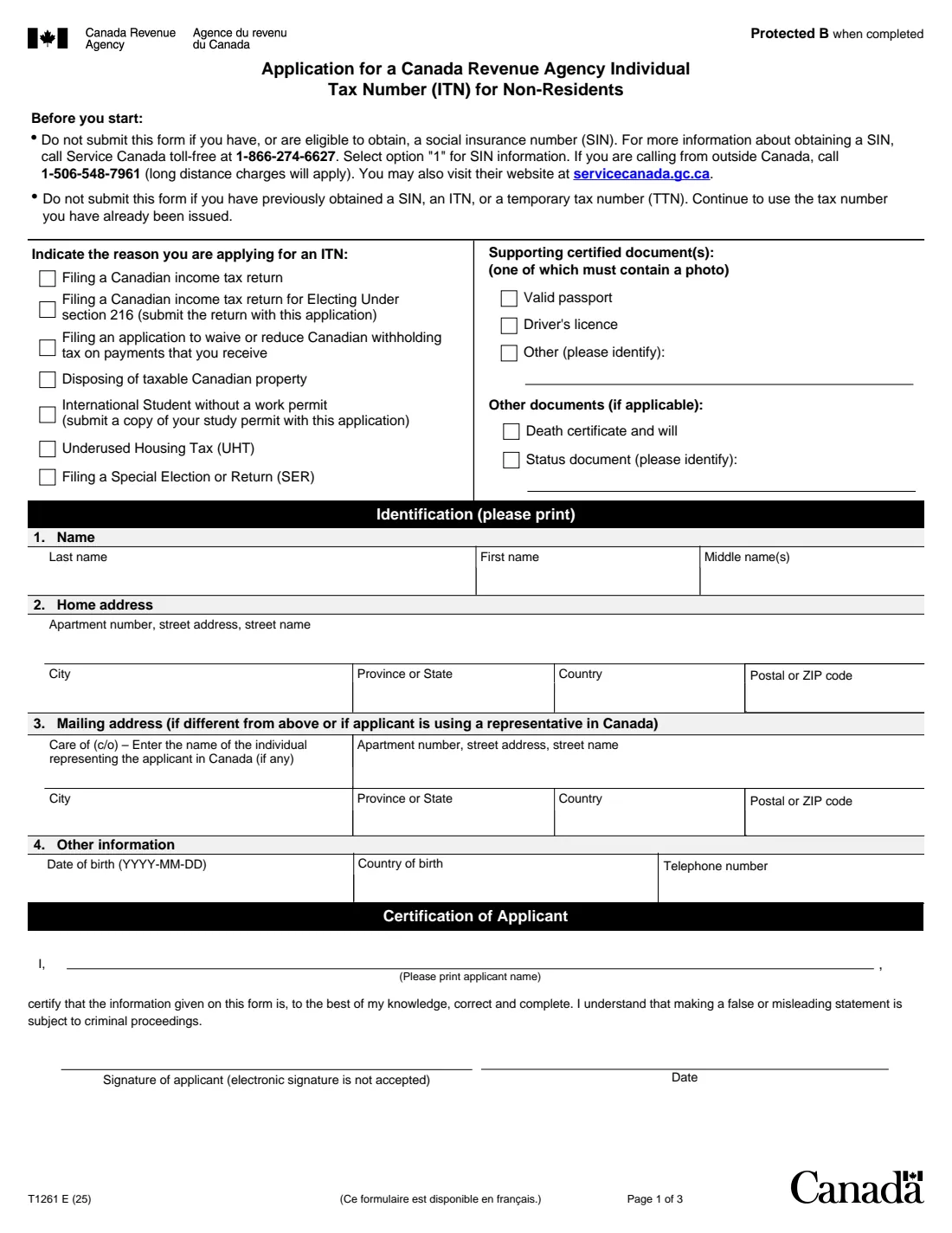
The 2025 edition has 3 pages. FileIt asks for it in 7 parts:
- Reason for applyingApplicant
- Supporting documentsApplicant
- Name and home addressApplicant
- Mailing addressApplicant
- Other informationApplicant
- CertificationApplicant
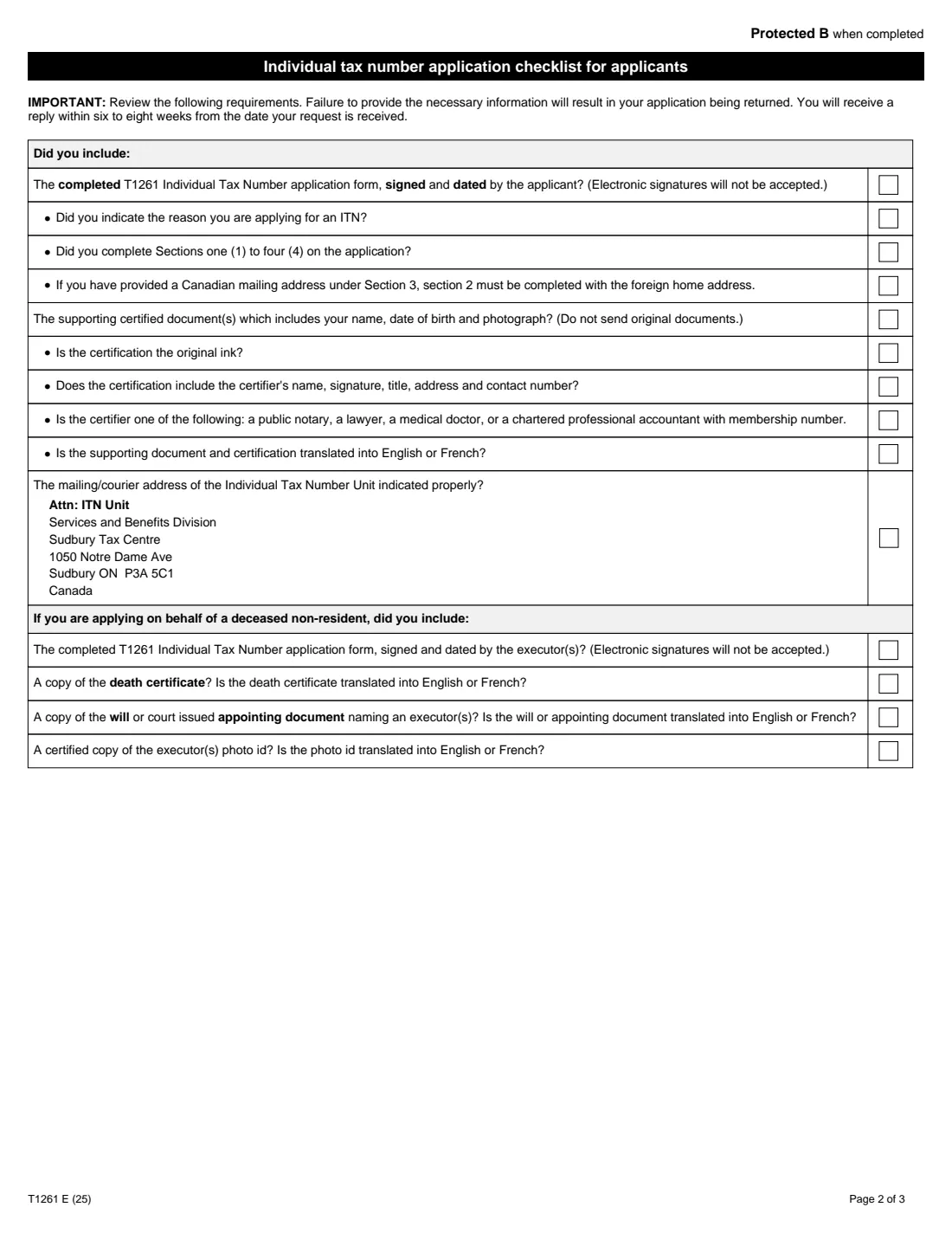
- Application checklist (page 2)Applicant
How to fill out Form T1261, step by step
1 Reason for applying
Tick why you need an ITN: a Canadian return, a section 216 return (send the return with the application), a withholding tax waiver or reduction, disposing of taxable Canadian property, being an international student without a work permit (send your study permit), the Underused Housing Tax, or a special election or return.
2 Supporting documents
Tick the certified documents you're sending — passport, driver's licence or another document you name. At least one must have your photo. For a deceased applicant, tick the death certificate and will; for a status document such as a study permit, name it.
3 Sections 1 to 4
Section 1 is your legal name as it appears on your documents. Section 2 is your home address in the country where you permanently or normally live. Section 3 is a mailing address only if it's different, or if you use a representative in Canada (give their name as care of) — the CRA sends your ITN letter there. Section 4 is your date of birth, country of birth and a contact phone number.
4 Certification
Your full name prints on the certification line. Sign and date it in ink; the form states that electronic signatures are not accepted. For a deceased applicant, the executor(s) named in the will or court document sign.
5 Checklist
Page 2 is the CRA's own checklist. Tick each item as you check it: the form is signed and dated, the reason is ticked, sections 1 to 4 are complete, your certified documents are included with original-ink certification from an eligible certifier, translations are attached, and the envelope is addressed to the ITN Unit. An application missing any of these is returned.
Common mistakes to avoid
- Applying when you have, or can get, a SIN, or already have an ITN or temporary tax number.
- Sending original passports or ID cards; the form says to send certified copies only.
- Certifying your own documents, or using a certifier who isn't a notary, lawyer, doctor or CPA.
- Photocopied certification instead of original ink, or a certification missing the certifier's name, title, address and phone number.
- Forgetting translations of documents that aren't in English or French.
- Giving a Canadian address as your home address; section 2 must be your foreign home address.
- Faxing, emailing or e-signing the application — the form accepts only a mailed application signed in ink.
After you fill it out
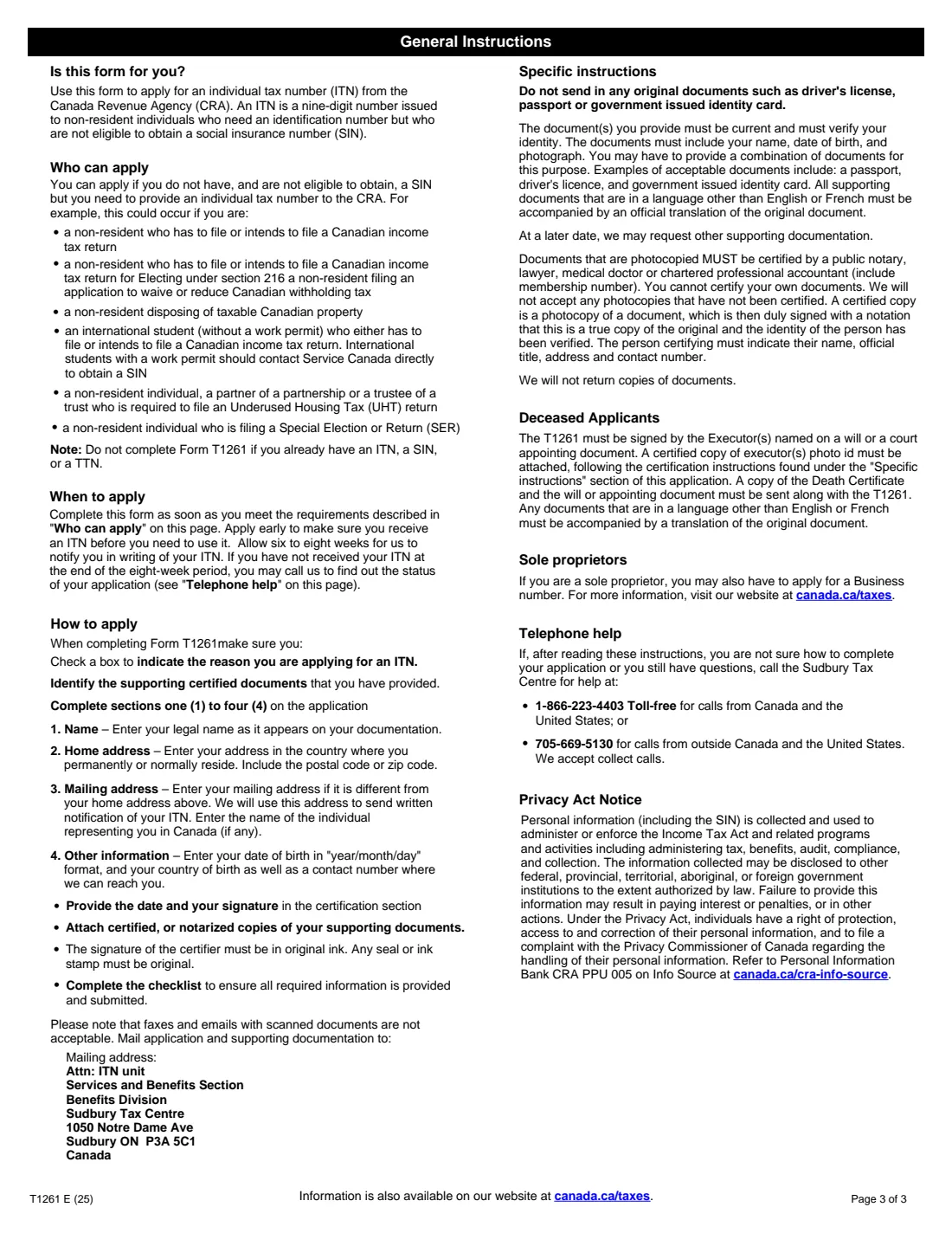
Print the completed PDF from your FileIt vault, sign and date it in ink, and mail it with your certified documents to: Attn: ITN Unit, Sudbury Tax Centre, 1050 Notre Dame Ave, Sudbury ON P3A 5C1, Canada. The form says faxes and emails with scanned documents are not acceptable, and the CRA does not return copies of documents. FileIt does not send the form for you.
The CRA notifies you of your ITN in writing within six to eight weeks. If you haven't heard by then, the form says to call the Sudbury Tax Centre at 1-866-223-4403 from Canada and the U.S. or 705-669-5130 from elsewhere (collect calls accepted).
Store the CRA's ITN letter in your FileIt vault next to your copy of the application; you'll quote the number on every return and form you send the CRA.
Fill out Form T1261 online with FileIt
- Pick the person. Choose someone from People and FileIt fills in their name, date of birth, address and other details it already knows.
- Answer plain-language questions. One part of the form at a time, with the official help text beside each question — 40 fields in all. Your answers save as you go.
- Check the live preview. Watch your answers land on the real Canada Revenue Agency (CRA) form, and let FileIt do any worksheet arithmetic.
- Generate the official PDF. FileIt prints your answers into the agency’s own PDF and files it in that person’s folder in your vault.
FileIt fills the form — it never files or submits anything for you. Deliver the finished form to whoever asked for it, the way the form’s instructions say.
Start Form T1261 now — it’s freeForm T1261: frequently asked questions
Can I fill out Form T1261 online?
Yes. FileIt guides you through the application and checklist, prints your answers into the CRA's official fillable T1261 PDF and saves it in your vault, free on every plan. You then sign it in ink and mail it yourself.
What is an ITN?
An individual tax number is a nine-digit number the CRA issues to non-resident individuals who need a tax identification number but aren't eligible for a social insurance number.
Can I sign it electronically or send it by fax or email?
No. The form says electronic signatures are not accepted, and that faxes and emails with scanned documents are not acceptable. Mail the signed application with your certified documents.
Who can certify my documents?
A public notary, a lawyer, a medical doctor or a chartered professional accountant (with their membership number). They sign in original ink with a note that it's a true copy and that they verified your identity, and give their name, title, address and phone number. You can't certify your own documents.
How long does it take?
The form says to allow six to eight weeks for the CRA to notify you of your ITN in writing.
I'm an international student. Do I need an ITN?
Only if you don't have a work permit and you have to or want to file a Canadian return. Students with a work permit should get a SIN from Service Canada instead.
Is this like the U.S. Form W-7?
Yes, in purpose: both give a tax number to people who can't get the country's regular one. The W-7 is for a U.S. ITIN from the IRS; the T1261 is for a Canadian ITN from the CRA.
Official sources
- Blank form (PDF), published by Canada Revenue Agency (CRA): https://www.canada.ca/content/dam/cra-arc/formspubs/pbg/t1261/t1261-fill-25e.pdf
- Official instructions and guidance: https://www.canada.ca/en/revenue-agency/services/forms-publications/forms/t1261.html
- Edition shown on this page: T1261 E (25) (checked 2026-09-28).
FileIt is not affiliated with or endorsed by Canada Revenue Agency (CRA) or any government. This page explains the form in general terms and is not legal, tax or immigration advice. Always read the official instructions, and check that you are using the edition the recipient accepts. Page last reviewed 2026-09-28.