What is Form RC4625?
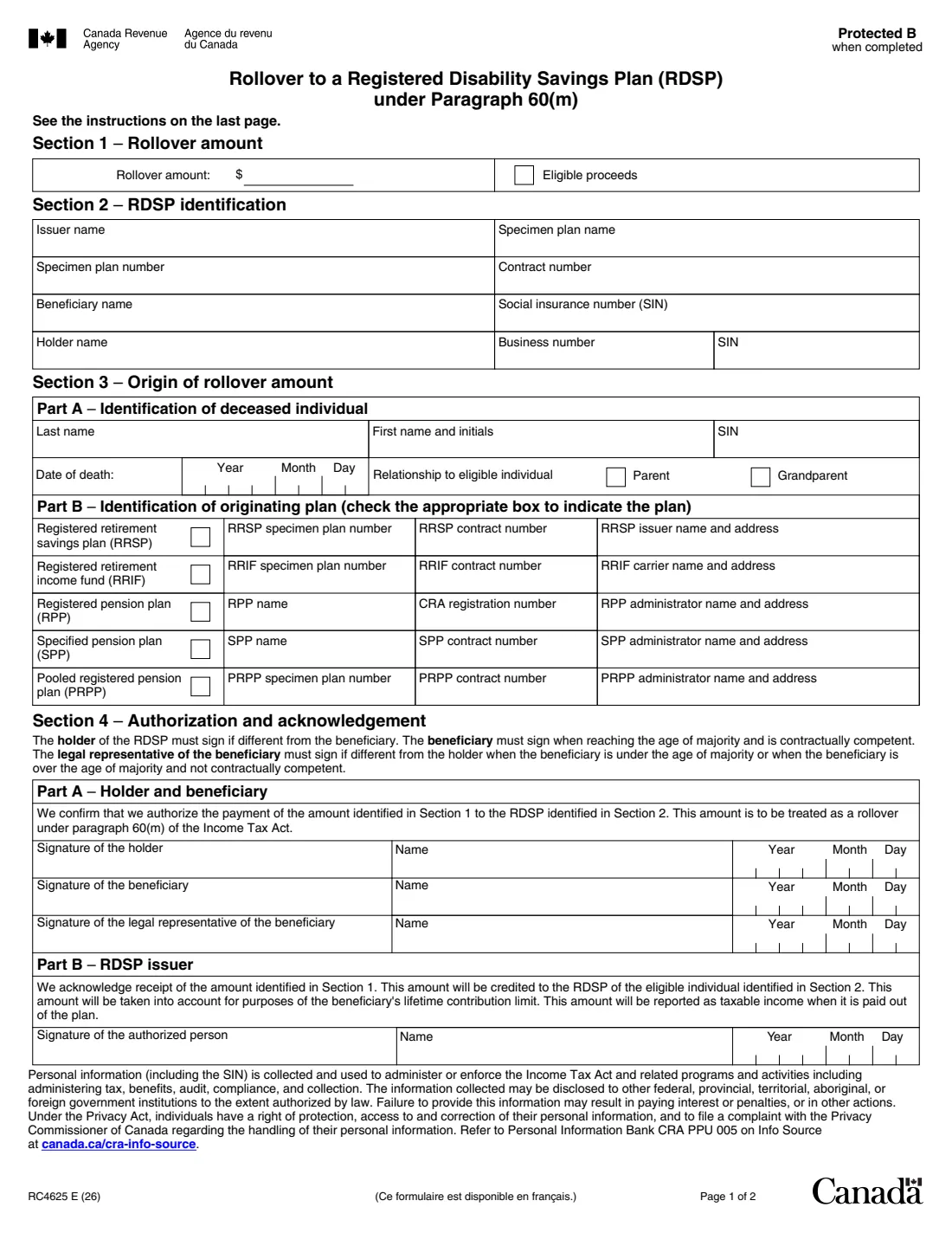
Form RC4625 is the Canada Revenue Agency (CRA) form an RDSP holder uses to record a rollover under paragraph 60(m) of the Income Tax Act: eligible proceeds paid because a parent or grandparent died are rolled into the registered disability savings plan (RDSP) of an eligible individual, a child or grandchild who was financially dependent on them because of a mental or physical infirmity. The current edition is RC4625 E (26).
Sections 1 to 3 give the rollover amount, the RDSP, the deceased person and the plan the proceeds came from: an RRSP, RRIF, registered pension plan, specified pension plan or pooled registered pension plan. In Section 4 the holder, the beneficiary or their legal representative signs, as the rule printed on the form requires, and the RDSP issuer acknowledges receipt. Filling it out is the last step in the rollover, and the issuer keeps it.
FileIt walks you through each section, asks only for the details of the plan you tick, and turns on just the signature lines that apply. The CRA's official PDF is filled in and saved in the person's vault folder. FileIt doesn't send it to the RDSP issuer for you.
- Who fills it
- The RDSP holder (Sections 1 to 3); signers in Section 4; the RDSP issuer
- Kept by
- The RDSP issuer, with the relevant documents; not sent to the CRA
- One form per
- Rollover transaction
- Originating plans
- RRSP, RRIF, RPP, SPP or PRPP
- Edition
- RC4625 E (26)
Who needs to fill out Form RC4625?
- Holders of an RDSP for a child or grandchild who received a refund of premiums, an eligible RRIF amount or a lump-sum pension payment because their parent or grandparent died.
- Beneficiaries who have reached the age of majority and are contractually competent, who sign too.
- Legal representatives of a beneficiary who is a minor or not contractually competent, when they aren't the holder.
When to use Form RC4625
- When eligible proceeds are being paid into the RDSP of the eligible individual.
- As the final step of the rollover; your RDSP issuer may also use its own documentation.
- Once for each rollover transaction.
What you need before you start
- The rollover amount.
- The RDSP issuer, specimen plan name and number, and contract number.
- The beneficiary's name and SIN, and the holder's name and SIN or business number.
- The deceased's name, SIN and date of death, and whether they were the beneficiary's parent or grandparent.
- The originating plan's details: specimen plan or registration number, contract number, and the issuer, carrier or administrator's name and address.
What’s on Form RC4625
The 2026 edition has 2 pages. FileIt asks for it in 8 parts, and it is signed by Rdsp holder (signing) and Beneficiary and Legal representative of the beneficiary and Rdsp issuer:
- Section 1 – Rollover amountRdsp holder
- Section 2 – RDSP identificationRdsp holder
- Section 3, Part A – The deceased individualRdsp holder
- Section 3, Part B – The originating planRdsp holder
- Section 4, Part A – The holder signsRdsp holder (signing)
- Section 4, Part A – The beneficiary signsBeneficiary
- Section 4, Part A – The legal representative signsLegal representative of the beneficiary
- Section 4, Part B – RDSP issuerRdsp issuer
How to fill out Form RC4625, step by step
1 Section 1 – Rollover amount
The amount being rolled over, and a tick to confirm it is eligible proceeds.
2 Section 2 – RDSP identification
The RDSP issuer, specimen plan name and number, contract number, the beneficiary's name and SIN, and the holder's name with a SIN or, for an agency or institution holder, a business number.
3 Section 3 – Origin of the rollover
Part A identifies the deceased individual: name, SIN, date of death and whether they were the eligible individual's parent or grandparent. Part B ticks the originating plan and gives its numbers and its issuer, carrier or administrator.
4 Section 4 – Authorization and acknowledgement
The holder signs if they aren't the beneficiary. The beneficiary signs once they've reached the age of majority and are contractually competent. The legal representative signs if they aren't the holder and the beneficiary is a minor or not contractually competent. The RDSP issuer then acknowledges receipt in Part B.
Common mistakes to avoid
- Using the form for proceeds from someone other than a parent or grandparent.
- Rolling over an amount already deducted under paragraph 60(l), which the definition of eligible proceeds excludes.
- Ticking more than one originating plan.
- Leaving out a signature the Section 4 rule calls for.
- Sending the form to the CRA; the RDSP issuer keeps it.
After you fill it out
Print the PDF from your FileIt vault, have the right people sign Section 4, and give it to your RDSP issuer, who keeps it with the relevant documents. FileIt doesn't send it.
Keep a copy for your records, as the instructions ask the holder to.
The rollover counts toward the beneficiary's lifetime contribution limit, as Part B says.
Fill out Form RC4625 online with FileIt
- Pick the person. Choose someone from People and FileIt fills in their name, date of birth, address and other details it already knows.
- Answer plain-language questions. One part of the form at a time, with the official help text beside each question — 40 fields in all. Your answers save as you go.
- Check the live preview. Watch your answers land on the real Canada Revenue Agency (CRA) form, and let FileIt do any worksheet arithmetic.
- Generate the official PDF. FileIt prints your answers into the agency’s own PDF and files it in that person’s folder in your vault. Sign it, or send it for e-signature.
FileIt fills the form — it never files or submits anything for you. Deliver the finished form to whoever asked for it, the way the form’s instructions say.
Start Form RC4625 now — it’s freeForm RC4625: frequently asked questions
What are eligible proceeds?
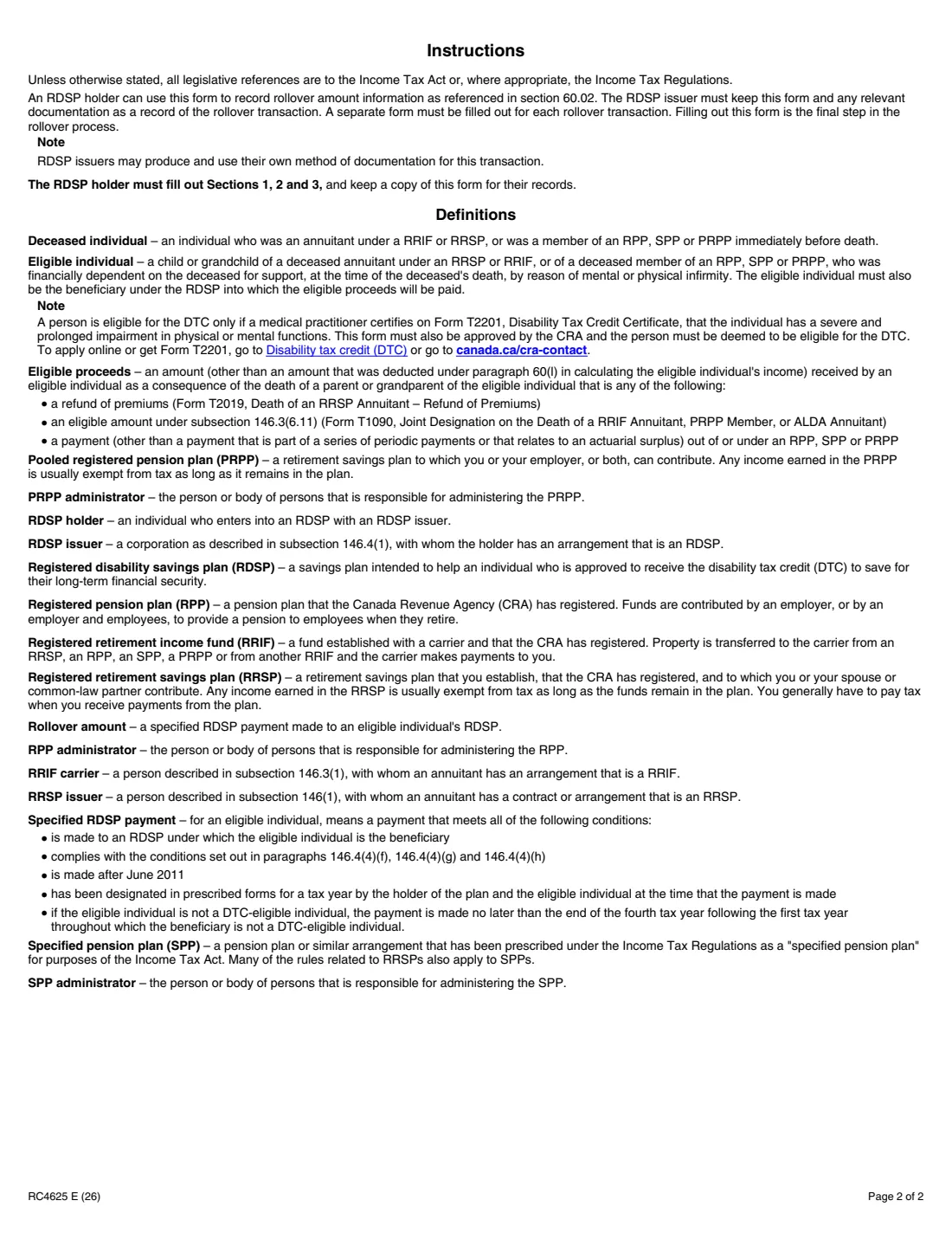
The form defines them as an amount received by an eligible individual because of the death of a parent or grandparent: a refund of premiums from an RRSP, an eligible amount from a RRIF, or a payment out of an RPP, SPP or PRPP that isn't part of a series of periodic payments. An amount deducted under paragraph 60(l) is excluded.
Who has to sign RC4625?
It depends on the beneficiary. The holder signs if different from the beneficiary, the beneficiary signs once of age and contractually competent, and a legal representative signs if different from the holder when the beneficiary is a minor or not competent.
Does the beneficiary need the disability tax credit?
The form's note says a person is eligible for the DTC only once a medical practitioner certifies Form T2201 and the CRA approves it. The definitions explain how the rules apply when a beneficiary stops being DTC-eligible.
Can I fill out RC4625 online?
Yes. FileIt guides you through Sections 1 to 4 and prints your answers on the CRA's official RC4625 PDF, saved in your vault, ready to sign and give the RDSP issuer.
Official sources
- Blank form (PDF), published by Canada Revenue Agency (CRA): https://www.canada.ca/content/dam/cra-arc/formspubs/pbg/rc4625/rc4625-fill-26e.pdf
- Official instructions and guidance: https://www.canada.ca/en/revenue-agency/services/forms-publications/forms/rc4625.html
- Edition shown on this page: RC4625 E (26) (checked 2026-10-19).
FileIt is not affiliated with or endorsed by Canada Revenue Agency (CRA) or any government. This page explains the form in general terms and is not legal, tax or immigration advice. Always read the official instructions, and check that you are using the edition the recipient accepts. Page last reviewed 2026-10-19.