What is RC240?
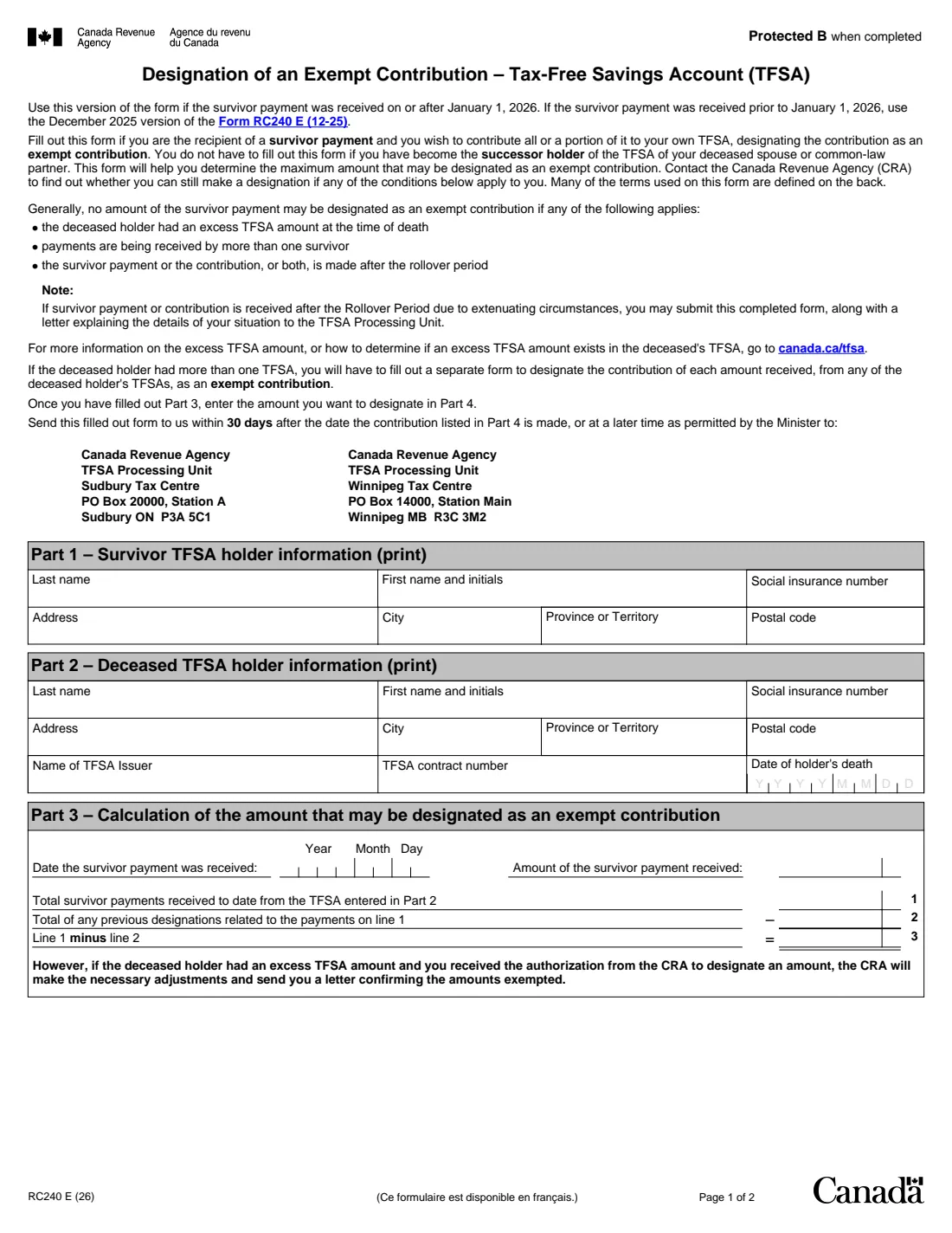
RC240, Designation of an Exempt Contribution – Tax-Free Savings Account (TFSA), is the Canada Revenue Agency (CRA) form for a survivor who received a payment out of a deceased spouse's or common-law partner's TFSA and contributed it to their own TFSA. Designating it as an exempt contribution means it doesn't use up the survivor's own TFSA contribution room. The edition RC240 E (26) is for survivor payments received on or after January 1, 2026; earlier payments use RC240 E (12-25).
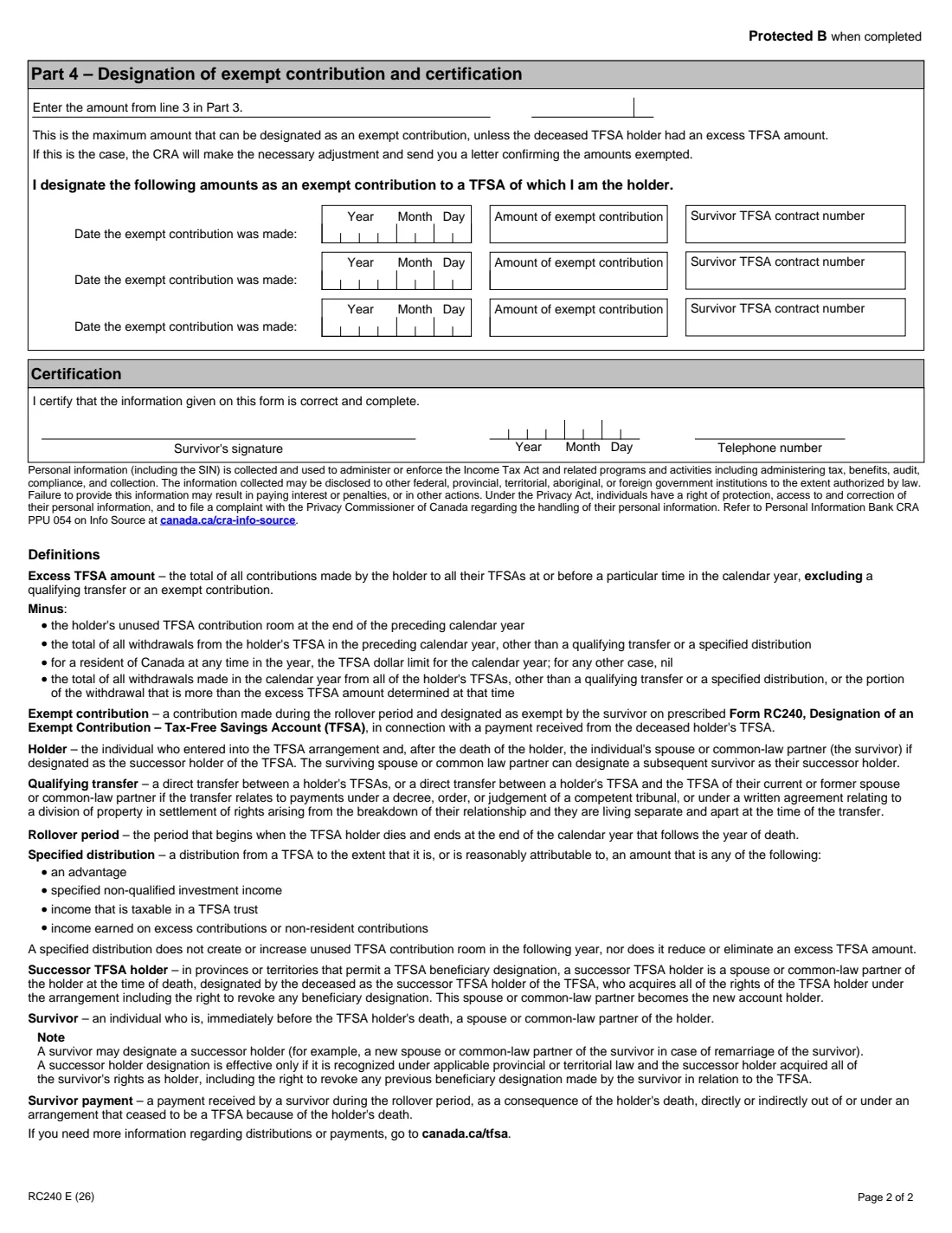
The form works out the most you can designate (survivor payments received to date minus earlier designations) and records up to three contributions to your TFSA. You don't need it if you became the successor holder of the TFSA. Generally nothing can be designated if the deceased had an excess TFSA amount, if more than one survivor receives payments, or if the payment or contribution falls after the rollover period, which ends at the end of the calendar year after the year of death.
FileIt fills in RC240 from a guided web form, works out line 3, checks the dates against the rollover period, and prints your answers on the CRA's own PDF. The finished PDF is filed in your vault. FileIt never sends anything to the CRA: you sign the form by hand and mail it yourself.
- Who fills it
- The surviving spouse or common-law partner who received a survivor payment from a TFSA
- Given to
- The CRA's TFSA Processing Unit at the Sudbury or Winnipeg Tax Centre, by mail
- When
- Within 30 days after the contribution, or later if the Minister permits
- Signatures
- Signed and dated by hand by the survivor
- Edition
- RC240 E (26), for survivor payments received on or after January 1, 2026
Who needs to fill out RC240?
- Surviving spouses and common-law partners who were paid money from the deceased's TFSA, for example as beneficiary, and put some or all of it into their own TFSA.
- Not survivors who became the successor holder of the deceased's TFSA; the TFSA simply continues in their name.
When to use RC240
- After you contribute the survivor payment to your own TFSA, within the rollover period (the year of death and the following calendar year).
- Mail it within 30 days after the contribution date.
- Fill out a separate form for each of the deceased's TFSAs that paid you.
- If the payment or contribution was after the rollover period because of extenuating circumstances, the form says you may send it with a letter explaining your situation.
What you need before you start
- Your name, SIN and address, and the deceased holder's name, SIN, address and date of death.
- The deceased's TFSA issuer and contract number.
- The date and amount of the survivor payment, the total survivor payments received from that TFSA, and any earlier designations for them.
- For each contribution to your own TFSA: the date, the amount and your TFSA contract number.
What’s on RC240
The 2026 edition has 2 pages. FileIt asks for it in 4 parts:
- Part 1 – You, the survivorSurvivor
- Part 2 – The deceased TFSA holderSurvivor
- Part 3 – Amount that may be designatedSurvivor
- Part 4 – Designation of exempt contributionSurvivor
How to fill out RC240, step by step
1 Part 1 – Survivor TFSA holder
Your name, SIN and address.
2 Part 2 – Deceased TFSA holder
The deceased's name, SIN and address, the TFSA issuer, the contract number and the date of death.
3 Part 3 – Calculation
The date and amount of the survivor payment, line 1 (total survivor payments received to date from that TFSA), line 2 (previous designations) and line 3 (line 1 minus line 2). FileIt calculates line 3.
4 Part 4 – Designation and certification
Line 3 again as the maximum you can designate, then the date, amount and your TFSA contract number for up to three exempt contributions, and your signature, date and telephone number.
Common mistakes to avoid
- Using this edition for a survivor payment received before January 1, 2026; use RC240 E (12-25).
- Designating more than line 3.
- Contributing after the rollover period ends (December 31 of the year after the year of death).
- Filing RC240 when you are the successor holder of the TFSA, which doesn't need it.
- Mailing it more than 30 days after the contribution.
After you fill it out
Print the PDF, sign and date the certification by hand, and mail it to the TFSA Processing Unit at the Sudbury or Winnipeg Tax Centre (addresses on page 1) within 30 days after the contribution. FileIt doesn't mail it for you.
If the deceased had an excess TFSA amount and the CRA authorized a designation, the CRA makes the adjustments and sends you a letter confirming the amounts exempted.
Keep a copy with the TFSA statements for the estate and for your own TFSA.
Fill out RC240 online with FileIt
- Pick the person. Choose someone from People and FileIt fills in their name, date of birth, address and other details it already knows.
- Answer plain-language questions. One part of the form at a time, with the official help text beside each question — 38 fields in all. Your answers save as you go.
- Check the live preview. Watch your answers land on the real Canada Revenue Agency (CRA) form, and let FileIt do any worksheet arithmetic.
- Generate the official PDF. FileIt prints your answers into the agency’s own PDF and files it in that person’s folder in your vault.
FileIt fills the form — it never files or submits anything for you. Deliver the finished form to whoever asked for it, the way the form’s instructions say.
Start RC240 now — it’s freeRC240: frequently asked questions
What is an exempt contribution?
A contribution to your own TFSA, made during the rollover period from a survivor payment out of your late spouse's or common-law partner's TFSA, that you designate on RC240. It doesn't reduce your own TFSA contribution room.
How long is the rollover period?
It begins when the TFSA holder dies and ends at the end of the calendar year after the year of death.
Do I need RC240 if I am the successor holder?
No. The form says you don't have to fill it out if you became the successor holder of your deceased spouse's or common-law partner's TFSA.
Which edition do I use?
RC240 E (26) for survivor payments received on or after January 1, 2026, and RC240 E (12-25) for payments received earlier.
Where do I send RC240?
To the CRA's TFSA Processing Unit at the Sudbury Tax Centre or the Winnipeg Tax Centre, as listed on page 1, within 30 days after the contribution.
Official sources
- Blank form (PDF), published by Canada Revenue Agency (CRA): https://www.canada.ca/content/dam/cra-arc/formspubs/pbg/rc240/rc240-fill-26e.pdf
- Official instructions and guidance: https://www.canada.ca/en/revenue-agency/services/forms-publications/forms/rc240.html
- Edition shown on this page: RC240 E (26) (checked 2026-10-01).
FileIt is not affiliated with or endorsed by Canada Revenue Agency (CRA) or any government. This page explains the form in general terms and is not legal, tax or immigration advice. Always read the official instructions, and check that you are using the edition the recipient accepts. Page last reviewed 2026-10-01.