What is Form ISP-3505?
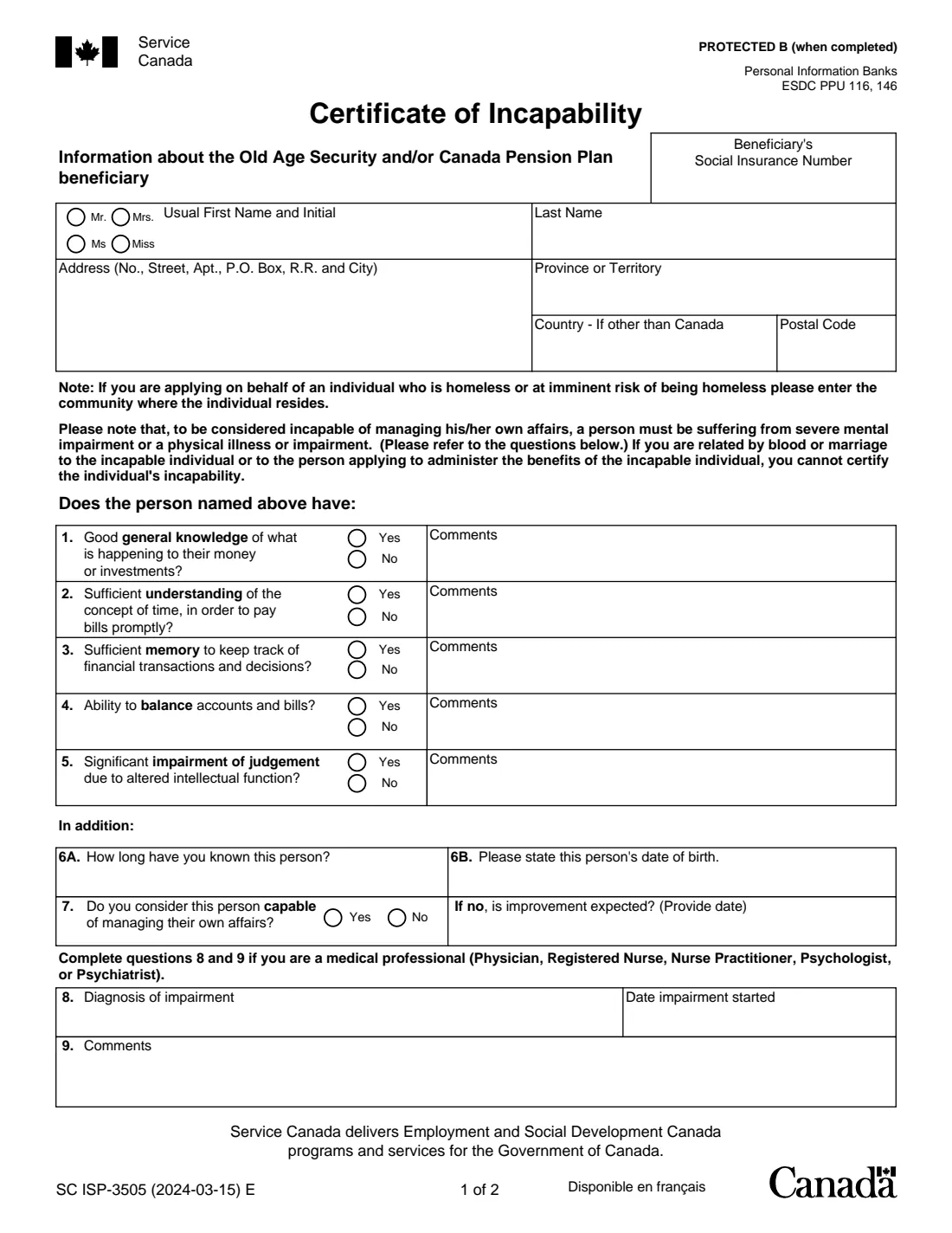
Form ISP-3505, Certificate of Incapability, is the Service Canada form a qualified professional completes to certify that a Canada Pension Plan (CPP) or Old Age Security (OAS) beneficiary is incapable of managing their own affairs. Families and trustees use it when someone else needs to receive and manage the person's benefits. To be considered incapable, the form says the person must be suffering from severe mental impairment or a physical illness or impairment.
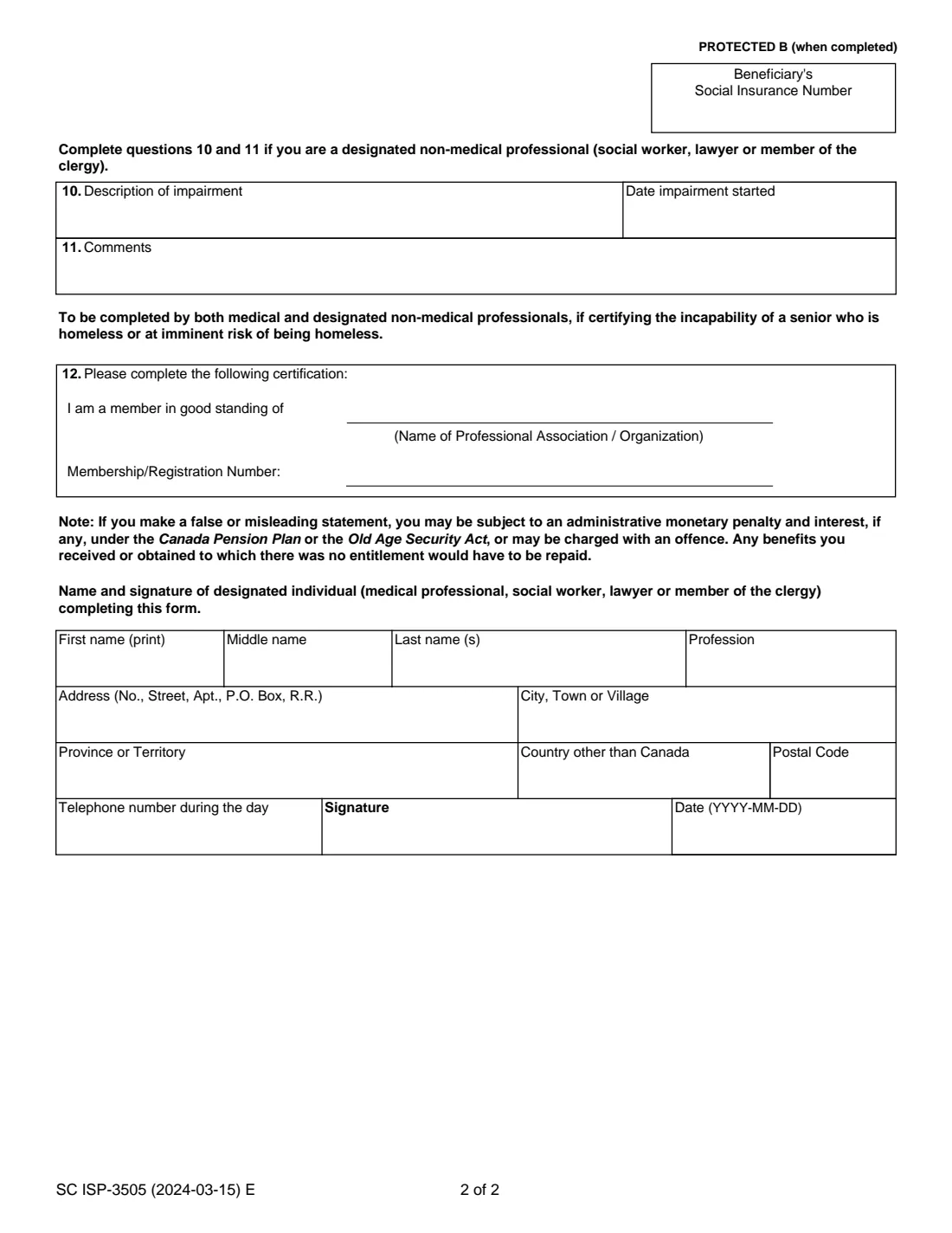
The beneficiary's details go at the top. The professional then answers questions 1 to 7 about the person's understanding of money, time and memory, their judgement and whether they can manage their own affairs. A medical professional (physician, registered nurse, nurse practitioner, psychologist or psychiatrist) answers questions 8 and 9; a designated non-medical professional (social worker, lawyer or member of the clergy) answers 10 and 11. Question 12 covers seniors who are homeless or at imminent risk of being homeless. Someone related by blood or marriage to the person, or to the applicant, can't certify.
FileIt lets the family fill in the beneficiary's part and the professional the rest, and prints it all into Service Canada's own PDF (edition SC ISP-3505 (2024-03-15) E). The professional signs the certificate by hand. FileIt never submits anything to Service Canada.
- Who completes it
- A medical professional or a designated non-medical professional (social worker, lawyer or member of the clergy)
- Who starts it
- A family member or the person applying to administer the benefits, with the beneficiary's details
- Can't certify
- Anyone related by blood or marriage to the beneficiary or to the applicant
- Pages
- 2
- Signatures
- The certifying professional, by hand
- Edition
- SC ISP-3505 (2024-03-15) E
Who needs to fill out Form ISP-3505?
- Families of a senior with dementia or another severe impairment who need someone to manage their CPP or OAS benefits.
- A person applying to become the trustee who administers those benefits.
- Physicians, nurses, nurse practitioners, psychologists and psychiatrists asked to certify incapability.
- Social workers, lawyers and clergy certifying incapability, including for a senior who is homeless or at imminent risk of being homeless.
When to use Form ISP-3505
- When a CPP or OAS beneficiary can no longer manage their own affairs and someone else needs to receive and manage the benefits for them.
- Along with the application to administer the benefits that Service Canada asks for.
- When the person is homeless or at imminent risk, enter the community where they live as the address, as the form's note says.
What you need before you start
- The beneficiary's Social Insurance Number, name, address and date of birth.
- A medical or designated non-medical professional who knows the person and isn't related to them or to the applicant.
- The professional's assessment: the answers to questions 1 to 7, and the diagnosis or description of the impairment and when it started.
- For question 12: the professional's association and membership or registration number.
- The professional's name, profession, address and daytime telephone number.
What’s on Form ISP-3505
The 2024 edition has 2 pages. FileIt asks for it in 5 parts:
- Information about the Old Age Security and/or Canada Pension Plan beneficiaryApplicant (family member or trustee)
- Does the person named above have…Certifying professional
- Questions 8 to 11 – ImpairmentCertifying professional
- Question 12 – Certifying for a senior who is homeless or at imminent risk of being homelessCertifying professional
- Name of the designated individual completing this formCertifying professional
How to fill out Form ISP-3505, step by step
1 The beneficiary
Enter the beneficiary's Social Insurance Number (it prints on both pages), salutation, name, address, province or territory, country if not Canada, and postal code.
2 Questions 1 to 7
The professional answers Yes or No to whether the person has a good general knowledge of their money, enough understanding of time to pay bills promptly, enough memory to keep track of transactions, the ability to balance accounts, and a significant impairment of judgement, with comments. They also say how long they've known the person, the person's date of birth, and whether the person can manage their own affairs (and if not, whether improvement is expected).
3 Questions 8 to 11
A medical professional gives the diagnosis, the date the impairment started and comments (questions 8 and 9). A designated non-medical professional describes the impairment and when it started, with comments (questions 10 and 11).
4 Question 12 and the professional's details
When certifying a senior who is homeless or at imminent risk of being homeless, the professional gives their professional association and membership number. Then they print their name, profession, address and telephone number, and sign and date the form by hand.
Common mistakes to avoid
- Asking a relative to certify. The form says someone related by blood or marriage to the person or to the applicant can't.
- A medical professional answering questions 10 and 11 instead of 8 and 9, or the reverse.
- Leaving the beneficiary's SIN off. It's asked at the top of both pages.
- Missing question 12 when the senior is homeless or at imminent risk of being homeless.
- Leaving the certificate unsigned.
After you fill it out
Print the PDF from your FileIt vault and have the certifying professional review it, then sign and date it by hand.
Send it to Service Canada with the application to administer the benefits.
Keep a copy in your FileIt vault with the beneficiary's other pension papers.
Fill out Form ISP-3505 online with FileIt
- Pick the person. Choose someone from People and FileIt fills in their name, date of birth, address and other details it already knows.
- Answer plain-language questions. One part of the form at a time, with the official help text beside each question — 41 fields in all. Your answers save as you go.
- Check the live preview. Watch your answers land on the real Service Canada (ESDC) form, and let FileIt do any worksheet arithmetic.
- Generate the official PDF. FileIt prints your answers into the agency’s own PDF and files it in that person’s folder in your vault.
FileIt fills the form — it never files or submits anything for you. Deliver the finished form to whoever asked for it, the way the form’s instructions say.
Start Form ISP-3505 now — it’s freeForm ISP-3505: frequently asked questions
Who can sign the Certificate of Incapability?
A medical professional (physician, registered nurse, nurse practitioner, psychologist or psychiatrist), or a designated non-medical professional (social worker, lawyer or member of the clergy). Someone related by blood or marriage to the person or to the applicant can't.
Can the family fill it in?
The family or applicant can fill in the beneficiary's details. The assessment questions and the certification are for the professional, who signs it.
What does "incapable" mean on this form?
The form says a person must be suffering from severe mental impairment or a physical illness or impairment to be considered incapable of managing their own affairs.
Can it be signed electronically in FileIt?
No. The professional's certification is signed by hand on the printed form, so FileIt offers no eSignature boxes on it.
Official sources
- Blank form (PDF), published by Service Canada (ESDC): https://catalogue.servicecanada.gc.ca/apps/EForms/pdf/en/ISP-3505.pdf
- Official instructions and guidance: https://catalogue.servicecanada.gc.ca/content/EForms/en/Detail.html?Form=ISP-3505
- Edition shown on this page: SC ISP-3505 (2024-03-15) E (checked 2026-10-25).
FileIt is not affiliated with or endorsed by Service Canada (ESDC) or any government. This page explains the form in general terms and is not legal, tax or immigration advice. Always read the official instructions, and check that you are using the edition the recipient accepts. Page last reviewed 2026-10-25.