What is the trap-neuter-return request form template?
Trap-neuter-return works best when the trapping team knows the site before they arrive: how many cats there are, whether there are kittens or pregnant females, who feeds them and when, and whether the landowner has agreed. Without that, volunteers waste evenings setting traps in the wrong place or at the wrong time.
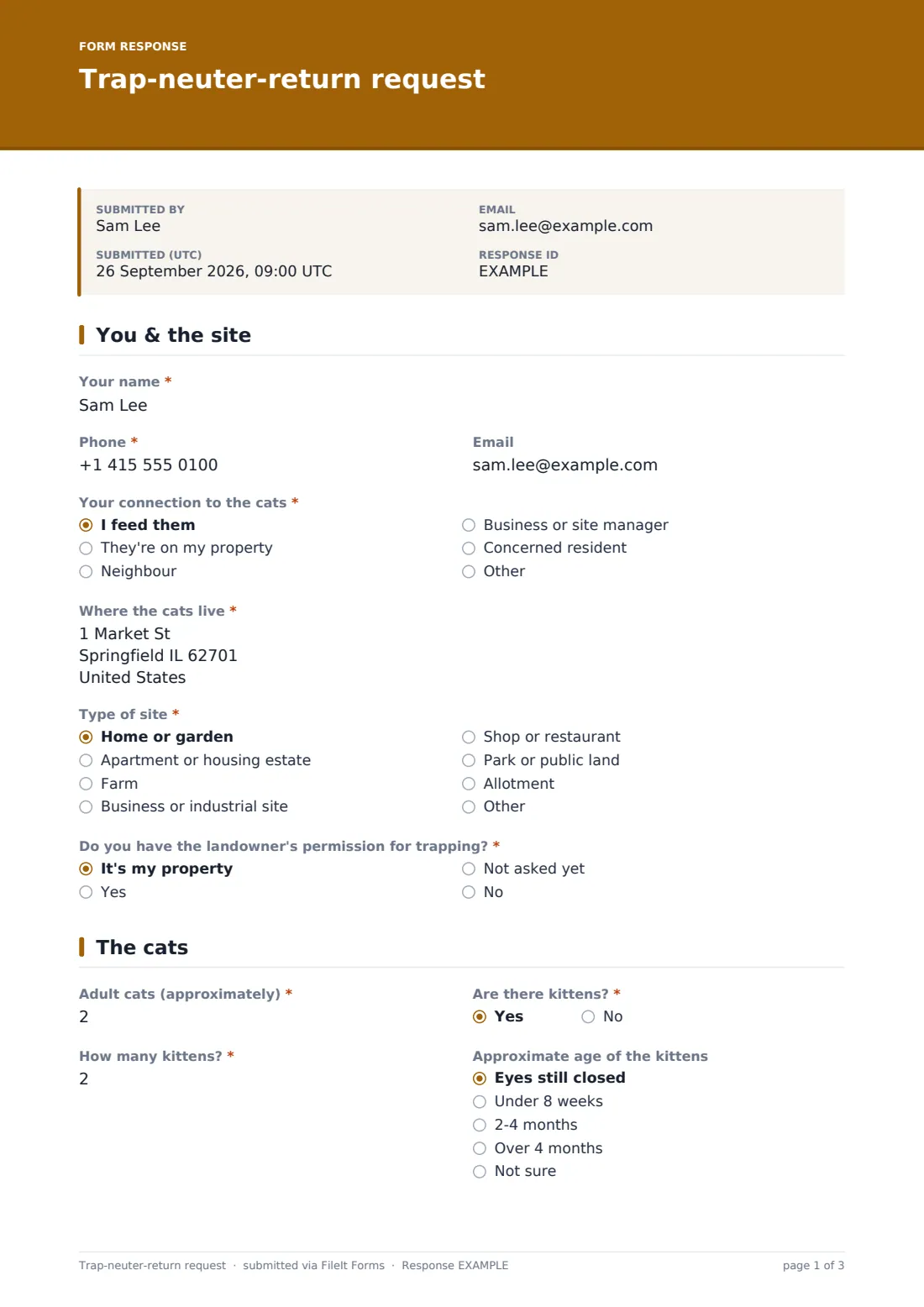
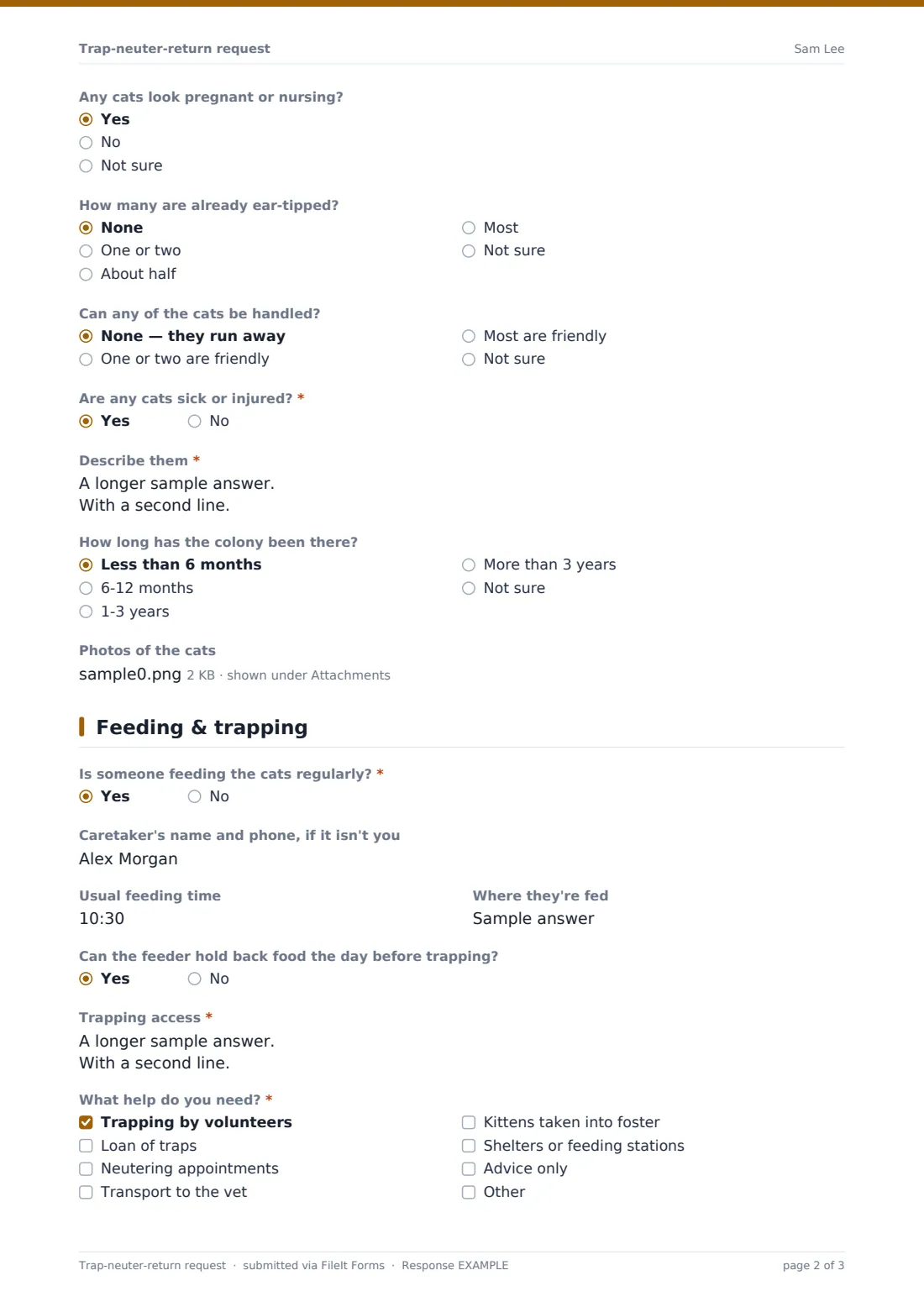
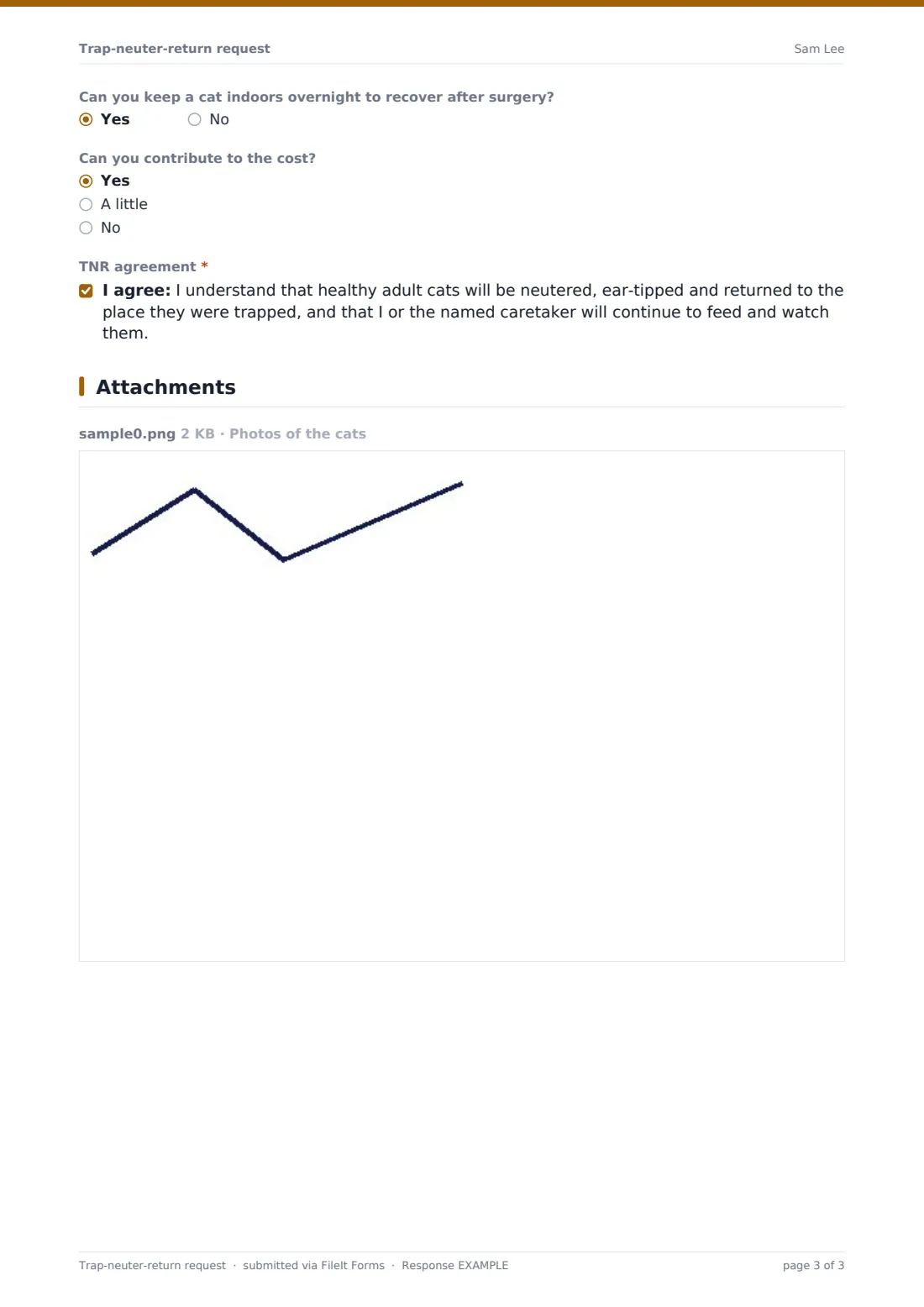
This request form has three pages. The first records the requester, their connection to the cats, the colony's address, the type of site and landowner permission. The second counts adult cats and kittens, asks about pregnant or nursing cats, ear tips, friendliness, sick or injured cats and how long the colony has been there, with photo uploads. The third covers the caretaker and feeding schedule, trapping access, the help needed and a TNR agreement.
Each request is filed as a PDF in your FileIt vault, so your coordinator can plan trapping and track every colony you've worked with.
- Best for
- Cat rescues, TNR groups, community cat programmes and animal welfare charities
- Filled in by
- Feeders, residents, landowners or businesses with cats on site
- Time to complete
- About 5-8 minutes
- Includes
- Site and permission questions, colony and kitten counts, sick-cat follow-up, feeding schedule, access notes, help checklist and TNR agreement
Who uses a trap-neuter-return request form?
- A TNR group taking requests from its website
- A cat rescue handling colonies reported by farms and businesses
- A city community cat programme logging new colonies
- A volunteer feeding a colony and asking for neutering help
- A housing estate manager asking for help with a growing colony
Questions on this trap-neuter-return request form
29 questions over 3 pages · includes file upload, conditional questions, multiple pages, consent checkbox.
1 You & the site
- Your name*
- Phone*
- Your connection to the cats* I feed them · They're on my property · Neighbour · Business or site manager · Concerned resident
- Where the cats live*
- Type of site* Home or garden · Apartment or housing estate · Farm · Business or industrial site · Shop or restaurant · Park or public land · Allotment · Other
- Do you have the landowner's permission for trapping?* It's my property · Yes · Not asked yet · No
- Landowner or site manager's name and contact asked only when it applies
2 The cats
- Adult cats (approximately)*
- Are there kittens?*
- How many kittens?* asked only when it applies
- Approximate age of the kittens asked only when it applies Eyes still closed · Under 8 weeks · 2-4 months · Over 4 months · Not sure
- Any cats look pregnant or nursing? Yes · No · Not sure
- How many are already ear-tipped? None · One or two · About half · Most · Not sure
- Can any of the cats be handled? None — they run away · One or two are friendly · Most are friendly · Not sure
- Are any cats sick or injured?*
- Describe them* asked only when it applies
- How long has the colony been there? Less than 6 months · 6-12 months · 1-3 years · More than 3 years · Not sure
- Photos of the cats
3 Feeding & trapping
- Is someone feeding the cats regularly?*
- Caretaker's name and phone, if it isn't you asked only when it applies
- Usual feeding time asked only when it applies
- Where they're fed asked only when it applies
- Can the feeder hold back food the day before trapping? asked only when it applies
- Trapping access*
- What help do you need?* Trapping by volunteers · Loan of traps · Neutering appointments · Transport to the vet · Kittens taken into foster · Shelters or feeding stations · Advice only
- Can you keep a cat indoors overnight to recover after surgery?
- Can you contribute to the cost? Yes · A little · No
- TNR agreement*
The trap-neuter-return request form, page by page
1 You & the site
The requester gives their name, phone and email, and their connection to the cats — feeder, property owner, neighbour, business manager or concerned resident. They enter the colony's address and type of site, and answer "Do you have the landowner's permission for trapping?" — any answer other than "It's my property" asks for the landowner or site manager's contact.
2 The cats
Requesters estimate the number of adult cats and say whether there are kittens, which asks how many and how old. They note pregnant or nursing cats, how many are already ear-tipped — with help text explaining what an ear tip means — whether any can be handled, and whether any are sick or injured, which asks for a description. They say how long the colony has been there and upload photos.
3 Feeding & trapping
"Is someone feeding the cats regularly?" asks, on a yes, for the caretaker's details, usual feeding time and place, and whether food can be held back the day before trapping. Trapping access notes are required. Requesters tick the help they need — volunteer trapping, trap loans, neutering, transport, kitten fostering, shelters or advice — and say whether a cat can recover indoors overnight and whether they can contribute to costs. The TNR agreement confirms that healthy cats will be returned and fed.
Make the template yours
- Add your neutering voucher or low-cost clinic details to a paragraph
- Change the help list to the services your group provides
- Add a waiting-list note if requests are high in kitten season
- Edit the agreement to match your group's return policy
- File requests into a folder per area so trappers see colonies near them
- Turn on notifications to your trapping coordinator
Tips for a better trap-neuter-return request form
- Ask for landowner permission before trapping starts
- Plan trapping around the feeding time the caretaker gives you
- Prioritise colonies with pregnant cats or young kittens
- Keep a record of each colony's ear-tipped count after every trapping session
- Thank caretakers — long-term feeding is what keeps a colony stable
Every response becomes a PDF in your vault
Each request is saved as a PDF in your FileIt vault with its photos, and your coordinator is emailed. The requester can receive a copy.
The Responses table lists every colony request. Sort by number of cats or kittens and export to a CSV to plan trapping weekends.
- Start from this template. It opens in the FileIt Forms designer — change any question, add pages, set the rules for when questions appear.
- Share it. Turn on a public link, or send it to people by email, each with their own link. They don’t need a FileIt account.
- Get the answers as PDFs. Each response is saved as a PDF in the vault folder you choose, with uploaded files attached — and listed in a Responses table you can export to CSV.
Trap-neuter-return request form: frequently asked questions
Is the TNR request form template free?
Yes. It's a FileIt Forms starter template on every plan.
Do requesters need an account?
No. They fill it in from a link or QR code.
What does ear-tipped mean?
A small part of one ear removed or notched during neutering, so a neutered community cat can be recognised. The form's help text explains it to requesters.
Can we use it for friendly stray cats too?
Yes. The friendliness question helps you spot cats that could be rehomed instead of returned.
Does it book vet appointments?
No. It collects the request. Your coordinator books neutering and trapping with the requester.
Can we add a waiver for trap loans?
Yes. Add a consent field shown when trap loan is ticked.