What is the postpartum wellbeing check form template?
The weeks after birth bring a lot of change: the body recovering, feeding getting established, very little sleep and big emotions. Midwives, health visitors and doctors check on all of this, but parents often forget to mention things in a short appointment, or don't know whether a symptom matters.
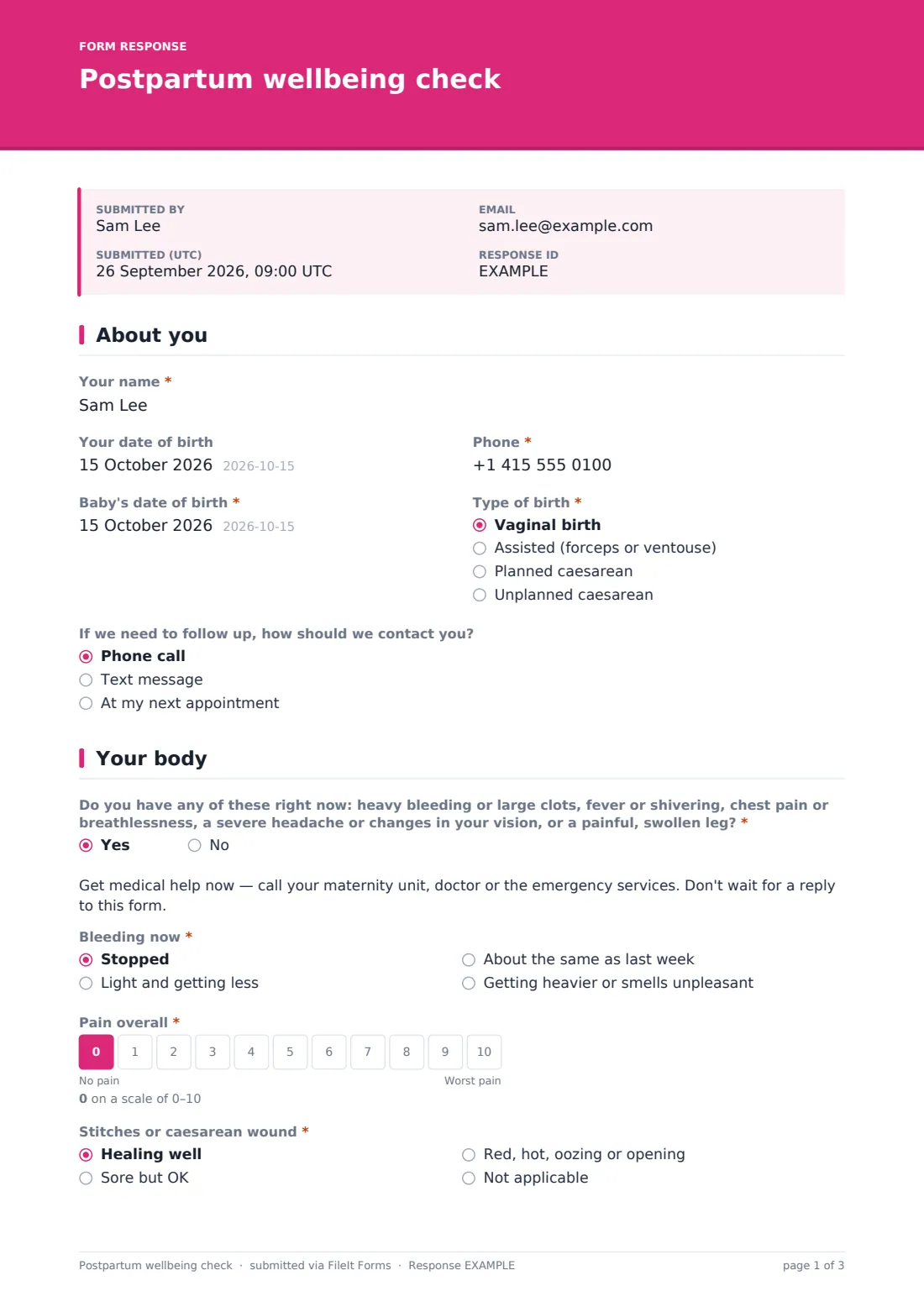
This template asks first about urgent warning signs — heavy bleeding, fever, chest pain or breathlessness, a severe headache or vision changes, or a painful swollen leg — and shows a clear message to get medical help now if any apply. It then covers bleeding, pain, the healing of stitches or a caesarean wound, and bladder and bowel problems, followed by how the baby is fed, feeding worries and sleep.
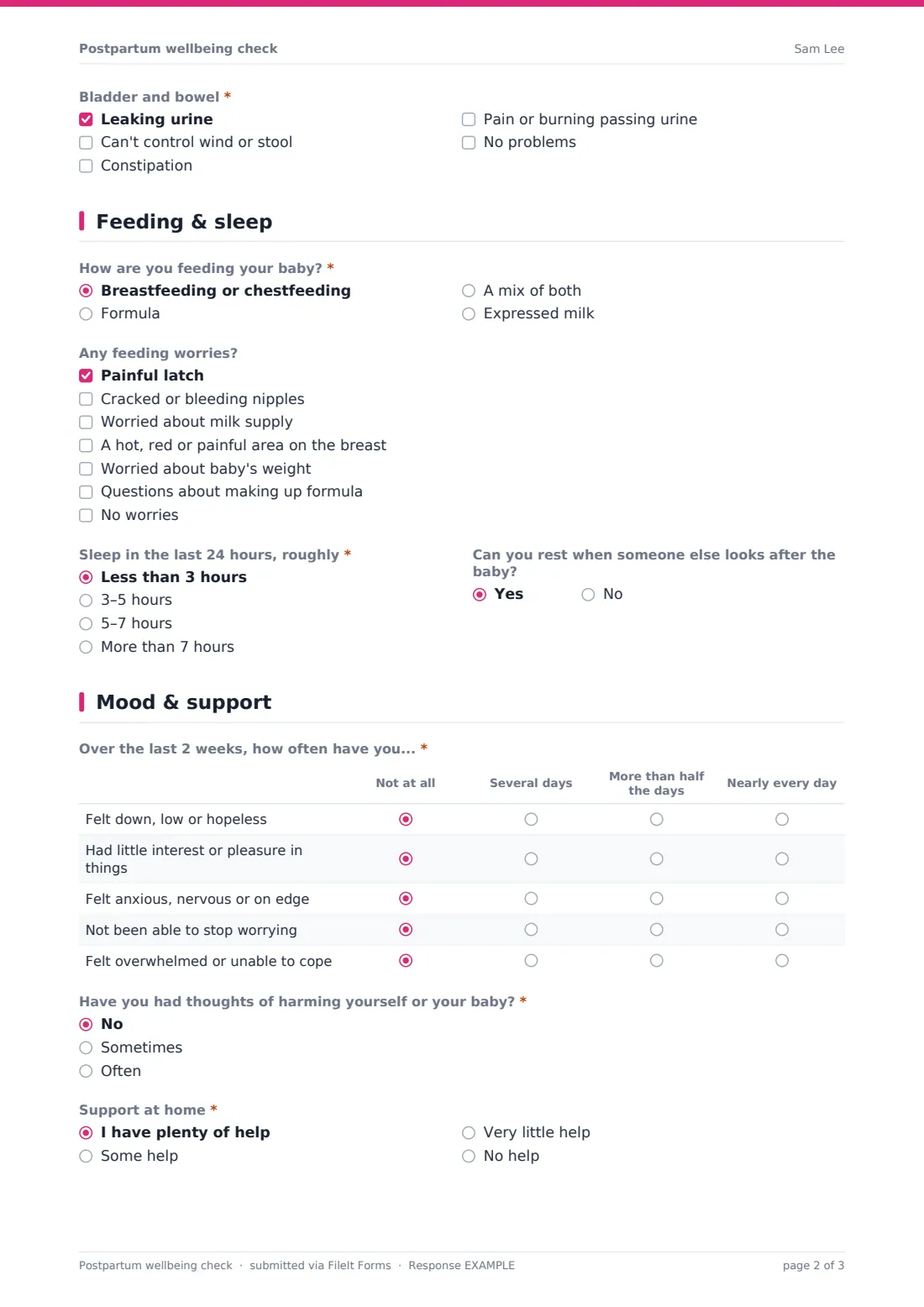
The mood page asks how often, over the last two weeks, the parent has felt low, lost interest, felt anxious, couldn't stop worrying or felt overwhelmed, and asks directly about thoughts of harm, showing a supportive message to talk to someone today. It ends with support at home, feeling safe, other worries, contraception and questions. Each check is saved as a PDF in FileIt.
- Best for
- Midwifery teams, health visitors, GP practices, obstetric clinics and doulas
- Filled in by
- The new parent, in the weeks after birth
- Time to complete
- About 5 minutes
- Includes
- Urgent warning-sign prompt, recovery questions, feeding and sleep, mood grid, harm question with support message, safety at home and questions for the clinician
Who uses a postpartum wellbeing check form?
- Midwives checking in before a postnatal home visit
- Health visitors preparing for a new birth visit
- GP practices ahead of the postnatal check
- Obstetric clinics following up after a caesarean
- Doulas checking in with clients in the fourth trimester
- Parenting services offering a wellbeing check-in
Questions on this postpartum wellbeing check form
22 questions over 4 pages · includes conditional questions, multiple pages, ratings.
1 About you
- Your name*
- Your date of birth
- Phone*
- Baby's date of birth*
- Type of birth* Vaginal birth · Assisted (forceps or ventouse) · Planned caesarean · Unplanned caesarean
- If we need to follow up, how should we contact you? Phone call · Text message · At my next appointment
2 Your body
- Do you have any of these right now: heavy bleeding or large clots, fever or shivering, chest pain or breathlessness, a severe headache or changes in your vision, or a painful, swollen leg?*
- Bleeding now* Stopped · Light and getting less · About the same as last week · Getting heavier or smells unpleasant
- Pain overall*
- Stitches or caesarean wound* Healing well · Sore but OK · Red, hot, oozing or opening · Not applicable
- Bladder and bowel* Leaking urine · Can't control wind or stool · Constipation · Pain or burning passing urine · No problems
3 Feeding & sleep
- How are you feeding your baby?* Breastfeeding or chestfeeding · Formula · A mix of both · Expressed milk
- Any feeding worries? Painful latch · Cracked or bleeding nipples · Worried about milk supply · A hot, red or painful area on the breast · Worried about baby's weight · Questions about making up formula · No worries
- Sleep in the last 24 hours, roughly* Less than 3 hours · 3–5 hours · 5–7 hours · More than 7 hours
- Can you rest when someone else looks after the baby?
4 Mood & support
- Over the last 2 weeks, how often have you...* Not at all · Several days · More than half the days · Nearly every day
- Have you had thoughts of harming yourself or your baby?* No · Sometimes · Often
- Support at home* I have plenty of help · Some help · Very little help · No help
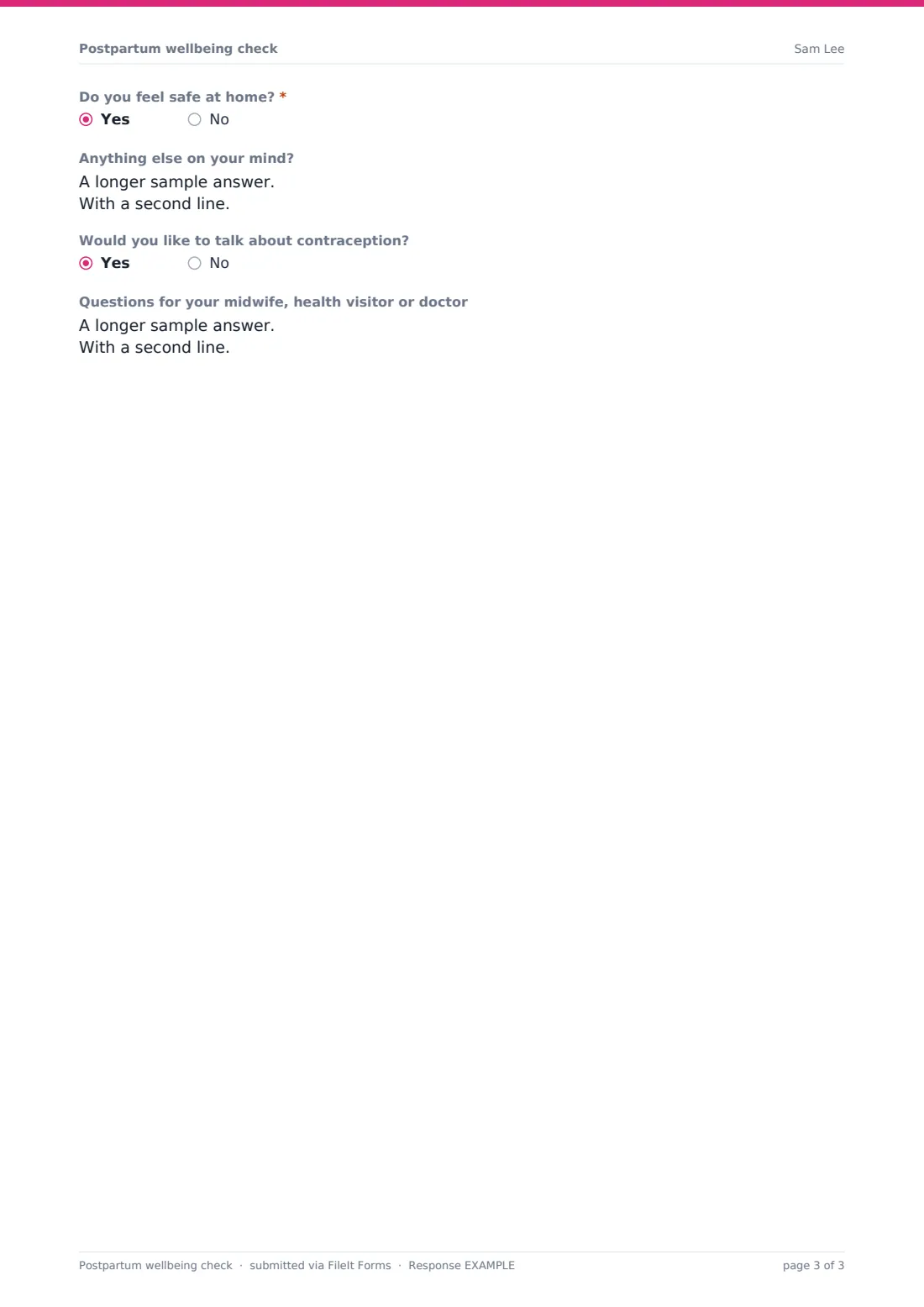
- Do you feel safe at home?*
- Anything else on your mind?
- Would you like to talk about contraception?
- Questions for your midwife, health visitor or doctor
The postpartum wellbeing check form, page by page
1 About you
The parent gives their name, date of birth, phone, the baby's date of birth and the type of birth — vaginal, assisted, planned or unplanned caesarean — and how they'd like to be contacted if a follow-up is needed.
2 Your body
A required question asks about urgent warning signs. Answering yes shows a message to get medical help now rather than wait for a reply. The parent then describes bleeding, rates pain from 0 to 10, says how stitches or a caesarean wound are healing, and ticks any bladder or bowel problems, from leaking urine to pain passing urine.
3 Feeding & sleep
The parent says how the baby is fed — breast or chestfeeding, formula, a mix or expressed milk — and ticks feeding worries such as a painful latch, sore nipples, milk supply, a hot or red area on the breast, the baby's weight or making up formula. They estimate sleep in the last 24 hours and whether they can rest when someone else has the baby.
4 Mood & support
A grid asks how often over the last two weeks the parent has felt down, lost interest, felt anxious, been unable to stop worrying or felt overwhelmed. A direct question about thoughts of harming themselves or the baby shows a supportive message and urgent advice if the answer is anything but no. The page ends with support at home, whether they feel safe at home — answering no shows a message about talking in private and getting help if they're in danger — other worries, contraception and questions for the clinician.
Make the template yours
- Replace the urgent advice with your maternity unit's phone numbers
- Swap the mood grid for the screening tool your service uses, if it's licensed for this use
- Send forms to the midwife or health visitor caseload inbox
- Prefill the parent's details with personal links before each visit
- Add questions about the baby, such as jaundice or feeding frequency
- File each family's checks in their own vault folder
Tips for a better postpartum wellbeing check form
- Read responses promptly — answers can raise urgent concerns
- Follow up every positive answer on harm thoughts or feeling unsafe the same day
- Make sure parents know the form is not monitored around the clock
- Ask about partners' wellbeing too; they can struggle as well
- Use the parent's own questions to shape the visit
- This form supports your clinical judgement and local pathways; it doesn't replace them
Every response becomes a PDF in your vault
Each check is saved as a PDF in the vault folder you choose, and the account owner and any extra addresses, such as a team inbox, can be emailed the moment it arrives. Urgent answers appear in the PDF and email like any other answer, so check every response.
In Responses, filter by name or date to see a parent's checks over time, or export to CSV for caseload review.
- Start from this template. It opens in the FileIt Forms designer — change any question, add pages, set the rules for when questions appear.
- Share it. Turn on a public link, or send it to people by email, each with their own link. They don’t need a FileIt account.
- Get the answers as PDFs. Each response is saved as a PDF in the vault folder you choose, with uploaded files attached — and listed in a Responses table you can export to CSV.
Postpartum wellbeing check form: frequently asked questions
Is this postpartum wellbeing check template free?
Yes. It's part of the Forms app, included with every FileIt account, the free plan too.
Does the form alert us to urgent answers?
It shows the parent a message to get help straight away and emails every response to your notification addresses, but it doesn't flag answers or escalate on its own. Someone on your team needs to read each response.
Is the mood grid a validated screening tool?
No. It asks plain-language questions about common feelings after birth. If your service uses a specific screening tool, replace the grid with it, checking you're allowed to use it.
When should parents fill it in?
Whenever your service checks in — for example before a postnatal visit in the first few weeks, or before the postnatal check.
Can partners use it?
The questions are written for the birthing parent. You could copy the form and adapt the mood questions for partners.
Who can see the answers?
Responses are filed in your FileIt vault. Keep them in a folder only your clinical team can open.