What is a trademark coexistence agreement?
It happens more often than people expect: a clothing brand and a coffee roaster discover they've both been trading as "Northwind" for years, or a new trademark application is refused because an older one looks too close. If the businesses sell different things to different customers, a coexistence agreement lets both keep their names instead of spending money on an opposition or a rebrand.
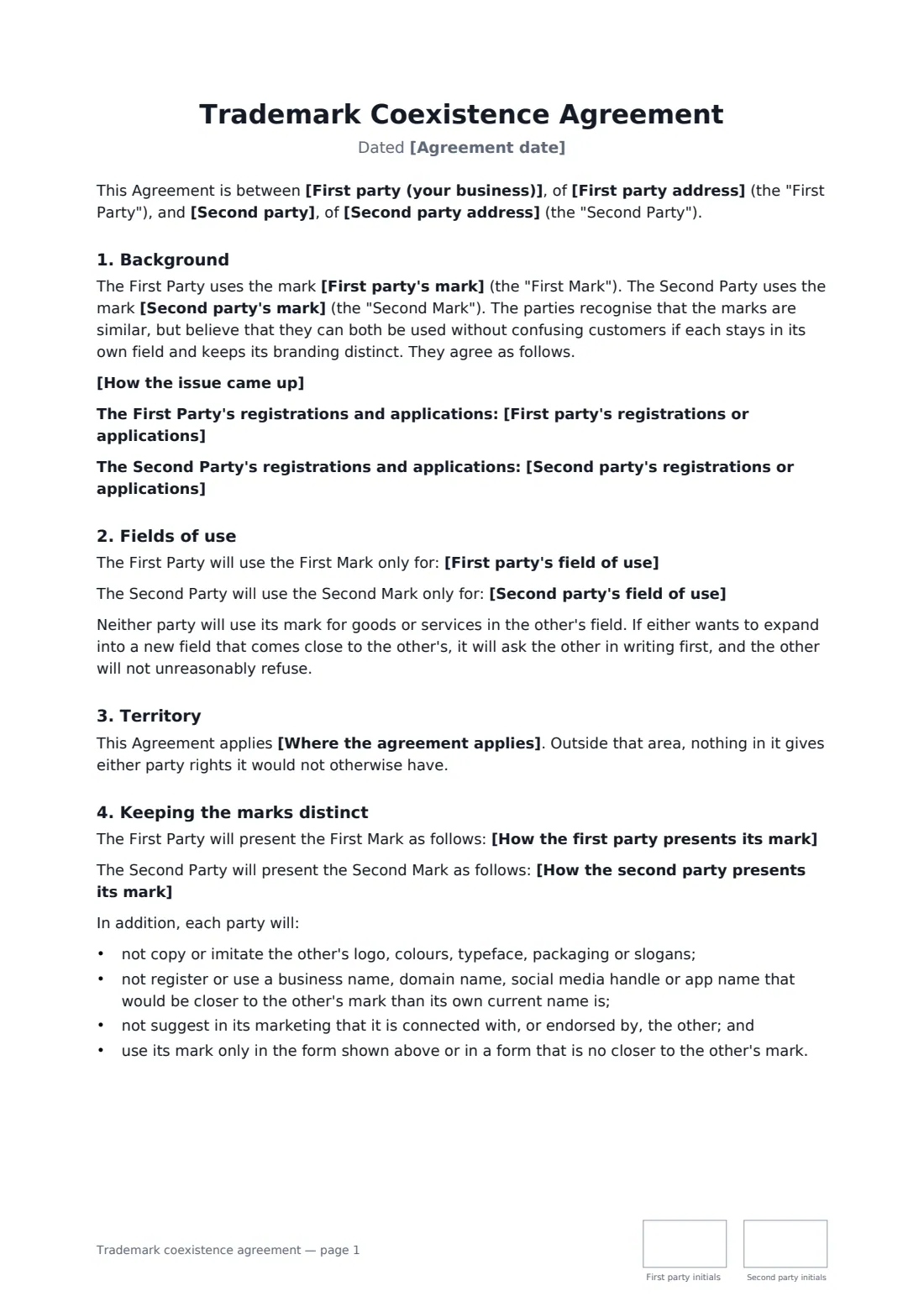
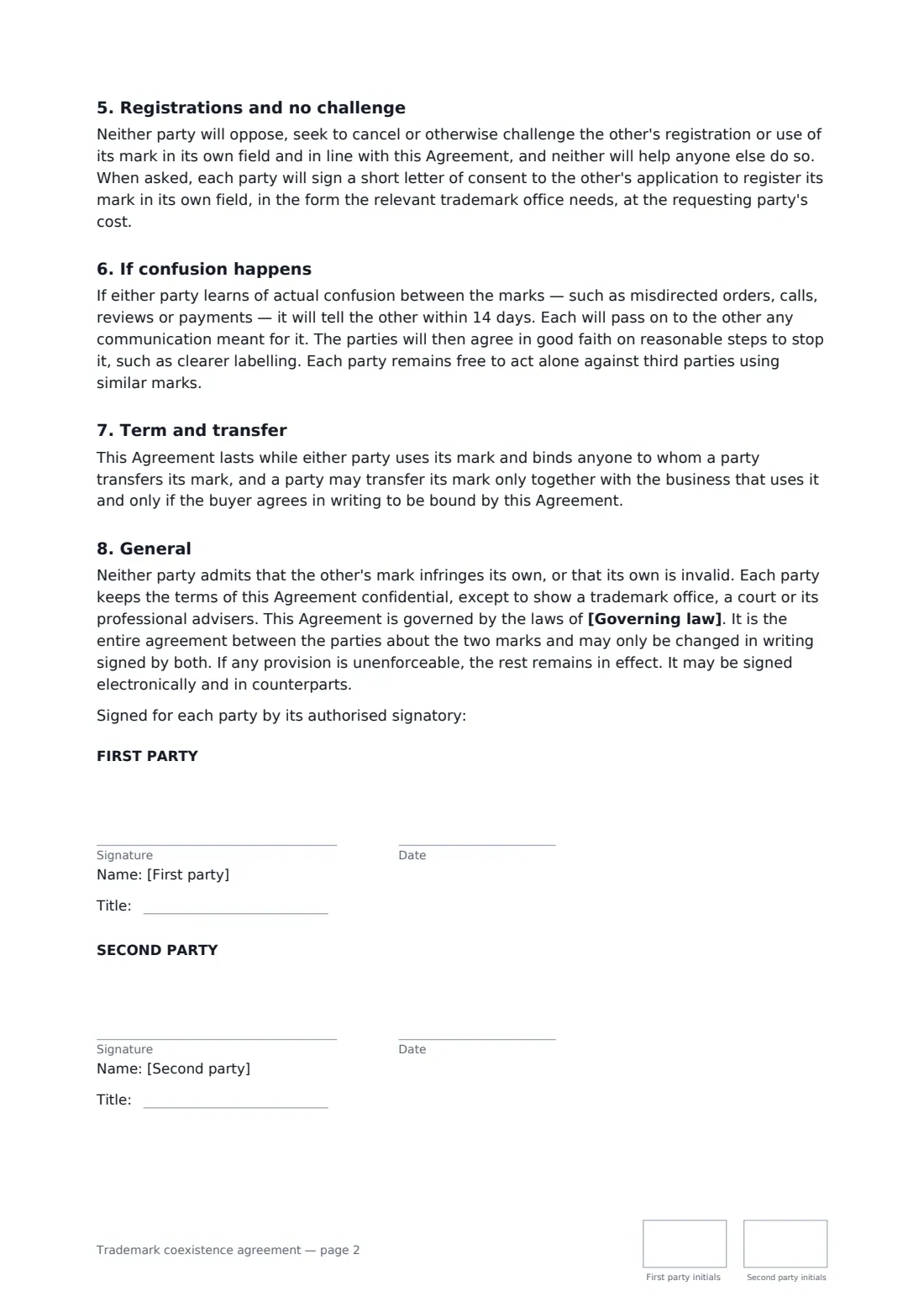
This template records each party's mark and any registrations, the field of goods or services each one keeps to, the territory, how each presents its mark (colours, logos, extra words) and a list of things neither will do to drift closer to the other. It adds a mutual no-challenge promise with consent letters for trademark offices, a process for real-life confusion such as misdirected orders, cooperation against third parties, and a rule that the agreement follows the mark if a business is sold.
- Best for
- Settling or avoiding a dispute between similar names in different markets
- Signed by
- Both mark owners
- Key promise
- Each stays in its own field and neither challenges the other's mark
- Length
- 2–3 pages, initialled by both on every page
When to use a trademark coexistence agreement
- A software company and a bakery that share a name agreeing to stay in their own sectors
- Resolving a trademark office objection by getting the earlier owner's written consent
- Settling a threatened opposition without either side rebranding
- Two regional businesses with the same name agreeing to keep to their own territories
- Setting out branding differences after a dispute that has already been settled informally
What you fill in
16 blanks, then the name and email of each person who signs: first party, second party.
1 The parties
- Agreement date*
- First party (your business)*
- First party address
- Second party*
- Second party address
2 The first party's mark
- First party's mark*
- First party's registrations or applications
- First party's field of use*
- How the first party presents its mark
3 The second party's mark
- Second party's mark*
- Second party's registrations or applications
- Second party's field of use*
- How the second party presents its mark
4 Terms
- Where the agreement applies*
- How the issue came up
- Governing law*
5 Who signs
- First party signature and date, job title, initials on every page · One of the two mark owners — usually you.
- Second party signature and date, job title, initials on every page · The other business using a similar mark.
What the trademark coexistence agreement covers
- Background
- Fields of use
- Territory
- Keeping the marks distinct
- Registrations and no challenge
- If confusion happens
- Term and transfer
- General
Using the trademark coexistence agreement, step by step
1 Describe both marks
Enter each mark as it is actually used — the word mark and any logo — plus registration or application numbers if there are any.
2 Draw the line between the fields
Write each party's goods or services as precisely as you can. The clearer the gap between the two fields, the more useful the agreement is.
3 Agree the styling
Describe how each mark is presented: colours, logos, added words such as "Coffee" or "Software". Then set the territory — worldwide or a list of countries.
4 Sign and file it
Send it to the other business's signer. The signed copy is filed in your FileIt vault, ready to show a trademark office or a lawyer if a question comes up later.
Tips before you send it
- Talk to a trademark adviser if you need the agreement to support a registration — trademark offices decide for themselves whether to accept it.
- Be specific about the fields of use; vague descriptions are what lead to the next dispute.
- Keep evidence of any confusion that does happen and share it under the confusion clause promptly.
- If you plan to expand into new products, raise it before you sign rather than after.
Sign it online in minutes
- Fill in the blanks. Names, dates and amounts go straight into the agreement — the preview shows exactly where.
- Name who signs. Tick “This is me” for your own part. FileIt builds the PDF with every signature, date and initials box on the right line, and you can check or move anything before sending.
- Send it. Each signer gets a secure link and signs from any device — no account needed. The signed PDF, with an audit trail and a Certificate of Completion, is filed in your vault and emailed to everyone.
Trademark coexistence agreement: frequently asked questions
Will a trademark office accept this agreement?
It may help, but each office decides for itself, and some give coexistence agreements little weight when the marks and goods are very close. The template includes a promise to sign consent letters in whatever form the office needs.
Does signing mean we admit infringement?
No. The agreement says that neither party admits the other's mark infringes its own or that its own mark is invalid.
What if one of us sells the business?
The agreement binds anyone who takes over a mark, and a mark can only be transferred with the business that uses it and if the buyer agrees to be bound.
Can it be signed electronically?
In most countries, including the US (ESIGN Act and UETA), the UK, the EU (eIDAS) and Canada, an electronic signature is generally valid for an ordinary commercial contract like this one. FileIt keeps an audit trail and a Certificate of Completion with the signed PDF as evidence of who signed and when.
Is this template free?
Yes. The template is free to use with the eSignature app in FileIt, and the people you send it to don't need a FileIt account to sign.