What is a time and materials contract?
Some work can't be quoted as a fixed price: finding a leak, repairing an old building, ongoing support, or a project whose scope will change as it goes. A time and materials contract pays the contractor for the hours worked and the materials used, and gives the client the controls that make that fair: clear rates, a limit, and records they can check.
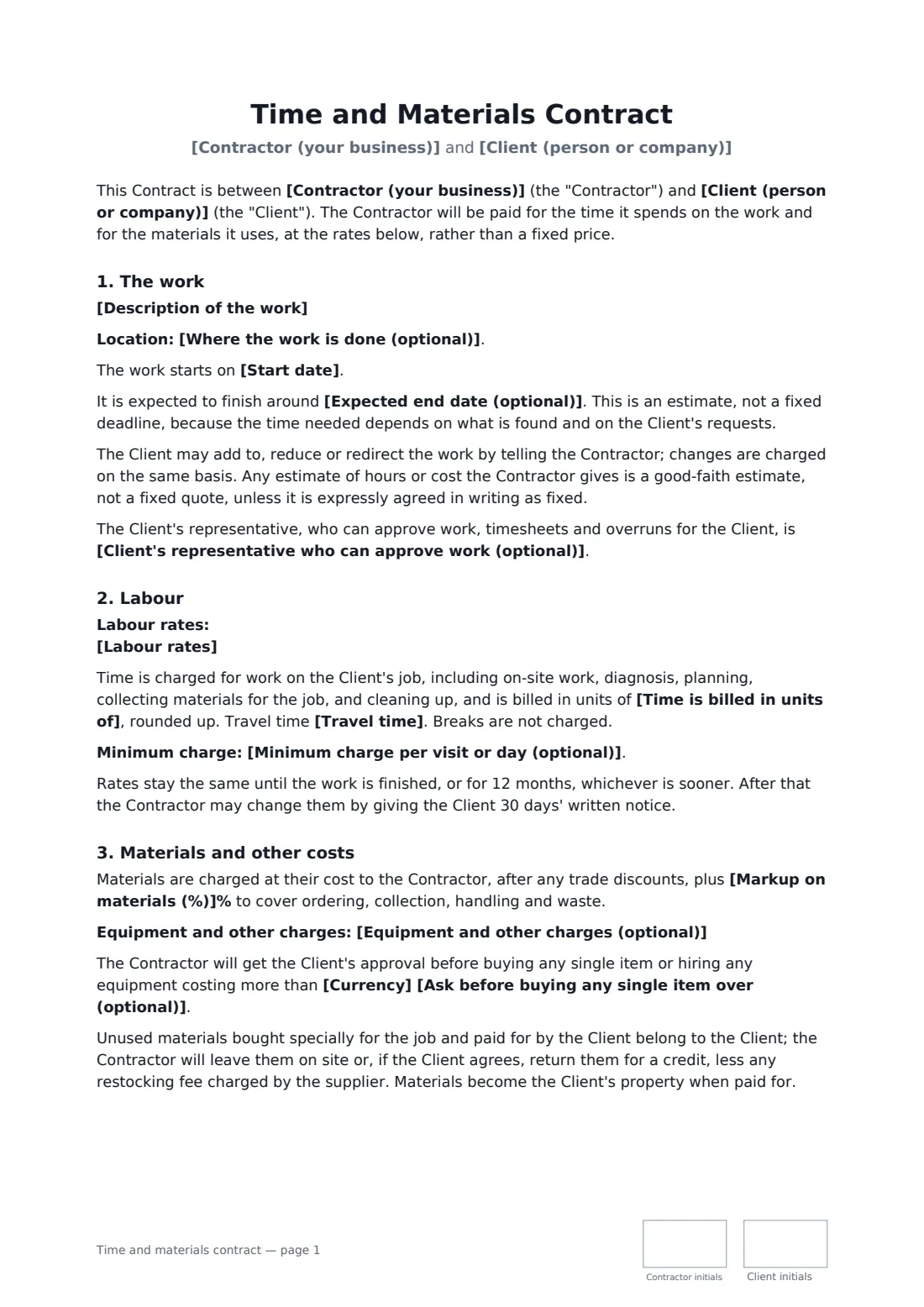
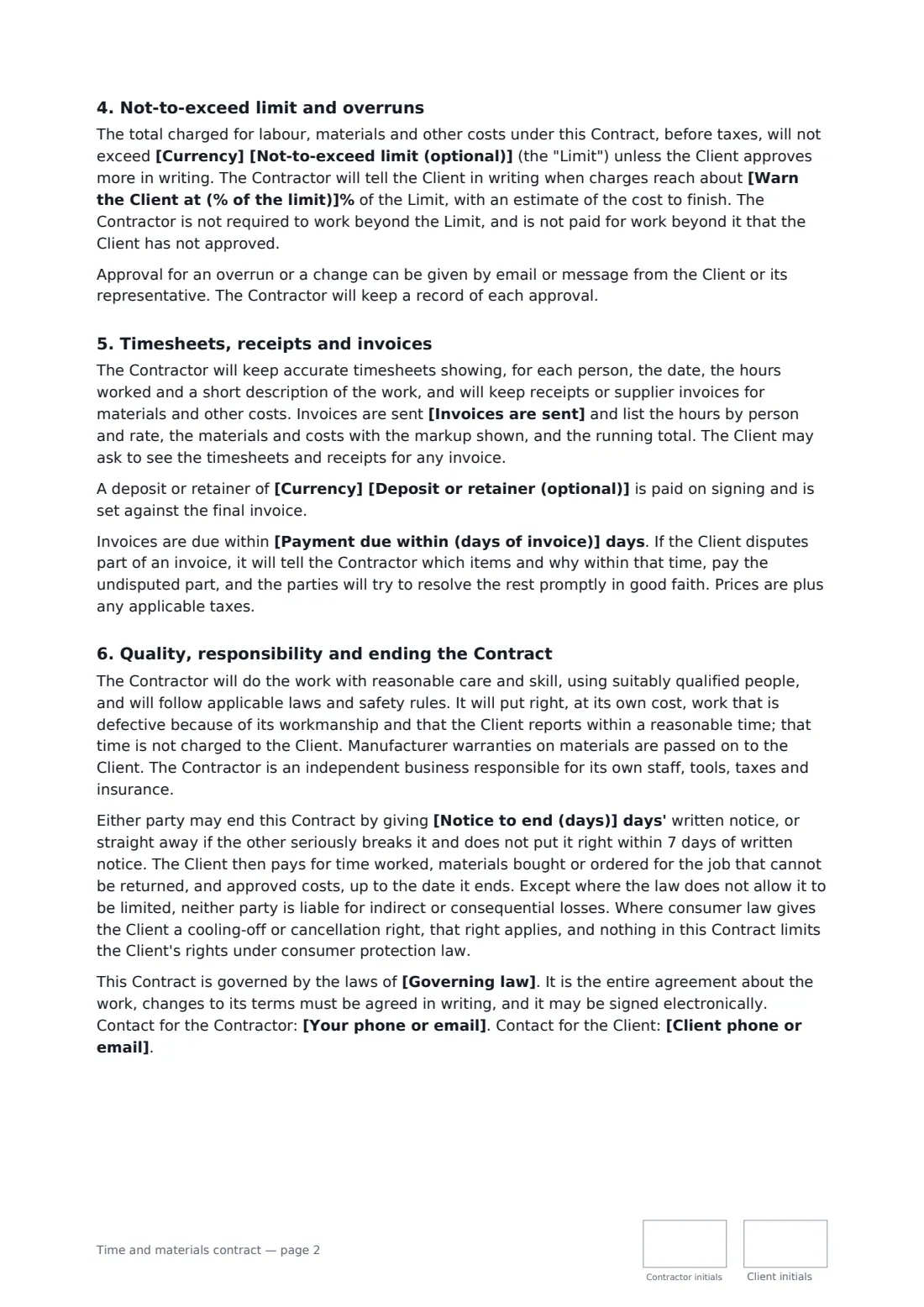
This template works for trades, contractors and consultants. It records the work, location, start date and an optional expected end date, and treats any estimate as an estimate. Labour rates are entered by role, with what time counts, billing units, travel time, an optional minimum charge, and rates held for the job or up to 12 months. Materials are at cost with an optional markup percentage, plus optional equipment charges and an approval threshold for expensive items. An optional not-to-exceed limit comes with a warning at a percentage you choose; without a limit, the contractor flags big overruns. Timesheets and receipts back every invoice, with a dispute process, deposit, payment days, putting defects right free, and notice to end.
- Best for
- Tradespeople, contractors and consultants billing by the hour
- Signed by
- The contractor and the client
- Covers
- Rates, markup, not-to-exceed limit, approvals, timesheets, invoices
- Length
- About 3 pages, initialled on every page
When to use a time and materials contract
- Tracing and repairing a hidden plumbing leak
- Repair work on an old building where the extent is unknown
- A consultant supporting a project whose scope will change
- Ongoing maintenance callouts for a small business
- Emergency storm repairs before an insurer has agreed a scope
What you fill in
24 blanks, then the name and email of each person who signs: contractor, client.
1 The parties
- Contractor (your business)*
- Your phone or email*
- Client (person or company)*
- Client phone or email*
- Client's representative who can approve work (optional)
2 The work
- Description of the work*
- Where the work is done (optional)
- Start date*
- Expected end date (optional)
3 Rates
- Currency*
- Labour rates*
- Minimum charge per visit or day (optional)
- Travel time* is not charged · is charged at the labour rate · is charged at half the labour rate · is charged as a fixed amount per visit, set out in the labour rates
- Time is billed in units of* 6 minutes · 15 minutes · 30 minutes · 1 hour
4 Materials
- Markup on materials (%)
- Equipment and other charges (optional)
- Ask before buying any single item over (optional)
5 Limit and invoicing
- Not-to-exceed limit (optional)
- Warn the Client at (% of the limit)
- Deposit or retainer (optional)
- Invoices are sent* weekly · every two weeks · monthly · on completion of the work
- Payment due within (days of invoice)*
- Notice to end (days)*
- Governing law*
6 Who signs
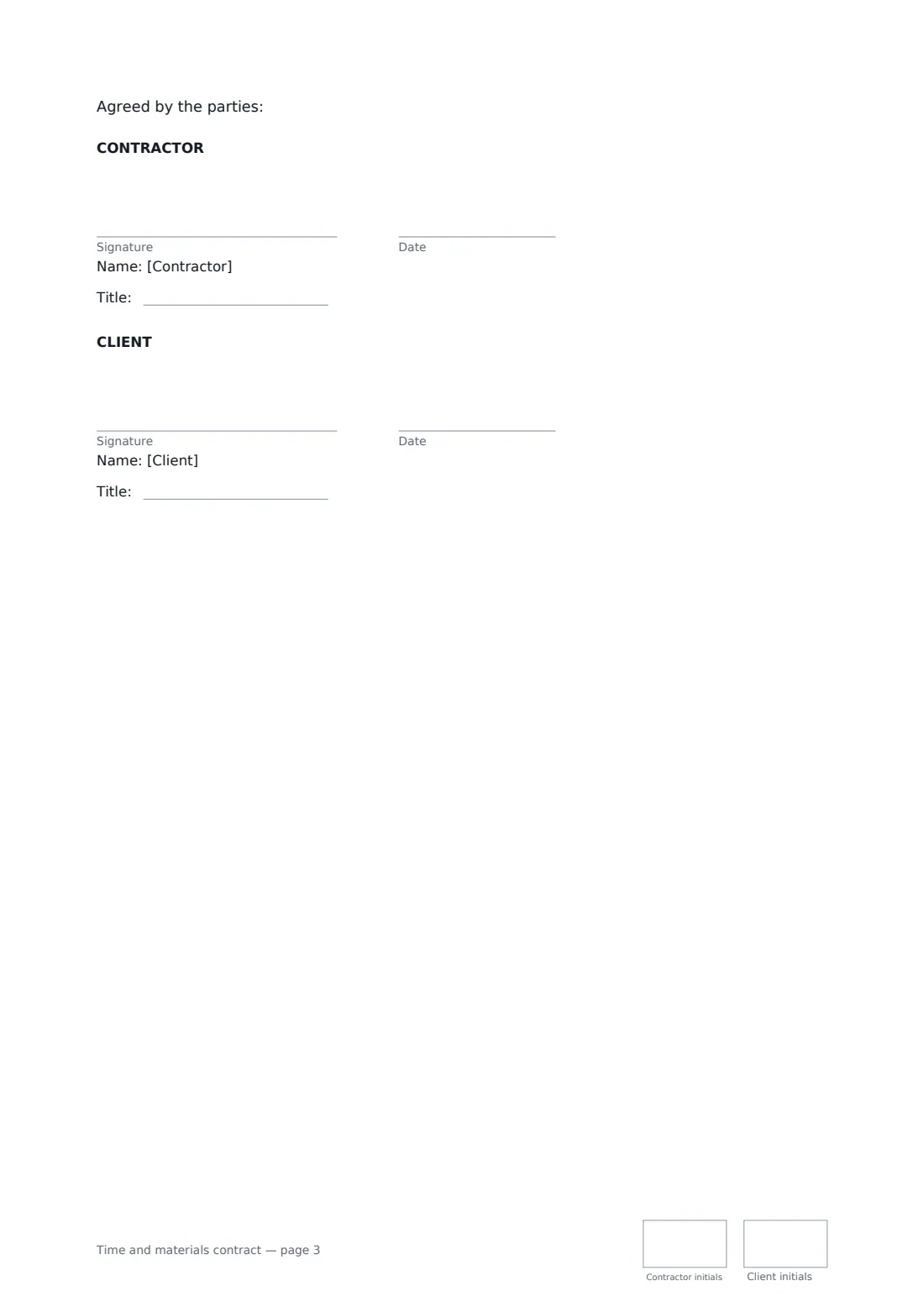
- Contractor signature and date, job title, initials on every page · The contractor, tradesperson or consultant doing the work.
- Client signature and date, job title, initials on every page · The person or business the work is done for. Add a job title if signing for a business.
What the time and materials contract covers
- The work
- Labour
- Materials and other costs
- Not-to-exceed limit and overruns
- Timesheets, receipts and invoices
- Quality, responsibility and ending the Contract
Using the time and materials contract, step by step
1 Describe the work
Enter what the work is, where, the start date, an optional expected end date, and the client's representative who can approve work.
2 Set the rates
List labour rates by role, add any minimum charge, and choose how travel time is charged and the billing unit.
3 Materials and limit
Set the materials markup, any equipment charges and approval threshold, and an optional not-to-exceed limit with a warning percentage.
4 Invoicing and send
Choose how often you invoice, the payment days, any deposit, the notice to end and governing law, then send it to the client.
Tips before you send it
- A not-to-exceed limit makes hourly work much easier for clients to accept. The warning at a percentage of the limit gives them time to decide.
- Describe each timesheet entry in a few words. The contract lets the client ask for timesheets and receipts behind any invoice.
- Get overrun approvals in writing, even by text or email. The contract says you aren't paid for unapproved work beyond the limit.
- Show the markup on invoices. The contract requires it, and it avoids arguments about material prices.
Sign it online in minutes
- Fill in the blanks. Names, dates and amounts go straight into the agreement — the preview shows exactly where.
- Name who signs. Tick “This is me” for your own part. FileIt builds the PDF with every signature, date and initials box on the right line, and you can check or move anything before sending.
- Send it. Each signer gets a secure link and signs from any device — no account needed. The signed PDF, with an audit trail and a Certificate of Completion, is filed in your vault and emailed to everyone.
Time and materials contract: frequently asked questions
What is a time and materials contract?
A contract where the client pays for the hours worked at agreed rates plus the cost of materials, usually with a markup, instead of a fixed price. It suits work whose scope can't be known up front.
What is a not-to-exceed limit?
A ceiling on the total charges before taxes. The contractor warns the client as charges approach it, isn't required to work beyond it, and isn't paid for unapproved work beyond it.
How is material markup handled?
Materials are charged at the contractor's cost after trade discounts plus the markup percentage you set, or at cost if you leave it empty. The markup is shown on invoices.
Can the client check the hours?
Yes. The contractor keeps timesheets by person, date and task, and receipts for materials, and the client may ask to see them for any invoice.
Can I sign it electronically?
Yes. E-signatures are generally valid for service and construction contracts in the US, UK, EU and Canada. FileIt keeps an audit trail with the signed PDF.