What is a temporary pay reduction agreement?
A temporary pay cut can be a fairer answer than layoffs when trade drops, a big contract is lost or cash is tight. But an employer usually can't simply decide to pay someone less. The change has to be explained, agreed and limited in time, or trust — and often the law — goes out of the window.
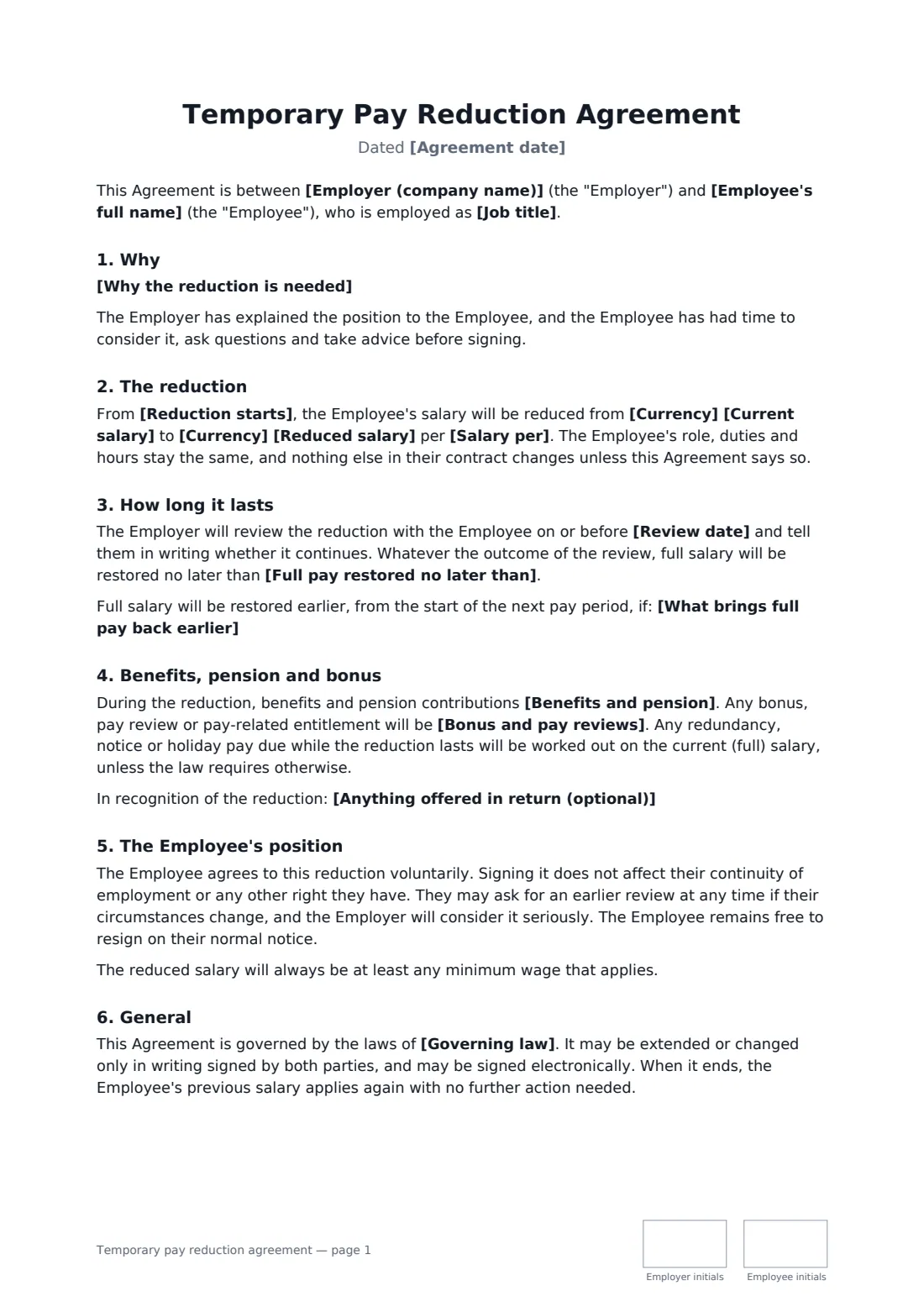
This agreement explains the reason in your own words, records the current and reduced salary, and keeps the role, duties and hours the same. It sets a start date, a review date and a latest date for full pay to return, with an optional earlier trigger and a choice of whether the amount given up is paid back later. You choose whether benefits, pension and bonus are worked out on full or reduced pay, can record anything offered in return, and the employee confirms they agree freely and can still resign on their normal notice.
- Best for
- Short-term, agreed salary cuts with no change of role
- Signed by
- The employer and the employee, initialled on every page
- Built-in limits
- Review date, latest restoration date, minimum wage floor
- Length
- About 2 pages
When to use a temporary pay reduction agreement
- A leadership team taking a pay cut to protect jobs
- A small business riding out a seasonal slump
- Bridging a gap until a new funding round closes
- Keeping staff on during a site refurbishment
- Sharing the cost of losing a major customer
What you fill in
18 blanks, then the name and email of each person who signs: employer, employee.
1 The parties
- Agreement date*
- Employer (company name)*
- Employee's full name*
- Job title*
2 The reduction
- Why the reduction is needed*
- Currency*
- Current salary*
- Reduced salary*
- Salary per* year · month · week · hour
3 Dates
- Reduction starts*
- Review date*
- Full pay restored no later than*
- What brings full pay back earlier
4 Benefits and bonus
- Will the reduction be paid back later?* No — the reduction is not repaid · Yes — if the trigger is met, the amount given up is repaid
- Benefits and pension* continue to be calculated on the Employee's current (full) salary · are calculated on the reduced salary while the reduction lasts
- Bonus and pay reviews* based on the Employee's current (full) salary · based on the salary actually paid during the year
- Anything offered in return (optional)
- Governing law*
5 Who signs
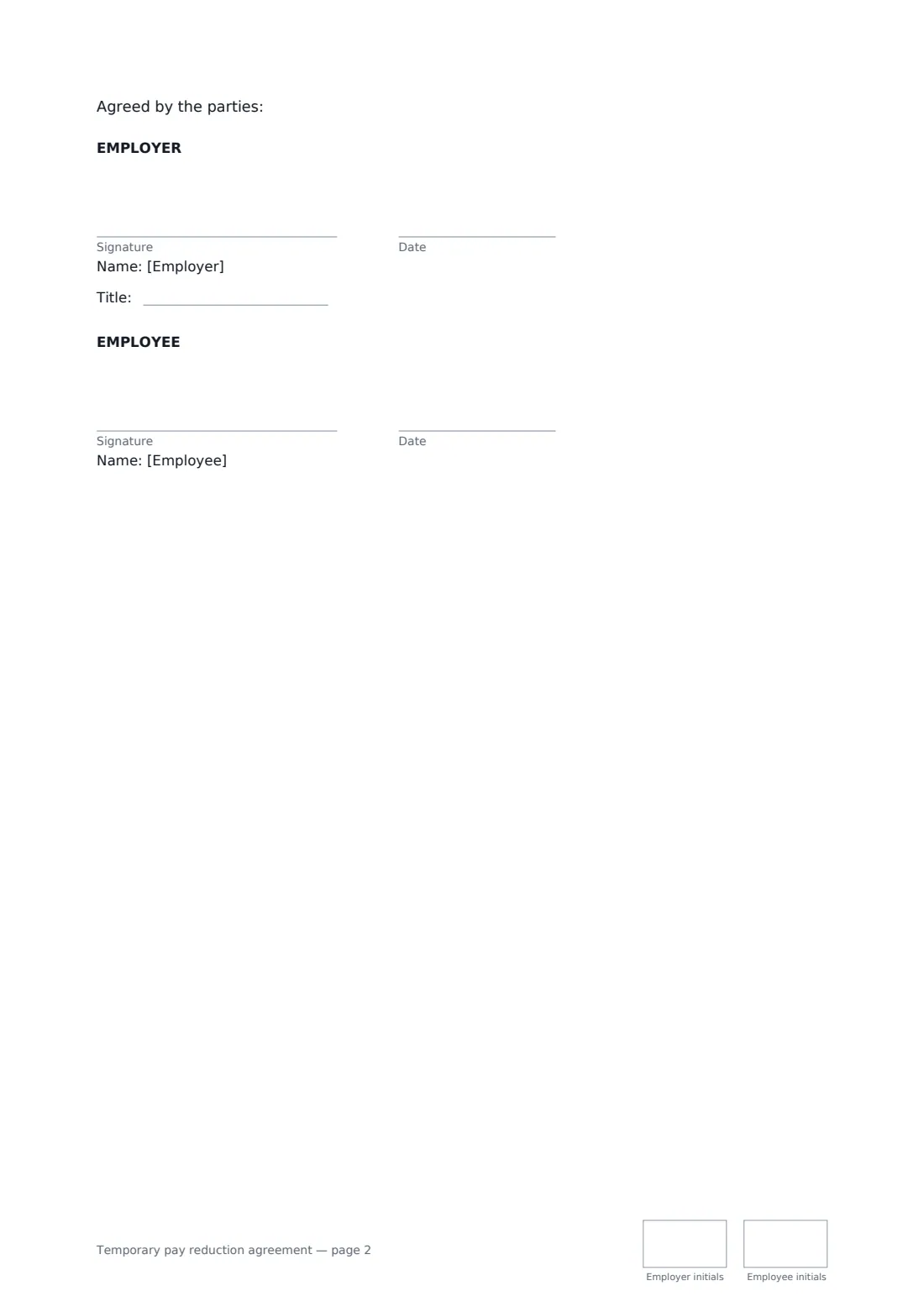
- Employer signature and date, job title, initials on every page · The person with authority to agree pay on the employer's behalf.
- Employee signature and date, initials on every page
What the temporary pay reduction agreement covers
- Why
- The reduction
- How long it lasts
- Benefits, pension and bonus
- The Employee's position
- General
Using the temporary pay reduction agreement, step by step
1 Explain the reason
Write a short, honest explanation of why the reduction is needed. The employee will read this first.
2 Enter the pay and dates
Add the current and reduced salary and the pay period, then the start date, review date and the latest date full pay will be restored. Add an earlier trigger if there is one.
3 Decide on benefits and bonus
Choose whether the reduction is repaid later, whether benefits and bonus use full or reduced pay, and anything you're offering in return, such as extra leave.
4 Send for signature
Give the employee time to read and ask questions before you send. Both of you initial each page and sign.
Tips before you send it
- Talk to people before sending anything — an agreement is easier to reach face to face than by email.
- Make sure the reduced pay still meets minimum wage and, where it matters, any salary threshold for overtime exemption.
- Check pension and insurance scheme rules before choosing how benefits are calculated.
- Hold the review on the date you promised, even if the answer is that the reduction continues.
Sign it online in minutes
- Fill in the blanks. Names, dates and amounts go straight into the agreement — the preview shows exactly where.
- Name who signs. Tick “This is me” for your own part. FileIt builds the PDF with every signature, date and initials box on the right line, and you can check or move anything before sending.
- Send it. Each signer gets a secure link and signs from any device — no account needed. The signed PDF, with an audit trail and a Certificate of Completion, is filed in your vault and emailed to everyone.
Temporary pay reduction agreement: frequently asked questions
Can an employer cut pay without agreement?
Usually not. In most places a pay cut is a change to the contract that needs the employee's agreement. This template records that agreement in writing.
What happens on the latest restoration date?
Full salary comes back automatically, whatever the outcome of the review. Extending the reduction needs a new written agreement signed by both.
Are notice or redundancy pay affected?
No. The agreement says any redundancy, notice or holiday pay due while the reduction lasts is worked out on full salary, unless the law requires otherwise.
How is this different from a reduced hours agreement?
A reduced hours agreement cuts hours and pay together. This one keeps the hours and role the same and reduces the salary only, for a limited time.