What is a standstill agreement?
Sometimes both sides would rather talk than litigate, but neither wants to give anything away by waiting. A creditor may be willing to hold off while a customer arranges refinancing; two businesses may want to try mediation before a claim about defective work goes to court. A standstill agreement creates that breathing space and protects both parties' positions while it lasts.
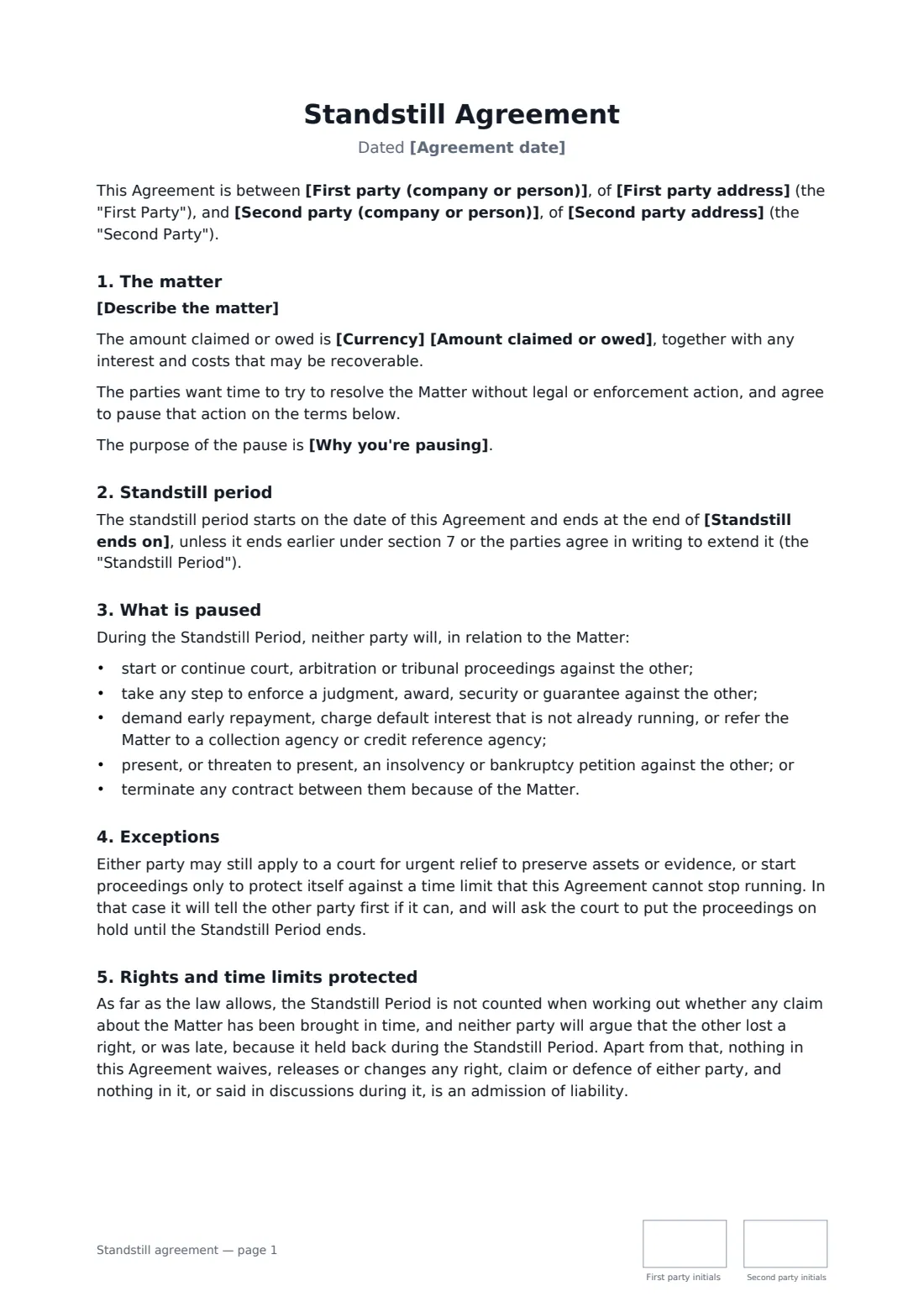
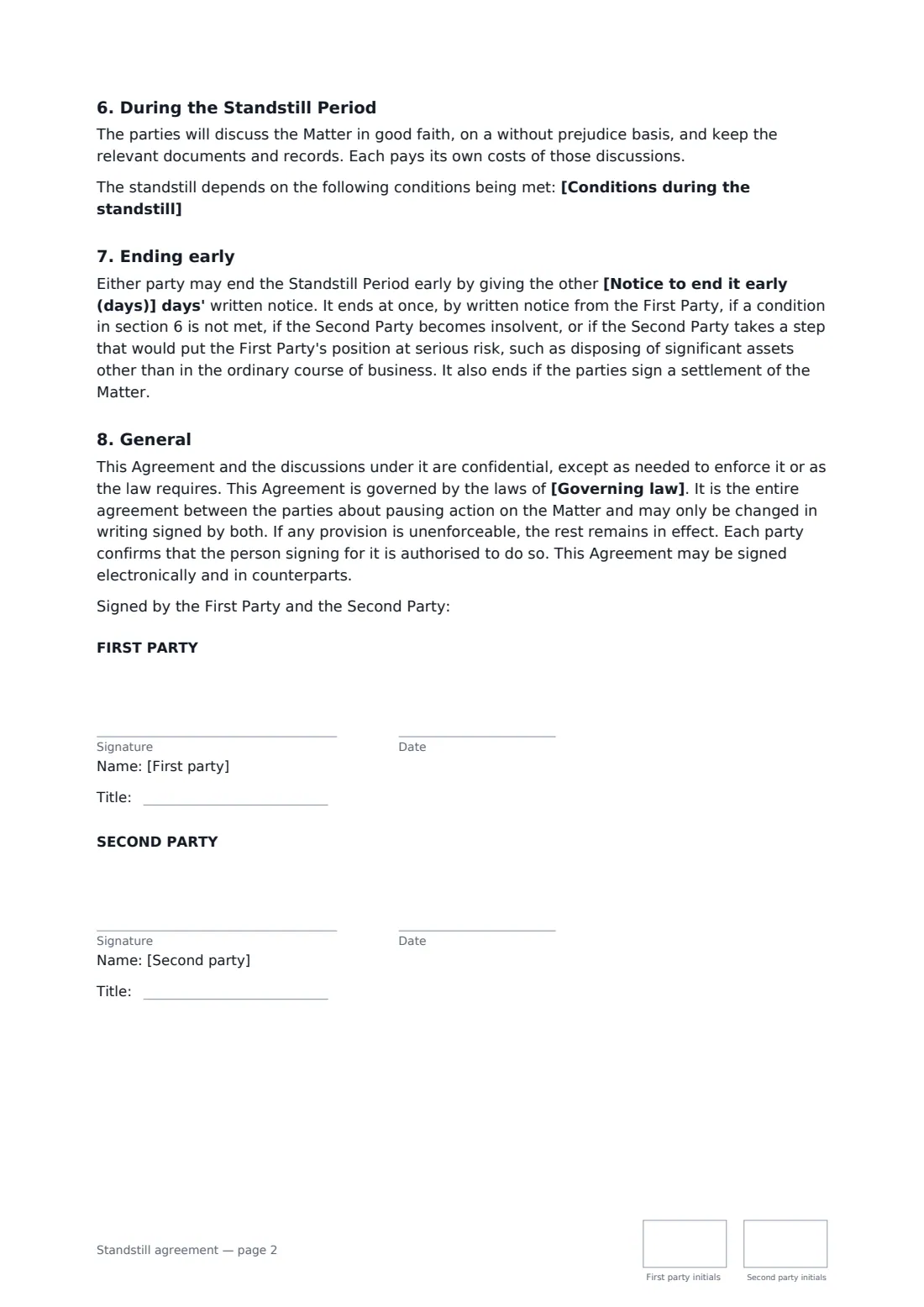
This template works for a dispute or for a debt. It describes the matter and any amount, sets the standstill period, and lists what's paused: proceedings, enforcement, acceleration and new default interest, collection or credit referrals, insolvency petitions and terminating contracts. It allows urgent court applications and protective filings, keeps time limits from running as far as the law allows, preserves every right and defence without admissions, records any conditions such as monthly payments, and explains how the standstill can end early.
- Best for
- Pausing a dispute for mediation, or a creditor holding off while a debtor recovers
- Signed by
- Both parties to the dispute or debt
- Protects
- Rights, defences and — as far as the law allows — time limits
- Length
- 2–3 pages, initialled by both on every page
When to use a standstill agreement
- A landlord and a commercial tenant pausing a rent arrears claim while a new payment plan is worked out
- A homeowner and a builder holding off on a defects claim to try mediation
- A supplier giving a struggling customer 90 days to refinance before enforcing its debt
- Two former business partners pausing a claim while they value the business
- A lender agreeing to forbear on a loan default while the borrower sells an asset
What you fill in
14 blanks, then the name and email of each person who signs: first party, second party.
1 The parties
- Agreement date*
- First party (company or person)*
- First party address
- Second party (company or person)*
- Second party address
2 The matter
- What the standstill is about* A dispute between the parties · A debt owed by the Second Party to the First Party
- Describe the matter*
- Currency
- Amount claimed or owed
- Why you're pausing
3 The standstill
- Standstill ends on*
- Conditions during the standstill
- Notice to end it early (days)*
- Governing law*
4 Who signs
- First party signature and date, job title, initials on every page · Usually the party that would otherwise take action — the claimant or the creditor.
- Second party signature and date, job title, initials on every page · Usually the party that would face the action — the respondent or the debtor.
What the standstill agreement covers
- The matter
- Standstill period
- What is paused
- Exceptions
- Rights and time limits protected
- During the Standstill Period
- Ending early
- General
Using the standstill agreement, step by step
1 Choose dispute or debt
Pick what the standstill is about and describe the matter. Add the amount and the reason for pausing, such as mediation or refinancing.
2 Set the period and conditions
Choose the end date. If the pause depends on something — monthly payments, financial updates, keeping assets in place — write it in the conditions.
3 Agree how it ends early
Set the notice period for either party to end the standstill. It also ends at once if a condition is broken or the second party becomes insolvent.
4 Sign quickly
Send it to the other side and track it in FileIt. Signing early matters when a deadline is approaching — the standstill only helps once both have signed.
Tips before you send it
- Check the time limits for your claim first. Rules on pausing them by agreement vary, and a protective filing may still be needed.
- Keep conditions specific and measurable — an amount and a date, not "reasonable progress".
- Use the period. Book the mediation or the meeting before you sign, so the pause has a purpose.
- If talks fail, diary the end date and decide your next step before it arrives.
Sign it online in minutes
- Fill in the blanks. Names, dates and amounts go straight into the agreement — the preview shows exactly where.
- Name who signs. Tick “This is me” for your own part. FileIt builds the PDF with every signature, date and initials box on the right line, and you can check or move anything before sending.
- Send it. Each signer gets a secure link and signs from any device — no account needed. The signed PDF, with an audit trail and a Certificate of Completion, is filed in your vault and emailed to everyone.
Standstill agreement: frequently asked questions
Is a standstill the same as a settlement?
No. A standstill only pauses action for a time. The underlying dispute or debt is still there, and every right and defence is preserved. If you resolve the matter, record it in a settlement agreement — FileIt has templates for dispute and debt settlements.
Does it stop limitation periods running?
The template says the standstill period is not counted for time limits as far as the law allows. In some places parties can agree that; in others, or for some claims, they can't. Take advice if a deadline is close.
What if the other side breaks the conditions?
The first party can end the standstill at once by written notice and then take whatever action it was entitled to before.
Can it be signed electronically?
In most countries, including the US (ESIGN Act and UETA), the UK, the EU (eIDAS) and Canada, an electronic signature is generally valid for an ordinary commercial agreement like this one. FileIt keeps an audit trail and a Certificate of Completion with the signed PDF as evidence of who signed and when.
Is this template free?
Yes. The template is free to use with the eSignature app in FileIt, and the people you send it to don't need a FileIt account to sign.