What is a owner-operator agreement?
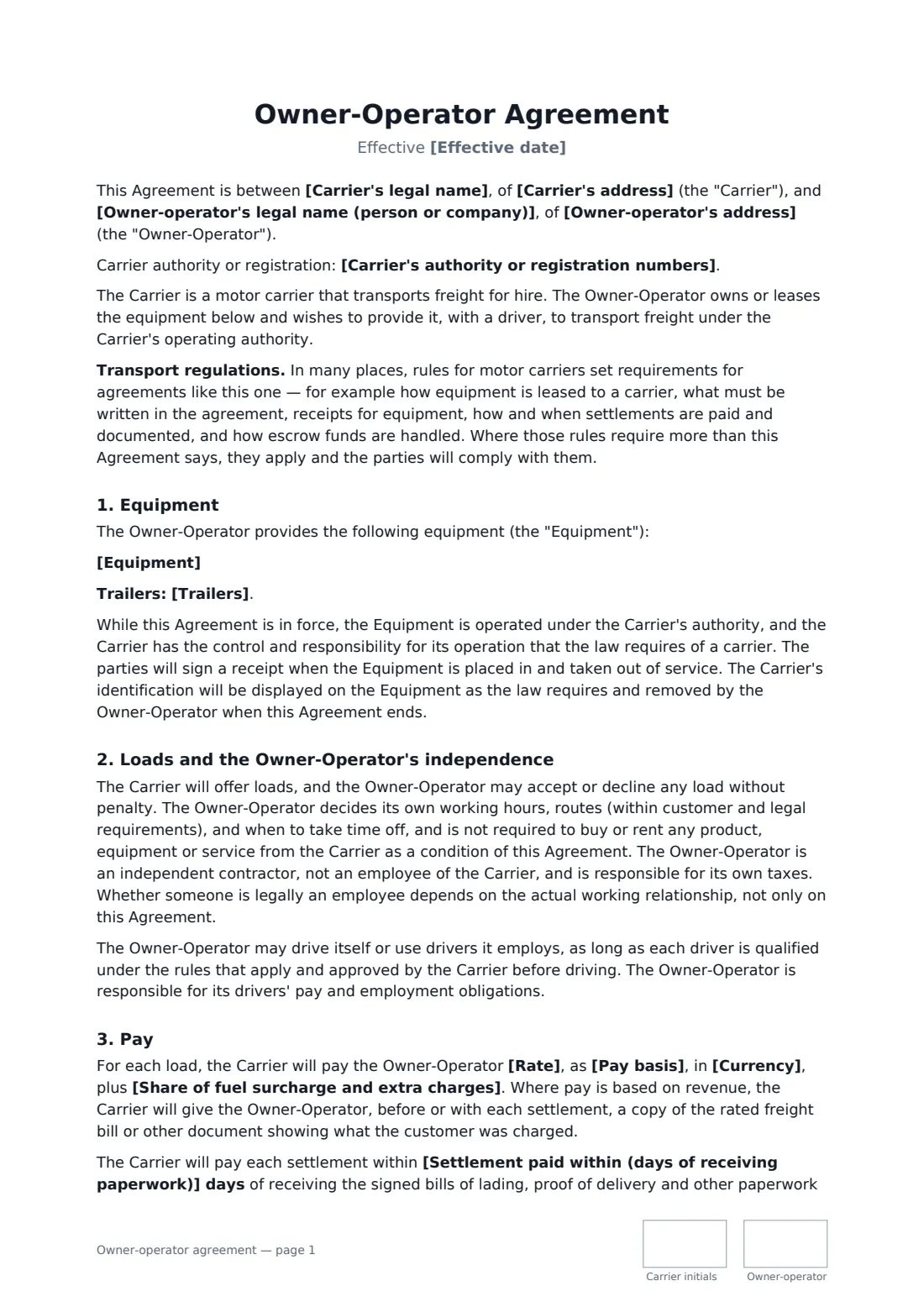
An owner-operator agreement (often called an independent contractor operating agreement or equipment lease) is signed when a motor carrier engages a driver who owns or leases their own truck to haul freight under the carrier's operating authority. Disputes usually come down to pay and deductions, so the agreement should say exactly how the owner-operator is paid and what may be taken out of each settlement.
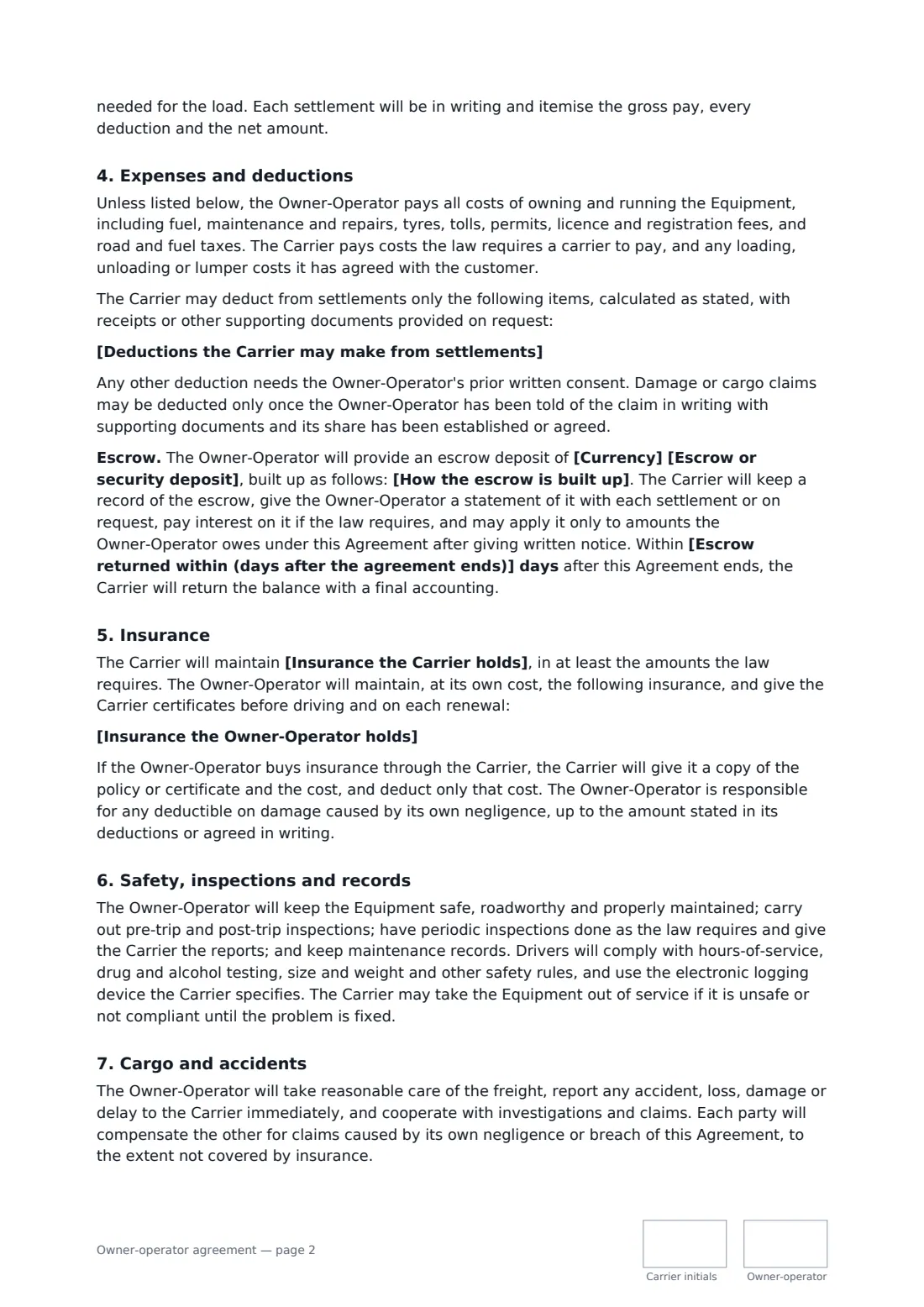
This template covers the equipment by year, make, VIN and plate, who supplies trailers, the carrier's control and responsibility while the equipment runs under its authority, the owner-operator's right to refuse loads, pay as a percentage of revenue, per mile or per load with fuel surcharge and extras, itemised written settlements paid within the days you set, a written list of permitted deductions, an optional escrow with statements and return, the insurance each side holds, safety, inspections and logs, cargo and accidents, and ending the agreement. It also notes that transport regulations in many places set extra requirements for these agreements, which apply where they ask for more.
- Best for
- Motor carriers and small fleets leasing on owner-operators
- Signed by
- The carrier (with a job title) and the owner-operator
- Pay
- Percentage of line-haul revenue, per loaded mile, per mile, or flat per load
- Length
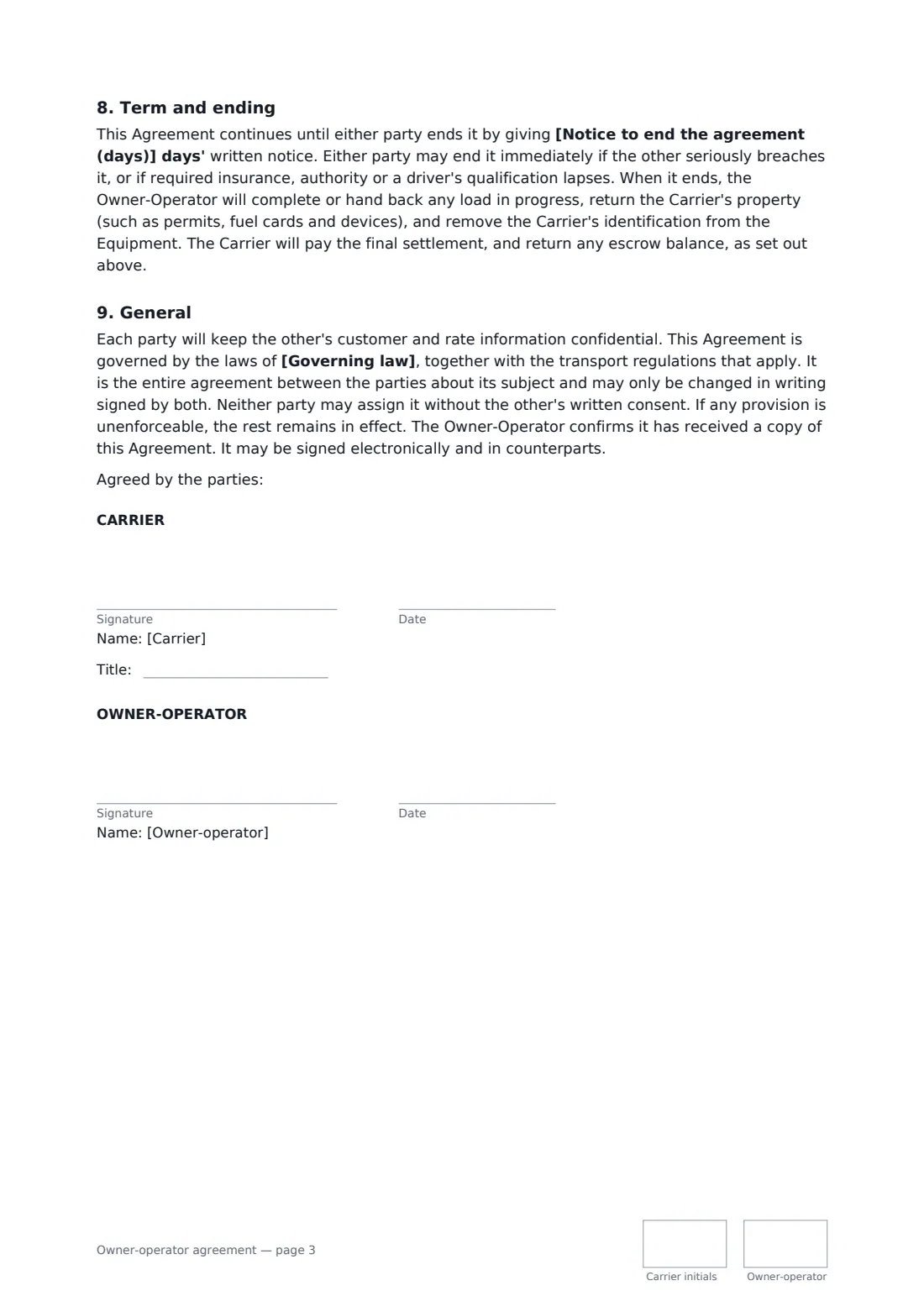
- 3 pages, initialled on every page
When to use a owner-operator agreement
- A trucking company leasing on an owner-operator with their own tractor and trailer
- A small fleet bringing on a power-only owner-operator to pull company trailers
- Updating an old lease agreement so every deduction is listed in writing
- Setting up an escrow with clear statements and return terms
- An owner-operator reviewing a carrier's terms before signing on
What you fill in
21 blanks, then the name and email of each person who signs: carrier, owner-operator.
1 The parties
- Effective date*
- Carrier's legal name*
- Carrier's authority or registration numbers
- Carrier's address
- Owner-operator's legal name (person or company)*
- Owner-operator's address
2 Equipment
- Equipment*
- Trailers* supplied by the Owner-Operator (listed above) · supplied by the Carrier as needed · not applicable (the Equipment does not include or pull a separate trailer)
3 Pay
- Pay basis* a percentage of the line-haul revenue for each load · a rate per loaded mile · a rate per mile (loaded and empty) · a flat amount per load, agreed before dispatch
- Rate*
- Share of fuel surcharge and extra charges*
- Currency*
- Settlement paid within (days of receiving paperwork)*
4 Deductions and escrow
- Deductions the Carrier may make from settlements*
- Escrow or security deposit
- How the escrow is built up
- Escrow returned within (days after the agreement ends)
5 Insurance
- Insurance the Carrier holds*
- Insurance the Owner-Operator holds*
6 Term and other terms
- Notice to end the agreement (days)*
- Governing law*
7 Who signs
- Carrier signature and date, job title, initials on every page · An owner, officer or authorised manager of the motor carrier.
- Owner-operator signature and date, initials on every page · The owner-operator, or an authorised person at the owner-operator's company.
What the owner-operator agreement covers
- Equipment
- Loads and the Owner-Operator's independence
- Pay
- Expenses and deductions
- Insurance
- Safety, inspections and records
- Cargo and accidents
- Term and ending
- General
Using the owner-operator agreement, step by step
1 Enter both parties and the equipment
Add the carrier's legal name and authority numbers, the owner-operator's name, and each unit's year, make, model, VIN and plate. Choose who supplies trailers.
2 Set the pay
Choose the pay basis and rate, the share of fuel surcharges and extra charges, and how many days after receiving the paperwork each settlement is paid. Revenue-based pay comes with the rated freight bill.
3 List deductions and any escrow
List every item the carrier may deduct, one per line, with how it is calculated — anything else needs written consent. Add an escrow amount, how it builds up and when it is returned, or leave it empty.
4 Insurance and notice
Describe the insurance the carrier holds and the cover the owner-operator must carry, such as non-trucking liability, physical damage and occupational accident cover, and set the notice to end.
5 Send for signature
Send it to the owner-operator. Once signed, it's filed in your vault — keep the equipment receipts and insurance certificates with it.
Tips before you send it
- Check the transport regulations where you operate. Many set specific requirements for leasing equipment, settlements, deductions and escrow funds, and they apply on top of this agreement.
- List every deduction. The template only allows the deductions written in the agreement, which avoids most settlement disputes.
- Whether someone is legally an independent contractor depends on how the relationship works in practice, not only on the label — the template says so.
- Collect certificates of insurance before the first load and on every renewal.
Sign it online in minutes
- Fill in the blanks. Names, dates and amounts go straight into the agreement — the preview shows exactly where.
- Name who signs. Tick “This is me” for your own part. FileIt builds the PDF with every signature, date and initials box on the right line, and you can check or move anything before sending.
- Send it. Each signer gets a secure link and signs from any device — no account needed. The signed PDF, with an audit trail and a Certificate of Completion, is filed in your vault and emailed to everyone.
Owner-operator agreement: frequently asked questions
Can the owner-operator turn down loads?
Yes. The owner-operator may accept or decline any load without penalty, decides its own working hours and time off, and is not required to buy products or services from the carrier as a condition of the agreement.
What can the carrier deduct from settlements?
Only the items listed in the agreement, calculated as stated, with receipts on request. Any other deduction needs the owner-operator's prior written consent, and damage or cargo claims may be deducted only after the claim is documented and the owner-operator's share is established or agreed.
When is the escrow returned?
Within the number of days you set after the agreement ends, with a final accounting. During the agreement, the carrier gives a statement of the escrow with each settlement or on request and may use it only for amounts owed, after written notice.
Can an owner-operator agreement be signed electronically?
In most countries, including the US (ESIGN Act and UETA), the UK, the EU (eIDAS) and Canada, an electronic signature is generally valid for an ordinary commercial contract like this one. FileIt keeps an audit trail and a Certificate of Completion with the signed PDF as evidence of who signed and when.
Is this template free?
Yes. The template is free to use with the eSignature app in FileIt, and the people you send it to don't need a FileIt account to sign.