What is a chapter affiliation agreement?
Many nonprofits grow through local chapters: volunteers in another city who want to run the same programs under the same name. That reach is powerful, but the national organisation's name, reputation and sometimes its insurance and tax position are on the line wherever a chapter operates. A clear affiliation agreement gives chapters room to run their own activities while protecting the brand and the people the programs serve.
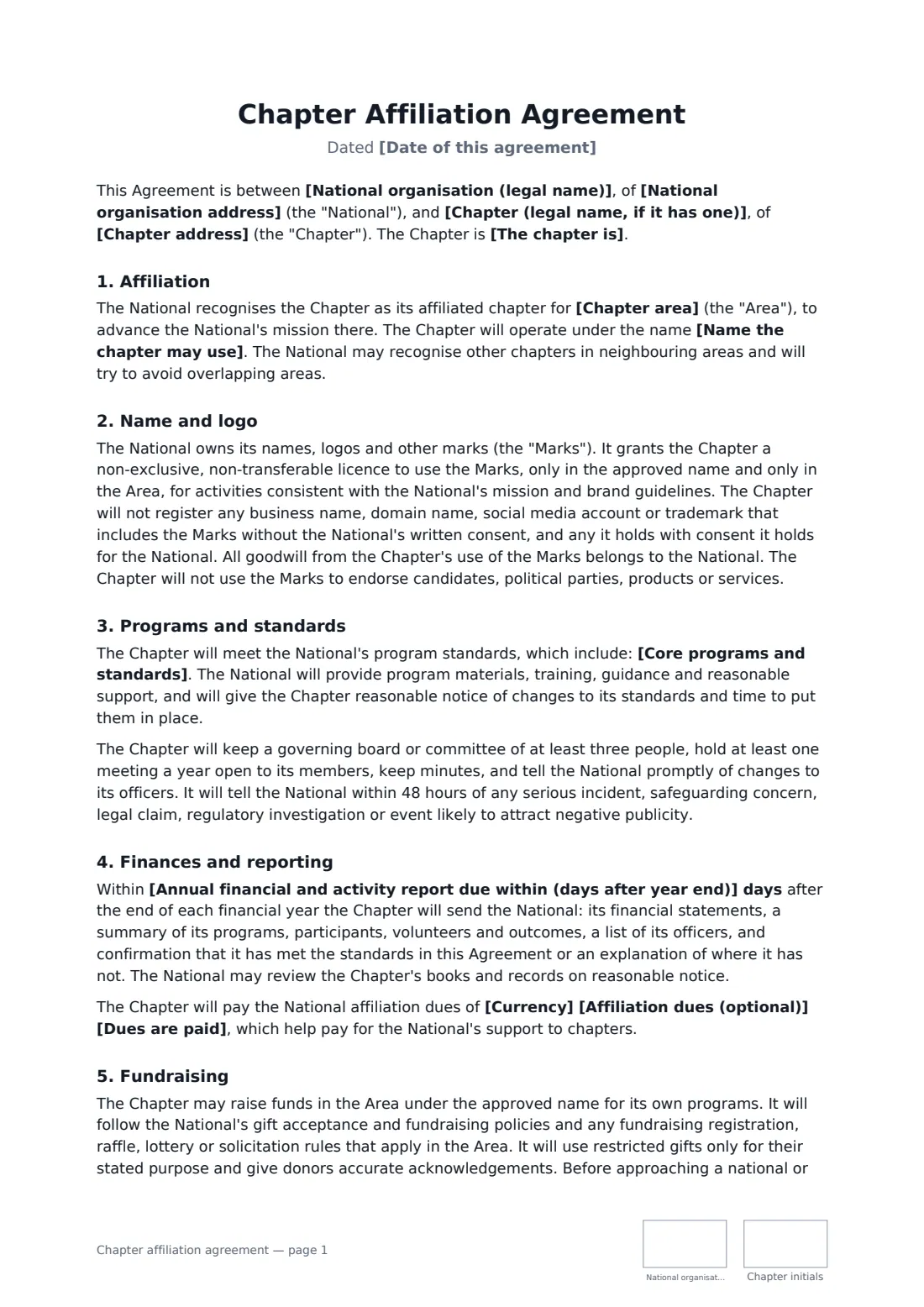
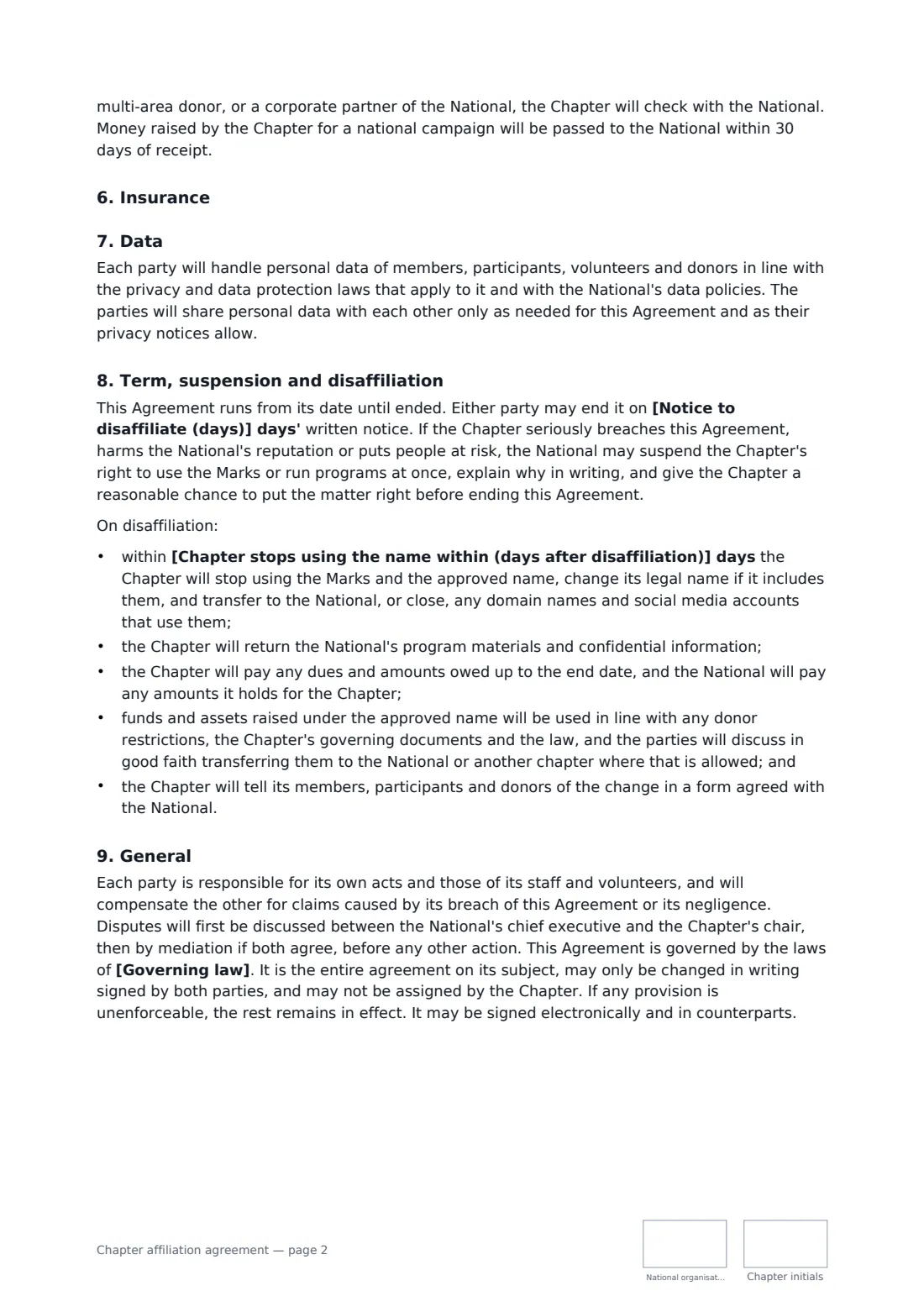
This template covers both separately incorporated chapters and volunteer groups run under the national's oversight, with different wording for each on contracts, bank accounts and financial controls. It licenses the name and logo only in the chapter's area and only for mission activities, keeps domain names and social media accounts with the national, sets program standards, governance and incident reporting, and requires an annual financial and activity report. It covers optional dues, fundraising and restricted gifts, your choice of insurance arrangement, data protection, suspension with a chance to put things right, and an orderly disaffiliation.
- Best for
- National and regional nonprofits with local chapters, branches or affiliates
- Signed by
- An officer of the national organisation and an officer of the chapter
- Chapter types
- Separate legal entity, or volunteer group under the national's oversight
- Length
- About 3 pages, initialled on every page
When to use a chapter affiliation agreement
- A youth mentoring charity recognising a new chapter in another city
- A professional association putting long-standing local chapters on a written footing
- An alumni or advocacy network licensing its name to volunteer groups
- A national nonprofit refreshing affiliation terms after a rebrand
- A federation of independent local charities that share a name and programs
What you fill in
18 blanks, then the name and email of each person who signs: national organisation, chapter.
1 The parties
- Date of this agreement*
- National organisation (legal name)*
- National organisation address
- Chapter (legal name, if it has one)*
- Chapter address
- The chapter is* a separate legal entity with its own governing documents · an unincorporated group run by local volunteers
2 Name and area
- Name the chapter may use*
- Chapter area*
3 Programs
- Core programs and standards*
4 Money
- Currency*
- Affiliation dues (optional)
- Dues are paid each year · each quarter · each month
- Annual financial and activity report due within (days after year end)*
- Insurance* The Chapter carries its own general liability insurance · The Chapter is covered under the National's group policy, on the National's conditions
- Minimum liability cover (if the chapter carries its own)
5 Term
- Notice to disaffiliate (days)*
- Chapter stops using the name within (days after disaffiliation)*
- Governing law*
6 Who signs
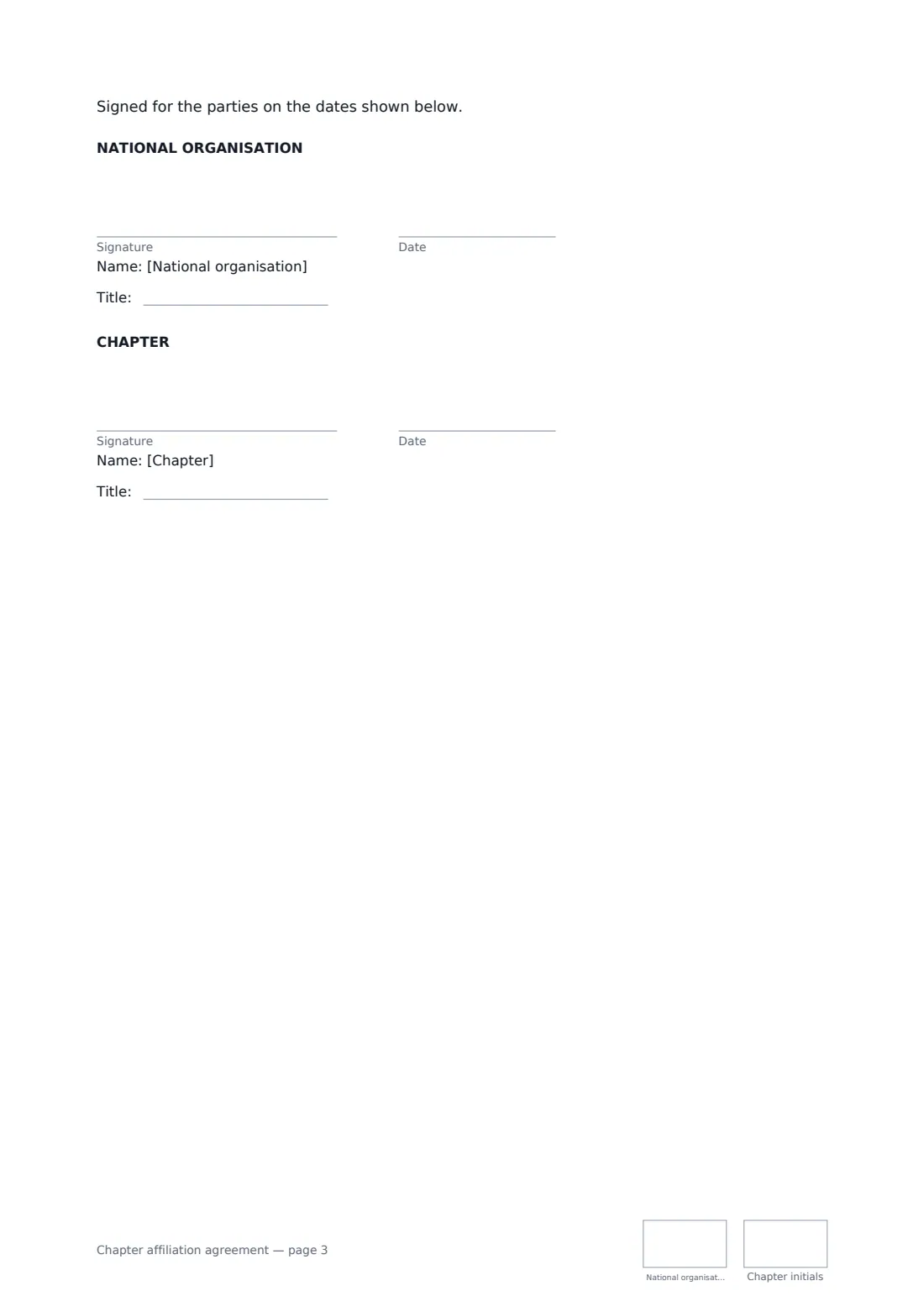
- National organisation signature and date, job title, initials on every page · The chief executive or other officer authorised to sign for the national organisation.
- Chapter signature and date, job title, initials on every page · The chair, president or other officer authorised to sign for the chapter.
What the chapter affiliation agreement covers
- Affiliation
- Name and logo
- Programs and standards
- Finances and reporting
- Fundraising
- Insurance
- Data
- Term, suspension and disaffiliation
- General
Using the chapter affiliation agreement, step by step
1 Name the parties and chapter type
Enter the national organisation and the chapter, and choose whether the chapter is its own legal entity or a volunteer group under the national's oversight.
2 Set the name and area
Enter the exact name the chapter may use and the area it covers.
3 Agree programs, money and insurance
Describe the core programs and standards, any dues, the reporting deadline after year end and the insurance arrangement.
4 Set disaffiliation terms and sign
Choose the notice period and how quickly the name must be dropped after disaffiliation, set the governing law and send for signature.
Tips before you send it
- Whether a chapter can operate under the national's tax-exempt or charity status depends on local law and on how the national is registered. Take advice before treating an unincorporated chapter as part of the national.
- Keep the chapter's domain names and social media accounts under accounts the national can recover. They are the hardest assets to get back after a split.
- Fundraising registration and raffle rules vary by place. Make sure each chapter knows the rules where it raises money.
- Review chapter reports each year. Early conversations about missed standards are far easier than suspensions.
Sign it online in minutes
- Fill in the blanks. Names, dates and amounts go straight into the agreement — the preview shows exactly where.
- Name who signs. Tick “This is me” for your own part. FileIt builds the PDF with every signature, date and initials box on the right line, and you can check or move anything before sending.
- Send it. Each signer gets a secure link and signs from any device — no account needed. The signed PDF, with an audit trail and a Certificate of Completion, is filed in your vault and emailed to everyone.
Chapter affiliation agreement: frequently asked questions
Does the national become liable for the chapter's debts?
Not for a separately incorporated chapter, which is responsible for its own contracts and debts under the template. For a volunteer group run under the national's oversight, the template limits what it can sign without written authorisation.
Can the national stop a chapter using the name?
Yes. It can suspend the licence at once for a serious breach or risk to people, explain why and give a chance to put things right, and on disaffiliation the chapter must stop using the name within the days you set.
What happens to money the chapter raised?
It is used in line with donor restrictions, the chapter's governing documents and the law, and the parties discuss transferring it to the national or another chapter where allowed.
Do chapters have to pay dues?
Only if you add them. Dues are optional and can be annual, quarterly or monthly.