What is a metal detecting permission?
Most good detecting land is private, and a farmer or landowner who says yes deserves to know exactly what they've agreed to. Written permission also protects the detectorist: if a valuable find turns up, there is no argument afterwards about who owns what, or whether they were allowed in that field at all.
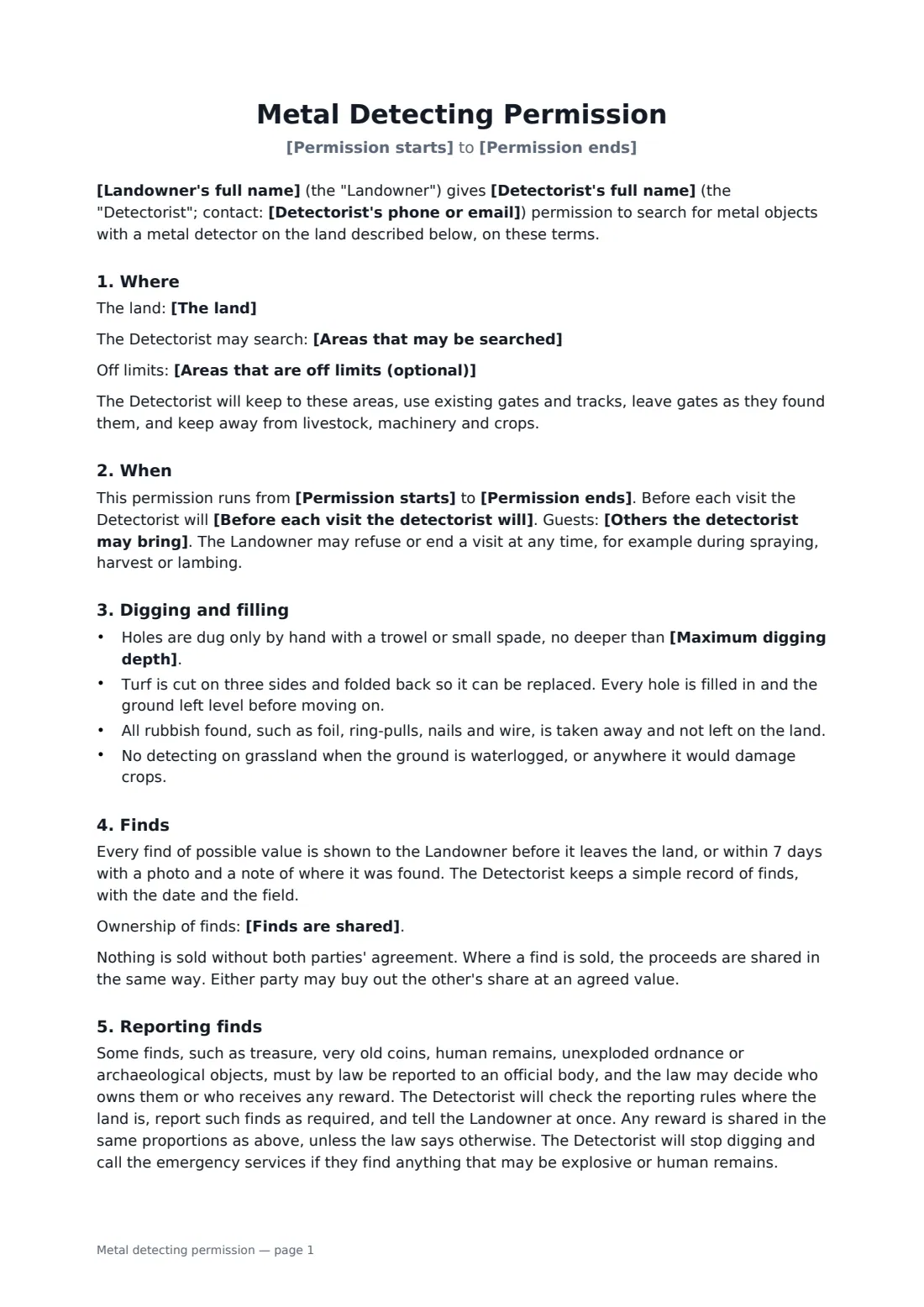
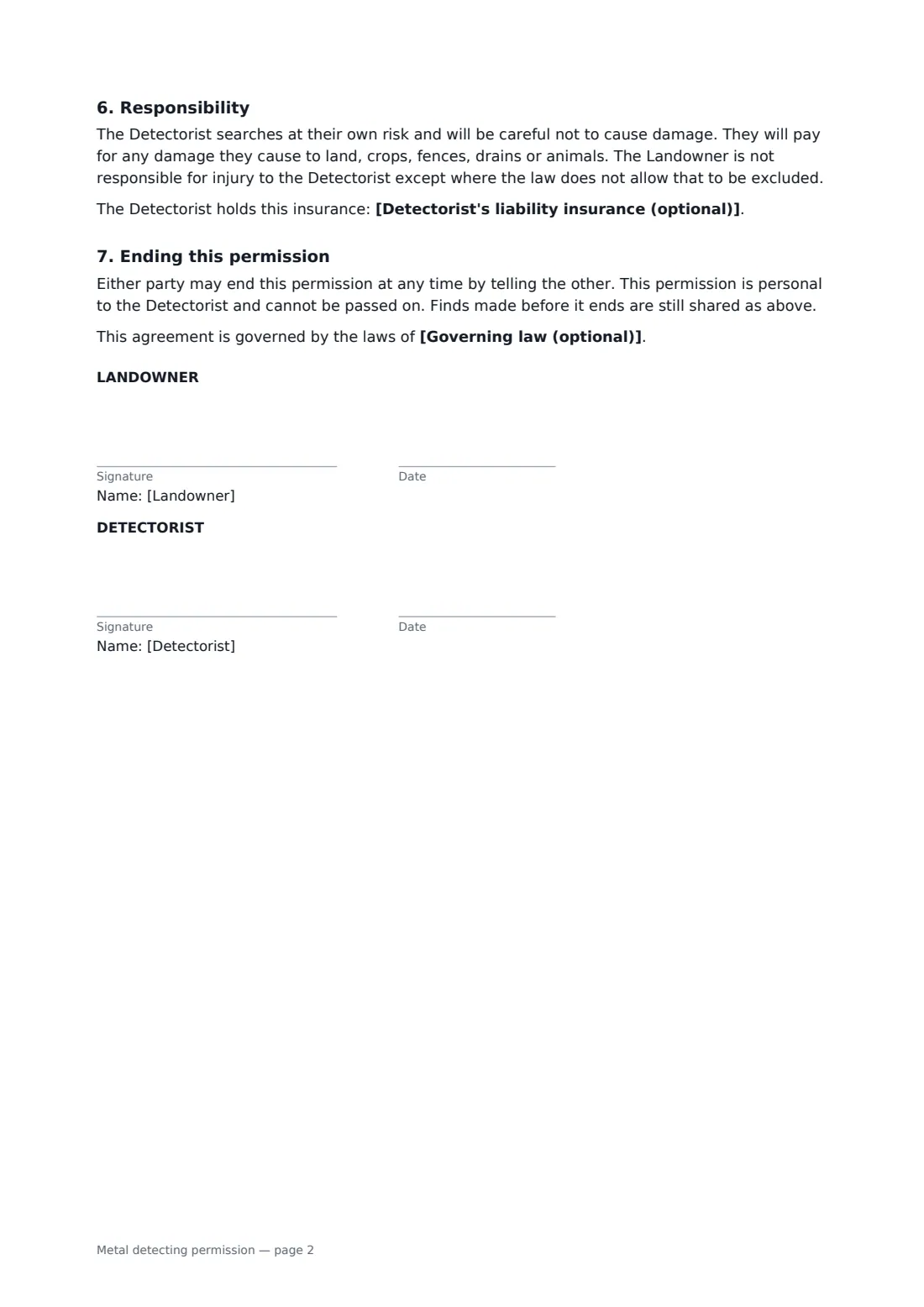
This form sets out the land and the areas you may search, what is off limits, the dates the permission runs, and how much notice you give before each visit. It covers digging by hand, filling every hole and taking rubbish away, then how finds are shown to the landowner and shared — 50/50 by value, a threshold below which the detectorist keeps small finds, everything to the landowner, or your own split. It also covers finds the law says must be reported, such as treasure or archaeological objects, and what to do about anything that might be explosive, and records who pays for damage and any insurance the detectorist holds.
- Best for
- Detectorists asking farmers and landowners for permission; clubs organising digs
- Signed by
- The landowner and the detectorist
- You set
- Land, areas, dates, notice, digging depth, finds split, insurance
- Length
- About 2 pages
When to use a metal detecting permission
- Asking a farmer for permission to search stubble and pasture fields
- Agreeing a finds split with a landowner before a season of visits
- Detecting on a large private garden or estate grounds
- Renewing an existing permission with clearer terms
- A club securing permission for members to search a site
What you fill in
17 blanks, then the name and email of each person who signs: landowner, detectorist.
1 The parties
- Detectorist's full name*
- Detectorist's phone or email*
- Landowner's full name*
2 The land
- The land*
- Areas that may be searched*
- Areas that are off limits (optional)
3 When
- Permission starts*
- Permission ends*
- Before each visit the detectorist will* text or call the landowner to say when they are coming · get the landowner's agreement to the day and time · no notice is needed
- Others the detectorist may bring* no one, unless the landowner agrees in advance · up to two named detecting companions approved by the landowner
4 Digging
- Maximum digging depth*
5 Finds
- Finds are shared* 50/50 by value between the landowner and the detectorist · the detectorist keeps finds worth less than the amount below; anything worth more is shared 50/50 · the landowner keeps all finds · as set out below
- Value threshold
- Currency
- Split details
6 Liability
- Detectorist's liability insurance (optional)
- Governing law (optional)
7 Who signs
- Landowner signature and date · The owner of the land, or the occupier with authority to grant access.
- Detectorist signature and date
What the metal detecting permission covers
- Where
- When
- Digging and filling
- Finds
- Reporting finds
- Responsibility
- Ending this permission
Using the metal detecting permission, step by step
1 Describe the land
Enter the farm or property, naming the fields so there's no doubt which ones are covered. List the areas you may search and anything off limits, such as the farmyard, crops, livestock fields or protected sites.
2 Agree when and who
Set start and end dates, how you'll let the landowner know before each visit, and whether you may bring a companion.
3 Settle the finds split
Choose how finds are shared. If you use a value threshold, enter the amount; disputed values go to an independent valuer, with the cost shared.
4 Send to the landowner
Add your insurance details if you have them and send the form. The landowner signs on their phone without a FileIt account, and you both keep the signed copy.
Tips before you send it
- Learn the reporting rules where you detect. England and Wales have the Treasure Act and a recording scheme, and many countries and US states restrict detecting or removing artefacts on certain land.
- Never detect on a protected or scheduled site, even with the landowner's permission.
- Show the landowner your finds regularly; trust is what keeps a permission going year after year.
- Club or association membership often includes public liability insurance. Mention it — landowners like to see it.
- Fill every hole as if the farmer were watching. Most lost permissions start with one left open.
Sign it online in minutes
- Fill in the blanks. Names, dates and amounts go straight into the agreement — the preview shows exactly where.
- Name who signs. Tick “This is me” for your own part. FileIt builds the PDF with every signature, date box on the right line, and you can check or move anything before sending.
- Send it. Each signer gets a secure link and signs from any device — no account needed. The signed PDF, with an audit trail and a Certificate of Completion, is filed in your vault and emailed to everyone.
Metal detecting permission: frequently asked questions
Do I need written permission to metal detect on private land?
You always need the landowner's permission, and written permission is far better than a verbal yes: it records where you may go and how finds are shared, which avoids disputes if something valuable turns up.
Who owns what I find?
Between you and the landowner, whatever you agree in the form. But the law may override that for some finds, such as treasure or archaeological objects, and may decide ownership or rewards. The form says any reward is shared in the same proportions unless the law says otherwise.
What does the landowner have to do?
Very little: let you on the land on the agreed terms. They can refuse or end a visit at any time, for example at harvest, and can end the permission by telling you.
What if I find something dangerous?
The form says the detectorist stops digging and calls the emergency services for anything that may be explosive, or for human remains.
Can the landowner sign on their phone?
Yes. They open the link, review the form and sign — no FileIt account needed. Both of you get the signed PDF with its audit trail.