What is a martial arts waiver?
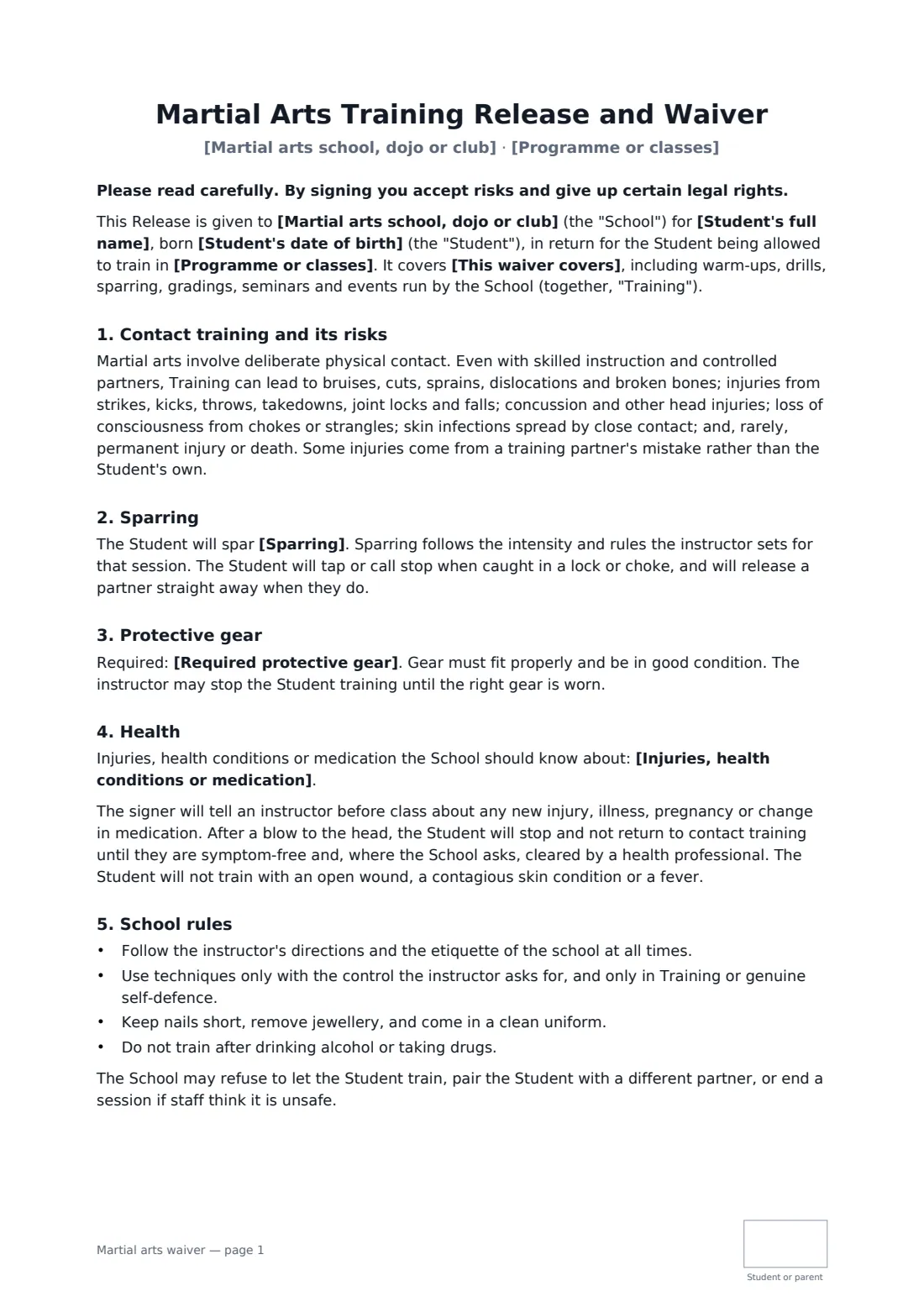
In martial arts, contact isn't an accident — it's the training. That makes a generic gym waiver a poor fit. Students and parents should know before the first class that throws, joint locks and chokes carry their own risks, that a partner's mistake can hurt you, and that close contact can pass on skin infections. This waiver says so in plain words.
You name the school and the programme, and choose how sparring works for this student: only when an instructor says they're ready, not at all, or including competitions. You set the protective gear rule. The student, or a parent for a child, discloses injuries and conditions, agrees to tap or call stop and to release a partner when they tap, and agrees to sit out after a blow to the head until symptom-free. Dojo basics — short nails, no jewellery, clean uniform, no training with a contagious skin condition — are included. The release goes as far as the law allows, and every page is initialled.
- Best for
- Karate, judo, jiu-jitsu, taekwondo, kickboxing, MMA and self-defence classes
- Signed by
- The student or a parent, and the school
- Covers
- A trial class, 12 months, or the whole enrolment
- Length
- 2 pages, initialled on every page
When to use a martial arts waiver
- New students joining after a free trial class
- Kids' and teens' classes where parents sign
- Adult grappling or striking programmes with regular sparring
- Self-defence workshops for community groups
- Students entering gradings or inter-club competitions
What you fill in
12 blanks, then the name and email of each person who signs: student or parent, school.
1 The school
- Martial arts school, dojo or club*
- Programme or classes*
- This waiver covers* a single trial class on the date signed · all classes and gradings for 12 months from signing · all classes and gradings while the student is enrolled
2 The student
- Student's full name*
- Student's date of birth*
- Who signs* The student (18 or over) · A parent or guardian of a student under 18
- Parent or guardian's name
- Injuries, health conditions or medication
- Emergency contact (name and phone)*
3 Training
- Sparring* only when an instructor decides the student is ready, and always under supervision · not at all — the student takes part in drills, forms and pad work only · in class and, if the student chooses, in competitions the school enters
- Required protective gear*
- Governing law*
4 Who signs
- Student or parent signature and date, initials on every page · The adult student, or a parent or legal guardian signing for a student under 18.
- School signature and date, job title, initials on every page
What the martial arts waiver covers
- Contact training and its risks
- Sparring
- Protective gear
- Health
- School rules
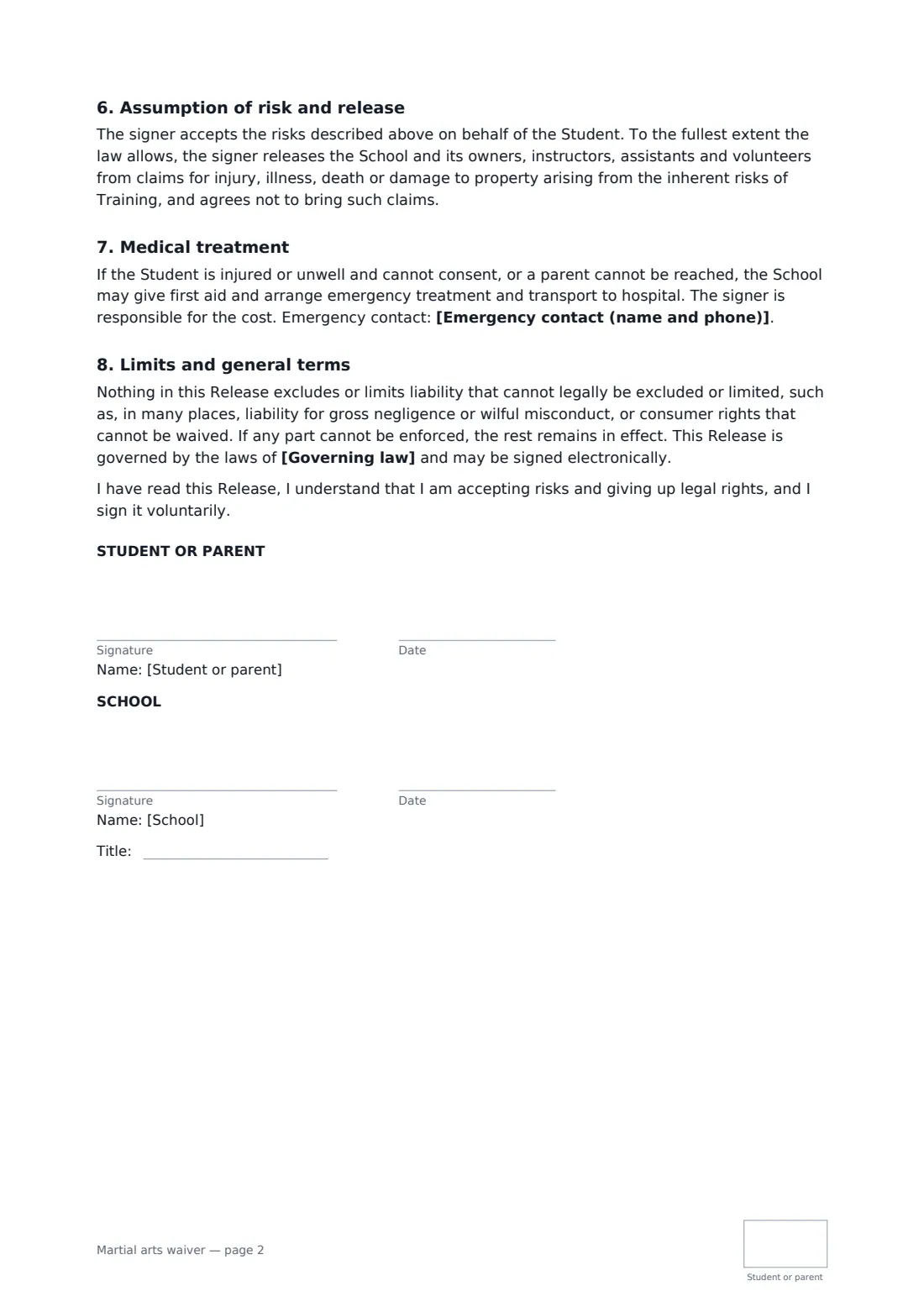
- Assumption of risk and release
- Medical treatment
- Limits and general terms
Using the martial arts waiver, step by step
1 Name your school and programme
Your school name fills in. Add the programme and choose whether the waiver covers a trial class, 12 months or the whole enrolment.
2 Choose the sparring setting
Pick the sparring line that fits this student, and edit the protective gear rule to match what you require.
3 Send it with the welcome email
The student, or a parent, fills in health details and an emergency contact, then signs and initials each page from their phone.
4 Countersign and keep it
You countersign and the signed waiver is filed in your FileIt vault, alongside the student's other paperwork.
Tips before you send it
- Ask students to tell you about new injuries at the start of each class, not just on the form.
- Have a written concussion return-to-training approach and apply it the same way every time.
- Keep sparring on "not at all" for a new student until an instructor has seen them train.
- Have parents re-sign when a child moves into a programme with more contact.
Sign it online in minutes
- Fill in the blanks. Names, dates and amounts go straight into the agreement — the preview shows exactly where.
- Name who signs. Tick “This is me” for your own part. FileIt builds the PDF with every signature, date and initials box on the right line, and you can check or move anything before sending.
- Send it. Each signer gets a secure link and signs from any device — no account needed. The signed PDF, with an audit trail and a Certificate of Completion, is filed in your vault and emailed to everyone.
Martial arts waiver: frequently asked questions
Can I use one form for children and adults?
Yes. Choose whether the student or a parent signs. The parent wording explains that a parent often can't give up a child's own claims.
What does the sparring choice change?
It sets what this student has agreed to: supervised sparring when ready, no sparring, or sparring including competitions. Change it later by sending a new waiver.
Does the waiver cover injuries a partner causes?
It names a partner's mistake as one of the risks of training and releases the school to the extent the law allows. It doesn't exclude liability the law won't let you exclude.
Do students need a FileIt account to sign?
No. They sign from the link on any device. The signed PDF includes an audit trail and a Certificate of Completion.