What is a intercompany services agreement?
When a parent or head-office company runs finance, HR, IT or management for its subsidiaries, it usually recharges the cost. Without a written agreement, those recharges are hard to explain: auditors ask what was provided, tax authorities ask whether the price is what independent businesses would agree, and directors of each company need to show the arrangement is in that company's interests. A signed agreement, backed by records of what was actually done, is the starting point.
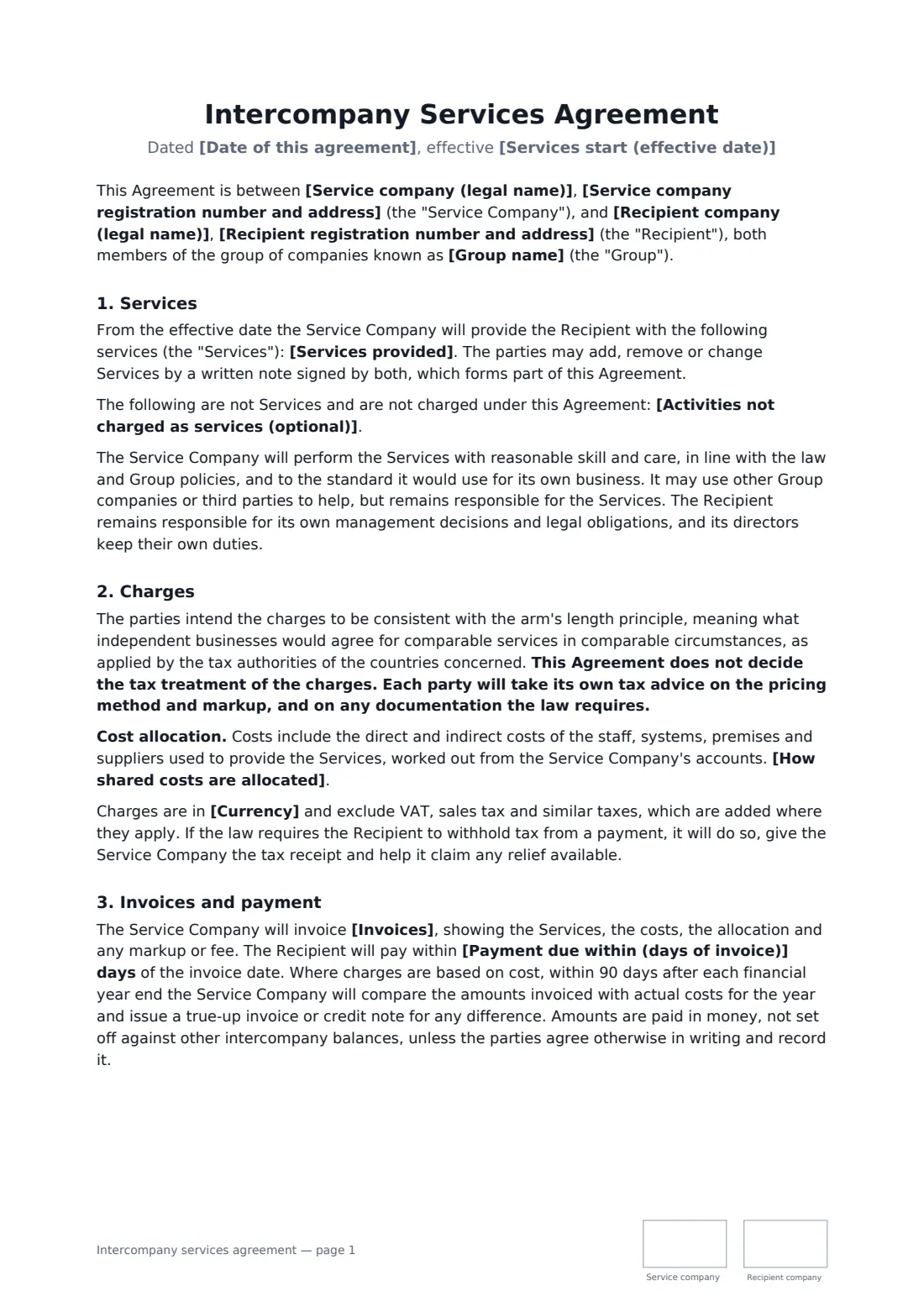
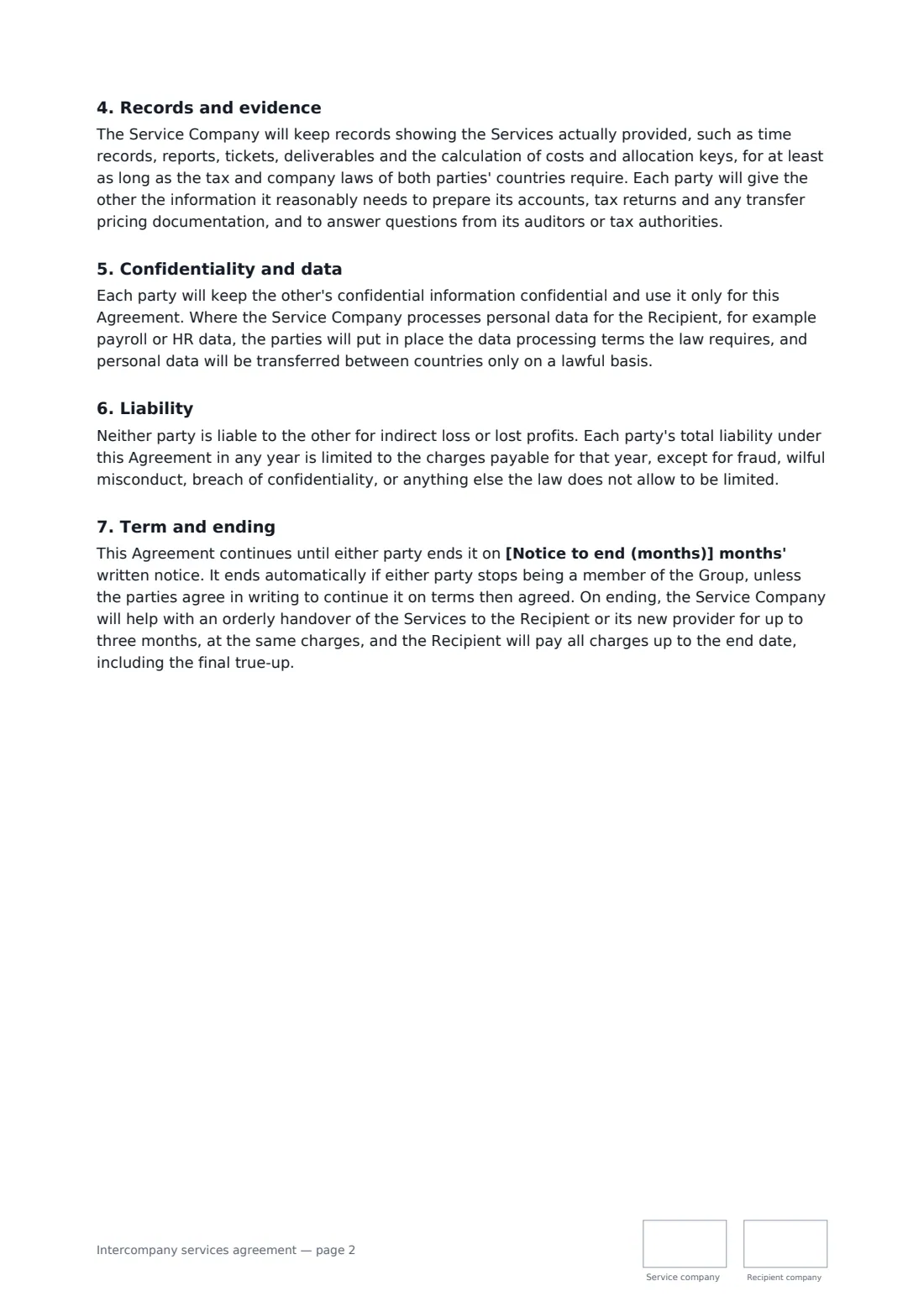
This template lists the services, any shareholder activities that are not charged, and the standard of service. You choose cost plus a markup, cost with no markup, or a fixed fee, and describe how shared costs are allocated, for example by headcount. It states the intention to follow the arm's length principle, makes clear the document does not settle tax treatment and that each company should take tax advice, and covers VAT and withholding tax, invoicing, an annual true-up of cost-based charges, records, confidentiality and data, a liability cap, notice, automatic ending if a company leaves the group and a handover period.
- Best for
- Groups with a parent or shared service company recharging subsidiaries
- Signed by
- An authorised signatory of each company
- Pricing options
- Cost plus markup, cost only, or fixed fee; annual true-up for cost-based charges
- Length
- About 3 pages, initialled on every page
When to use a intercompany services agreement
- A parent company recharging finance and payroll services to overseas subsidiaries
- A shared IT company supplying helpdesk and licences to sister companies
- A founder's holding company providing management services to an operating company
- A group formalising long-standing recharges before an audit or due diligence
- A newly acquired subsidiary moving onto group HR and finance systems
What you fill in
18 blanks, then the name and email of each person who signs: service company, recipient company.
1 The parties
- Date of this agreement*
- Services start (effective date)*
- Group name*
- Service company (legal name)*
- Service company registration number and address
- Recipient company (legal name)*
- Recipient registration number and address
2 The services
- Services provided*
- Activities not charged as services (optional)
3 Charges
- How services are charged* cost plus a markup · cost with no markup · a fixed fee
- Markup on cost (%)
- How shared costs are allocated
- Fixed fee
- Currency*
- Invoices* monthly · quarterly · every six months · annually
- Payment due within (days of invoice)*
4 Term and law
- Notice to end (months)*
- Governing law*
5 Who signs
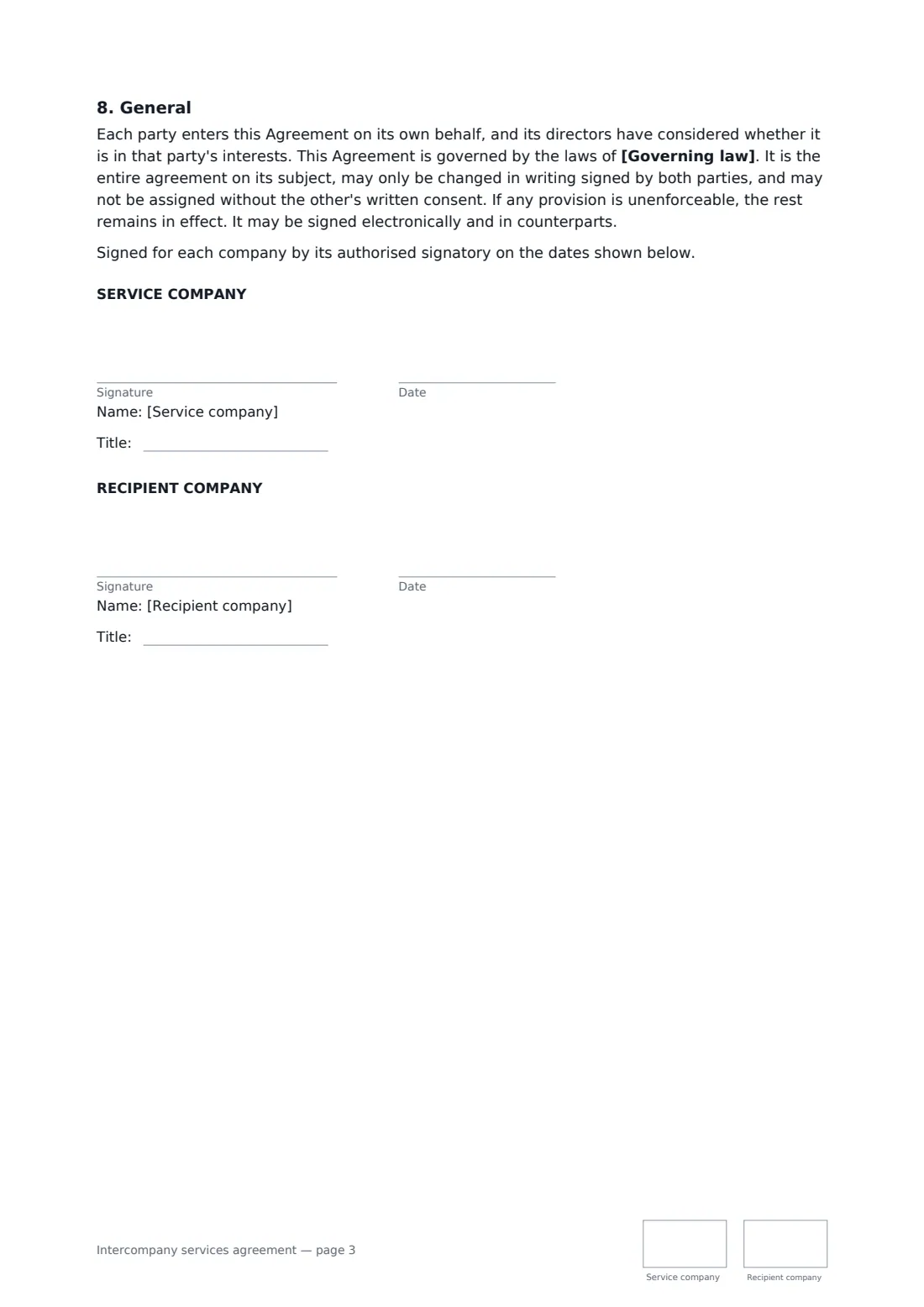
- Service company signature and date, job title, initials on every page · A director or authorised officer of the company providing the services.
- Recipient company signature and date, job title, initials on every page · A director or authorised officer of the company receiving them. Ideally a different person from the provider's signer.
What the intercompany services agreement covers
- Services
- Charges
- Invoices and payment
- Records and evidence
- Confidentiality and data
- Liability
- Term and ending
- General
Using the intercompany services agreement, step by step
1 Name the companies
Enter both companies' legal names, registration numbers and addresses, the group name and the date the services started.
2 Describe the services
List the services specifically and note any shareholder activities that are not charged.
3 Choose the pricing
Pick cost plus a markup, cost only, or a fixed fee. Enter the markup or fee and describe the allocation key for shared costs. Take tax advice on the method and percentage.
4 Set invoicing and sign
Choose the invoice frequency, payment term, notice period and governing law. Have an authorised signatory of each company sign, ideally different people.
Tips before you send it
- Transfer pricing rules differ between countries and can carry penalties. The template deliberately leaves the markup to you and your tax adviser.
- Keep evidence of the services: reports, tickets, time records. An agreement on its own rarely satisfies a tax authority.
- Only backdate the effective date if the services really did start then, and record the true start date.
- Check whether your services are subject to VAT or withholding tax across borders before the first invoice.
Sign it online in minutes
- Fill in the blanks. Names, dates and amounts go straight into the agreement — the preview shows exactly where.
- Name who signs. Tick “This is me” for your own part. FileIt builds the PDF with every signature, date and initials box on the right line, and you can check or move anything before sending.
- Send it. Each signer gets a secure link and signs from any device — no account needed. The signed PDF, with an audit trail and a Certificate of Completion, is filed in your vault and emailed to everyone.
Intercompany services agreement: frequently asked questions
What markup should we use?
There is no single answer. It depends on the services, the countries involved and their rules. Many groups take advice and benchmark routine services. The template lets you enter any markup, or none.
Does signing this agreement fix our tax position?
No. The template says expressly that it does not decide the tax treatment of the charges. It is evidence of what was agreed, which helps, but the pricing must also be supportable.
What is a true-up?
Where charges are based on cost, after each year end the service company compares what it invoiced with actual costs and issues a further invoice or a credit note for the difference.
What happens if one company is sold?
The agreement ends automatically when either company leaves the group, unless both agree to continue. The service company helps hand over the services for up to three months.