What is a hot work permit?
Hot work is a well-known cause of fires in workplaces and in buildings under construction or repair. Sparks travel, smoulder in hidden spaces and can start a fire hours after the welder has gone home. Fire codes and insurers commonly expect a written permit system: someone checks the area, the precautions are put in place, a fire watch stays behind, and the area is checked again later.
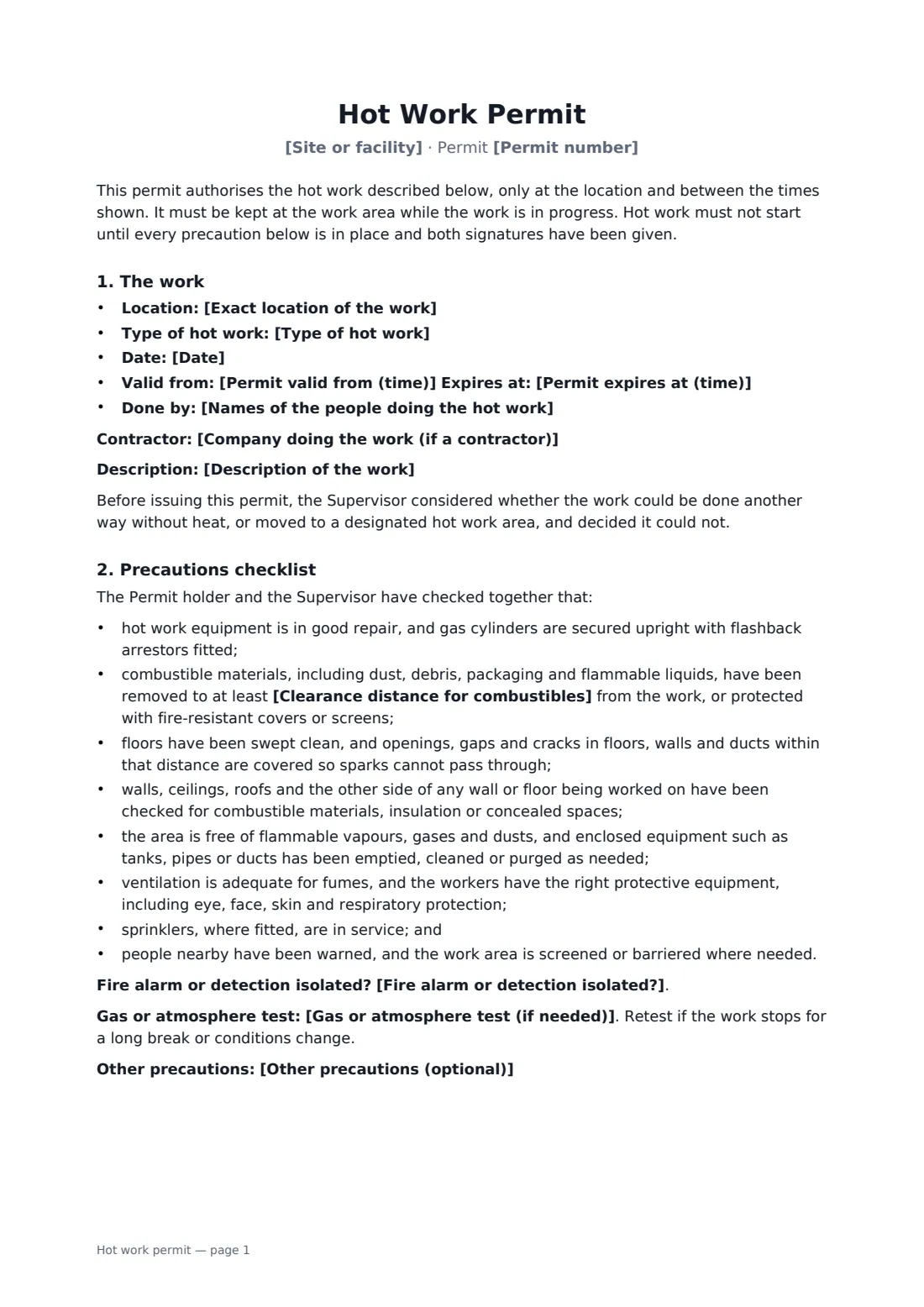
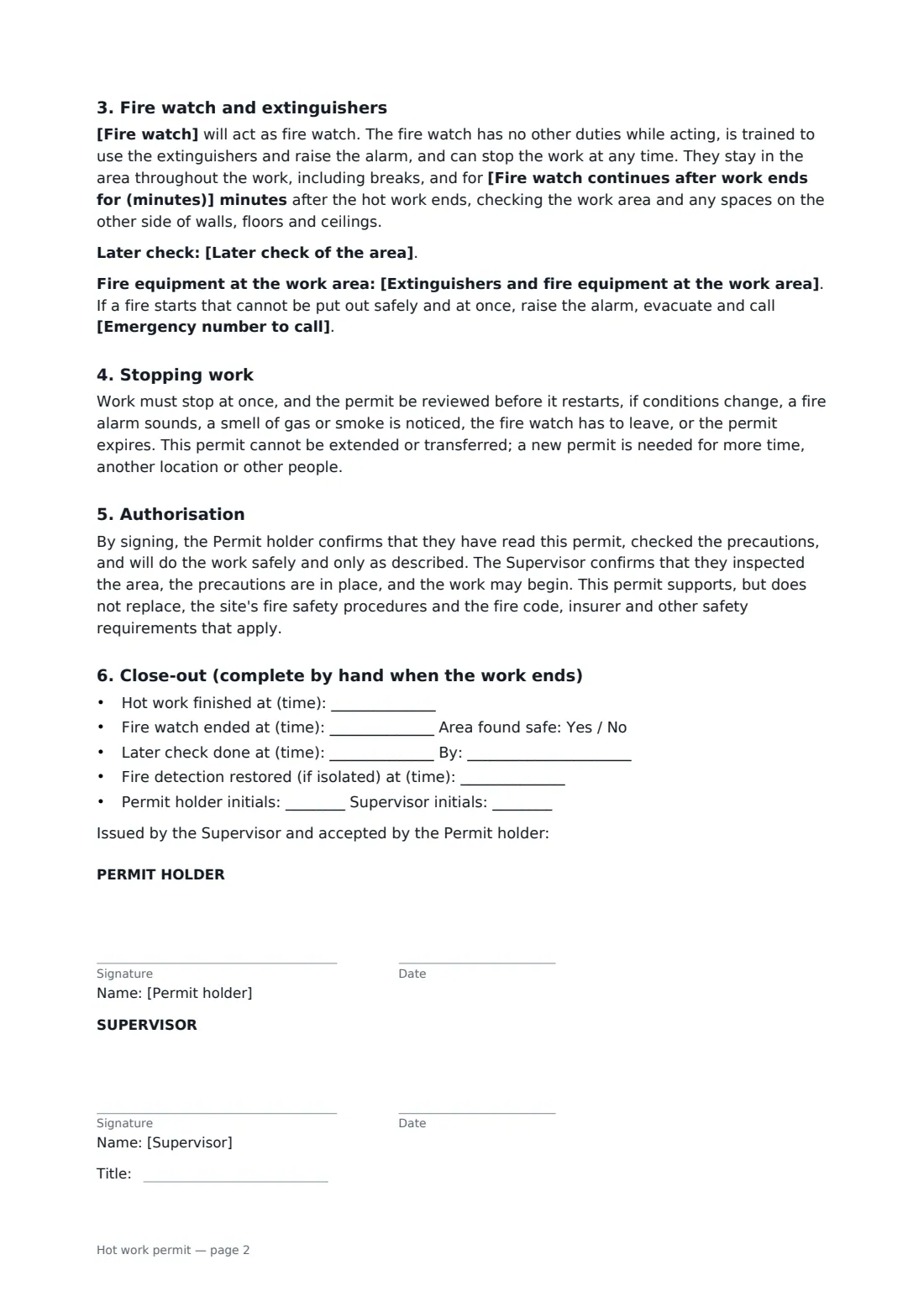
This permit records the exact location, type of hot work, description, the people and any contractor doing it, and the date and time window. It includes a precautions checklist covering equipment, combustibles cleared to the distance you set, openings covered, hidden spaces, flammable atmospheres, ventilation and protective equipment, sprinklers and warning people nearby; whether fire detection is isolated; an optional gas test; the named fire watch, how long they stay after work ends, and a later check; the fire equipment at the work area and the emergency number; when work must stop; and a close-out section completed by hand at the end.
- Best for
- Factories, warehouses, construction and refurbishment, facilities maintenance, roofing
- Signed by
- The permit holder and the site's authorising supervisor
- Valid for
- One location and one time window, usually a single shift
- Length
- 2 pages
When to use a hot work permit
- A contractor welding brackets in an occupied warehouse
- Maintenance staff cutting out a pipe section in a plant room
- Torch-applied roofing on a commercial building
- Grinding steelwork during a shop fit-out
- Brazing or soldering in a building with fire detection
What you fill in
19 blanks, then the name and email of each person who signs: permit holder, supervisor.
1 The work
- Site or facility*
- Permit number
- Exact location of the work*
- Type of hot work* Welding · Cutting (torch or plasma) · Grinding · Brazing or soldering · Torch-applied roofing · Thawing pipes with a torch · Several of these (see description)
- Description of the work*
- Company doing the work (if a contractor)
- Names of the people doing the hot work*
2 Time limits
- Date*
- Permit valid from (time)*
- Permit expires at (time)*
3 Fire watch
- Fire watch*
- Fire watch continues after work ends for (minutes)*
- Later check of the area
- Extinguishers and fire equipment at the work area*
4 Precautions
- Clearance distance for combustibles*
- Fire alarm or detection isolated?* No — detection stays live · Yes — detector heads isolated in the work zone only, and restored when the permit closes
- Gas or atmosphere test (if needed)
- Other precautions (optional)
- Emergency number to call*
5 Who signs
- Permit holder signature and date · The person doing, or in charge of, the hot work. If they work for a contractor, put the company in the work details.
- Supervisor signature and date, job title · The site's authorising person, who checks the area and the precautions before work starts.
What the hot work permit covers
- The work
- Precautions checklist
- Fire watch and extinguishers
- Stopping work
- Authorisation
- Close-out (complete by hand when the work ends)
Using the hot work permit, step by step
1 Describe the work
Enter the site, permit number, exact location, type of hot work, description, who is doing it and any contractor.
2 Set the time window
Enter the date and the times the permit is valid. Keep it to one shift; a new permit is needed for more time.
3 Name the fire watch
Name the fire watch, how many minutes they stay after work ends, any later check, the extinguishers at the work area and the emergency number.
4 Check the precautions
Enter the clearance distance for combustibles your fire code or insurer requires, whether detection is isolated, any gas test and other precautions. Walk the area together against the checklist.
5 Sign, work, close out
Both sign before work starts. Print the permit for the work area, and complete the close-out by hand when the fire watch ends.
Tips before you send it
- Ask first whether the job can be done without heat, or moved to a designated hot work area. The permit records that this was considered.
- Check the other side of walls, floors and ceilings. Many hot work fires start where no one was looking.
- Use the fire watch period and clearance distance your fire code or insurer sets. They differ, so the template leaves them as blanks.
- If detectors are isolated, restore them as soon as the permit closes, and record the time.
Sign it online in minutes
- Fill in the blanks. Names, dates and amounts go straight into the agreement — the preview shows exactly where.
- Name who signs. Tick “This is me” for your own part. FileIt builds the PDF with every signature, date box on the right line, and you can check or move anything before sending.
- Send it. Each signer gets a secure link and signs from any device — no account needed. The signed PDF, with an audit trail and a Certificate of Completion, is filed in your vault and emailed to everyone.
Hot work permit: frequently asked questions
What counts as hot work?
Any work with flames, sparks or heat that could ignite something: welding, torch or plasma cutting, grinding, brazing, soldering, torch-applied roofing and thawing pipes with a torch.
How long must the fire watch stay?
You set the time after work ends, as your fire code, insurer or site rules require, and can add a later check of the area. The fire watch has no other duties and can stop the work at any time.
Can a permit be extended?
No. The permit can't be extended or transferred. A new permit is needed for more time, another location or other people.
Why sign electronically if it's kept at the work area?
Signing online records who issued and accepted the permit and when. Print the signed PDF for the work area and complete the close-out on it; the signed original stays in your vault.