What is a family charter?
A family charter, sometimes called a family constitution, is a short statement a family writes for itself. It says what the family values and how it makes decisions together. Families with a business, a shared holiday home or investments use one to keep things fair as children grow up, marry and have children of their own. Families without any shared assets use one too, simply to stay close as everyone spreads out.
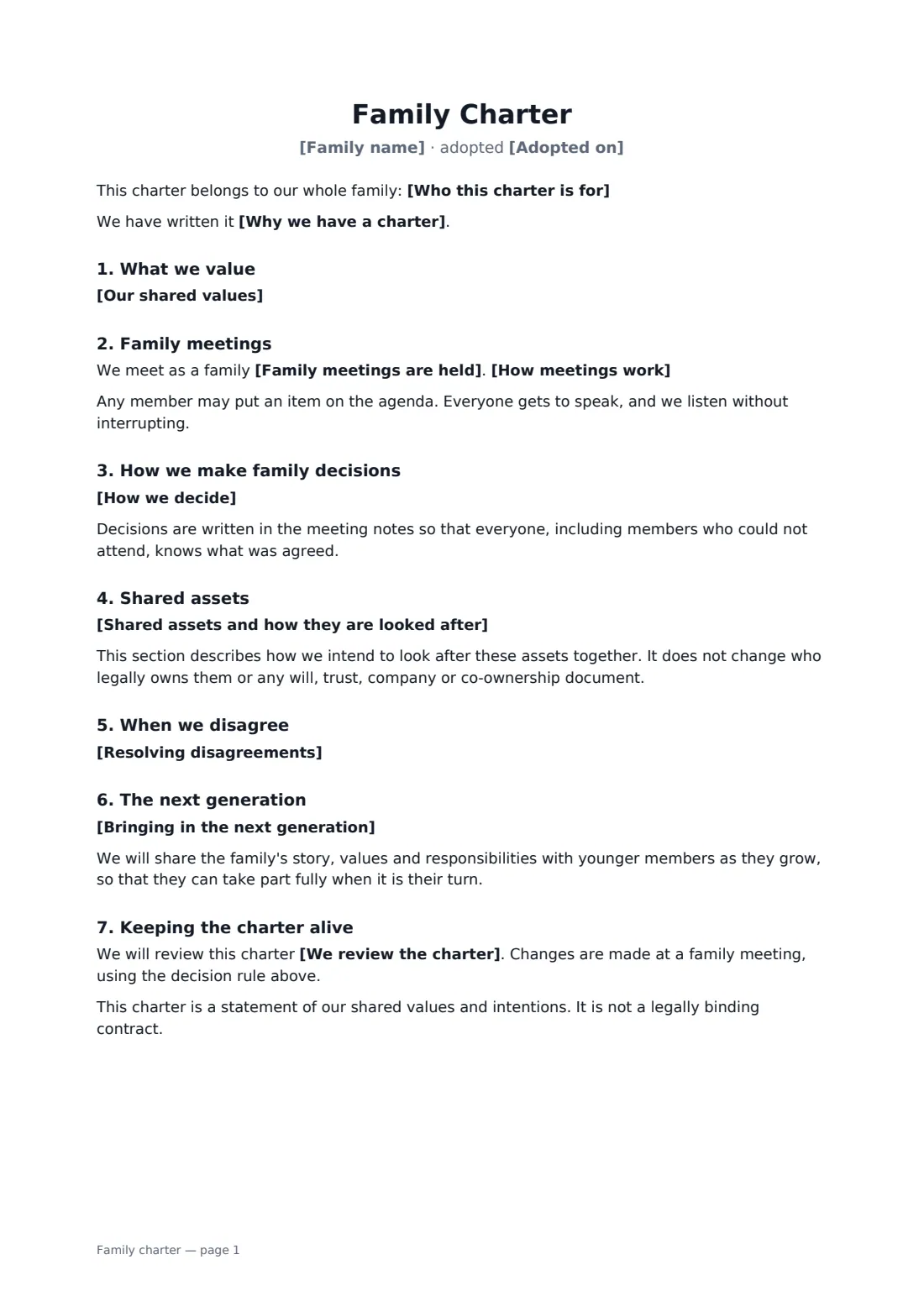
This template covers why you have a charter, your shared values in your own words, how often family meetings are held and how they run, how decisions are made (agreement, majority, the founding generation, or one vote per branch), shared assets and how they are looked after, how disagreements are resolved, how younger members are brought in, and how often the charter is reviewed. It says clearly that it is a statement of values, not a legal contract, and that it doesn't change who owns anything.
- Best for
- Families with shared property, a family business, or simply a wish to stay close
- Signed by
- Adult family members
- Decision rules
- Agreement, majority, founding generation or one vote per branch
- Length
- About 2 pages
When to use a family charter
- Siblings who have inherited a holiday home and need a fair way to share it
- A family business preparing for the next generation to get involved
- Grandparents who want to pass on the family's values, not only its savings
- Setting up regular family meetings after years of decisions made by one person
- Agreeing how to handle disagreements before they become a rift
What you fill in
12 blanks, then the name and email of each person who signs: family member, other family member.
1 Our family
- Family name*
- Who this charter is for*
- Adopted on*
- Why we have a charter
2 Values
- Our shared values*
3 Family meetings
- Family meetings are held* every month · every quarter · twice a year · once a year
- How meetings work*
- How we decide* We aim for agreement. If we can't reach it, adult members decide by a majority vote. · Decisions need the agreement of every adult member. · The founding generation decides after hearing everyone's views. · Each branch of the family has one vote.
4 Shared assets
- Shared assets and how they are looked after
5 Disagreements
- Resolving disagreements*
6 Next generation
- Bringing in the next generation
- We review the charter*
7 Who signs
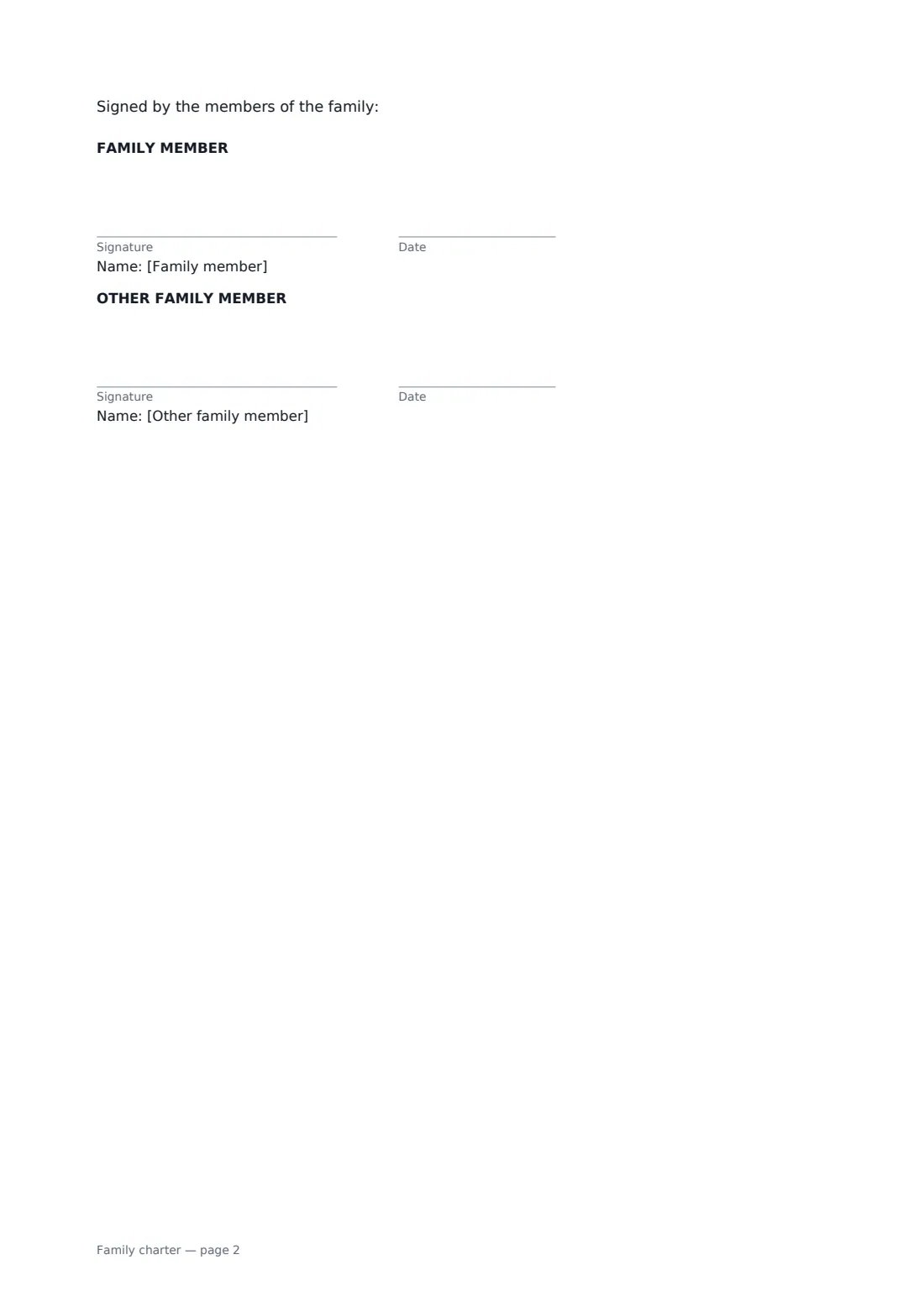
- Family member signature and date · The family member who prepared the charter and sends it round.
- Other family member signature and date · Add every adult family member who should sign as an extra signer in the editor, or send one copy to each.
What the family charter covers
- What we value
- Family meetings
- How we make family decisions
- Shared assets
- When we disagree
- The next generation
- Keeping the charter alive
Using the family charter, step by step
1 Say who it's for and why
List the family members the charter covers, including partners if you want to include them, and write a line on why you are doing this. Keep it in your family's voice.
2 Write your values
Pick a handful of values and add a sentence on what each looks like in practice. "Honesty, even when it's hard" means more than "honesty". This is the part people remember.
3 Agree meetings and decisions
Choose how often you meet, describe how meetings run (in person or on video, who chairs, how notes are shared) and pick a decision rule. Then describe any shared assets and how you look after them together.
4 Plan for disagreements and the next generation, then sign
Edit the default steps for resolving disagreements, say when children join meetings or get a vote, and set how often you review the charter. Add each adult as a signer in the editor and everyone signs online.
Tips before you send it
- Write it together at a family meeting, not alone. Ownership matters more than polish.
- Keep it short enough to read aloud. A charter nobody reads doesn't help.
- The charter describes intentions. Wills, trusts, company documents and deeds still decide who owns what, so keep them in step with it.
- Rotate who chairs meetings so the younger generation gets practice.
- Store the signed copy where everyone can find it. FileIt keeps it in your vault with the other family documents.
Sign it online in minutes
- Fill in the blanks. Names, dates and amounts go straight into the agreement — the preview shows exactly where.
- Name who signs. Tick “This is me” for your own part. FileIt builds the PDF with every signature, date box on the right line, and you can check or move anything before sending.
- Send it. Each signer gets a secure link and signs from any device — no account needed. The signed PDF, with an audit trail and a Certificate of Completion, is filed in your vault and emailed to everyone.
Family charter: frequently asked questions
What is the difference between a family charter and a family constitution?
They are names for the same idea. Wealthier families with a business often say constitution, and the document can be longer and more formal. This template keeps it to a plain-language charter any family can use.
Is a family charter legally binding?
No, and this one says so. It sets out shared values and intentions. To make a binding arrangement for shared property or a business, you need the right legal documents, such as a co-ownership or shareholders' agreement.
Who should sign it?
Usually every adult family member it covers. Add each one as a signer in the eSignature editor, or send each a separate copy.
How often should we review it?
Every few years, and whenever the family changes in a big way, such as a marriage, a death or the sale of a shared asset. The template has a review clause.
Is this template free?
Yes. It is free with the eSignature app in FileIt, and family members don't need a FileIt account to sign.