What is a earn-out agreement?
An earn-out lets a buyer and seller agree a price when they disagree about what the business will earn. Part of the price is paid at completion and part later, only if the business hits agreed targets. Earn-outs are also a common source of disputes: the seller no longer controls the business, and the buyer controls the accounts that decide the payment. Most of those disputes come back to a vague metric, unclear accounting or a buyer who changed how the business was run.
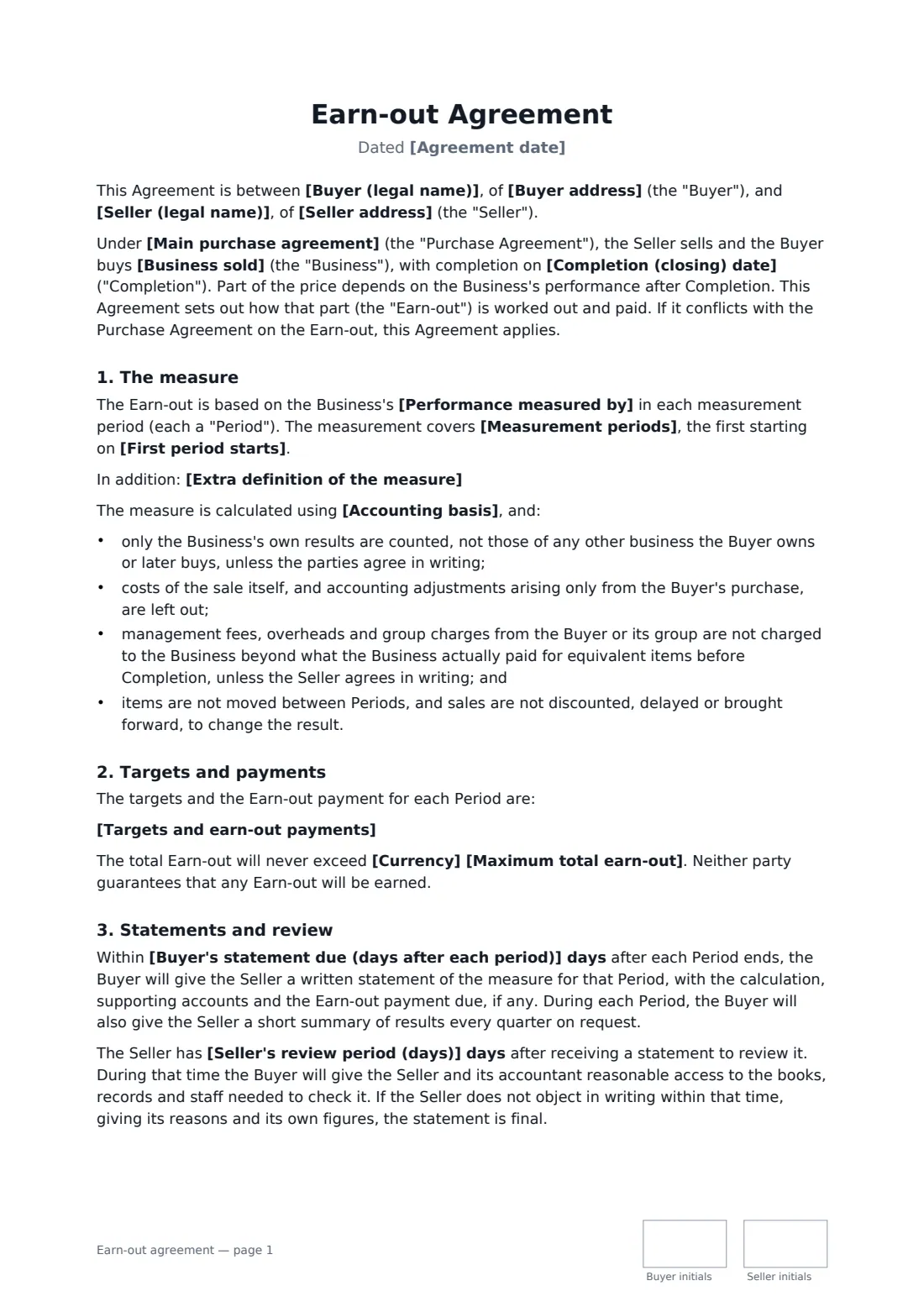
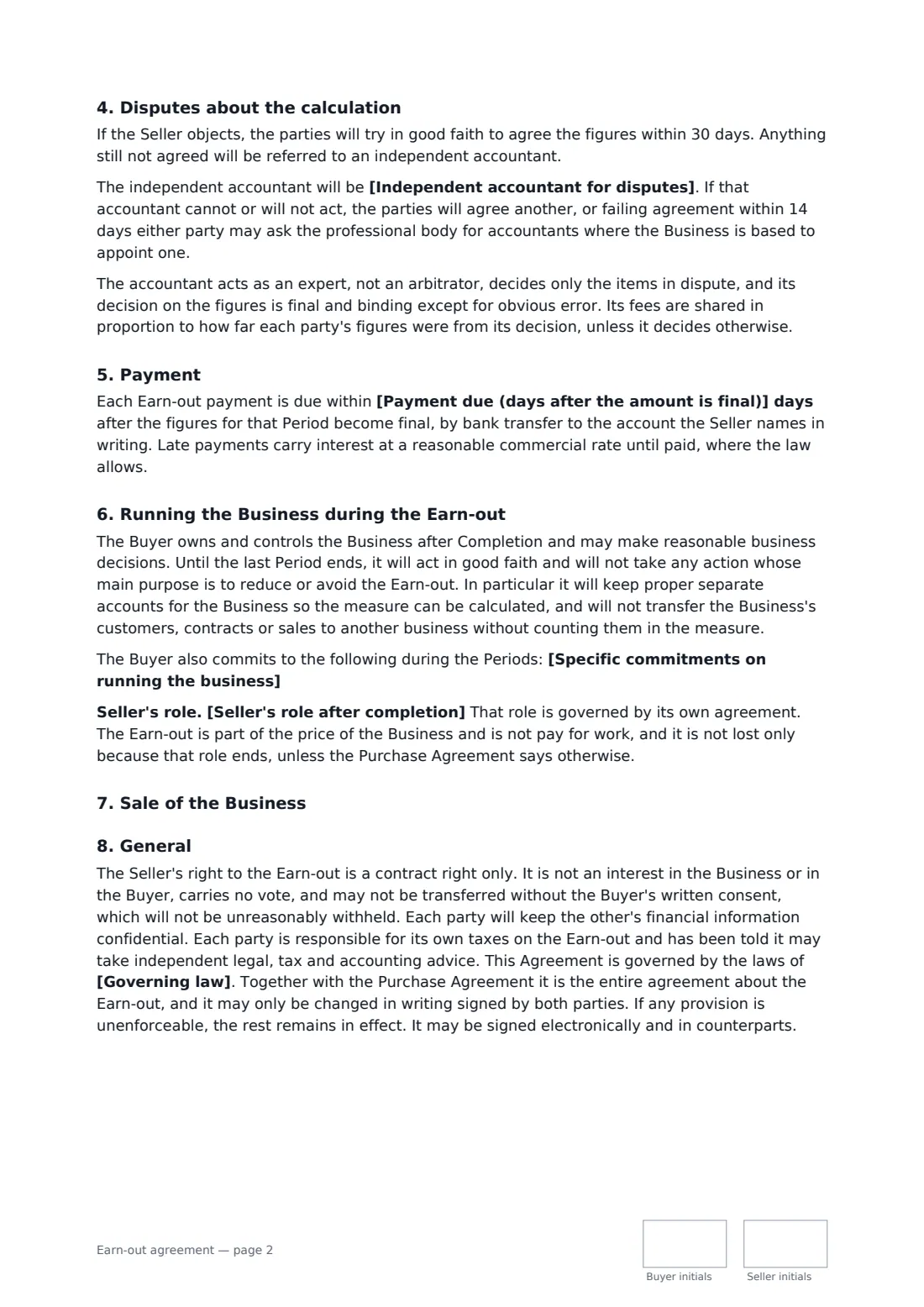
This template sits alongside your main purchase agreement. You choose revenue, gross profit or EBITDA, the number of 12-month periods, the targets and payments, all-or-nothing or proportional payment above a floor, an optional catch-up, and a cap. Standard rules keep the measure clean: no other group businesses, no deal costs or purchase accounting, no extra group overheads, no shifting sales between periods. It sets deadlines for the buyer's statement and the seller's review, sends disputes about figures to an independent accountant, and covers payment, set-off, a good-faith duty on the buyer with optional specific commitments, the seller's role, and what happens if the buyer sells the business.
- Best for
- Small business sales where part of the price depends on future results
- Signed by
- The buyer and the seller
- Measures
- Revenue, gross profit or EBITDA over 1 to 3 annual periods
- Length
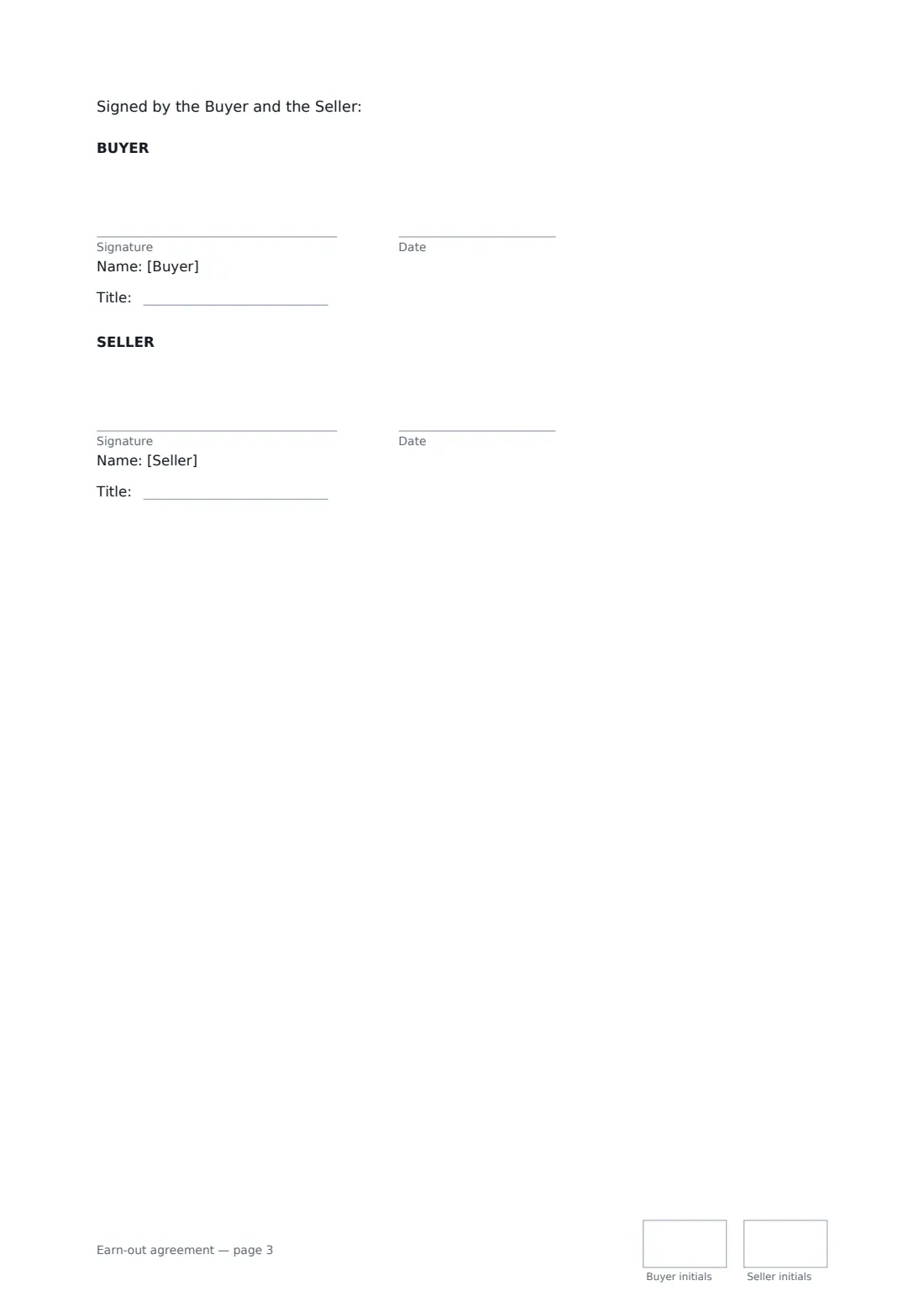
- 3 pages, initialled by both on every page
When to use a earn-out agreement
- Selling a bakery, salon or agency where the buyer won't pay full price for forecast growth
- A buyer keeping the founder on as manager, with part of the price earned over two years
- Buying a customer book where the price depends on how much revenue it keeps producing
- A seller accepting a lower upfront price in exchange for a capped earn-out
- A management buy-out paying the outgoing owner partly from future revenue
What you fill in
28 blanks, then the name and email of each person who signs: buyer, seller.
1 The deal
- Agreement date*
- Buyer (legal name)*
- Buyer address
- Seller (legal name)*
- Seller address
- Business sold*
- Main purchase agreement*
- Completion (closing) date*
2 The measure
- Performance measured by* Revenue · Gross profit · EBITDA
- Extra definition of the measure
- Accounting basis*
- Measurement periods* one 12-month period · two consecutive 12-month periods · three consecutive 12-month periods
- First period starts*
3 The payments
- Targets and earn-out payments*
- Currency*
- If a target is only partly met* Nothing is paid for that period. · A proportional amount is paid, as long as the floor below is reached.
- Floor for a proportional payment
- Shortfall made up in a later period?* No · Yes
- Maximum total earn-out*
4 Process
- Buyer's statement due (days after each period)*
- Seller's review period (days)*
- Payment due (days after the amount is final)*
- Independent accountant for disputes
- Specific commitments on running the business
- Seller's role after completion
- If the buyer sells the business during the earn-out* The unpaid maximum earn-out becomes payable. · The new owner must take on this Agreement.
- Can the buyer set off claims against earn-out payments?* Only amounts agreed or finally decided · No set-off
- Governing law*
5 Who signs
- Buyer signature and date, job title, initials on every page · A person authorised to sign for the buyer.
- Seller signature and date, job title, initials on every page · The seller, or a person authorised to sign for a selling company.
What the earn-out agreement covers
- The measure
- Targets and payments
- Statements and review
- Disputes about the calculation
- Payment
- Running the Business during the Earn-out
- Sale of the Business
- General
Using the earn-out agreement, step by step
1 Link it to the purchase agreement
Name the main purchase agreement, the business sold and the completion date. On the earn-out, this agreement takes priority.
2 Choose the measure and periods
Pick revenue, gross profit or EBITDA, add any extra definition, and set the accounting basis and when the first period starts.
3 Set targets and payments
Write one line per period with its target and payment, choose all-or-nothing or proportional above a floor, decide on catch-up and set the cap.
4 Agree the process and sign
Set the deadlines for statements, review and payment, any commitments on running the business and what happens on a sale, then send it to the seller.
Tips before you send it
- Revenue is the easiest measure to check and the hardest to manipulate. Profit measures need clear rules on which costs count.
- Write targets with worked examples in your notes so both sides read them the same way.
- Name the independent accountant now if you can — it is much harder to agree one in the middle of a dispute.
- Each side should get its own tax and accounting advice: how an earn-out is taxed depends on where you are and how it's structured.
Sign it online in minutes
- Fill in the blanks. Names, dates and amounts go straight into the agreement — the preview shows exactly where.
- Name who signs. Tick “This is me” for your own part. FileIt builds the PDF with every signature, date and initials box on the right line, and you can check or move anything before sending.
- Send it. Each signer gets a secure link and signs from any device — no account needed. The signed PDF, with an audit trail and a Certificate of Completion, is filed in your vault and emailed to everyone.
Earn-out agreement: frequently asked questions
What happens if the target is only nearly met?
You choose. Either nothing is paid for that period, or a proportional amount is paid as long as the result reaches a floor you set, such as 80% of the target.
Can the buyer run the business in a way that avoids the earn-out?
The buyer controls the business but must act in good faith and not take steps mainly to reduce the earn-out, keep separate accounts, and not move the business's customers or sales elsewhere. You can add specific commitments, such as keeping shops open.
Who decides if we disagree about the figures?
After 30 days of trying to agree, the disputed items go to an independent accountant acting as an expert, whose decision on the figures is final except for obvious error.
Is an earn-out guaranteed?
No. The agreement says plainly that neither party guarantees any earn-out will be earned. If the buyer sells the business during the earn-out, you can choose whether the maximum becomes payable or the new owner takes over the agreement.
Can it be signed electronically?
In most countries, including the US (ESIGN Act and UETA), the UK, the EU (eIDAS) and Canada, an electronic signature is generally valid for an agreement like this one. FileIt keeps an audit trail and a Certificate of Completion with the signed PDF as evidence of who signed and when.