What is a crop purchase agreement?
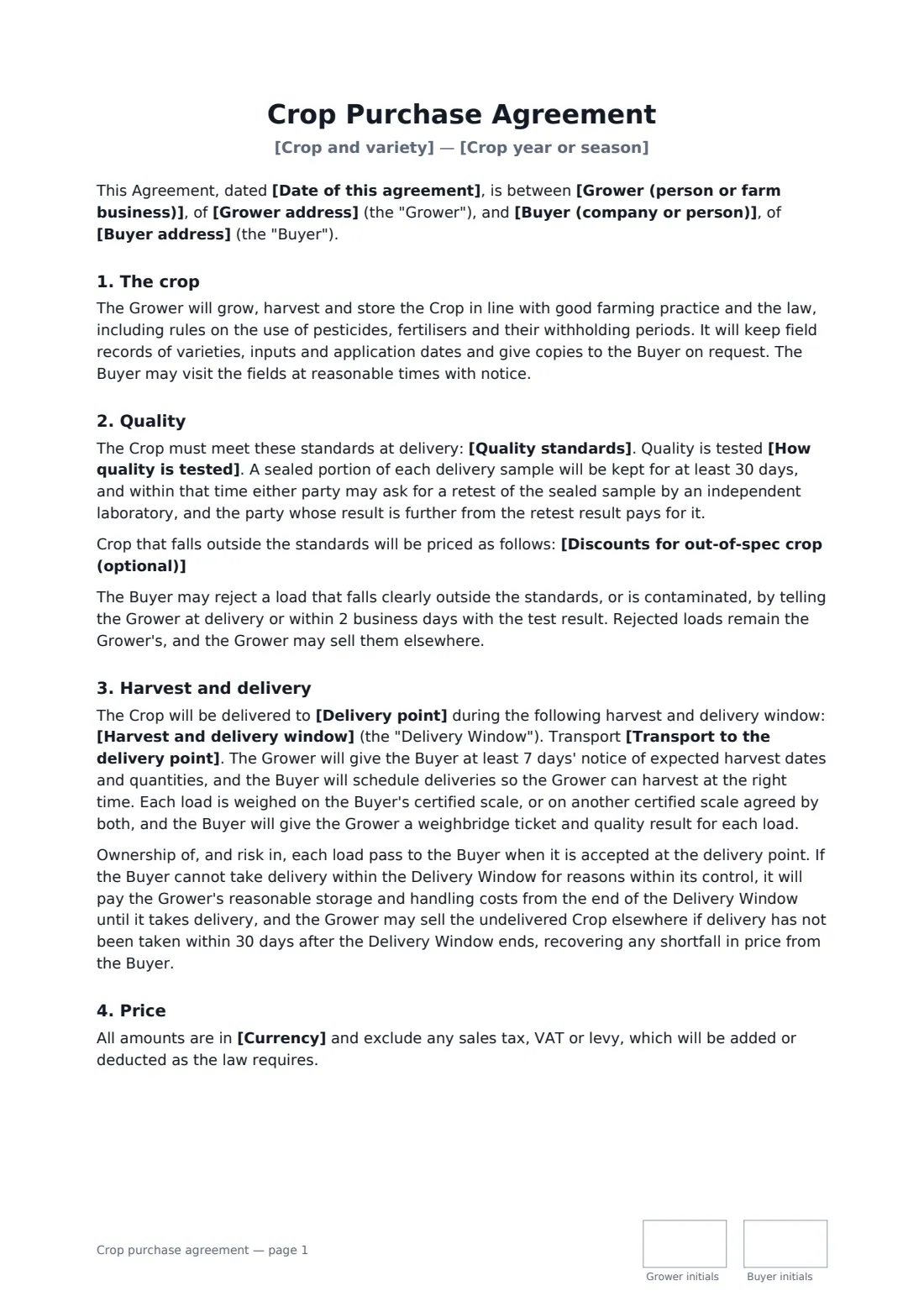
Selling a crop before it is grown gives a farmer a secure market and a buyer a reliable supply, whether it is malting barley for a brewery, potatoes for a processor, apples for a cider maker or vegetables for a box scheme. Forward contracts like this go wrong in predictable ways: disagreements over moisture readings and grading, a buyer who cannot take delivery at harvest, a price source nobody can find, or a drought that leaves the grower short.
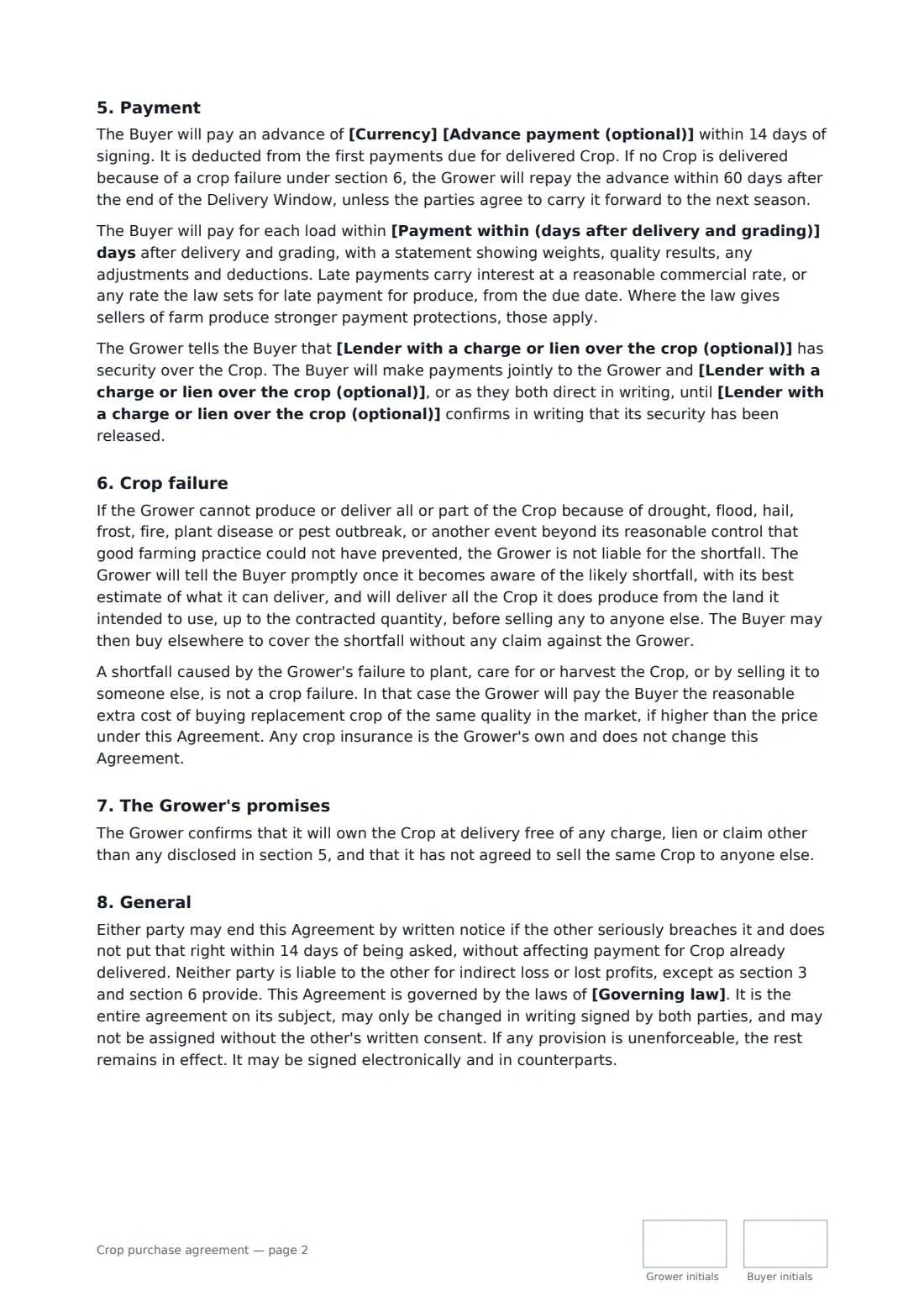
This template lets you buy a fixed quantity with a tolerance, or the entire production of named fields. It sets quality standards and how they are tested, with a sealed sample kept for 30 days and an independent retest, optional discounts for out-of-spec crop and a right to reject. You choose a fixed price per unit or a formula based on a published price, with an optional advance. Delivery windows, notice of harvest, certified weighing and storage costs if the buyer is late are covered, along with payment terms, joint payment where a lender has security over the crop, and a crop failure clause that excuses genuine weather and disease losses but not neglect or sales elsewhere.
- Best for
- Grain, oilseeds, potatoes, fruit, vegetables, hops and other field crops
- Signed by
- The grower and the buyer
- Pricing
- Fixed price per unit or a formula based on a published price
- Length
- About 3 pages, initialled on every page
When to use a crop purchase agreement
- A craft maltster contracting barley from local farms a season ahead
- A food processor buying the entire production of a grower's potato fields
- A cider maker agreeing apple tonnage and sugar levels with an orchard
- A brewery buying hops from a small grower on a formula price
- A farm shop or box scheme securing vegetables from a neighbouring grower
What you fill in
26 blanks, then the name and email of each person who signs: grower, buyer.
1 The parties
- Date of this agreement*
- Grower (person or farm business)*
- Grower address
- Buyer (company or person)*
- Buyer address
2 The crop
- Crop and variety*
- Crop year or season*
- What the buyer is buying* a fixed quantity · the entire production of the acreage below
- Quantity
- Unit*
- Quantity tolerance (+/- %)
- Acreage or field(s)
3 Quality
- Quality standards*
- How quality is tested* by the Buyer, from samples taken at delivery in the Grower's presence or with a sealed sample kept for the Grower · by an independent laboratory agreed by both parties, from samples taken at delivery
- Discounts for out-of-spec crop (optional)
4 Price and payment
- Price* a fixed price · a pricing formula
- Currency*
- Fixed price per unit
- Pricing formula
- Advance payment (optional)
- Payment within (days after delivery and grading)*
- Lender with a charge or lien over the crop (optional)
5 Delivery
- Harvest and delivery window*
- Delivery point*
- Transport to the delivery point* is arranged and paid for by the Grower · is arranged and paid for by the Buyer, collecting from the farm
- Governing law*
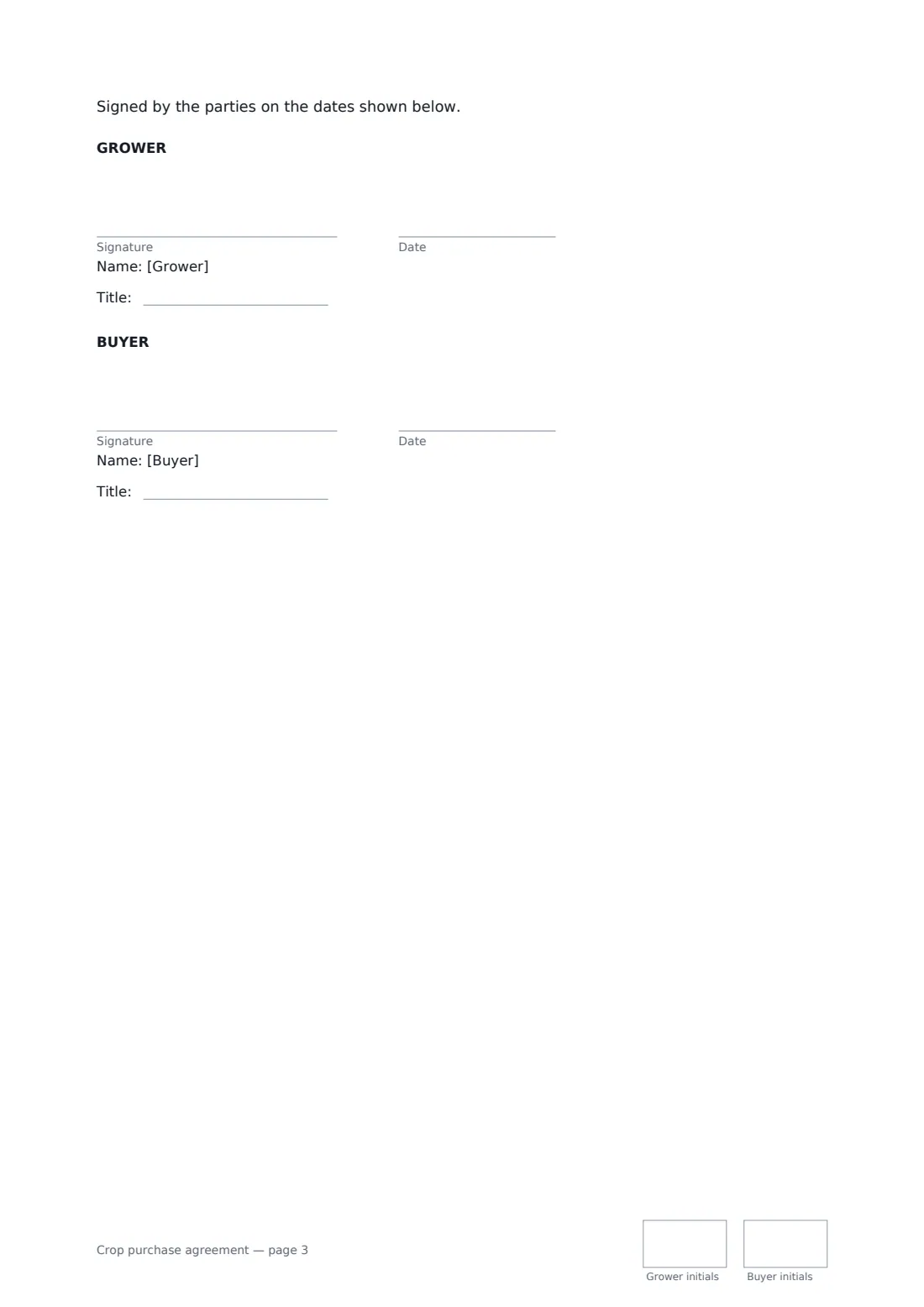
6 Who signs
- Grower signature and date, job title, initials on every page · The farmer or farm business growing the crop.
- Buyer signature and date, job title, initials on every page
What the crop purchase agreement covers
- The crop
- Quality
- Harvest and delivery
- Price
- Payment
- Crop failure
- The Grower's promises
- General
Using the crop purchase agreement, step by step
1 Describe the crop
Enter the crop and variety, the season, and whether the buyer takes a fixed quantity or everything grown on named fields. Add the tolerance and the acreage.
2 Set quality and testing
List the standards that matter, such as moisture, protein, size or freedom from defects, choose how they are tested and add any discount schedule.
3 Agree price and payment
Choose a fixed price per unit or describe a pricing formula, add any advance and the payment period, and name any lender with security over the crop.
4 Plan delivery and sign
Enter the delivery window and point and who arranges transport, set the governing law and send for signature.
Tips before you send it
- Name a price source both of you can check, and agree in advance what happens if it stops being published. The template commits you to agree the nearest equivalent.
- Some countries have laws that protect sellers of farm produce, such as payment deadlines or trust rules. Where they give stronger protection, they apply.
- If your bank has security over your crops, tell the buyer. The template makes payments joint until the lender releases its security.
- Keep your field records and weighbridge tickets together. They settle most disputes about quantity and quality.
Sign it online in minutes
- Fill in the blanks. Names, dates and amounts go straight into the agreement — the preview shows exactly where.
- Name who signs. Tick “This is me” for your own part. FileIt builds the PDF with every signature, date and initials box on the right line, and you can check or move anything before sending.
- Send it. Each signer gets a secure link and signs from any device — no account needed. The signed PDF, with an audit trail and a Certificate of Completion, is filed in your vault and emailed to everyone.
Crop purchase agreement: frequently asked questions
What happens if drought or hail ruins the crop?
The grower is not liable for a shortfall caused by weather, disease, pests or other events beyond its control that good farming practice could not prevent. It must warn the buyer, deliver what it produces first, and the buyer can buy elsewhere.
What if the grower sells the crop to someone else?
That is not a crop failure. The grower must pay the buyer's reasonable extra cost of buying replacement crop of the same quality.
Who decides whether the crop meets the standard?
Either the buyer from samples at delivery, with a sealed sample kept, or an independent laboratory. Either side can ask for an independent retest, and the side whose result was further off pays for it.
What if the buyer cannot take delivery at harvest?
It pays the grower's reasonable storage and handling costs. If it still has not taken delivery 30 days after the window, the grower may sell elsewhere and recover any price shortfall.