What is a client list purchase agreement?
When a bookkeeper retires, a stylist moves away or an insurance agent winds down, their most valuable asset is often the client book. Selling it to a trusted practitioner keeps clients looked after and gives the seller a fair return. The hard part is that clients are free to leave: a buyer does not want to pay full price for clients who walk in the first month, and a seller does not want to be penalised for things the buyer does.
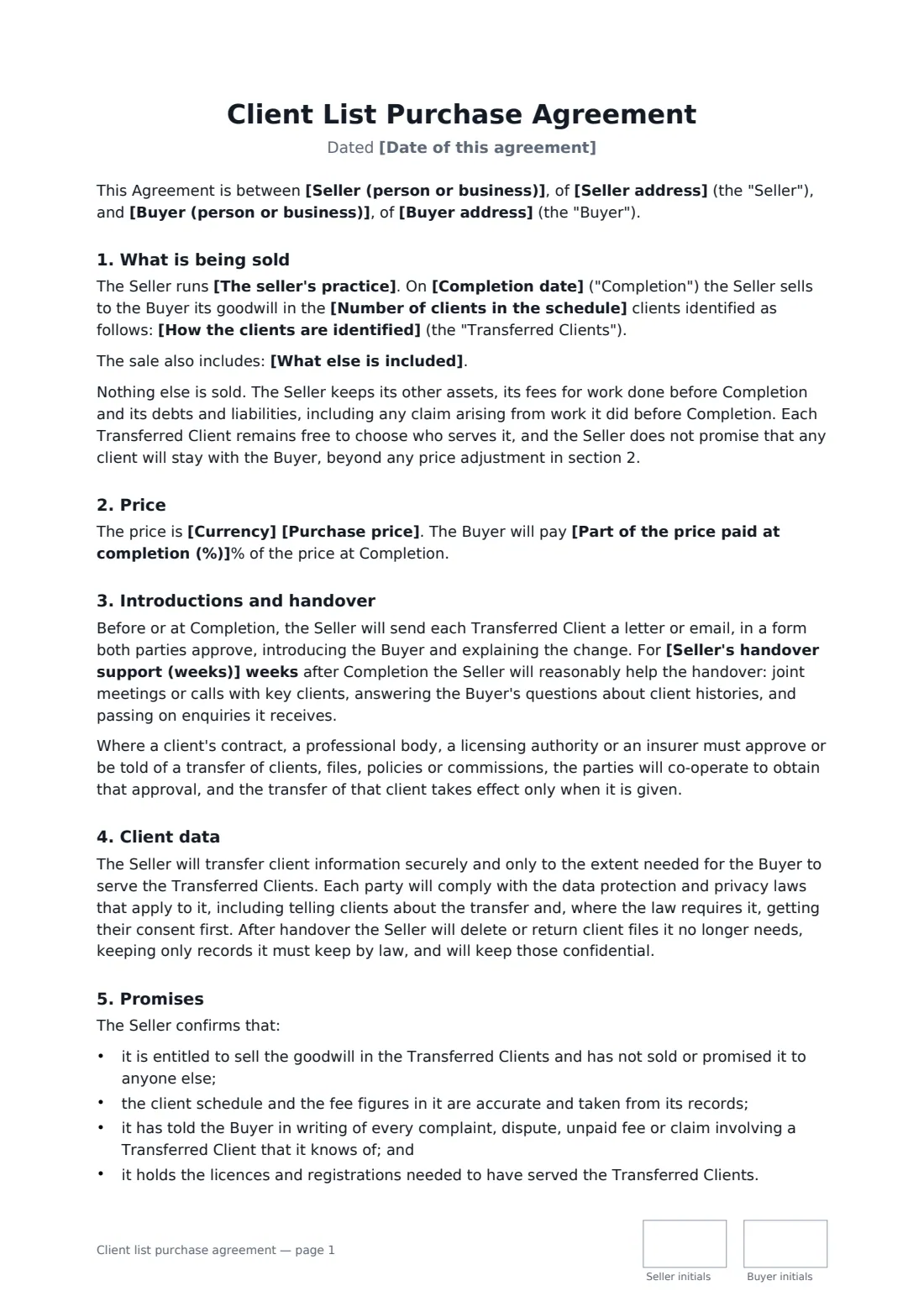
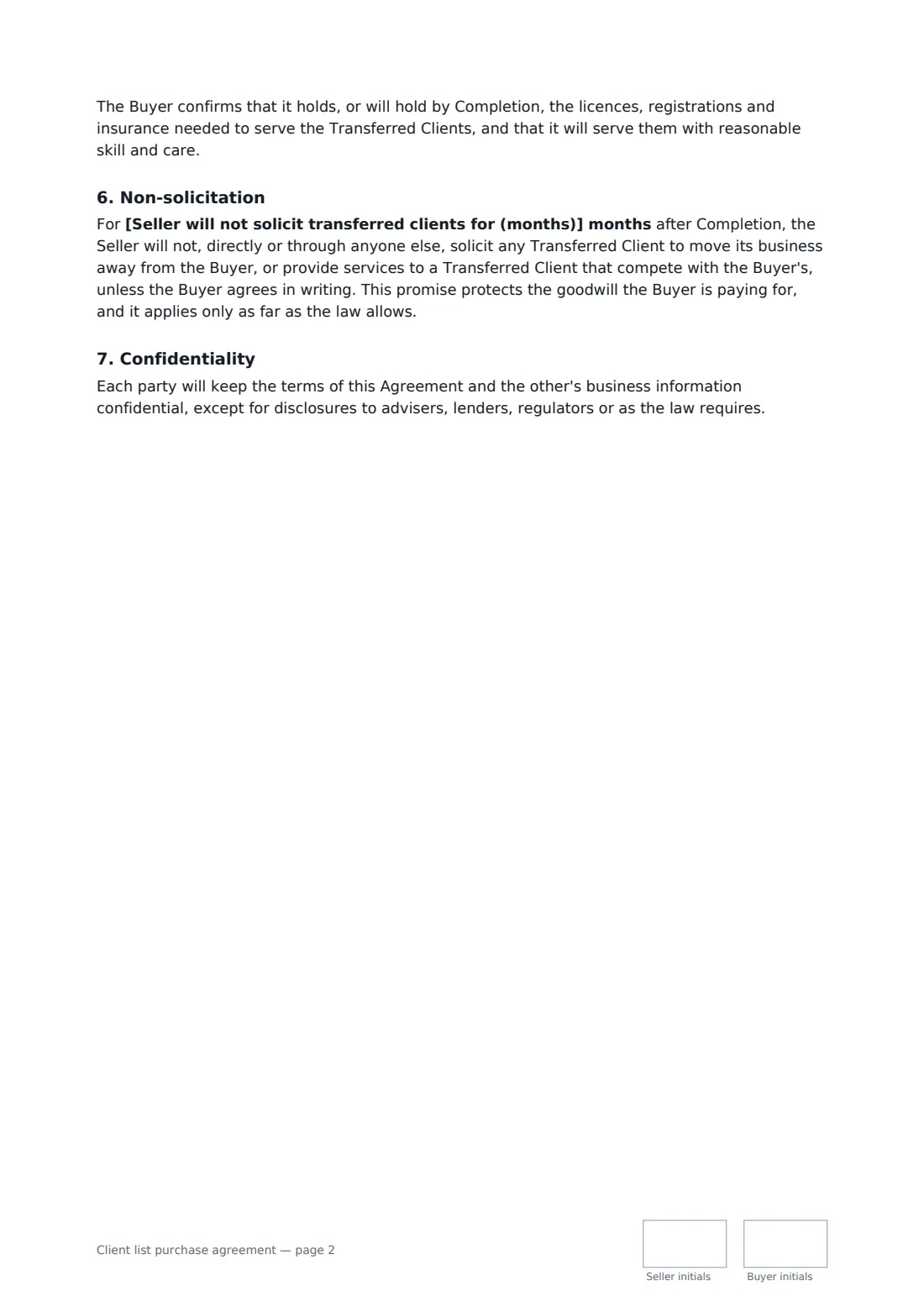
This template sells the goodwill in a scheduled list of clients, plus any files, phone numbers or other items you name, on a completion date. You set the price and how much is paid up front. With the retention option on, the balance is adjusted at the end of a retention period by the same percentage as any shortfall in fees against a baseline, with protection for the seller if the buyer raises prices or drops services. It also covers joint introduction letters, a handover period, approvals from clients, regulators or insurers where needed, secure transfer and deletion of client data, both sides' promises, including the seller's about the list, and a non-solicitation period.
- Best for
- Bookkeepers, accountants, stylists, therapists, insurance agents and other client-based practices
- Signed by
- The seller and the buyer
- Price options
- Paid in full, or part up front with a retention-based adjustment to the balance
- Length
- About 3 pages, initialled on every page, plus your client schedule
When to use a client list purchase agreement
- A retiring bookkeeper selling her client book to a local firm
- A hairdresser leaving town and introducing her regulars to another stylist
- An insurance agent selling renewals to a colleague, subject to insurer approval
- A personal trainer handing over clients when moving into a salaried role
- A consultant selling one service line while keeping the rest of the practice
What you fill in
20 blanks, then the name and email of each person who signs: seller, buyer.
1 The parties
- Date of this agreement*
- Seller (person or business)*
- Seller address
- Buyer (person or business)*
- Buyer address
2 The clients
- The seller's practice*
- Number of clients in the schedule*
- How the clients are identified*
- What else is included
3 The deal
- Completion date*
4 Price
- Currency*
- Purchase price*
- Part of the price paid at completion (%)*
- Adjust the balance for clients who leave?* Yes · No
- Retention period (months after completion)
- Baseline fees
- Balance paid within (days after the retention period or completion)*
5 Handover
- Seller's handover support (weeks)*
- Seller will not solicit transferred clients for (months)*
- Governing law*
6 Who signs
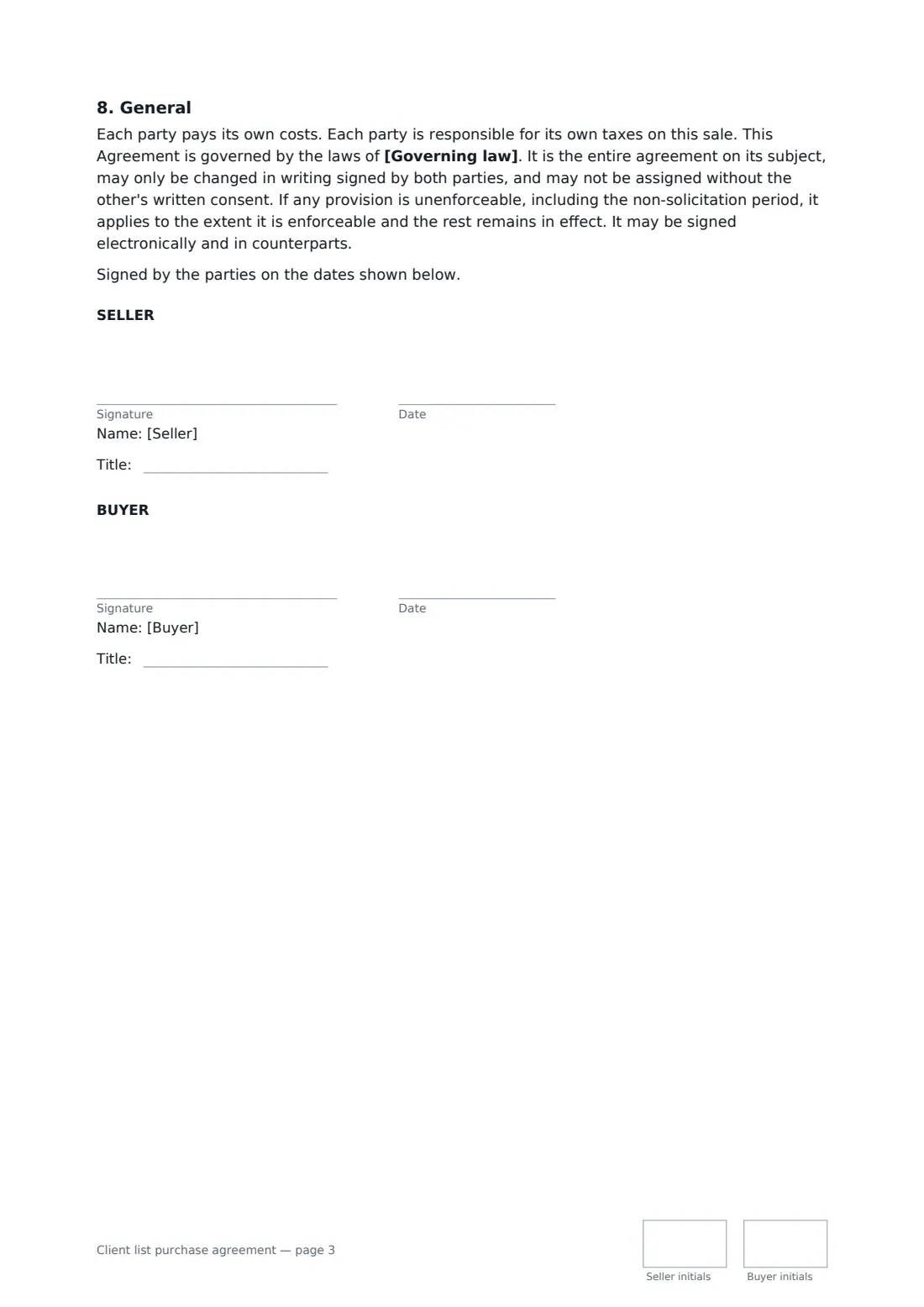
- Seller signature and date, job title, initials on every page · The practitioner or business selling its clients.
- Buyer signature and date, job title, initials on every page · The practitioner or business taking the clients over.
What the client list purchase agreement covers
- What is being sold
- Price
- Introductions and handover
- Client data
- Promises
- Non-solicitation
- Confidentiality
- General
Using the client list purchase agreement, step by step
1 Describe the practice and the clients
Describe the seller's practice, the number of clients and how they are identified. Keep the names on a separate schedule that both of you initial, and list what else transfers, such as files or the business phone number.
2 Set the price and retention terms
Enter the price and the percentage paid at completion. With the retention option, set the period and the baseline fees from the schedule. The balance drops by the same percentage as any shortfall.
3 Plan the handover
Choose how many weeks the seller helps after completion and how long the seller will not solicit the transferred clients.
4 Sign and file
Set the governing law and send for signature. Both parties initial every page. Keep the signed schedule with the agreement in your vault.
Tips before you send it
- Base the baseline on invoices actually paid, not on quoted rates. Both of you should be able to trace every figure to records.
- Regulated practices often need extra steps. Insurers may need to approve the transfer of policies and commissions, and professional bodies may have rules on client files.
- Privacy laws may require you to tell clients before their data moves, or to get their consent. Send the introduction letter before handing over files where that applies.
- Courts in some places limit non-solicitation and non-compete promises. A period tied to the retention period and the clients actually sold is easier to defend.
Sign it online in minutes
- Fill in the blanks. Names, dates and amounts go straight into the agreement — the preview shows exactly where.
- Name who signs. Tick “This is me” for your own part. FileIt builds the PDF with every signature, date and initials box on the right line, and you can check or move anything before sending.
- Send it. Each signer gets a secure link and signs from any device — no account needed. The signed PDF, with an audit trail and a Certificate of Completion, is filed in your vault and emailed to everyone.
Client list purchase agreement: frequently asked questions
Can you really sell clients?
You sell the goodwill: your introduction, records and promise not to compete for them. Each client stays free to choose who serves them, which is why the template offers a retention adjustment.
How does the retention adjustment work?
At the end of the retention period, the buyer's fees from transferred clients are scaled to a 12-month figure and compared with the baseline. If they are, say, 15% lower, the price drops by 15% and that comes off the balance. The up-front payment is never refunded.
What if the buyer loses clients by raising prices?
Fees lost because the buyer raised prices beyond inflation, cut services or ended relationships itself count as retained, so the seller is not penalised for the buyer's decisions.
Does the buyer take on the seller's old mistakes?
No. The seller keeps its liabilities, including claims about work done before completion, and its own unpaid fees for that work.