What is a aI use addendum?
Agencies, consultants, developers and freelancers increasingly use AI assistants, image generators and transcription tools in client work. Most services contracts were written before that, and say nothing about whether confidential files can be pasted into a chatbot, whether the tool's provider can train on them, who checks what the AI produced, or whether the client should be told. An addendum fills that gap without renegotiating the whole contract.
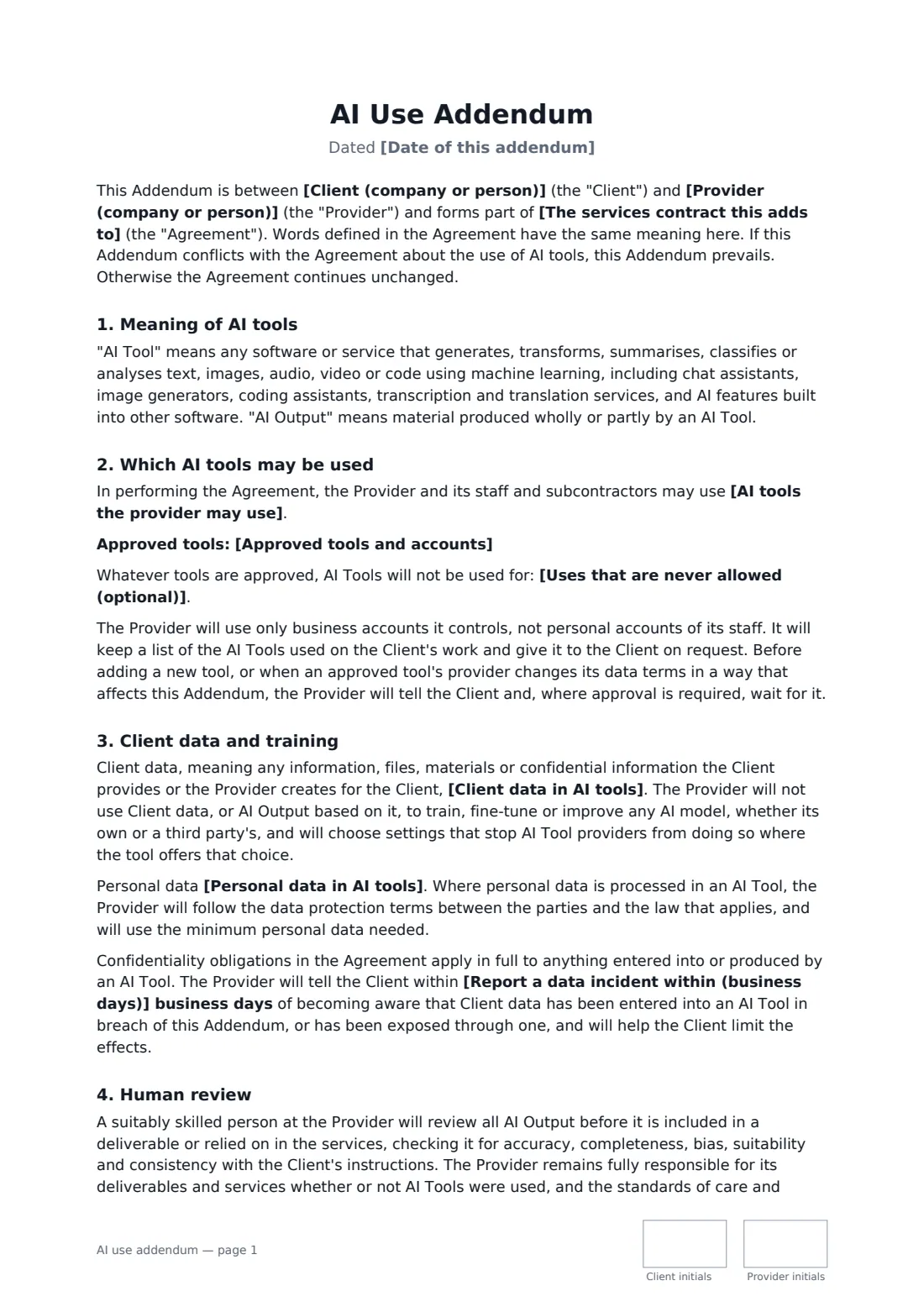
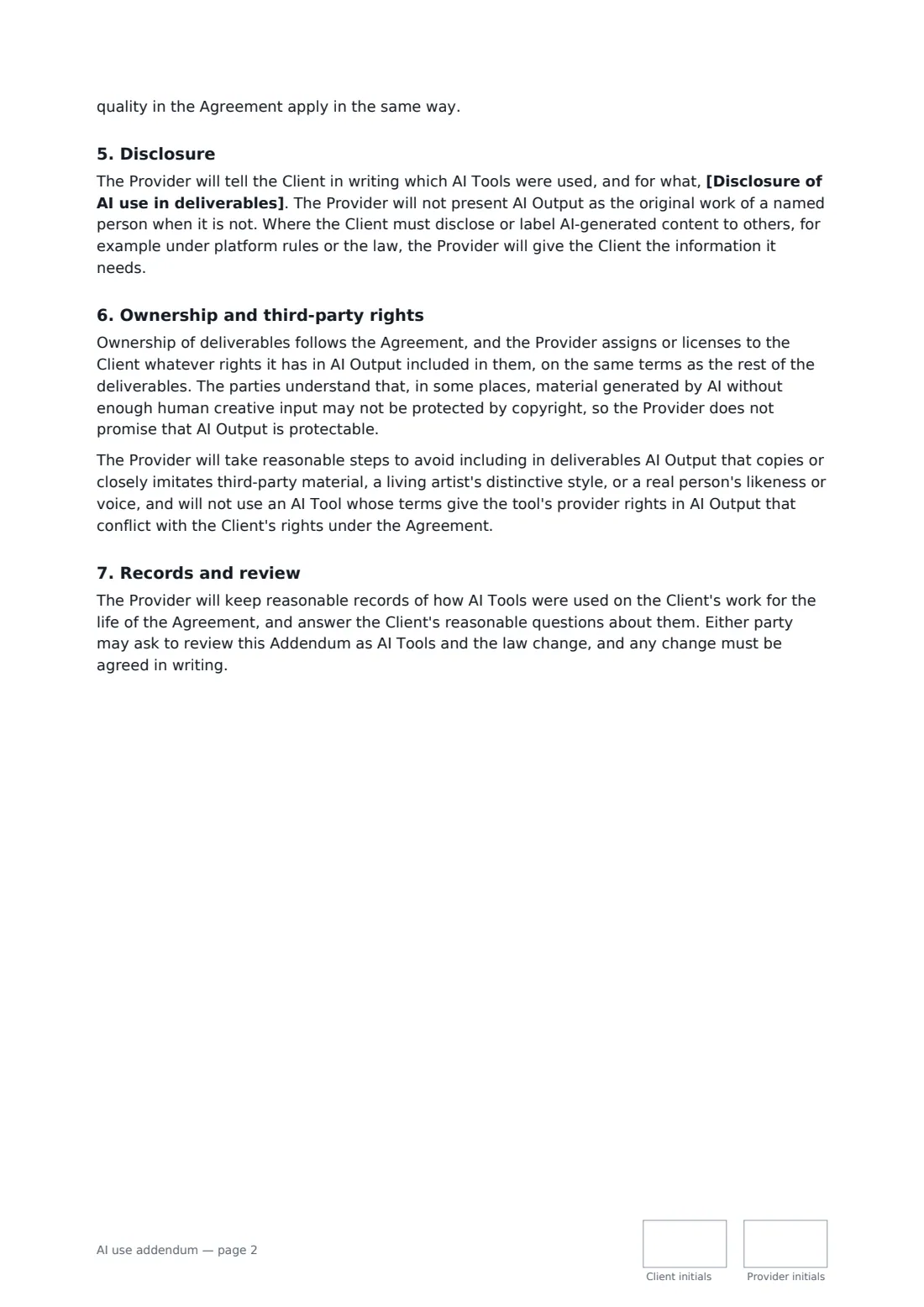
This template attaches to the existing agreement and prevails on AI matters. You choose whether the provider may use only listed tools, listed tools plus others you approve, or none without approval, and you can list uses that are never allowed. It sets rules for client data and personal data in AI tools, bans training on client data, applies confidentiality in full, requires a skilled human to review every AI output, and sets when AI use must be disclosed. It deals with ownership of AI output, the uncertain copyright status of machine-generated material and avoiding imitation of third-party works, plus records, incident reporting and fees.
- Best for
- Businesses working with agencies, consultants, developers, writers and designers
- Signed by
- The client and the provider under the existing contract
- Key choices
- Tool permission level, client and personal data rules, disclosure trigger
- Length
- About 3 pages, initialled on every page
When to use a aI use addendum
- A company adding AI rules to its master services agreement with a marketing agency
- A law or accounting firm setting limits on a freelance writer's use of chat assistants
- A software buyer allowing AI coding assistants on enterprise plans only
- An agency offering clients a standard AI addendum to build trust
- A charity requiring disclosure of AI-generated images in campaign materials
What you fill in
11 blanks, then the name and email of each person who signs: client, provider.
1 The parties
- Date of this addendum*
- Client (company or person)*
- Provider (company or person)*
- The services contract this adds to*
2 Tools
- AI tools the provider may use* only the approved tools listed below · the approved tools listed below, and others the Client approves in writing · no AI tools at all unless the Client approves a specific use in writing
- Approved tools and accounts
- Uses that are never allowed (optional)
3 Data
- Client data in AI tools* may be entered only into approved tools, on terms that do not allow it to be used for training · must never be entered into any AI tool
- Personal data in AI tools* must not be entered unless the Client has approved it in writing · may be entered into approved tools covered by the parties' data processing terms
4 Deliverables
- Disclosure of AI use in deliverables* for every deliverable that contains material generated by AI · for every deliverable, stating so when no AI Tool was used · when the Client asks
- Report a data incident within (business days)*
5 Who signs
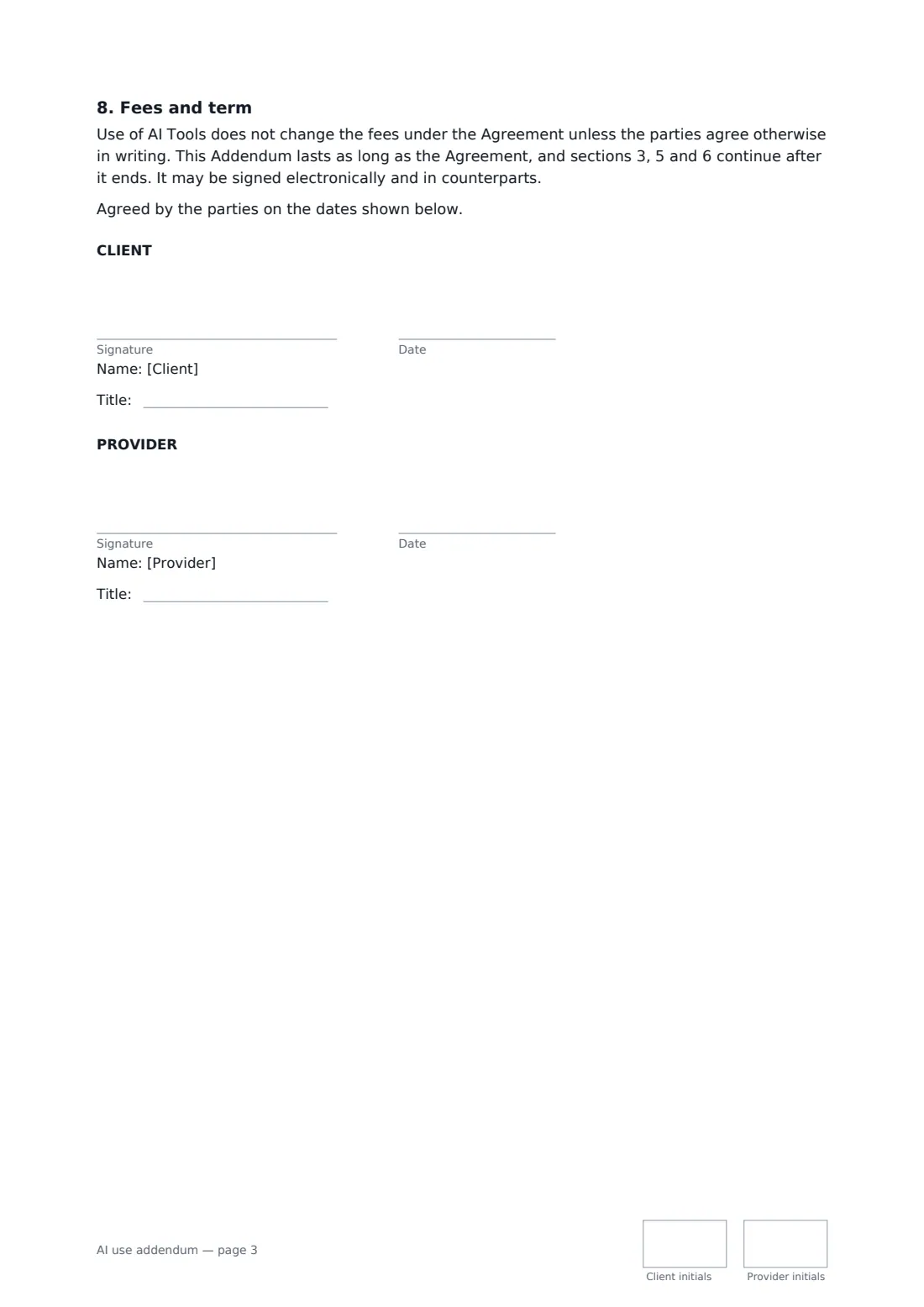
- Client signature and date, job title, initials on every page · The person signing for the business receiving the services.
- Provider signature and date, job title, initials on every page · The person signing for the agency, consultant or contractor providing the services.
What the aI use addendum covers
- Meaning of AI tools
- Which AI tools may be used
- Client data and training
- Human review
- Disclosure
- Ownership and third-party rights
- Records and review
- Fees and term
Using the aI use addendum, step by step
1 Identify the main contract
Name the parties and the services contract this addendum adds to, with its date.
2 Decide which tools are allowed
Choose the permission level and list approved tools with the plan or setting that applies, such as a business plan with training switched off. Add any uses that are never allowed.
3 Set data and disclosure rules
Choose whether client data may go into approved tools or none at all, how personal data is handled, when AI use must be disclosed and how quickly an incident must be reported.
4 Sign alongside the contract
Send it for signature. Both parties initial every page and the signed addendum is stored in your vault next to the main agreement.
Tips before you send it
- Check the actual data terms of each tool. Free and consumer plans often allow training on what you type, while business plans usually let you switch that off.
- Keep the approved list short and specific. Naming the plan or setting matters as much as naming the product.
- Copyright in AI-generated material is unsettled and differs between countries. If you need to own and protect a deliverable, ask for meaningful human authorship.
- Pair this addendum with a data processing agreement when the provider handles personal data.
Sign it online in minutes
- Fill in the blanks. Names, dates and amounts go straight into the agreement — the preview shows exactly where.
- Name who signs. Tick “This is me” for your own part. FileIt builds the PDF with every signature, date and initials box on the right line, and you can check or move anything before sending.
- Send it. Each signer gets a secure link and signs from any device — no account needed. The signed PDF, with an audit trail and a Certificate of Completion, is filed in your vault and emailed to everyone.
AI use addendum: frequently asked questions
Does this replace our services contract?
No. It adds to it. The main contract continues, and this addendum wins only where the two conflict about AI tools.
Can the provider still use AI features built into ordinary software?
Those count as AI tools under the addendum's definition, so they follow the same permission and data rules. List them as approved if you are comfortable with them.
Who is responsible if AI output is wrong?
The provider. A skilled person must review all AI output, and the provider stays fully responsible for its work to the same standard as before.
Will we own AI-generated deliverables?
Ownership follows your main contract and the provider passes on whatever rights it has. The addendum is honest that, in some places, purely machine-generated material may not be protected by copyright.