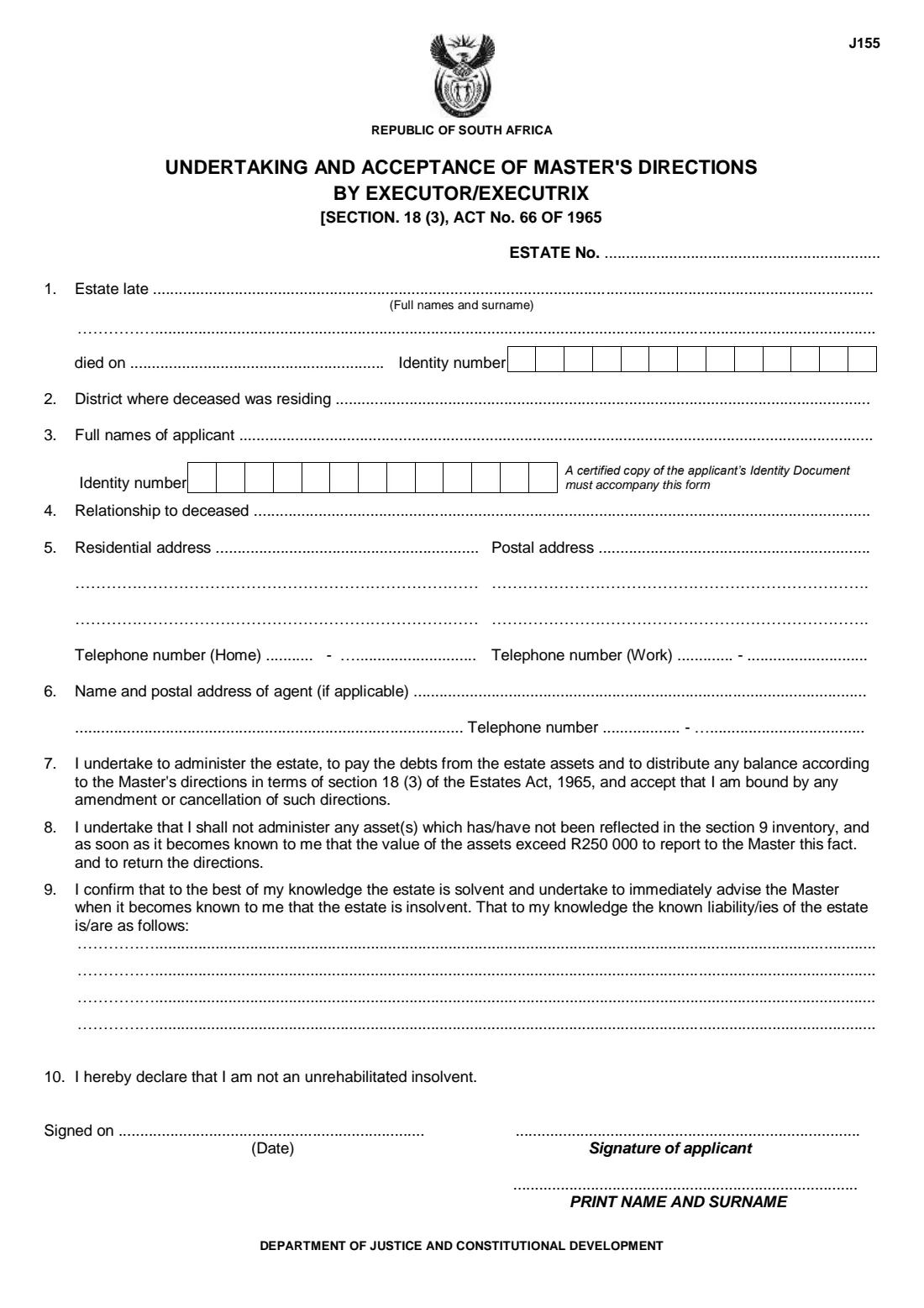
What is J155 Executor's undertaking?
When someone dies leaving an estate worth R250 000 or less, the Master of the High Court can let a person wind it up under section 18(3) of the Administration of Estates Act, 1965, following written directions instead of the full executorship process. The J155 is the form in which that person accepts those directions and undertakes to follow them.
On one page you identify the estate and the deceased, give your own details, name an agent if someone is helping you, and list the estate's known debts. The printed undertakings say you will pay the debts from the estate assets, distribute the balance as the Master directs, not deal with assets left off the inventory, and tell the Master if the assets turn out to be worth more than R250 000 or the estate proves insolvent.
FileIt asks each question in plain language, prints both 13-digit ID numbers one digit per box, and fills the Department of Justice's own J155 PDF. You print it, sign it and lodge it with the Master together with a certified copy of your ID.
- Who fills it
- The person the Master will direct to administer a smaller estate (often the surviving spouse or a child)
- Lodged with
- The Master of the High Court, or the Master's service point at a Magistrate's Office
- Estate size
- Estates of R250 000 or less, handled under section 18(3)
- Attach
- A certified copy of the applicant's identity document
- Pages
- 1
- Agency
- Department of Justice and Constitutional Development — Master of the High Court
Who needs to fill out J155 Executor's undertaking?
- A surviving spouse, child or other family member who will wind up a small estate under the Master's directions.
- Anyone the Master has asked to sign an undertaking before issuing a letter of authority for an estate of R250 000 or less.
- Families who have already reported the death with a J294 death notice and an inventory, and now need to take the next step.
When to use J155 Executor's undertaking
- After the estate has been reported to the Master and it is clear the estate falls under section 18(3).
- Together with the other documents the Master's office asks for when it considers a letter of authority.
- Again, if the Master asks for a fresh undertaking because the person administering the estate changes.
What you need before you start
- The estate number from the Master, if one has been allocated.
- The deceased's full names, 13-digit ID number and date of death, as on the death certificate.
- The district where the deceased normally lived.
- Your own full names, 13-digit ID number, relationship to the deceased, residential and postal address and phone numbers.
- A certified copy of your identity document to lodge with the form.
- The name, postal address and phone number of any agent who is helping you.
- A list of the estate's debts you know about, such as municipal accounts, store cards or the funeral bill.
What’s on J155 Executor's undertaking
The 2015 edition has 1 page. FileIt asks for it in 4 parts, and it is signed by Applicant (executor):
- 1–2. The estateApplicant (executor)
- 3–5. You, the applicantApplicant (executor)
- 6. Agent (if applicable)Applicant (executor)
- 7–10. Undertaking, liabilities and signatureApplicant (executor)
How to fill out J155 Executor's undertaking, step by step
1 The estate and the deceased
At the top you give the estate number, then the deceased's full names and surname after 'Estate late', the date of death and the deceased's ID number in the 13 boxes. Paragraph 2 asks for the district where the deceased was living.
FileIt pre-fills the deceased's name from the person you picked in your vault and prints the date as dd/mm/yyyy.
2 You, the applicant
Paragraphs 3 to 5 are about you: your full names, ID number (one digit per box), your relationship to the deceased, your residential and postal addresses on three lines each, and home and work telephone numbers split into dialling code and number.
The form reminds you that a certified copy of your identity document must accompany it.
3 An agent, if you have one
Paragraph 6 is only for someone helping you with the estate, such as an attorney or estate practitioner. Give their name, postal address and telephone number. If you are doing it yourself, leave this part switched off in FileIt.
4 The undertakings and the estate's debts
Paragraphs 7 and 8 are printed undertakings: to administer the estate, pay the debts from the estate assets and distribute the balance according to the Master's directions, not to administer any asset left off the section 9 inventory, and to report to the Master if the assets exceed R250 000.
Paragraph 9 confirms that, as far as you know, the estate is solvent, and asks you to list the known liabilities on three lines. Paragraph 10 declares that you are not an unrehabilitated insolvent.
5 Date and signature
Write the date next to 'Signed on', sign above 'Signature of applicant' and print your name and surname underneath. FileIt prints the date and your name in capitals; you add the signature.
Common mistakes to avoid
- Using this form for an estate worth more than R250 000 — larger estates go through the full executorship process instead.
- Leaving out the certified copy of your ID, which the form says must accompany it.
- Writing an ID number with a digit missing; South African ID numbers have 13 digits.
- Leaving the liabilities lines blank when the estate does owe money. List what you know, or write 'None'.
- Listing the deceased's name differently from the death notice and death certificate.
After you fill it out
Print the filled J155 from your FileIt vault, check every detail, and sign it where it says 'Signature of applicant'.
Lodge it with the Master's office handling the estate, with the certified copy of your ID and anything else the office asks for. FileIt does not submit forms for you.
Keep the PDF in the deceased's folder in your vault, next to the death notice and inventory, so the estate papers stay together.
Fill out J155 Executor's undertaking online with FileIt
- Pick the person. Choose someone from People and FileIt fills in their name, date of birth, address and other details it already knows.
- Answer plain-language questions. One part of the form at a time, with the official help text beside each question — 26 fields in all. Your answers save as you go.
- Check the live preview. Watch your answers land on the real Department of Justice and Constitutional Development — Master of the High Court form, and let FileIt do any worksheet arithmetic.
- Generate the official PDF. FileIt prints your answers into the agency’s own PDF and files it in that person’s folder in your vault. Sign it, or send it for e-signature.
FileIt fills the form — it never files or submits anything for you. Deliver the finished form to whoever asked for it, the way the form’s instructions say.
Start J155 Executor's undertaking now — it’s freeJ155 Executor's undertaking: frequently asked questions
What is the J155 used for?
It is the undertaking and acceptance of the Master's directions under section 18(3) of the Administration of Estates Act. The person who will wind up a smaller estate signs it to accept the Master's directions and the undertakings printed on the form.
Is the J155 the same as the J190?
No. The J190 is the acceptance of trust as executor, used when someone applies to be appointed executor. The J155 is the undertaking for estates the Master lets be handled under section 18(3) directions.
Can I fill in the J155 online?
Yes. FileIt asks the questions, checks the ID numbers and dates, and prints your answers into the official J155 PDF, saved in your vault. You then print it, sign it and lodge it yourself.
What does R250 000 have to do with this form?
The form's paragraph 8 asks you to report to the Master if you find that the value of the assets exceeds R250 000, the limit for estates handled this way.
Do I need an agent?
No. Paragraph 6 is marked 'if applicable'. Fill it in only if someone such as an attorney is helping you.
What if I don't know the estate number yet?
Leave it blank. The Master's office allocates the number when the estate is reported, and you can add it by hand later.
Official sources
- Blank form (PDF), published by Department of Justice and Constitutional Development — Master of the High Court: https://www.justice.gov.za/master/m_forms/J155.pdf
- Official instructions and guidance: https://www.justice.gov.za/master/deceased-how.html
- Edition shown on this page: J155 (no revision date printed; PDF dated May 2015) (checked 2026-10-19).
FileIt is not affiliated with or endorsed by Department of Justice and Constitutional Development — Master of the High Court or any government. This page explains the form in general terms and is not legal, tax or immigration advice. Always read the official instructions, and check that you are using the edition the recipient accepts. Page last reviewed 2026-10-19.