What is Form W-8BEN-E?
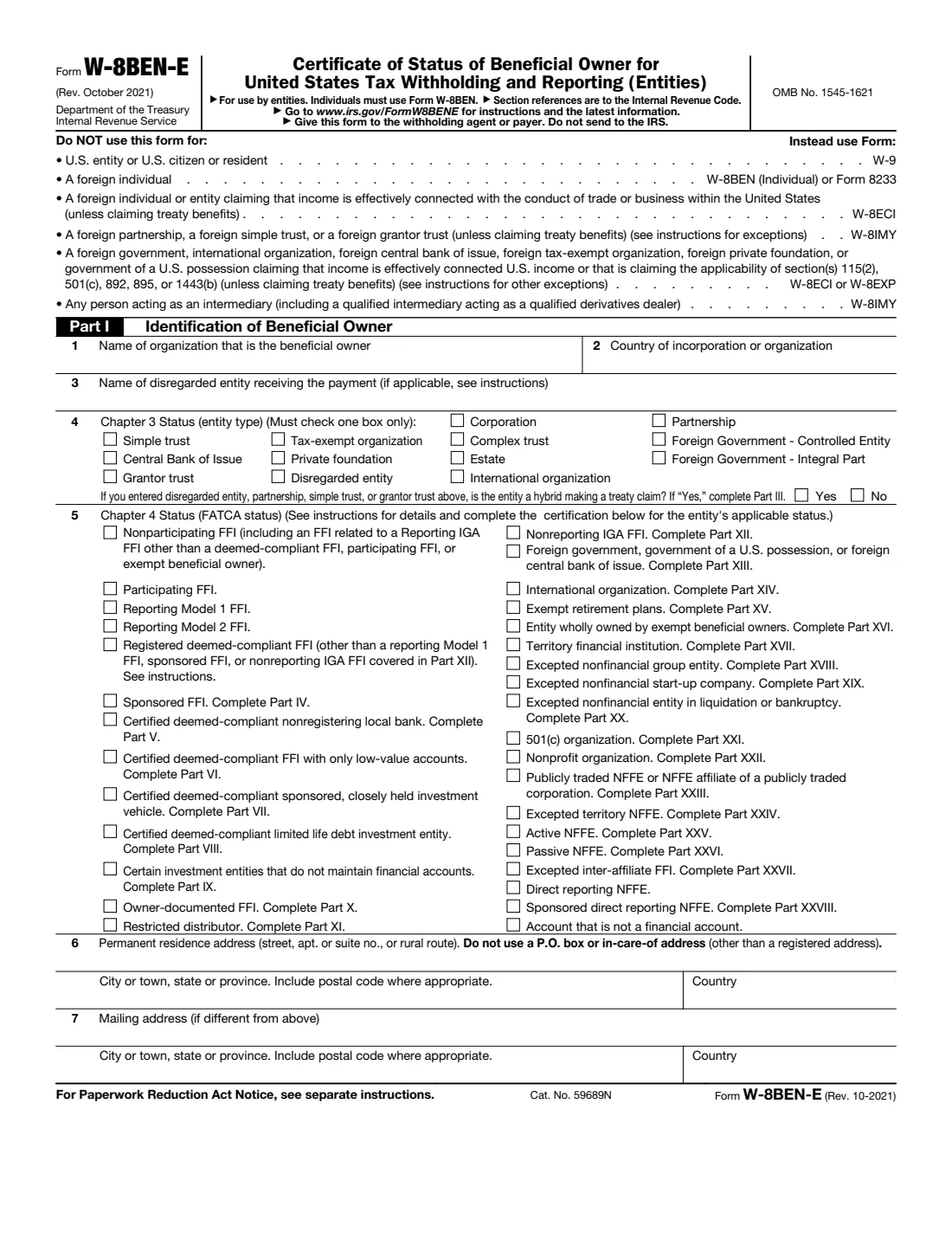
Form W-8BEN-E, Certificate of Status of Beneficial Owner for United States Tax Withholding and Reporting (Entities), is how a foreign entity tells a U.S. withholding agent that it is not a U.S. person. U.S. clients, marketplaces, app stores, banks and brokers ask for it before paying a foreign company. Without it they may withhold U.S. tax at the full 30% rate on certain U.S.-source income, or treat the company as a U.S. person.
The form also records the entity's chapter 4 (FATCA) status, such as active NFFE for most trading companies or passive NFFE for many holding companies, with the certification Part for that status, and lets it claim a reduced rate under an income tax treaty in Part III. Foreign individuals use Form W-8BEN instead, and U.S. entities use Form W-9. The current revision is Rev. October 2021. It goes to the payer, not to the IRS.
FileIt shows only the questions that apply to your status, explains each line in plain language, and prints the answers into the IRS's own eight-page PDF, including names with letters such as ł, ś or ș. The finished form is kept in your vault and can be sent for e-signature.
- Who fills it
- A foreign entity (company, partnership, trust, foundation, government body) that receives U.S. income or holds an account with a financial institution.
- Given to
- The withholding agent, payer or financial institution that asked for it. Do not send it to the IRS.
- Validity
- Generally until the last day of the third calendar year after signing, unless something on it changes.
- Signatures
- An individual authorized to sign for the entity signs and dates Part XXX.
- Edition
- Rev. October 2021
- Agency
- Internal Revenue Service (IRS), Department of the Treasury
Who needs to fill out Form W-8BEN-E?
- Foreign companies paid by U.S. clients, marketplaces or app stores.
- Foreign holding companies, funds, trusts and foundations with U.S. investments or U.S. brokerage accounts.
- Foreign entities opening or holding accounts with banks that must document their FATCA status.
- Foreign entities claiming a reduced treaty rate on U.S. dividends, interest or royalties.
- Not for: foreign individuals (Form W-8BEN), U.S. entities (Form W-9), income effectively connected with a U.S. business (Form W-8ECI), intermediaries and most flow-through entities not claiming treaty benefits (Form W-8IMY), or government and tax-exempt bodies claiming certain exemptions (Form W-8EXP).
When to use Form W-8BEN-E
- When a U.S. payer, platform, bank or broker asks your entity to certify its foreign status.
- Before the first payment, so the right amount of U.S. tax is withheld.
- Within 30 days of a change that makes any certification incorrect, as the form says you agree to.
- When the form expires: generally on the last day of the third calendar year after the year you signed it.
What you need before you start
- The entity's legal name, country of incorporation or organization, and permanent residence address.
- Its chapter 3 classification under U.S. tax principles (corporation, partnership, trust and so on).
- Its chapter 4 (FATCA) status and, for many statuses, the facts that its certification Part asks for.
- Its GIIN, if it is a participating FFI, reporting Model 1 or 2 FFI, registered deemed-compliant FFI or direct reporting NFFE.
- Its foreign tax identifying number, and a U.S. EIN if it has or needs one.
- For a treaty claim: the treaty country, the limitation on benefits test it meets and, for special rates, the article, rate and conditions.
- For a passive NFFE with substantial U.S. owners: each owner's name, address and U.S. TIN.
What’s on Form W-8BEN-E
The 2021 edition has 8 pages. FileIt asks for it in 10 parts, and it is signed by Authorized signer for the entity:
- Part I, lines 1-3: The entityAuthorized signer for the entity
- Part I, lines 4-5: Chapter 3 and chapter 4 (FATCA) statusAuthorized signer for the entity
- Lines 6-7: AddressesAuthorized signer for the entity
- Line 7: Mailing address (if different)Authorized signer for the entity
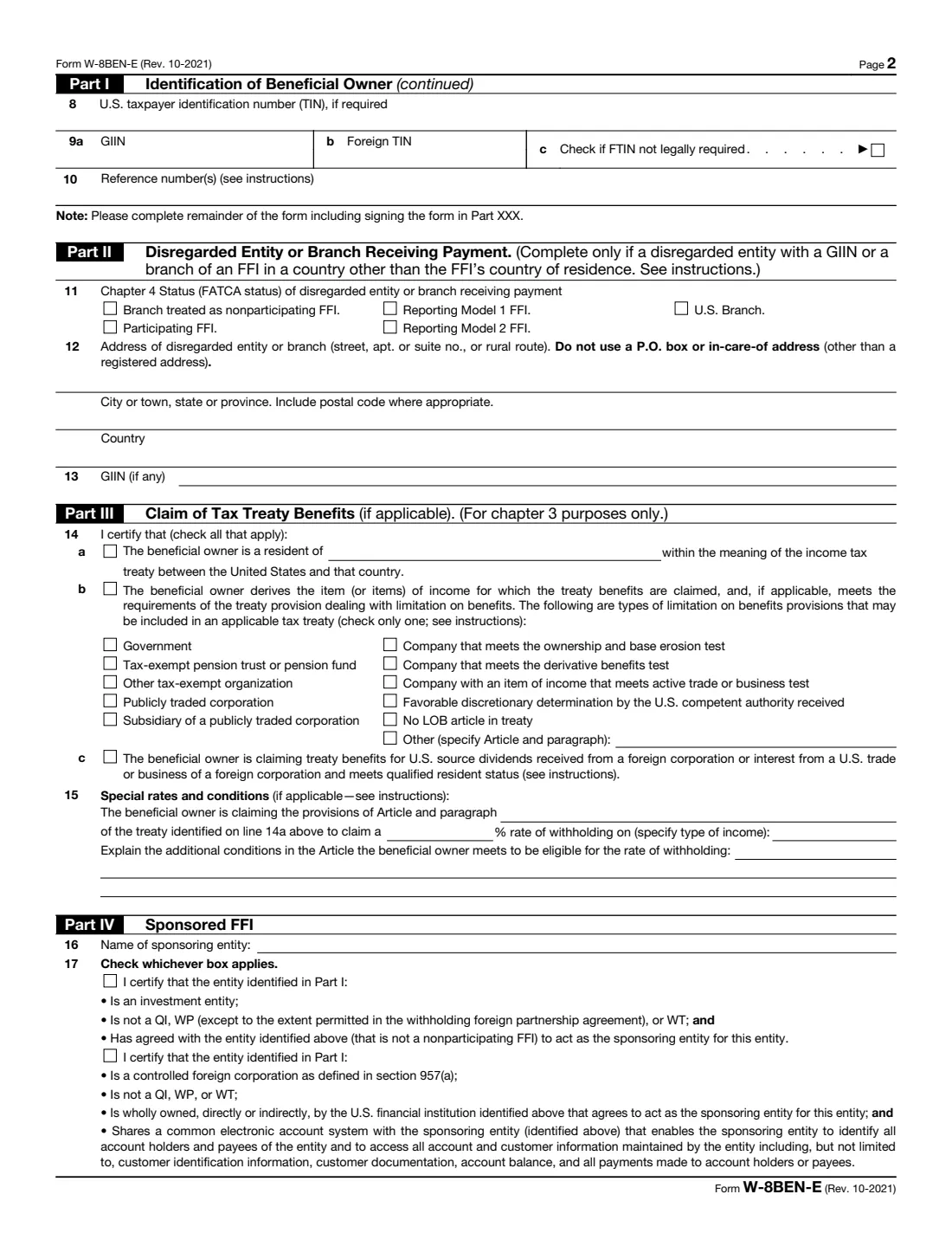
- Lines 8-10: Tax numbers and referenceAuthorized signer for the entity
- Part II: Disregarded entity or branch receiving paymentAuthorized signer for the entity
- Part III: Claim of tax treaty benefitsAuthorized signer for the entity
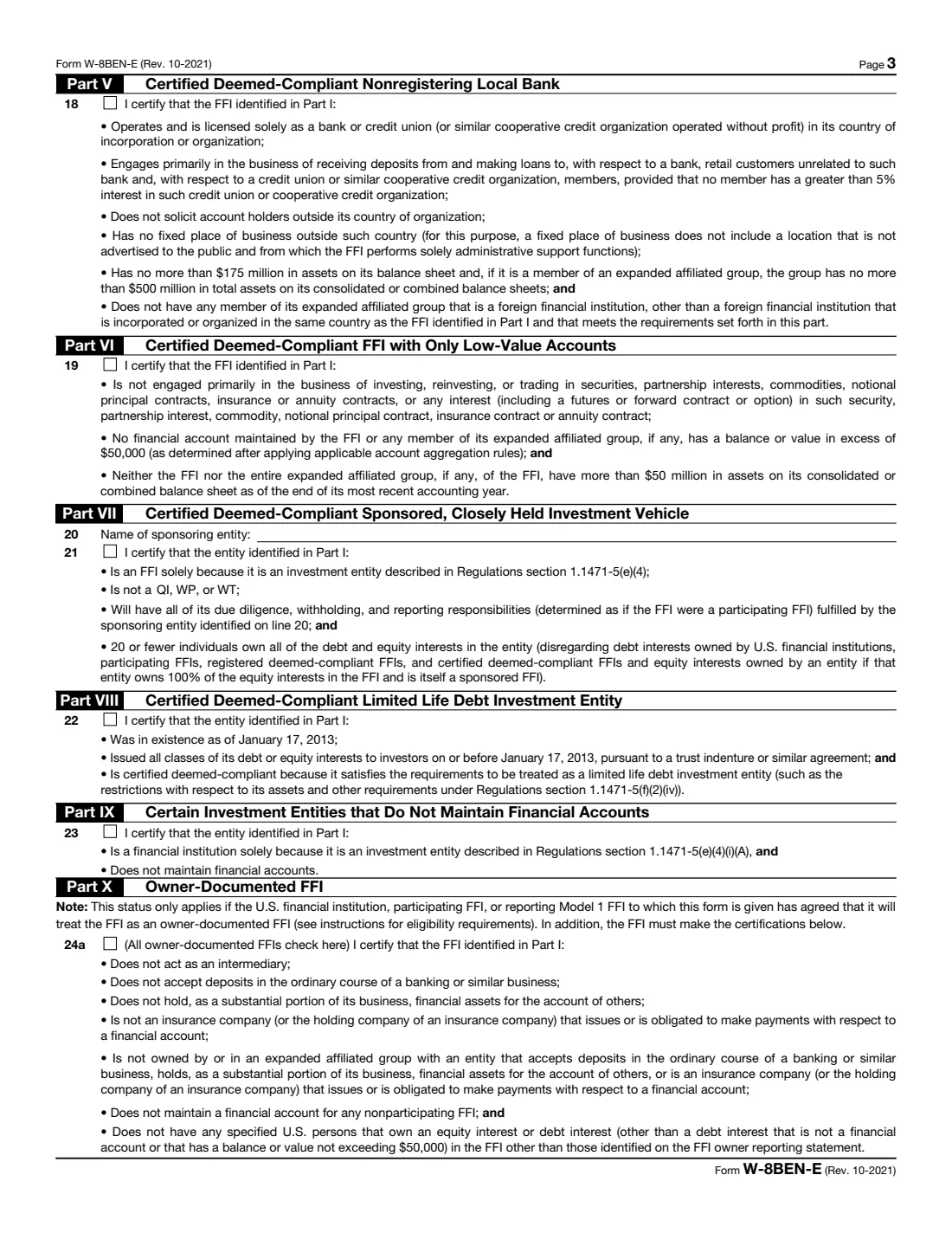
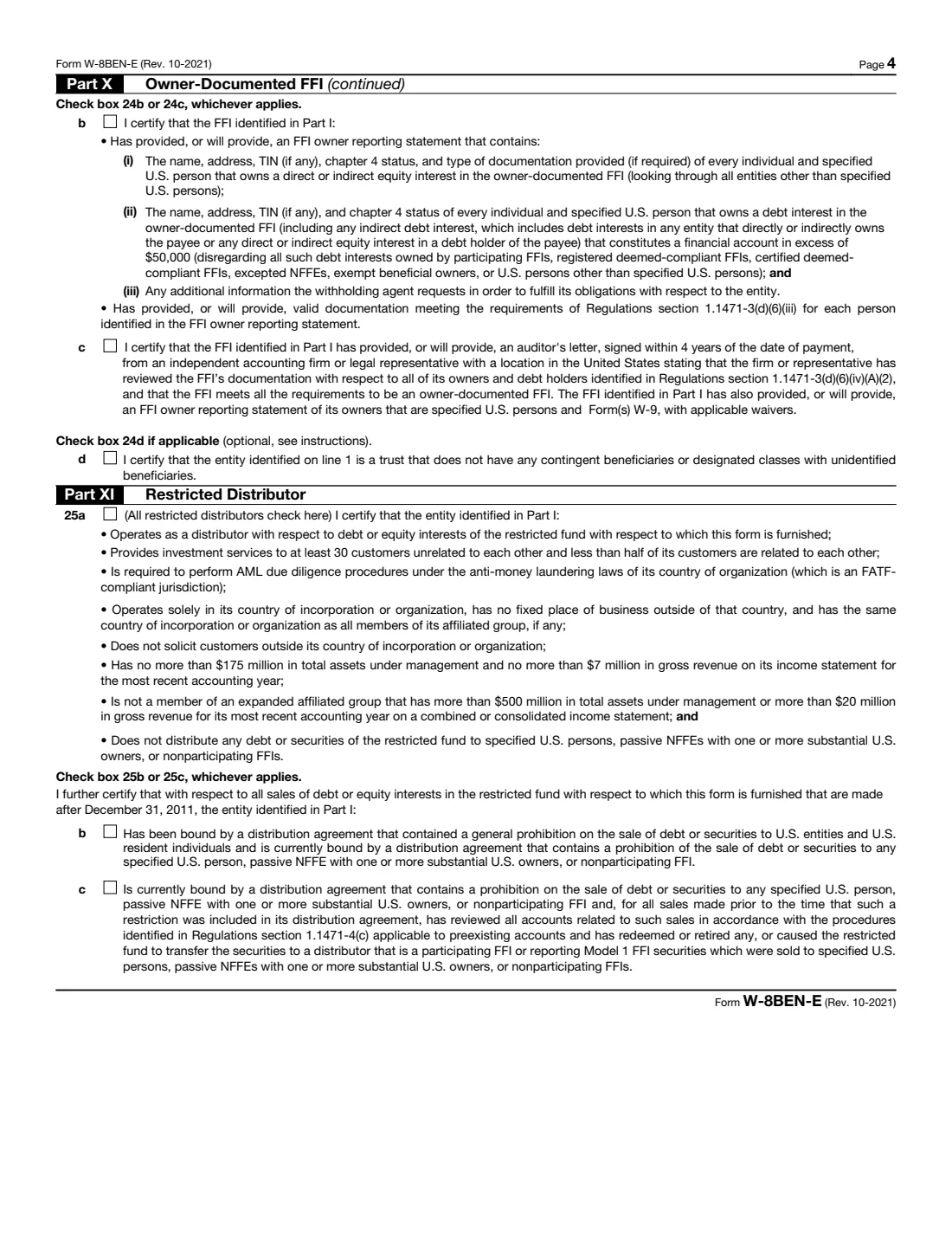
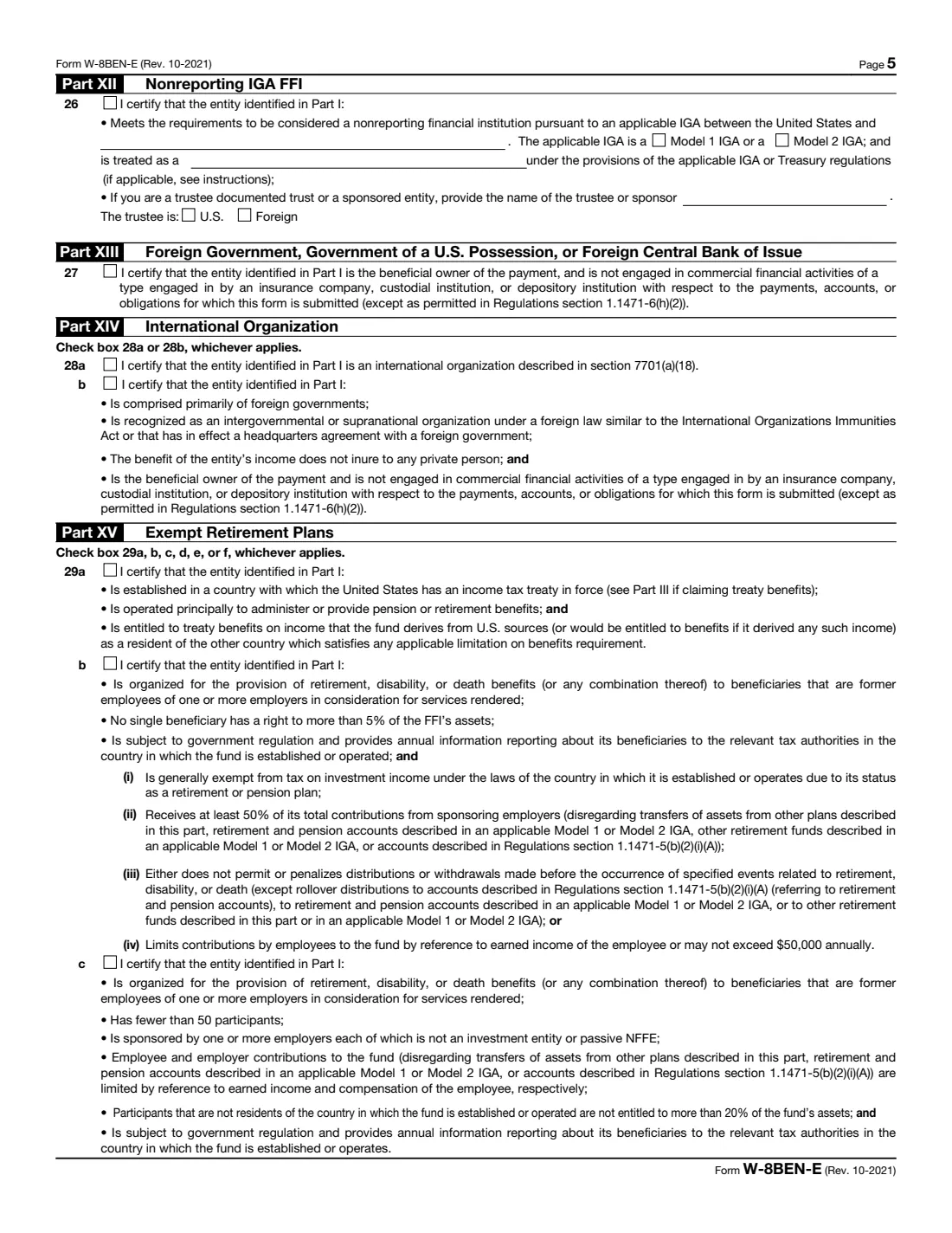
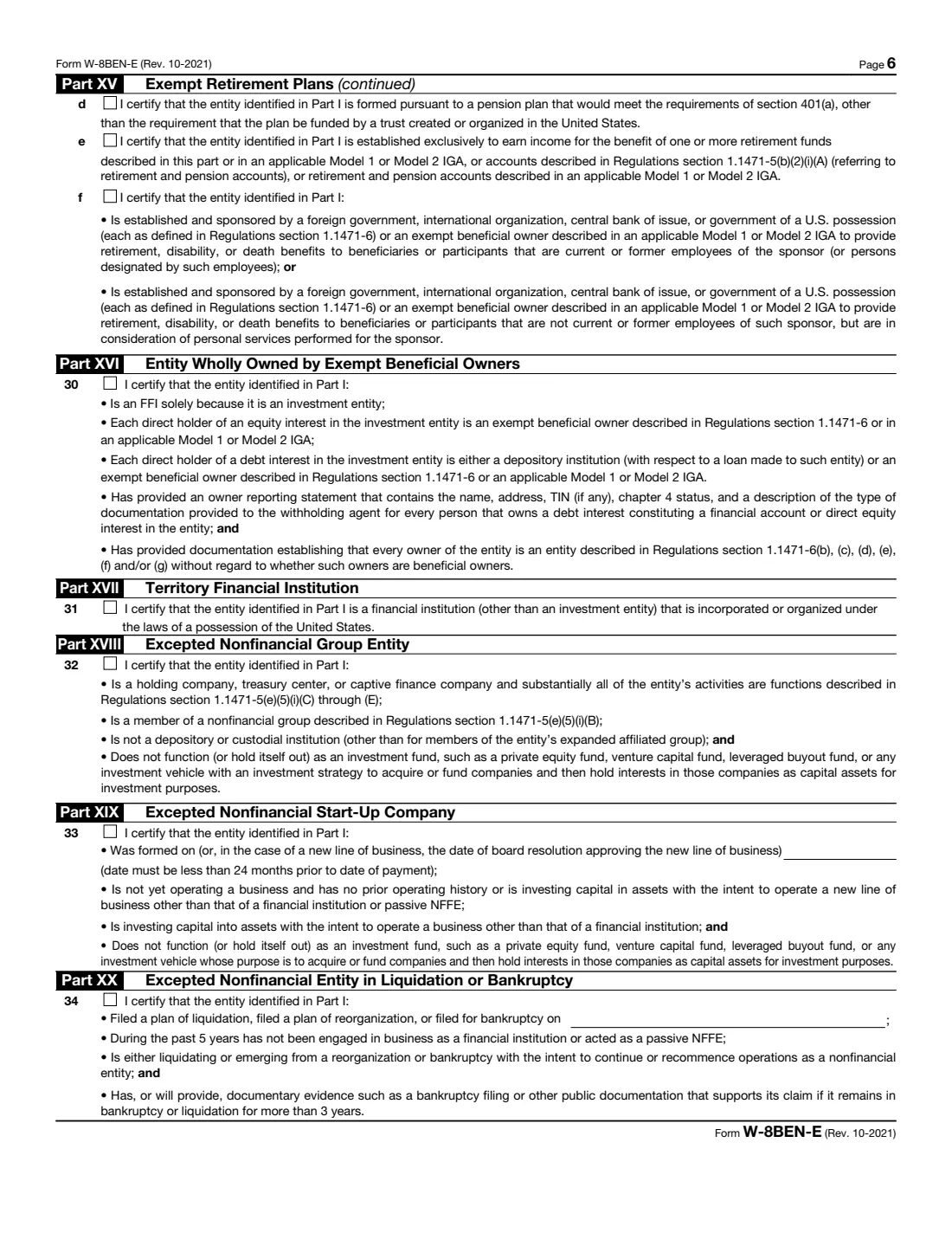
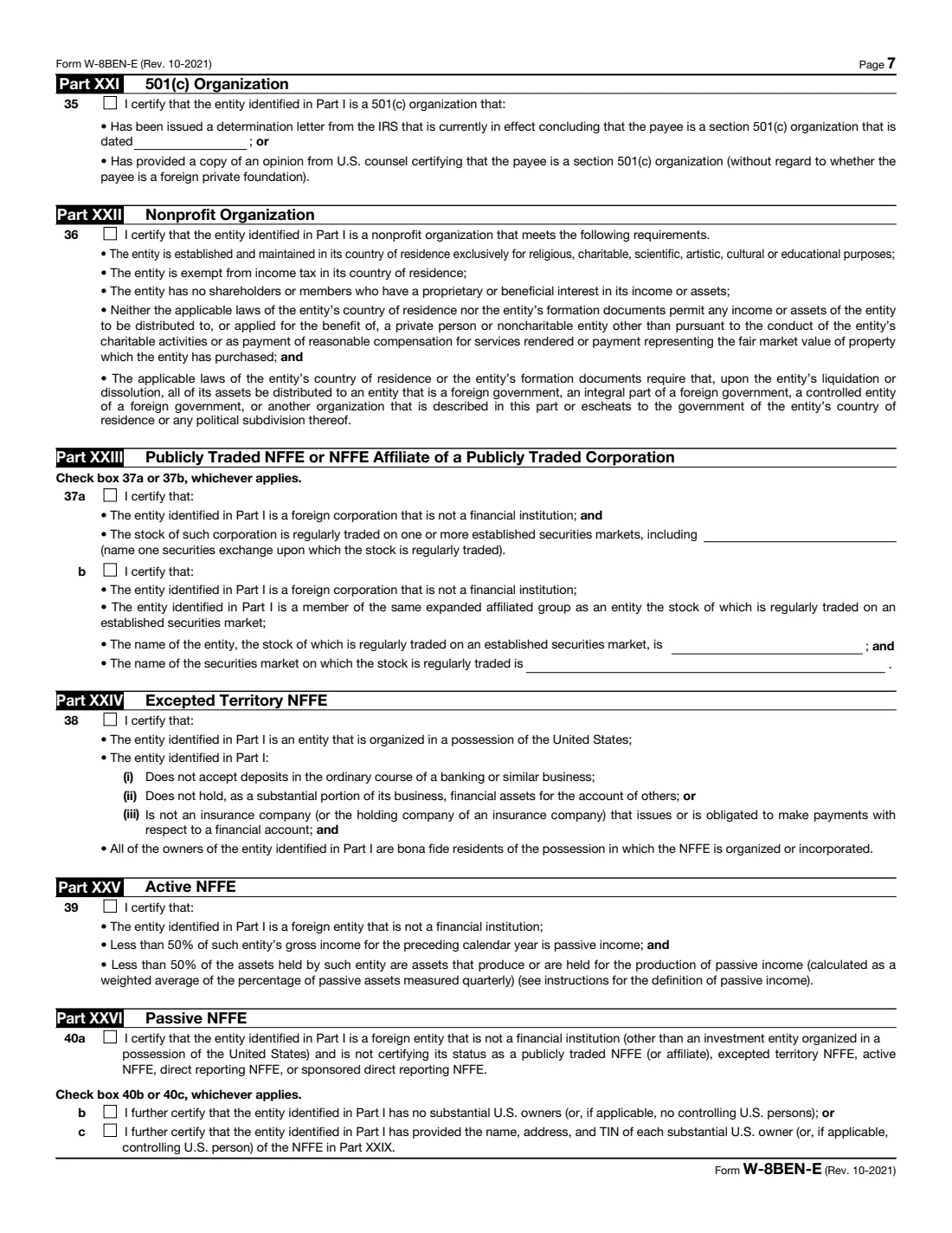
- Parts IV-XXVIII: Certification for the chapter 4 statusAuthorized signer for the entity
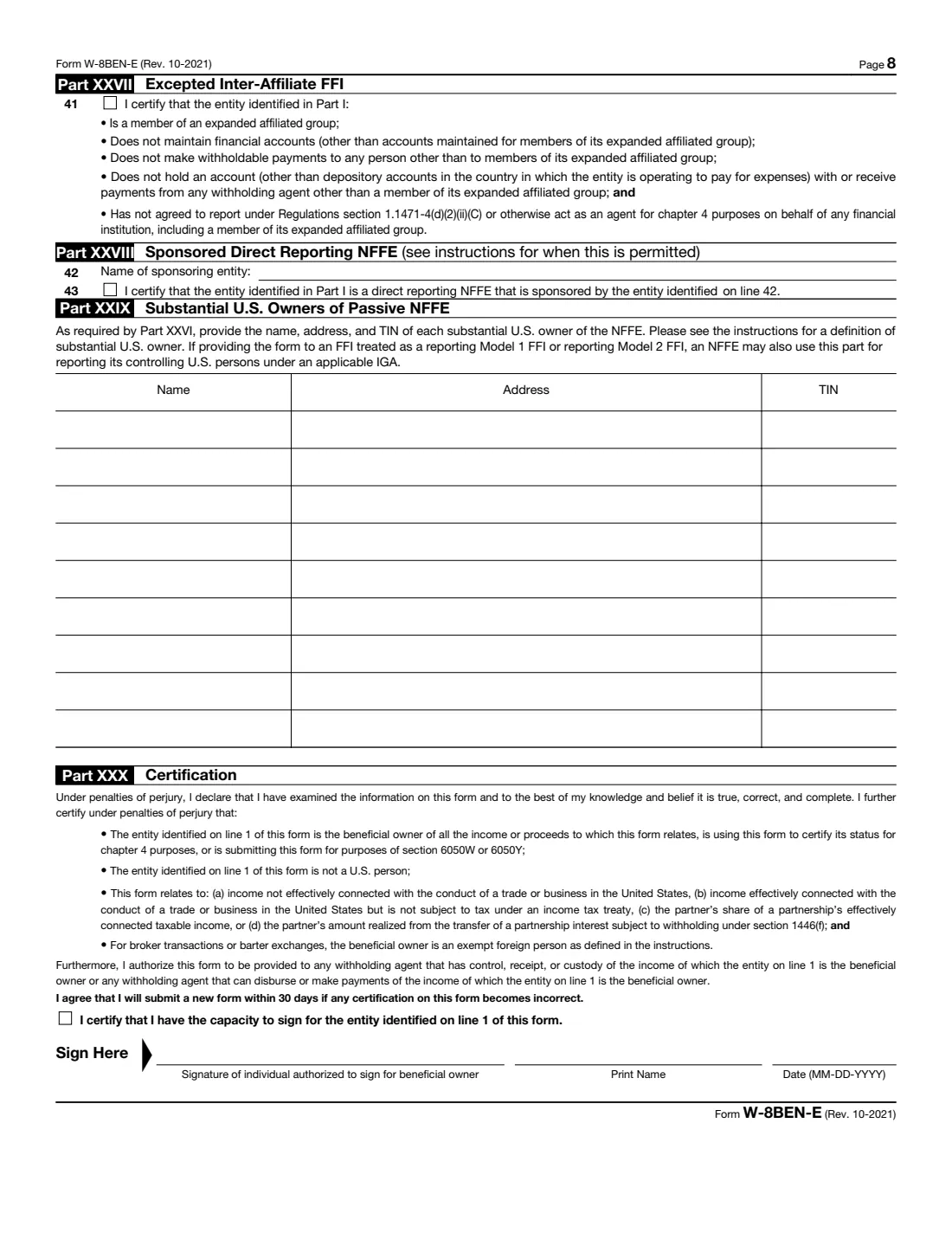
- Part XXIX: Substantial U.S. owners of passive NFFEAuthorized signer for the entity
- Part XXX: CertificationAuthorized signer for the entity
How to fill out Form W-8BEN-E, step by step
1 Part I, lines 1-3: The entity
Enter the legal name of the entity that is the beneficial owner and its country of incorporation or organization. A disregarded entity normally enters its owner's name on line 1; its own name goes on line 3 only in the cases the instructions describe.
2 Line 4: Chapter 3 status
Check the one box for the entity's classification under U.S. tax principles. A disregarded entity, partnership, simple trust or grantor trust also answers whether it is a hybrid making a treaty claim.
3 Line 5: Chapter 4 (FATCA) status
Check the one FATCA status that applies in the entity's country of residence. Many statuses send you to a certification Part later in the form; FileIt shows just that Part.
4 Lines 6-10: Addresses and numbers
Give the permanent residence address (no P.O. box or in-care-of address, unless it is the registered address), a mailing address if different, a U.S. TIN if required, the GIIN if the status needs one, the foreign TIN, and any reference the payer asked for.
5 Part II: Disregarded entity or branch
Only for a disregarded entity with its own GIIN or a branch in another country receiving the payment: its FATCA status, address and GIIN.
6 Part III: Treaty benefits
To claim a reduced rate, certify the treaty country of residence (14a), that the entity derives the income and meets any limitation on benefits provision (14b, with the test it meets), and, only where needed, the special rate and conditions on line 15.
7 Parts IV-XXIX: Status certifications
Complete the Part for the line 5 status, for example Part XXV for an active NFFE or Part XXVI for a passive NFFE. A passive NFFE with substantial U.S. owners lists them in Part XXIX.
8 Part XXX: Certification
The authorized signer ticks the capacity box, prints their name, and signs and dates (MM-DD-YYYY).
Common mistakes to avoid
- Using W-8BEN-E for an individual (use W-8BEN) or for a U.S. company (use W-9).
- Checking more than one box on line 4 or line 5.
- Choosing a line 5 status but not completing its certification Part.
- Leaving out the GIIN when the status requires one.
- Giving a P.O. box or in-care-of address as the permanent residence address.
- Claiming a treaty rate without checking 14a and 14b, or using line 15 when the standard treaty rate needs no special conditions.
- A passive NFFE neither certifying 40b (no substantial U.S. owners) nor listing its owners in Part XXIX.
- Not ticking the capacity box in Part XXX.
After you fill it out
Sign and date Part XXX, by hand or with FileIt's e-signature if the withholding agent accepts electronic signatures, and give the form to whoever asked for it. Do not send it to the IRS.
Keep the finished PDF in your FileIt vault, and note when it expires (the last day of the third calendar year after signing).
Give a new form within 30 days if anything you certified becomes incorrect, such as a change of FATCA status or address.
Fill out Form W-8BEN-E online with FileIt
- Pick the person. Choose someone from People and FileIt fills in their name, date of birth, address and other details it already knows.
- Answer plain-language questions. One part of the form at a time, with the official help text beside each question — 108 fields in all. Your answers save as you go.
- Check the live preview. Watch your answers land on the real Internal Revenue Service (IRS) form, and let FileIt do any worksheet arithmetic.
- Generate the official PDF. FileIt prints your answers into the agency’s own PDF and files it in that person’s folder in your vault. Sign it, or send it for e-signature.
FileIt fills the form — it never files or submits anything for you. Deliver the finished form to whoever asked for it, the way the form’s instructions say.
Start Form W-8BEN-E now — it’s freeForm W-8BEN-E: frequently asked questions
Can I fill out Form W-8BEN-E online?
Yes. FileIt asks each question in plain language, shows only the parts that apply to your status, and prints the answers into the official IRS PDF for you to sign and give to the payer.
Where do I send Form W-8BEN-E?
To the withholding agent, payer or financial institution that requested it. The form says: do not send to the IRS.
What FATCA status is my company?
Most operating companies that are not banks, funds or insurers are an active NFFE: less than 50% of their gross income for the preceding year is passive income and less than 50% of their assets produce passive income. Holding companies with mostly investment income are often passive NFFEs. Financial institutions usually have a GIIN. The IRS instructions explain every status; ask an adviser if you're unsure.
What is a GIIN?
A Global Intermediary Identification Number, issued when a financial institution or certain NFFEs register with the IRS for FATCA. Most ordinary companies don't have one and leave line 9a blank.
Do we need a U.S. EIN?
Not usually. Line 8 is needed in some cases, for example a partner in a partnership with a U.S. business, or a treaty claim without a foreign TIN on line 9b.
How long is Form W-8BEN-E valid?
Generally from the date it is signed until the last day of the third succeeding calendar year, unless a change in circumstances makes it incorrect. A form signed in 2026 generally stays valid through December 31, 2029.
What is the difference between W-8BEN and W-8BEN-E?
W-8BEN is for foreign individuals; W-8BEN-E is for foreign entities such as companies, partnerships and trusts.
Official sources
- Blank form (PDF), published by Internal Revenue Service (IRS): https://www.irs.gov/pub/irs-pdf/fw8bene.pdf
- Official instructions and guidance: https://www.irs.gov/forms-pubs/about-form-w-8-ben-e
- Edition shown on this page: Rev. October 2021 (checked 2026-10-25).
FileIt is not affiliated with or endorsed by Internal Revenue Service (IRS) or any government. This page explains the form in general terms and is not legal, tax or immigration advice. Always read the official instructions, and check that you are using the edition the recipient accepts. Page last reviewed 2026-10-25.