
What is SKV 4600 - Estate inventory (bouppteckning)?
When someone who lived in Sweden dies, a bouppteckning (estate inventory) is normally drawn up. It lists the heirs and everyone else who must be summoned, and everything the deceased owned and owed on the day of death. If the deceased was married or living with a cohabitee, it also lists the survivor's own assets and debts, which are needed for the property division. The inventory is drawn up at a meeting called a bouppteckningsförrättning. It is then signed by the informant (bouppgivare), the person who knows the estate best, and by two estate assessors who are not heirs. Skatteverket (the Swedish Tax Agency) then registers it. SKV 4600 is Skatteverket's form for it.
Skatteverket's form page notes that a new law on digital estate inventories took effect on 1 July 2026. The form hasn't been updated yet, but Skatteverket says it can still be used. Everyone summoned must now be given with a personal identity or coordination number, a copy of the inventory no longer has to be sent with it, and two terms have new names: förrättningspersoner for the assessors and bouppgivarens bekräftelse for the informant's declaration.
FileIt asks each part of the seven-page form in English with the Swedish wording beside it. It checks every personal identity number, keeps the asset and debt tables tidy, and adds up the totals the form asks for: all assets and debts, plus how much is separate property or part of a cohabitees' division. Your answers are printed into Skatteverket's own PDF and saved in your vault. The informant and the assessors sign by hand, and you send it in. FileIt never submits it.
- Who fills it
- The estate (dödsboet): usually the informant or the person arranging the inventory
- Given to
- Skatteverket, Bouppteckningssektionen, 871 87 Härnösand (printed on the form)
- When
- After a death; the inventory meeting is held and the inventory then registered with Skatteverket
- Signatures
- The informant (bouppgivare) and two estate assessors, by hand
- Edition
- SKV 4600 14 sv web 02 (not yet updated for the 1 July 2026 law, still usable)
- Pages
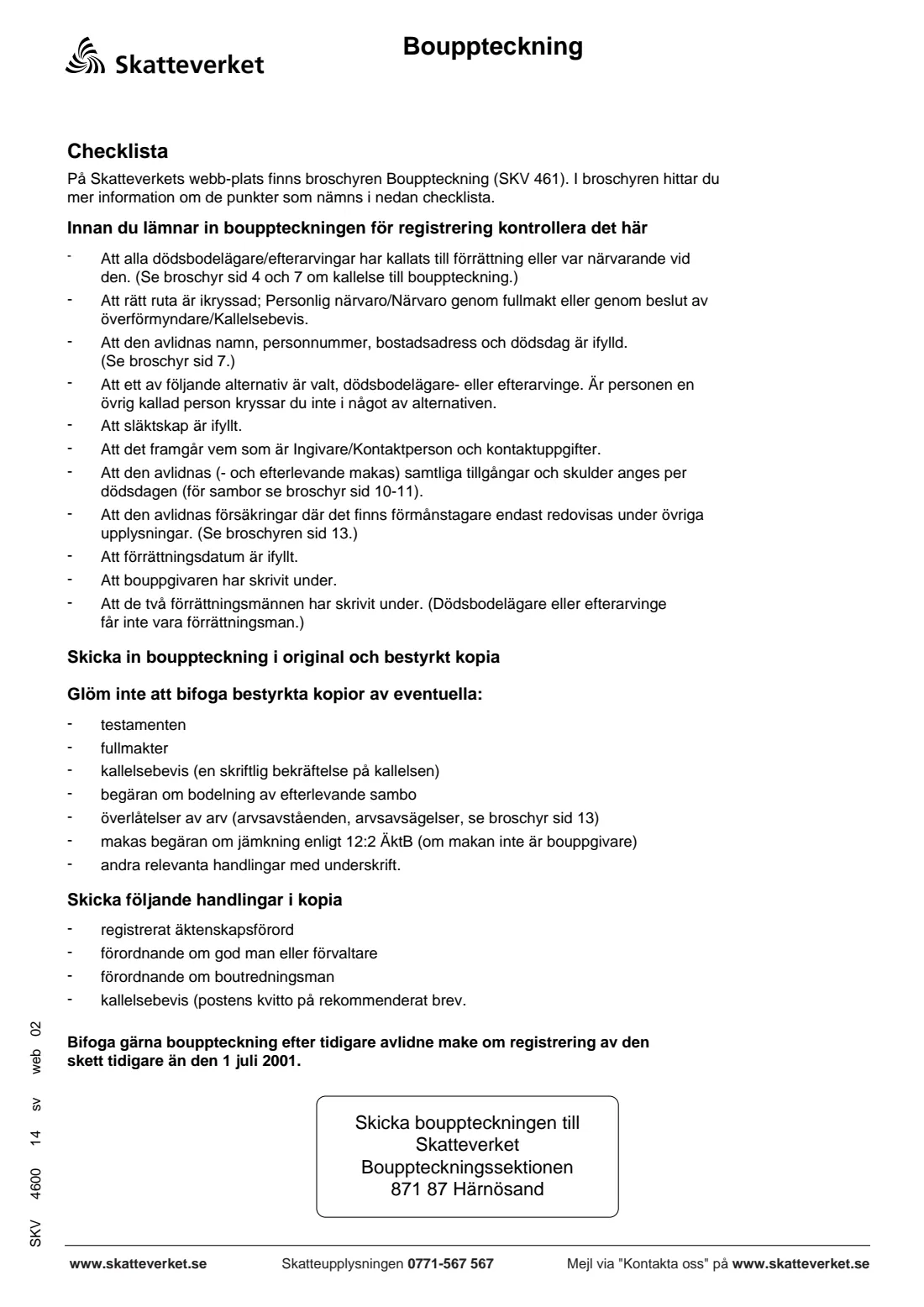
- 7 (page 1 is a checklist)
Who needs to fill out SKV 4600 - Estate inventory (bouppteckning)?
- Families in Sweden arranging the estate inventory after a relative's death.
- Surviving spouses and cohabitees, whose own assets and debts go into the inventory for the property division.
- Heirs living abroad who are handling the inventory for a parent or relative who lived in Sweden.
- Estate administrators and others helping a family, as long as they aren't heirs acting as assessors.
When to use SKV 4600 - Estate inventory (bouppteckning)
- After a death, when an estate inventory is to be drawn up and registered with Skatteverket.
- At or after the inventory meeting, once the heirs have been summoned and the assets and debts on the day of death are known.
- When the estate is too large for a simpler death notice (dödsboanmälan) from the municipality. A death notice is only possible for small estates.
- Now, even though the form predates the 1 July 2026 law: Skatteverket says it can still be used.
What you need before you start
- The deceased's name, address, personal identity number, date of death and citizenship, if not Swedish.
- The surviving spouse's or cohabitee's details, and the name, address and personal identity number of everyone to be summoned: estate shareholders (dödsbodelägare) and reversionary heirs (efterarvingar).
- How each person took part: in person, by power of attorney, through a guardian or good man, or summoned with proof of the summons.
- Balances and values on the day of death: property (tax or market value), tenant-owned flats, bank accounts, securities, vehicles, household goods and insurance that belongs to the estate.
- Debts on the day of death: mortgages, other loans and bills, the funeral costs and the cost of the inventory.
- Wills, prenuptial agreements, powers of attorney, proof of summons and other documents, which go with the inventory as certified copies or copies.
- Two estate assessors who aren't heirs, and the date of the inventory meeting.
What’s on SKV 4600 - Estate inventory (bouppteckning)
The 2026 edition has 7 pages. FileIt asks for it in 16 parts:
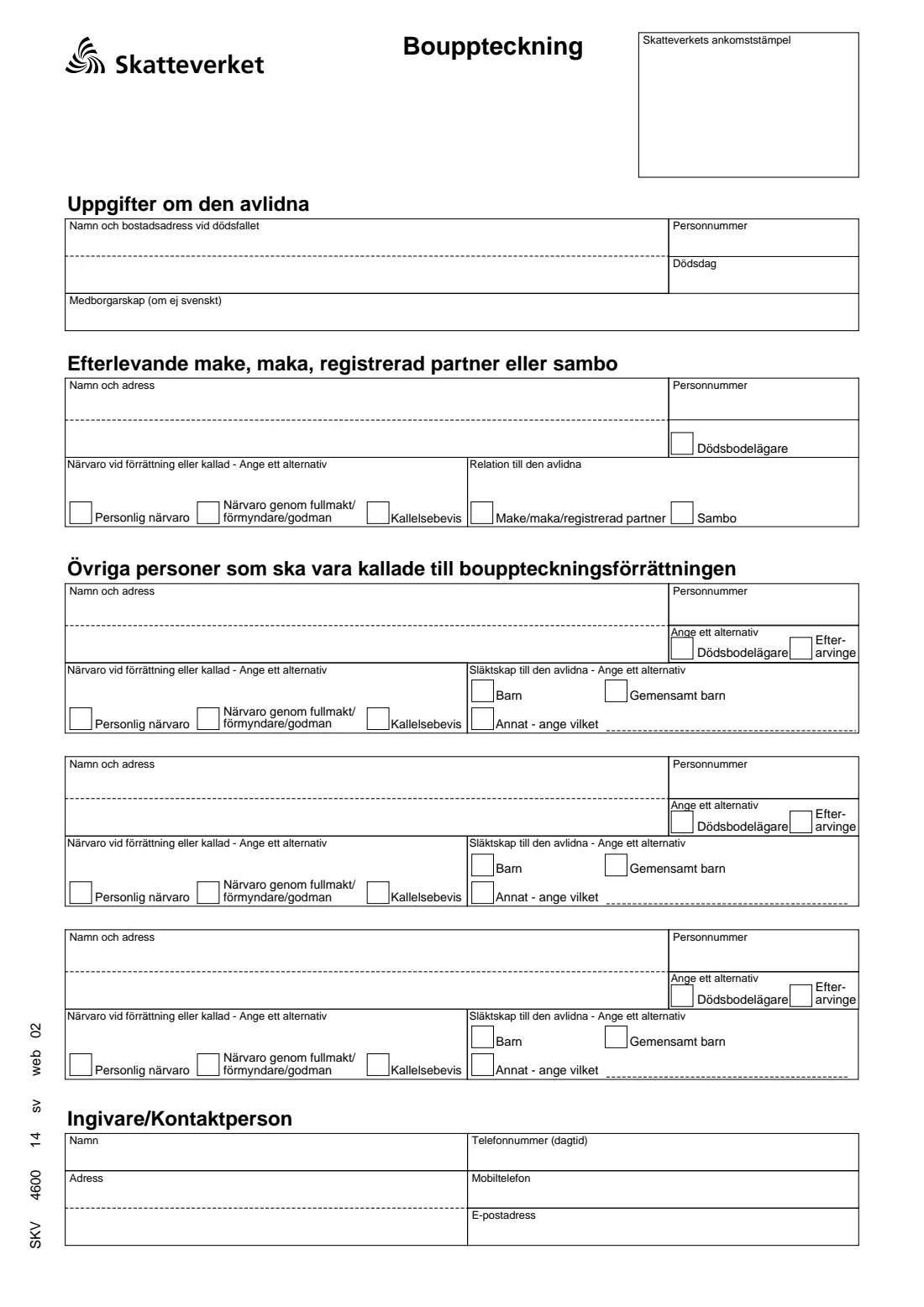
- The deceased (Uppgifter om den avlidna)The estate (dödsboet)
- Surviving spouse, registered partner or cohabitee (Efterlevande make, maka, registrerad partner eller sambo)The estate (dödsboet)
- Other person who must be summoned: 1 (Övriga personer som ska vara kallade)The estate (dödsboet)
- Other person who must be summoned: 2 (Övriga personer som ska vara kallade)The estate (dödsboet)
- Other person who must be summoned: 3 (Övriga personer som ska vara kallade)The estate (dödsboet)
- Person submitting the inventory / contact (Ingivare/Kontaktperson)The estate (dödsboet)
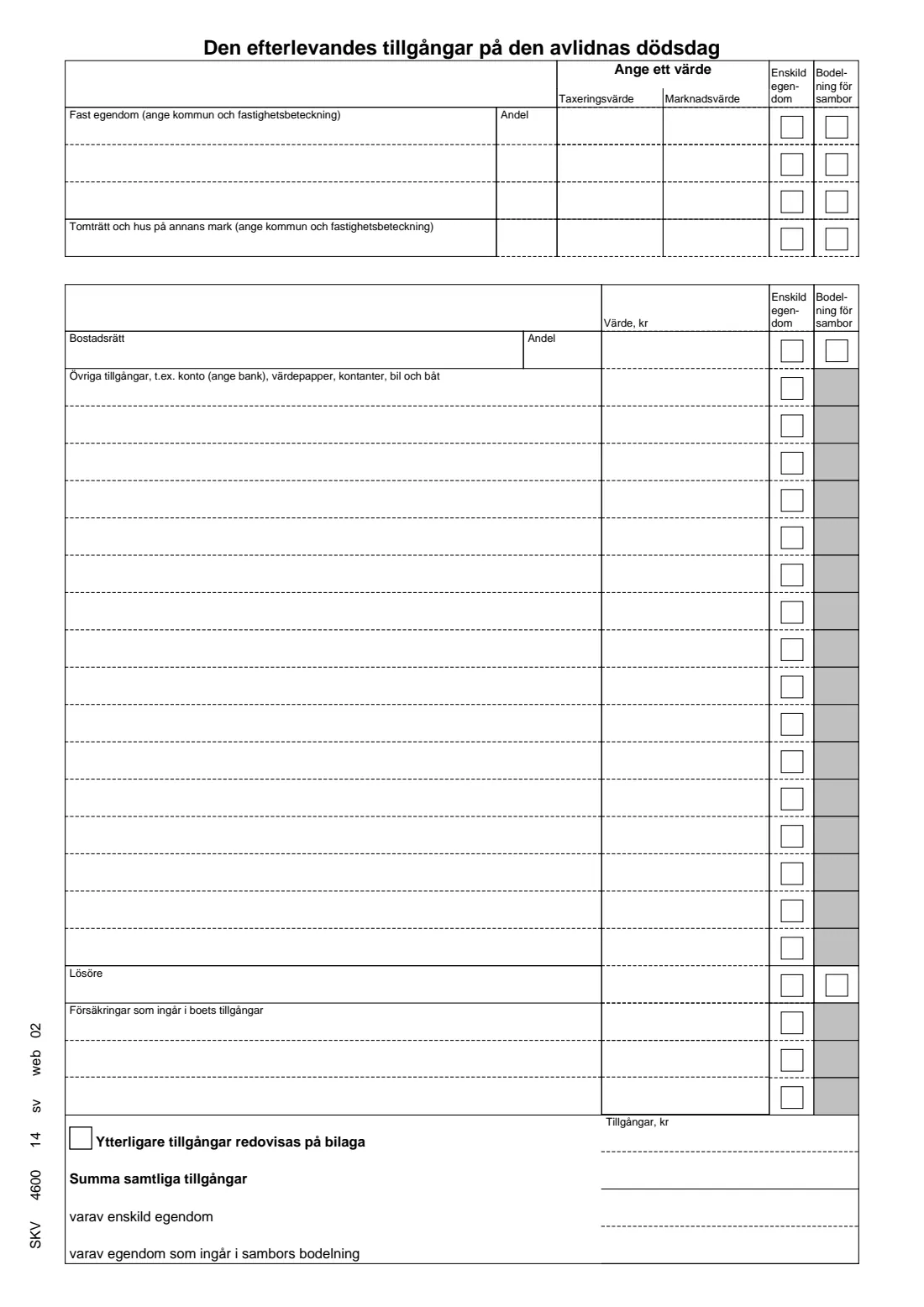
- Real property: the deceased's assets on the day of death (Fast egendom)The estate (dödsboet)
- Tenant-owned flat: the deceased's assets (Bostadsrätt)The estate (dödsboet)
- Other assets, household goods and insurance: the deceased's assets on the day of deathThe estate (dödsboet)
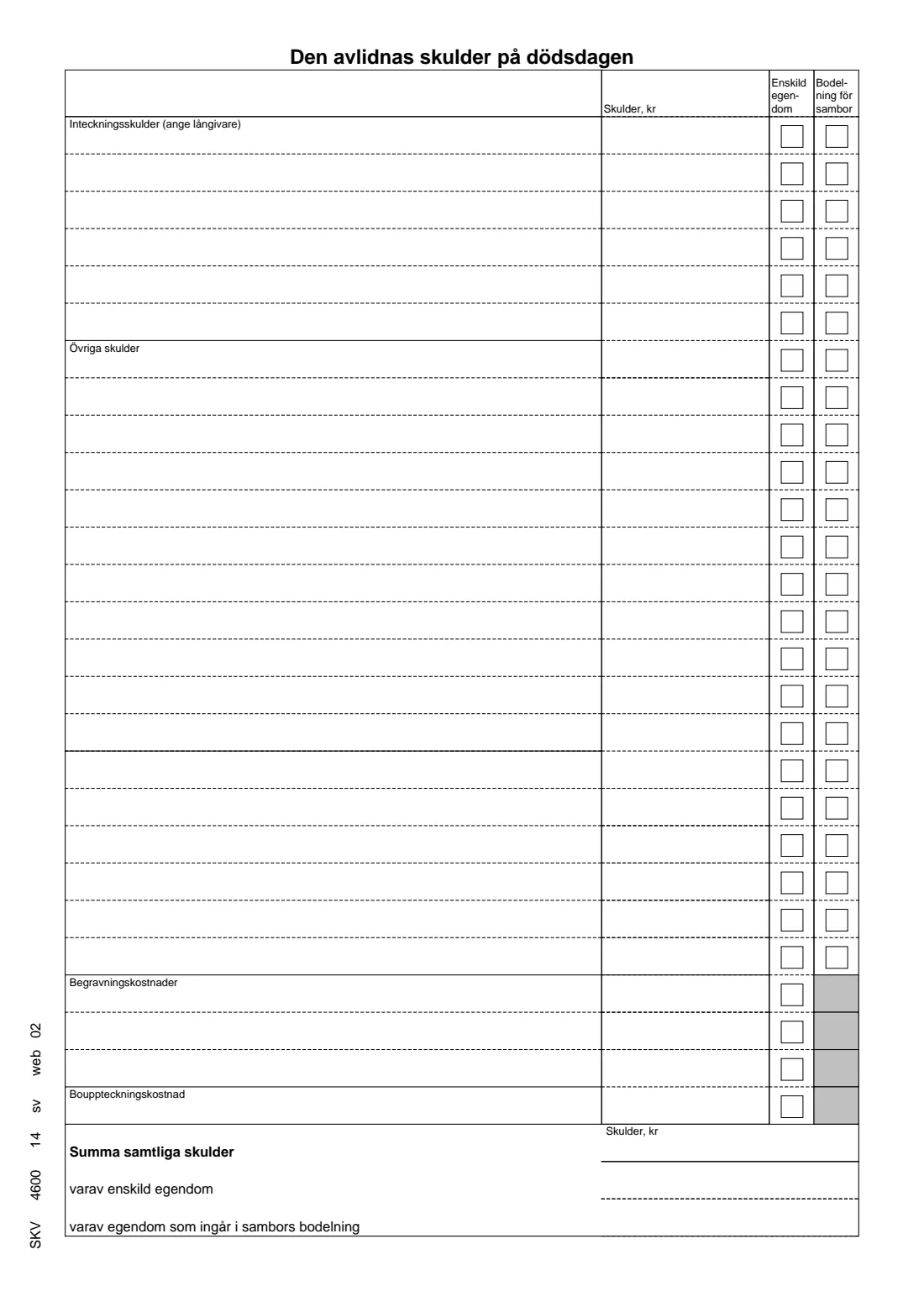
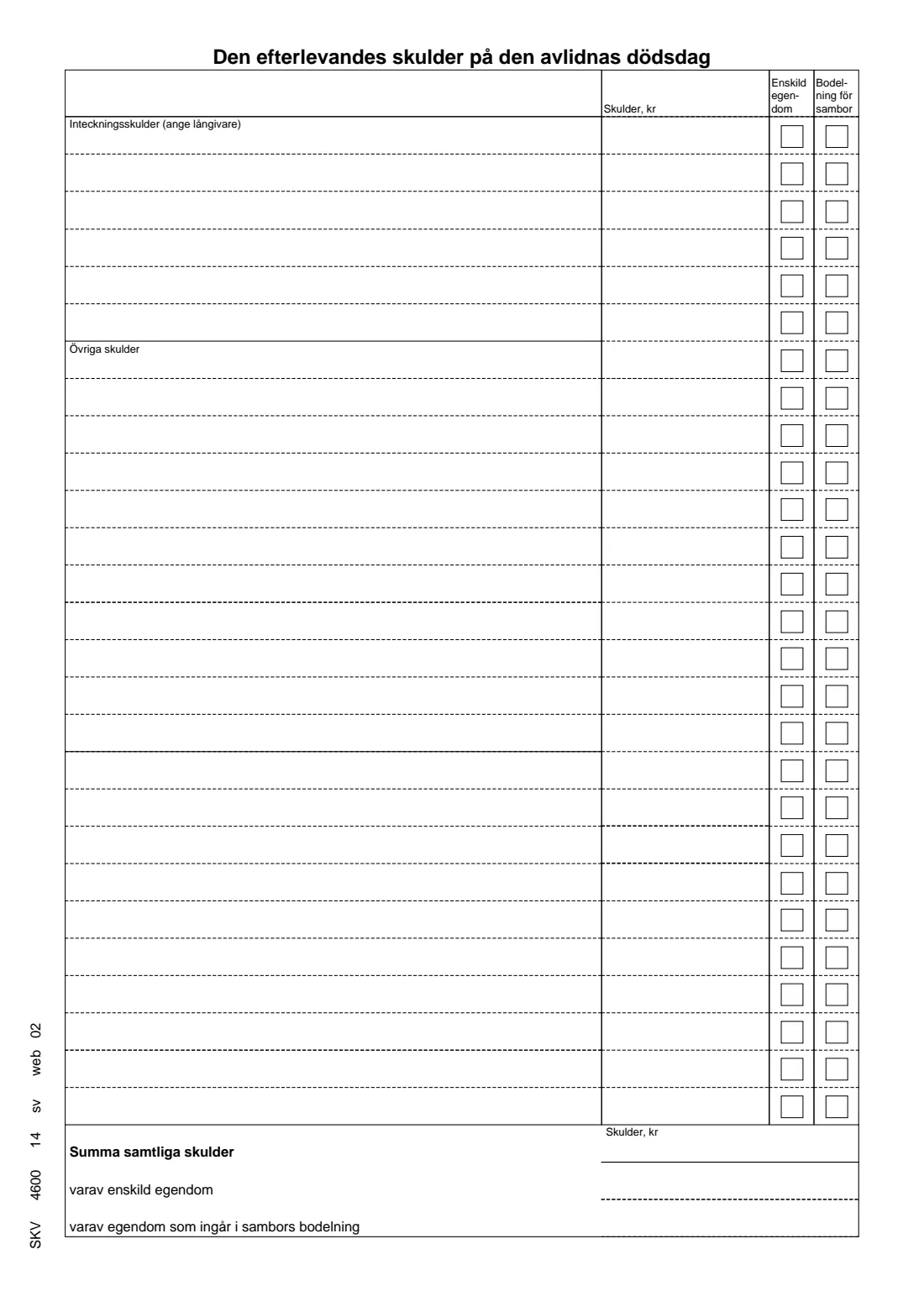
- Debts: the deceased's debts on the day of death (Skulder på dödsdagen)The estate (dödsboet)
- Real property: the surviving spouse's or cohabitee's assets on the day of death (Fast egendom)The estate (dödsboet)
- Tenant-owned flat: the surviving spouse's or cohabitee's assets (Bostadsrätt)The estate (dödsboet)
- Other assets, household goods and insurance: the surviving spouse's or cohabitee's assets on the day of deathThe estate (dödsboet)
- Debts: the surviving spouse's or cohabitee's debts on the day of death (Skulder på dödsdagen)The estate (dödsboet)
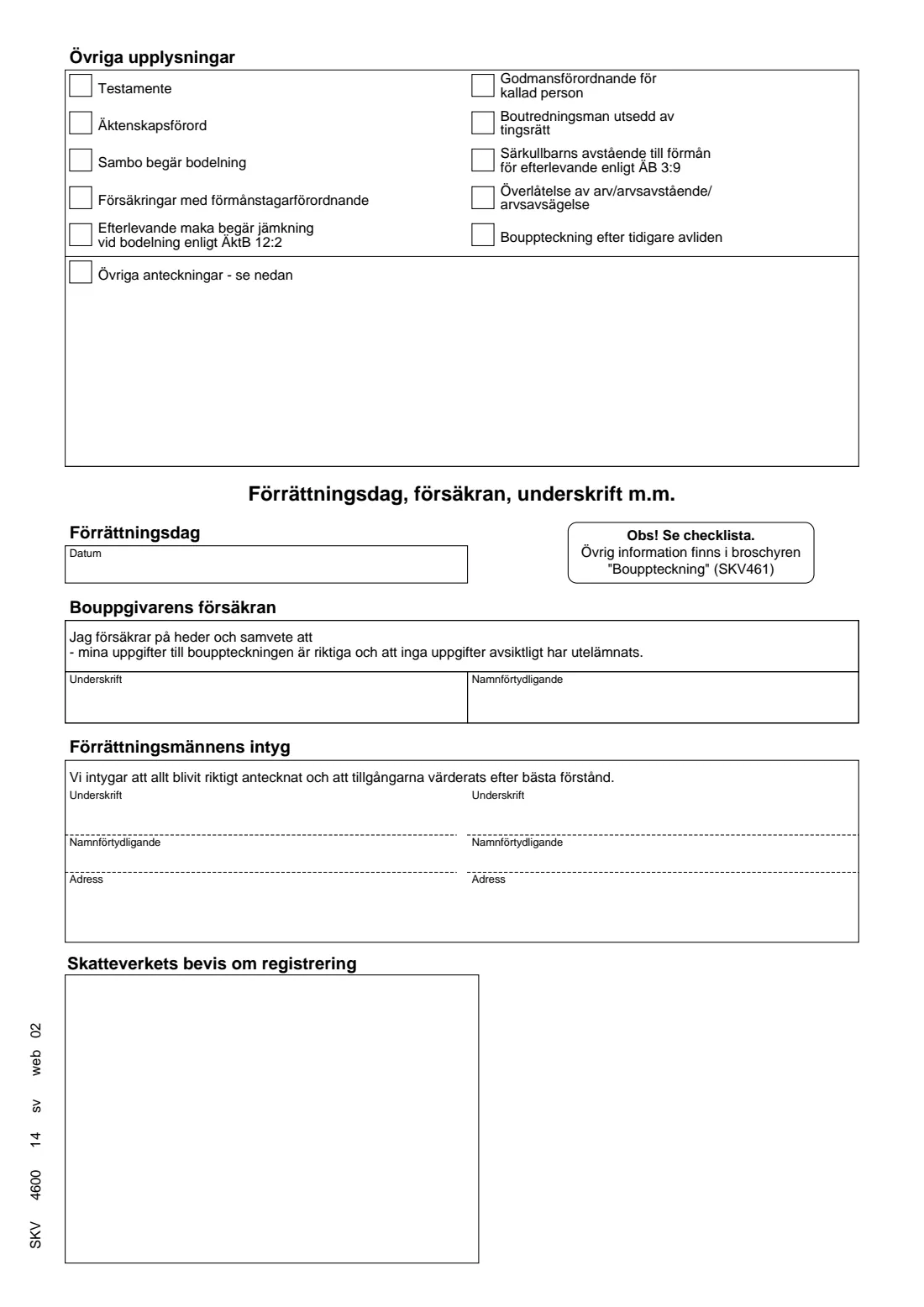
- Other information (Övriga upplysningar)The estate (dödsboet)
- Inventory meeting, declaration and signatures (Förrättningsdag, försäkran, underskrift)The estate (dödsboet)
How to fill out SKV 4600 - Estate inventory (bouppteckning), step by step
1 The deceased and the survivor
The deceased's name and address at the time of death, personal identity number, date of death and citizenship, if not Swedish. Then the surviving spouse, registered partner or cohabitee: name, address, personal identity number, whether they are an estate shareholder, how they took part in the meeting, and the relationship.
2 Everyone else summoned
Up to three other people, each with name, address and personal identity number. Say whether each is an estate shareholder, a reversionary heir, or neither. Then how they took part, and their relationship to the deceased: child, child of both spouses, or something else. More people go on an attachment.
3 Person submitting and contact
Who Skatteverket should contact and send the registered inventory to, with address, phone numbers and email.
4 The deceased's assets
Real property with its municipality, property designation, share and one value, either the tax assessment value or the market value. Then a tenant-owned flat; other assets such as bank accounts, securities, cash, cars and boats; household goods; and insurance that belongs to the estate. Tick the rows that are separate property (enskild egendom) or part of a cohabitees' property division. FileIt calculates the totals.
5 The deceased's debts
Mortgage debts with the lender, other debts, the funeral costs and the cost of the inventory, with the same ticks. FileIt calculates the totals here too.
6 The survivor's assets and debts
The surviving spouse's or cohabitee's own assets and debts on the day of death, set out the same way, for the property division (bodelning).
7 Other information
Tick what applies, such as a will, a prenuptial agreement, a cohabitee's request for a division, insurance with a named beneficiary, an appointed good man or estate administrator, or a waiver or transfer of inheritance. Add notes below. Insurance with a named beneficiary belongs here, not among the assets.
8 Meeting date and signatures
The date of the inventory meeting. The informant confirms on their honour that the information is correct and nothing was left out on purpose. The two estate assessors certify that everything was recorded correctly and valued to the best of their judgement. All three sign by hand. FileIt prints their names and the assessors' addresses.
Common mistakes to avoid
- Leaving out someone who should have been summoned, or a personal identity number. Since 1 July 2026 every summoned person needs one.
- Using an heir or estate shareholder as an estate assessor. The checklist says they may not be one.
- Listing insurance with a named beneficiary as an estate asset. It goes under Other information.
- Giving both a tax value and a market value for a property. The form asks for one.
- Valuing assets at a date other than the day of death.
- Forgetting the survivor's own assets and debts when the deceased was married.
- Sending the inventory without the documents it refers to, such as wills, powers of attorney and proof of summons.
After you fill it out
Print the inventory. The informant and both estate assessors sign by hand.
Gather the attachments from page 1's checklist: certified copies of wills, powers of attorney, proof of summons and transfers of inheritance, plus copies of a registered prenuptial agreement or appointment orders. Under the new law a copy of the inventory itself is no longer needed.
Send it to Skatteverket, Bouppteckningssektionen, 871 87 Härnösand, as printed on the form. FileIt doesn't send it.
Keep the filled copy in your FileIt vault with the death certificate and the estate's papers. Once registered, the inventory is what the estate's bank and others ask to see.
Fill out SKV 4600 - Estate inventory (bouppteckning) online with FileIt
- Pick the person. Choose someone from People and FileIt fills in their name, date of birth, address and other details it already knows.
- Answer plain-language questions. One part of the form at a time, with the official help text beside each question — 464 fields in all. Your answers save as you go.
- Check the live preview. Watch your answers land on the real Skatteverket (Swedish Tax Agency) form, and let FileIt do any worksheet arithmetic.
- Generate the official PDF. FileIt prints your answers into the agency’s own PDF and files it in that person’s folder in your vault.
FileIt fills the form — it never files or submits anything for you. Deliver the finished form to whoever asked for it, the way the form’s instructions say.
Start SKV 4600 - Estate inventory (bouppteckning) now — it’s freeSKV 4600 - Estate inventory (bouppteckning): frequently asked questions
What is a bouppteckning?
A Swedish estate inventory. It records who the heirs are and what the deceased owned and owed on the day of death. It's drawn up at an inventory meeting, signed by the informant and two estate assessors, and registered by Skatteverket.
Can I still use this form after the 1 July 2026 law change?
Yes. Skatteverket's form page says the form hasn't been updated for the new rules on digital estate inventories but works fine. Give every summoned person's personal identity or coordination number, and you no longer need to send a copy of the inventory.
Who can be an estate assessor (förrättningsman)?
Two people with knowledge of the matter who are not estate shareholders or reversionary heirs. The form's checklist says heirs may not be assessors.
Who is the informant (bouppgivare)?
The person who knows the estate best, often the surviving spouse or someone who lived with or looked after the deceased. They confirm the information on their honour.
Does the survivor's property go in too?
Yes, when the deceased was married. The survivor's assets and debts on the day of death go on pages 5 and 6, because they matter for the property division. For a cohabitee, the property in a cohabitees' division is marked.
What if there isn't room for everything?
List more summoned people, assets or debts on an attachment. On the asset pages, tick 'Ytterligare tillgångar redovisas på bilaga' and give the attachment's total, which FileIt adds to the sum.
Does FileIt submit the inventory to Skatteverket?
No. FileIt fills Skatteverket's PDF and saves it in your vault. The informant and assessors sign it, and you send it to Skatteverket in Härnösand yourself.
Official sources
- Blank form (PDF), published by Skatteverket (Swedish Tax Agency): https://www1.skatteverket.se/lcmp2/lc_webapp/secure/PdfServlet.do?formularID=4600&sprak=sv&format=pdf
- Official instructions and guidance: https://www.skatteverket.se/privat/etjansterochblanketter/blanketterbroschyrer/blanketter/info/4600
- Edition shown on this page: SKV 4600 14 sv web 02 (checked 2026-10-19).
FileIt is not affiliated with or endorsed by Skatteverket (Swedish Tax Agency) or any government. This page explains the form in general terms and is not legal, tax or immigration advice. Always read the official instructions, and check that you are using the edition the recipient accepts. Page last reviewed 2026-10-19.