What is PCC-3 civil-law transactions tax return?
Poland's civil-law transactions tax (podatek od czynności cywilnoprawnych, PCC) applies to transactions such as buying a car or other goods from a private person, a loan, an exchange, setting up a mortgage, or a company agreement. When no notary collects the tax, the taxpayer files the PCC-3 return with the tax office and pays the tax within 14 days of the date the tax obligation arose. For a used car bought from a private seller, that is usually the buyer, at 2% of the car's market value.
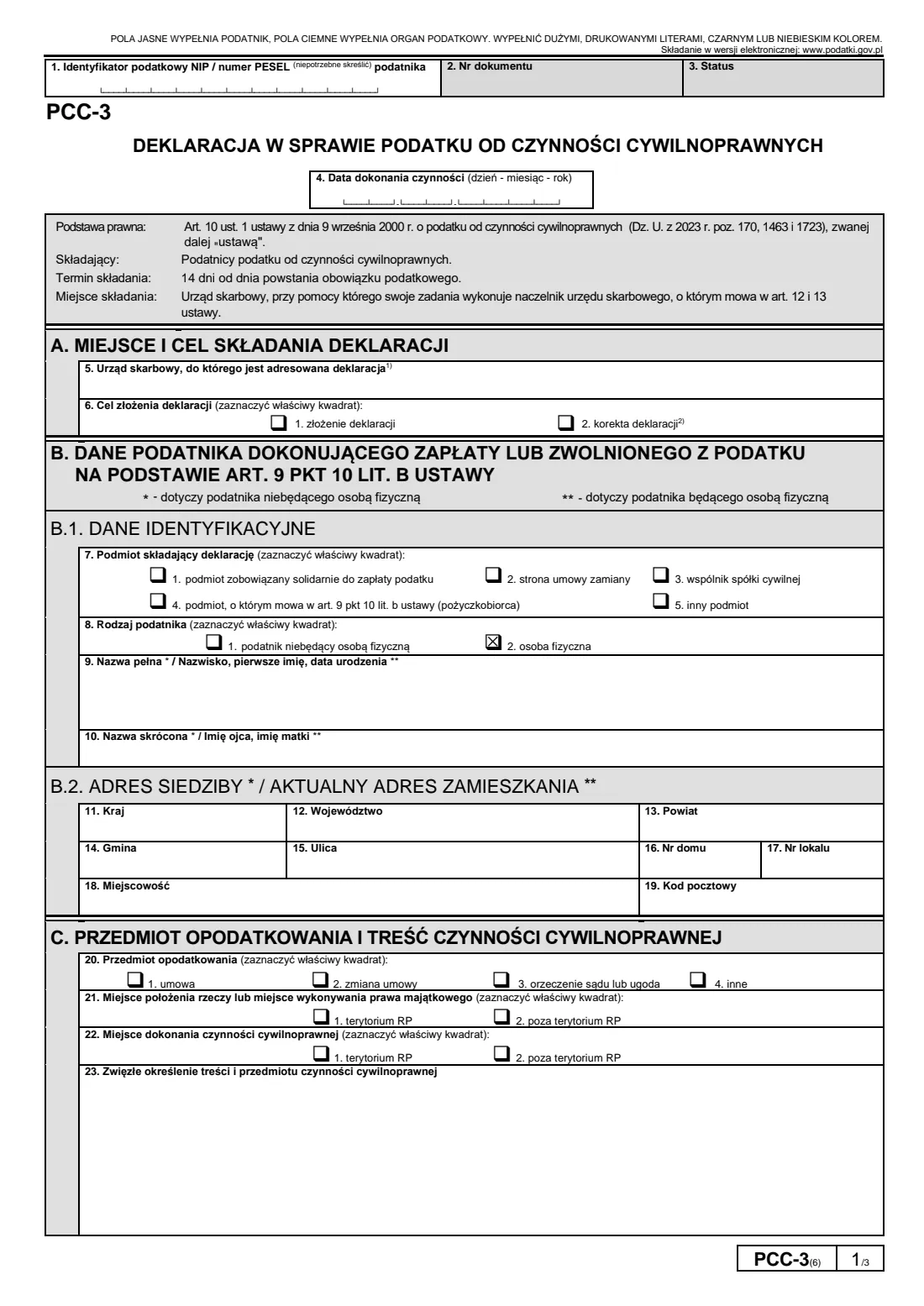
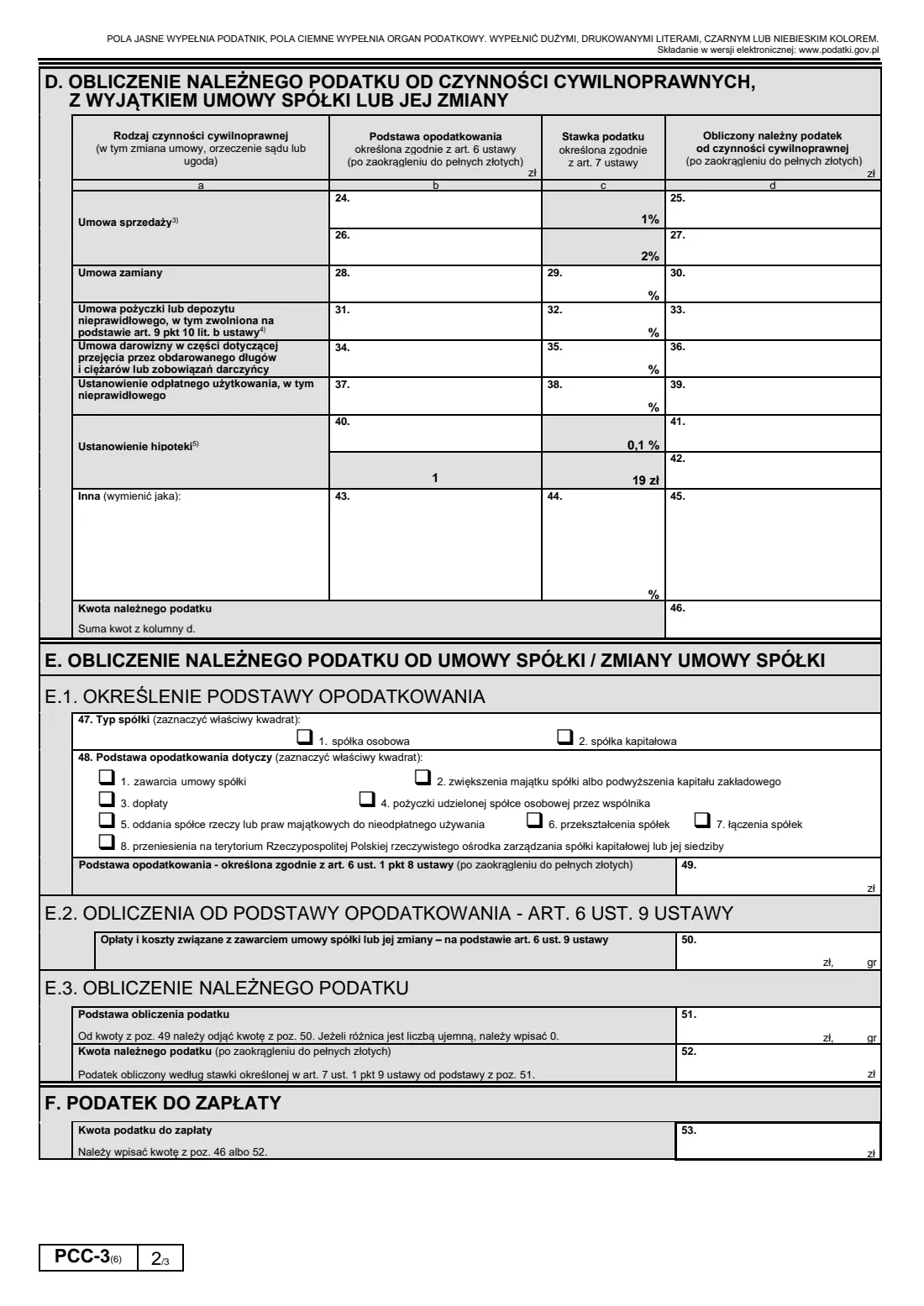
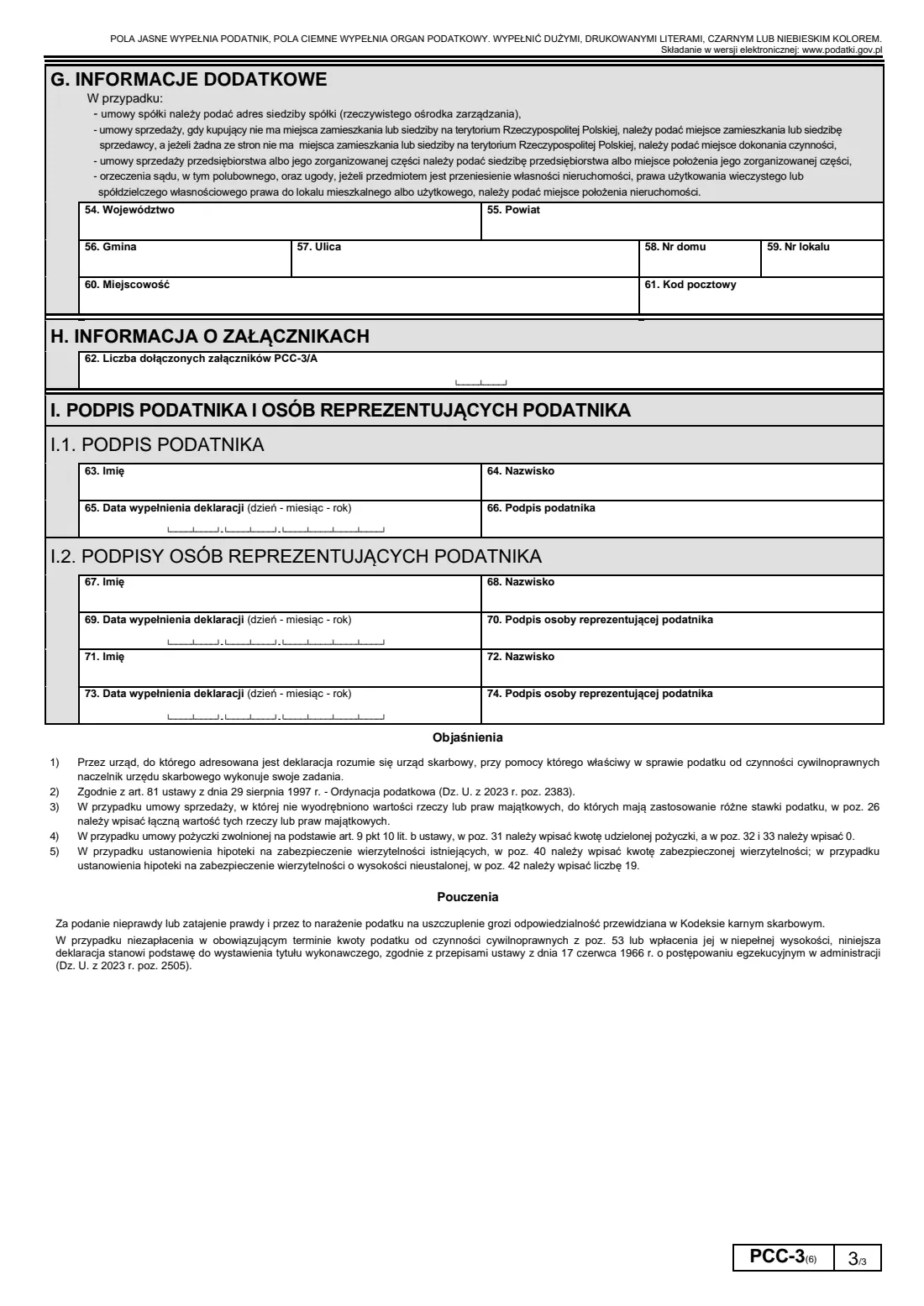
The PCC-3(6) form has three pages: your identifier (PESEL or NIP) and the date of the transaction, the tax office and purpose (first filing or correction), your personal details and address, a description of the transaction, the calculation in part D (sales, exchange, loan, gift with debts, usufruct, mortgage or another transaction) or part E (a company agreement), the tax to pay, and your signature. The form asks for capital letters.
FileIt asks the questions in English with the Polish wording beside them and prints your answers in capitals into the Ministry of Finance's own PDF. It checks your PESEL or NIP and the date of birth it encodes, crosses out the identifier you don't use, works out each tax amount and the total (base times rate, rounded to whole złoty), and saves the finished PDF in your FileIt vault. FileIt never files or pays anything: you file the return and pay the tax yourself.
- Who files
- The taxpayer, e.g. the buyer of a used car or the borrower
- Filed with
- Your tax office (urząd skarbowy), on paper or online
- Deadline
- 14 days from the tax obligation (printed on the form)
- Signatures
- You sign item 66
- Edition
- PCC-3(6)
Who needs to fill out PCC-3 civil-law transactions tax return?
- Private individuals who bought a used car, motorbike or other movable goods from a private seller in Poland.
- Borrowers under a loan agreement, including family loans claimed as exempt under art. 9(10)(b), which must still be reported.
- Parties to an exchange agreement, people taking over a donor's debts in a gift, or paying for usufruct.
- Owners setting up a mortgage, and partners making a civil-law partnership agreement or contribution.
When to use PCC-3 civil-law transactions tax return
- Within 14 days of signing a contract that is subject to PCC, when no notary collects the tax.
- When you claim the exemption for a loan from close family, so it is reported in time.
- To correct a PCC-3 you already filed (korekta deklaracji).
What you need before you start
- Your PESEL (or NIP if you run a business) and date of birth.
- Your parents' first names and your current home address.
- The name of your tax office.
- The contract date and a short description, e.g. car make, model, year and VIN.
- The tax base in whole złoty: for a sale, the market value; for a loan, the amount lent.
- For a company agreement: the base and the fees and costs that may be deducted.
What’s on PCC-3 civil-law transactions tax return
The 2024 edition has 3 pages. FileIt asks for it in 10 parts, and it is signed by Taxpayer:
- Taxpayer's identifier and date of the transactionTaxpayer
- A. Where and why you file (Miejsce i cel składania deklaracji)Taxpayer
- B. Taxpayer (Dane podatnika)Taxpayer
- B.2 Current home address (Aktualny adres zamieszkania)Taxpayer
- C. The transaction (Przedmiot opodatkowania i treść czynności)Taxpayer
- D. Tax on the transaction, other than a company agreement (część D)Taxpayer
- E. Tax on a company agreement or its change (część E)Taxpayer
- F. Tax to pay (Podatek do zapłaty)Taxpayer
- G. Additional address (Informacje dodatkowe)Taxpayer
- H-I. Annexes and signature (Załączniki, podpis podatnika)Taxpayer
How to fill out PCC-3 civil-law transactions tax return, step by step
1 Header: PESEL / NIP and date (items 1 and 4)
Enter your PESEL, or your NIP if you use one; FileIt checks the check digit and crosses out the other word, as the form asks ('niepotrzebne skreślić'). The date of the transaction prints in the day-month-year boxes.
2 A. Tax office and purpose (items 5-6)
Name the tax office the return is addressed to and tick first filing or correction.
3 B. Taxpayer (items 7-19)
Say who is filing, for example 'inny podmiot' for the only buyer of a car or 'pożyczkobiorca' for an exempt family loan. FileIt prints your surname, first name and date of birth in item 9, your parents' first names in item 10, and your current address.
4 C. The transaction (items 20-23)
Tick what is taxed (usually 'umowa', an agreement), whether the thing is in Poland and where the transaction took place, and describe it briefly.
5 D. Tax calculation (items 24-46)
Fill in the row for your transaction. A used car goes in item 26 at 2%. Loans, exchanges, gifts with debts and usufruct have a rate to choose; a mortgage is 0.1%, or a fixed 19 zł for a claim of undetermined amount. FileIt works out each amount and the total in item 46.
6 E. Company agreement (items 47-52)
Only for a company or partnership agreement: the company type, what the base concerns, the base, deductible costs, and the tax at 0.5%, worked out by FileIt.
7 F-I. Tax to pay, extra address and signature
Item 53 is the tax to pay. Part G is only for the special cases listed on page 3. Your name prints in items 63-64, the date in item 65, and you sign item 66.
Common mistakes to avoid
- Filing after the 14-day deadline.
- Using the price in the contract as the base when the car's market value is higher; the base is the market value.
- Putting a car sale in item 24 (1%) instead of item 26 (2%).
- Not reporting an exempt family loan on time.
- Forgetting to cross out NIP or PESEL; FileIt does this for you.
After you fill it out
Sign item 66 and file the return with your tax office in person or by post, or file online instead through e-Urząd Skarbowy.
Pay the tax in item 53 to your individual tax account (mikrorachunek podatkowy) by the same 14-day deadline.
Keep the PDF FileIt saves in your vault with the contract, for example next to the car's registration papers.
Fill out PCC-3 civil-law transactions tax return online with FileIt
- Pick the person. Choose someone from People and FileIt fills in their name, date of birth, address and other details it already knows.
- Answer plain-language questions. One part of the form at a time, with the official help text beside each question — 70 fields in all. Your answers save as you go.
- Check the live preview. Watch your answers land on the real Ministerstwo Finansów — Ministry of Finance of Poland (MF) form, and let FileIt do any worksheet arithmetic.
- Generate the official PDF. FileIt prints your answers into the agency’s own PDF and files it in that person’s folder in your vault. Sign it, or send it for e-signature.
FileIt fills the form — it never files or submits anything for you. Deliver the finished form to whoever asked for it, the way the form’s instructions say.
Start PCC-3 civil-law transactions tax return now — it’s freePCC-3 civil-law transactions tax return: frequently asked questions
Do I need PCC-3 when buying a used car?
When you buy a car from a private person in Poland, the buyer usually pays 2% of its market value and files PCC-3 within 14 days. If you're unsure whether your purchase is taxed, check with your tax office.
Can I file it on paper?
Yes. The form says it can be filed electronically at podatki.gov.pl, and the paper form is also accepted. FileIt prepares the paper version.
Does FileIt calculate the tax?
Yes. FileIt multiplies each base by its rate, rounds to whole złoty and adds up item 46 or works out item 52, then copies the result to item 53. Check the base and rate you enter.
What if several people bought the car together?
Each buyer is jointly liable; one can file and tick item 7 option 1. The other taxpayers go on the PCC-3/A annex, which FileIt doesn't fill in, and item 62 counts the annexes.
Can a company use this FileIt version?
FileIt's version is for private individuals (item 8, 'osoba fizyczna'). A company or other entity should use the full form or e-filing.
Does FileIt file or pay for me?
No. FileIt never submits anything: you file the signed return and pay the tax yourself.
Official sources
- Blank form (PDF), published by Ministerstwo Finansów — Ministry of Finance of Poland (MF): https://www.podatki.gov.pl/media/1crptyvc/pcc-3-06-08.pdf
- Official instructions and guidance: https://www.podatki.gov.pl/pcc-sd/
- Edition shown on this page: PCC-3(6) (checked 2026-10-19).
FileIt is not affiliated with or endorsed by Ministerstwo Finansów — Ministry of Finance of Poland (MF) or any government. This page explains the form in general terms and is not legal, tax or immigration advice. Always read the official instructions, and check that you are using the edition the recipient accepts. Page last reviewed 2026-10-19.