What is PIT-2 employee tax statements?
PIT-2 (Oświadczenia / wnioski podatnika dla celów obliczania miesięcznych zaliczek na podatek dochodowy od osób fizycznych) is the form you hand to whoever pays you — your employer, or the client under a contract of mandate (umowa zlecenia) — so it deducts the right monthly income tax advances. It is not a tax return and it doesn't go to the tax office. It collects, in one place, a set of separate statements and requests, and you fill in only the parts you need.
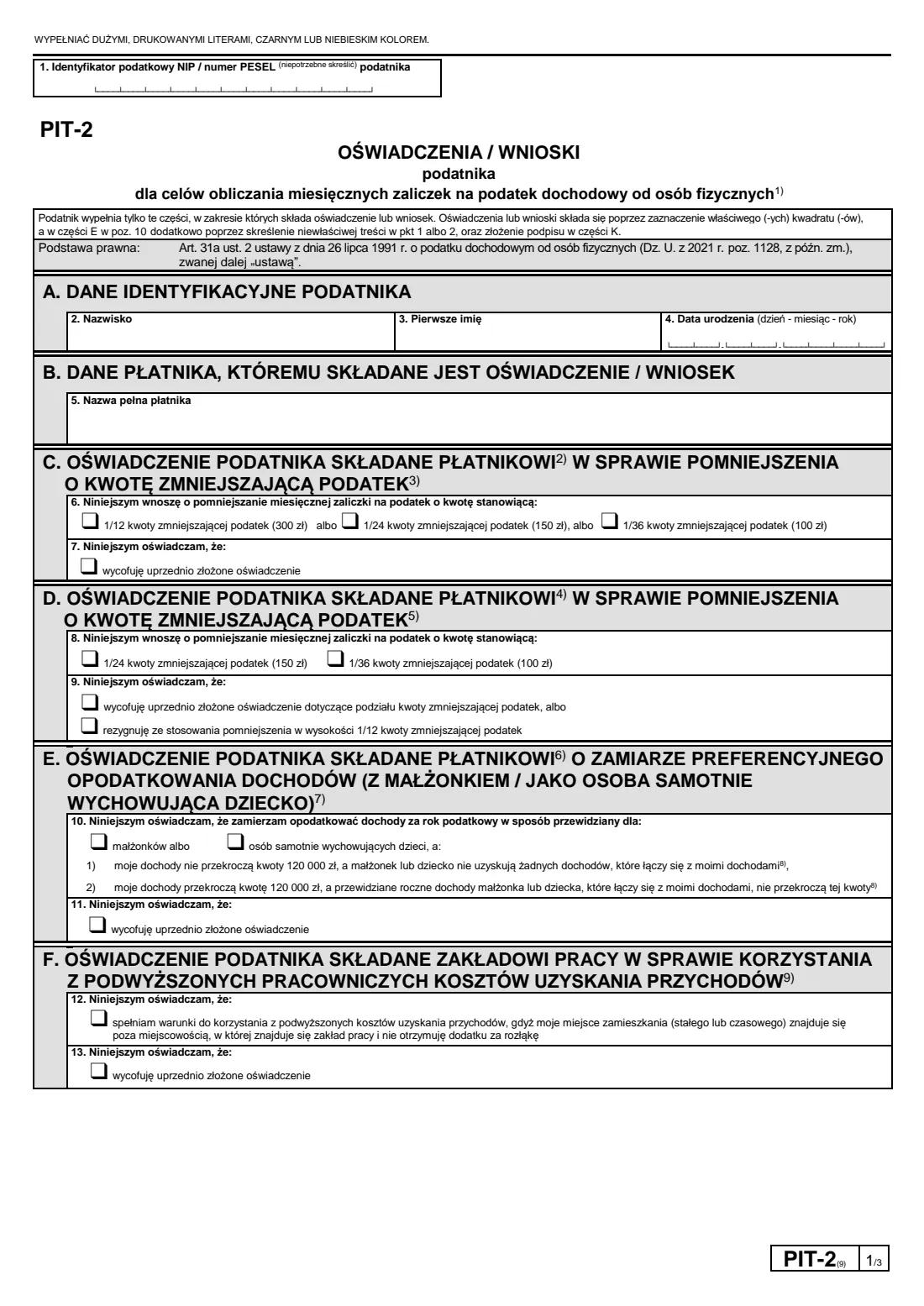
The best-known part is part C, where you ask a payer to reduce each monthly advance by part of the annual tax-reducing amount (kwota zmniejszająca podatek): 1/12 (300 zł), 1/24 (150 zł) or 1/36 (100 zł), as printed on the PIT-2(9). Other parts cover joint taxation with a spouse or as a single parent, higher costs for commuters, the return relief, the 4+ family relief and the working seniors' relief, opting out of the relief for young people or of standard employee costs, dropping 50% authors' costs, and asking for no advances at all when you expect a low income.
FileIt walks you through each part in plain English, pre-fills your name and date of birth from the People in your FileIt vault and your employer's name from their record, checks your PESEL or NIP check digit and that your PESEL matches your date of birth, and prints everything in capitals into the Ministry's official PIT-2(9) PDF. It even crosses out the words the form tells you to strike out. The finished PDF is saved in your vault; you sign it (or send it for e-signature if your employer accepts that) and hand it over yourself.
- Who fills it
- The taxpayer: an employee, or someone paid under a contract of mandate or similar
- Given to
- The payer — your employer or other payer (płatnik), not the tax office
- When
- When you start work, or whenever you want to change or withdraw an earlier statement
- Signatures
- The taxpayer signs and dates part K
- Edition
- PIT-2(9)
- Pages
- 3 (two form pages and one page of explanations)
Who needs to fill out PIT-2 employee tax statements?
- Employees in Poland who want their employer to apply the monthly tax-reducing amount to their pay.
- People with more than one job or contract who need to split the tax-reducing amount between payers (1/24 or 1/36 each) so they don't get too much reduction in a month.
- Taxpayers who plan to file jointly with a spouse, or as a single parent, and want the payer to take that into account.
- Employees who commute from another town and qualify for the higher standard employee costs.
- People claiming the return relief (ulga na powrót), the relief for families with four or more children, or the working seniors' relief through their payer.
- Young workers who would rather not use the relief for young people during the year, or anyone who wants to drop employee costs or 50% authors' costs from their advances.
- Anyone who expects their income on the tax scale to stay within the 30 000 zł figure printed on the form and wants no advances deducted for the year.
When to use PIT-2 employee tax statements
- When you start a new job or a new contract of mandate and want the payer to reduce your advances.
- When your situation changes — a second job, marriage, a child, moving further from work — because the form says you must change or withdraw a statement when circumstances affecting your advances change.
- At the start of a tax year you want to claim an exemption for, such as the return relief for up to four years.
- When you want to withdraw a statement or request you made earlier: each part has its own 'withdraw' box.
- Any time during the year — the payer applies it from the month after the month it receives it at the latest.
What you need before you start
- Your PESEL number, or your NIP if you use one because you run a business or are registered for VAT.
- Your surname, first given name and date of birth.
- The payer's full name, as on your contract or payslip.
- Knowing how many payers you want to apply the tax-reducing amount, so you can choose 1/12, 1/24 or 1/36.
- For part E: whether you'll file jointly with your spouse or as a single parent, and roughly whether your income will stay within 120 000 zł.
- For part G: which exemption you qualify for, and for the return relief the years you want it applied.
- For part J: the tax year and a realistic idea of your expected income.
What’s on PIT-2 employee tax statements
The 2026 edition has 3 pages. FileIt asks for it in 11 parts, and it is signed by Taxpayer:
- A. Taxpayer's identification (Dane identyfikacyjne podatnika)Taxpayer
- B. The payer you give it to (Dane płatnika)Taxpayer
- C. Monthly tax-reducing amount (Pomniejszenie o kwotę zmniejszającą podatek)Taxpayer
- D. Splitting the tax-reducing amount — cooperatives and other payers (część D)Taxpayer
- E. Joint taxation with a spouse or as a single parent (część E)Taxpayer
- F. Higher employee costs for commuters (część F)Taxpayer
- G. Tax exemptions: return relief, 4+ families, working seniors (część G)Taxpayer
- H. Don't apply the youth relief or employee costs (część H)Taxpayer
- I. Stop applying 50% authors' costs (część I)Taxpayer
- J. No tax advances this year (część J)Taxpayer
- K. Signature (Podpis)Taxpayer
How to fill out PIT-2 employee tax statements, step by step
1 1. Tax identifier (NIP / PESEL)
At the top you write your tax identifier in the 11 boxes. Most individuals use their PESEL; you use NIP only if you have one for business or VAT. The form says 'niepotrzebne skreślić' — cross out whichever of NIP or PESEL you didn't use. FileIt works out which one you entered from its length and strikes out the other word for you.
FileIt also checks the number's check digit, and for a PESEL, that the date of birth coded in it matches the date you enter in part A.
2 A. Taxpayer's identification (Dane identyfikacyjne podatnika)
Your surname, your first given name only, and your date of birth in day-month-year boxes. The form asks for capital letters in black or blue; FileIt prints your answers in capitals, keeping Polish letters such as Ł, Ż and Ó.
3 B. Payer's details (Dane płatnika)
The full name of the employer or other payer you are giving the form to. If you have several payers you give each one its own PIT-2, filled in only with the parts that apply to that payer.
4 C. Tax-reducing amount (pomniejszenie o kwotę zmniejszającą podatek)
Item 6 asks the payer to reduce each monthly advance by 1/12, 1/24 or 1/36 of the annual tax-reducing amount — 300 zł, 150 zł or 100 zł on this edition. Item 7 withdraws an earlier statement. Part C goes to your employer or to a payer under art. 41(1) of the Act, such as a client under a contract of mandate.
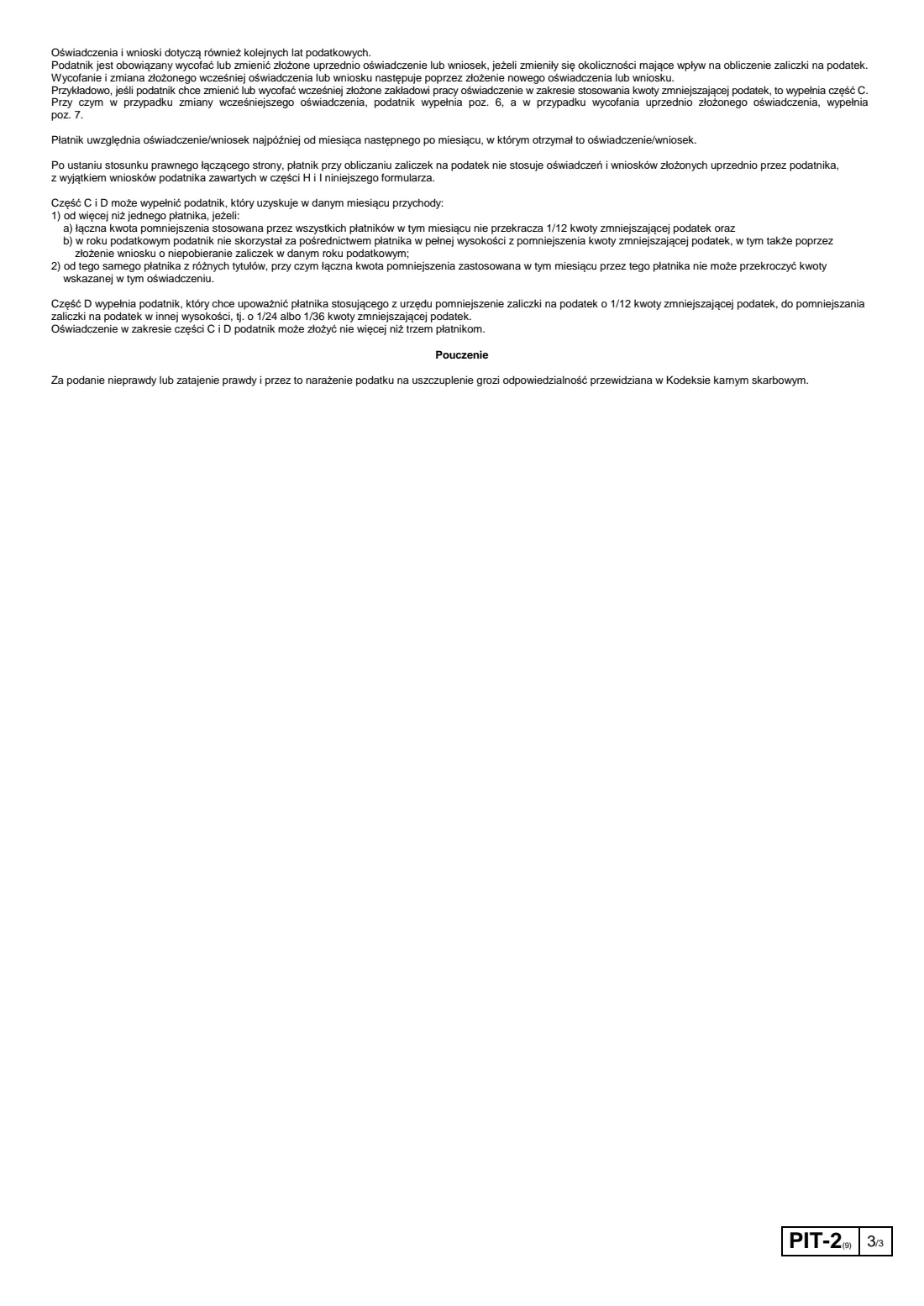
The explanations on page 3 matter here: if you earn from more than one payer, the reductions all of them apply in a month together must not exceed 1/12, and you may give this statement to no more than three payers.
5 D. Tax-reducing amount — cooperatives and other payers
Part D is narrower. It goes to agricultural production cooperatives and other farming cooperatives, to an enforcement authority paying wages instead of the employer, or to a body that took over an employer's obligations without being its legal successor. Such a payer applies 1/12 automatically; here you can ask for 1/24 or 1/36 instead, withdraw an earlier split, or stop the reduction altogether.
6 E. Joint taxation or single parent (preferencyjne opodatkowanie)
Item 10 tells your employer you intend to be taxed jointly with your spouse, or as a single parent. You then keep one of two statements about income and cross out the other: 1) your income won't exceed 120 000 zł and your spouse or child has no income combined with yours, or 2) your income will exceed 120 000 zł but the expected income of your spouse or child combined with yours won't. FileIt strikes out the statement that doesn't apply. Item 11 withdraws an earlier statement.
7 F. Higher employee costs (podwyższone koszty uzyskania przychodów)
Item 12 says you qualify for higher employee costs because your permanent or temporary home is outside the town where your workplace is and you don't receive a separation allowance. Item 13 withdraws it. This part goes to your employer.
8 G. Exemptions under art. 21(1)(152)-(154)
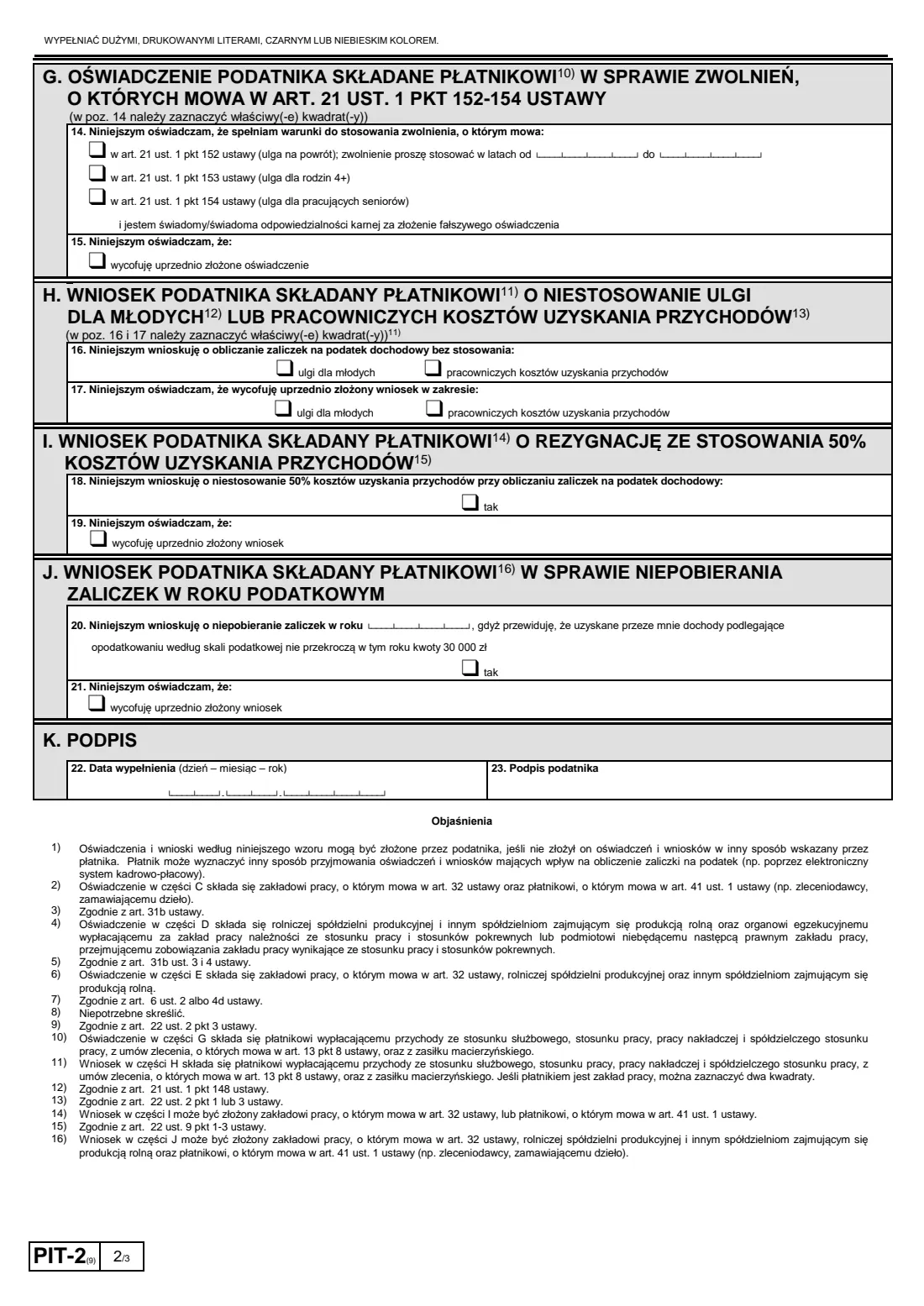
Tick every exemption you qualify for: the return relief for people moving their residence back to Poland (with the years you want it applied — at most four consecutive years), the relief for families with four or more children, and the relief for working seniors. You make this statement aware of criminal liability for a false one. Item 15 withdraws an earlier statement instead.
9 H. No youth relief or employee costs
Item 16 asks the payer to calculate your advances without the relief for young people and/or without employee costs — if the payer is your employer you may tick both. Item 17 withdraws an earlier request.
10 I. Dropping 50% costs
Item 18 asks the payer not to apply the 50% deductible costs (commonly used for copyright income) when calculating advances; item 19 withdraws that request. Unlike most PIT-2 statements, requests in parts H and I still apply after your contract with the payer ends.
11 J. No tax advances for the year
Item 20 asks the payer not to collect advances in a given tax year because you expect your income taxed on the tax scale not to exceed 30 000 zł that year (the figure printed on this edition). Item 21 withdraws the request. If your income ends up higher, you'll owe the tax in your annual return.
12 K. Signature (Podpis)
Enter the date you filled the form in (item 22) and sign it (item 23). FileIt pre-fills today's date.
Common mistakes to avoid
- Leaving both NIP and PESEL showing — the form asks you to cross out the one you didn't use (FileIt does this).
- Asking more than one payer to apply the full 1/12 reduction, so the combined monthly reduction exceeds 1/12 of the tax-reducing amount.
- Giving the part C statement to more than three payers.
- Ticking a choice and the matching 'withdraw' box in the same part.
- In part E, forgetting to cross out the income statement that doesn't apply to you.
- Claiming the return relief for more than four years, or with the years in the wrong order.
- Forgetting that statements carry over to later years — if things change, you must file a new PIT-2 to change or withdraw them.
- Giving the form to the tax office instead of to your payer.
After you fill it out
Sign and date part K. Most payers accept the printed, signed PIT-2 on paper; footnote 1 of the form also lets a payer set up another way to collect these statements, such as its HR or payroll system, so ask your employer how they want it. If they accept an electronically signed PDF, you can send it for e-signature from FileIt. FileIt never sends the form to your payer or to the tax office — you hand it over yourself.
The payer applies your statement or request from the month after the month it receives it at the latest. When the working relationship ends, the payer stops applying your statements, except for the requests in parts H and I.
Your filled PIT-2 is saved in your FileIt vault, so you have a record of what you told each payer. Statements also apply to later tax years, so review them when you change jobs, add a second contract, marry, or move.
Fill out PIT-2 employee tax statements online with FileIt
- Pick the person. Choose someone from People and FileIt fills in their name, date of birth, address and other details it already knows.
- Answer plain-language questions. One part of the form at a time, with the official help text beside each question — 25 fields in all. Your answers save as you go.
- Check the live preview. Watch your answers land on the real Ministerstwo Finansów — Ministry of Finance of Poland (MF) form, and let FileIt do any worksheet arithmetic.
- Generate the official PDF. FileIt prints your answers into the agency’s own PDF and files it in that person’s folder in your vault. Sign it, or send it for e-signature.
FileIt fills the form — it never files or submits anything for you. Deliver the finished form to whoever asked for it, the way the form’s instructions say.
Start PIT-2 employee tax statements now — it’s freePIT-2 employee tax statements: frequently asked questions
What is the PIT-2 form used for?
PIT-2 is how a Polish taxpayer tells an employer or other payer how to calculate monthly income tax advances. The best-known use is asking the payer to reduce each advance by part of the tax-reducing amount, but it also covers joint or single-parent taxation, commuter costs, several exemptions and opting out of certain reliefs.
Where do I send PIT-2 — to the tax office?
No. You give PIT-2 to your payer — your employer or, for example, the client under a contract of mandate. It does not go to the tax office. Your payer may also collect it through its own HR or payroll system.
Can I fill in PIT-2 online?
Yes. FileIt guides you through each part, checks your PESEL or NIP, and prints your answers into the Ministry of Finance's official PIT-2(9) PDF, which is saved in your vault. You then sign it and give it to your payer yourself; FileIt doesn't submit it.
Should I choose 1/12, 1/24 or 1/36?
The printed amounts on this edition are 300 zł (1/12), 150 zł (1/24) and 100 zł (1/36) a month. If you have one payer, 1/12 is the usual choice. With two or three payers you split it so that the total reduction all payers apply in a month doesn't exceed 1/12 — for example 1/24 with each of two payers.
Do I need to file a new PIT-2 every year?
Not necessarily. The form says statements and requests also apply to later tax years. You must change or withdraw them by filing a new PIT-2 when your circumstances change.
How do I withdraw a PIT-2 statement?
File a new PIT-2 and tick the 'wycofuję uprzednio złożone oświadczenie' (or 'wniosek') box in the part concerned. For example, to withdraw the tax-reducing amount statement you tick item 7 in part C.
Do I use NIP or PESEL on PIT-2?
Most individuals use their 11-digit PESEL. You'd use a 10-digit NIP only if you have one, for example because you run a business or are registered for VAT. Cross out whichever you didn't use.
When will my employer start applying it?
According to the form, the payer applies your statement or request from the month after the month in which it received it, at the latest.
Official sources
- Blank form (PDF), published by Ministerstwo Finansów — Ministry of Finance of Poland (MF): https://www.gov.pl/attachment/7d32c2f6-e428-4824-80fc-bd2f6c07bb0f
- Official instructions and guidance: https://podatki-arch.mf.gov.pl/formularze-do-druku-pit/
- Edition shown on this page: PIT-2(9) (checked 2026-09-26).
FileIt is not affiliated with or endorsed by Ministerstwo Finansów — Ministry of Finance of Poland (MF) or any government. This page explains the form in general terms and is not legal, tax or immigration advice. Always read the official instructions, and check that you are using the edition the recipient accepts. Page last reviewed 2026-09-26.